



Block Inc. is a company classified as a “fintech” and one of the stars of today’s session. After the close on February 26, it published its results. The results themselves turned out to be good: profit came in close to market expectations, rising 18% year over year.
What the market reacted to most strongly, however, was the massive reduction in employment, 4,000 employees out of a workforce of 10,000. The company’s CEO speaks with pride and confidence about the success of AI initiatives at the firm and about how they allow the company to reduce headcount and, as a result, costs.
In recent quarters, people have been talking more and more—both more often and more loudly, about the threat AI poses to employment, especially for so-called “white-collar” workers. The latest layoffs at Block, a cut of nearly half despite strong results, fit perfectly into the trend of a gradual yet decisive erosion of the labor market without an apparent impact on corporate performance. Setting aside the broader labor market, however, is that really what we are seeing at Block?
All indications are that Block’s story looks quite different. Block is not the owner of just individual platforms and the financial solutions tied to them. It sells a system of mutually complementary products and solutions. Such systems typically require a lot of work and capital to develop, and their success depends on achieving the so-called “network effect,” meaning reaching a certain, more or less specific, number of users.
That is the case with Block. Platforms such as “Square” and “Cash App” needed many years to grow and to become the highly profitable, self-reinforcing machine they are today. The word “self-reinforcing” is key here. Block has already built its product and its network, so it simply no longer needs as many employees: maintaining and developing existing solutions does not require as many people as creating them in the first place. It really is that simple.
But what about the very clear declarations regarding AI and its key role in the company’s strategy? As the name suggests, these are only declarations. Block had already reduced a significant part of its workforce before, at the beginning of 2025 and in 2024, and at that time the board did not communicate anything about implementing AI.
What’s more, the company’s strategy, besides AI, also mentions a “distributed work model,” which is a euphemism for the well-known “offshoring.” For investors interested in whether the company has truly reduced its number of employees, it will be crucial to monitor whether there is an increase in liabilities for external services. That would be clear evidence that work is being shifted outside the company “at cost,” rather than being automated.
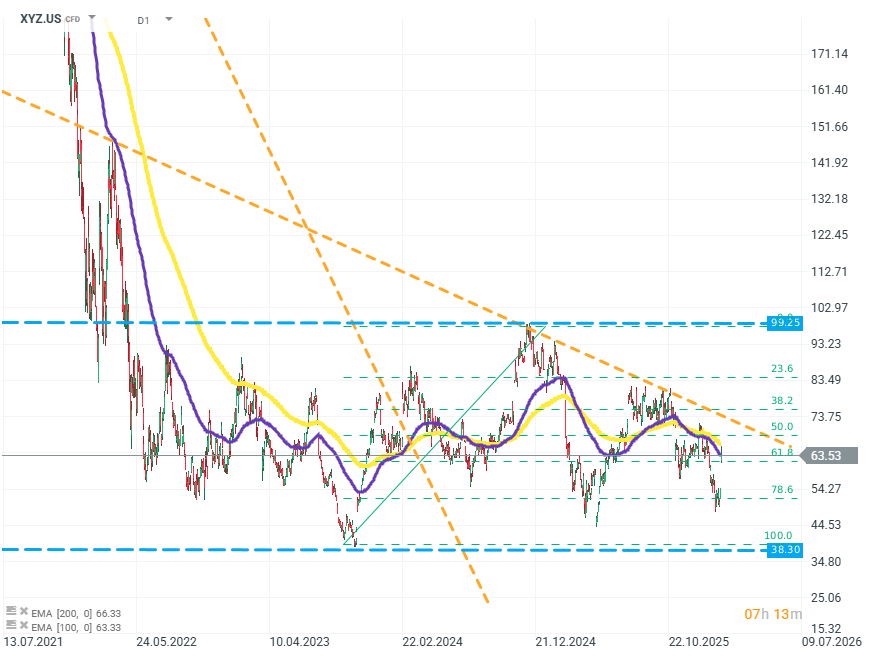
XYZ.US (D1)
Source: xStation5
Although today’s session delivered an impressive increase, the company still remains very far from its post-COVID valuation peak.



US Open: Further declines on Wall Street, Brent above 111 USD, AI correction continues (14.10.2026)


Market Wrap: "Decent" results are not enough – tech stocks fall further; oil highest since May (22.10.2026)


Tesla was supposed to burn $5 billion, but posted a positive result. Will Tesla still be a car company in a year?

Record-breaking Meta, though with a cash loss. Investors (for now) are buying Zuckerberg's plan anyway
This content has been created by XTB S.A. This service is provided by XTB S.A., with its registered office in Warsaw, at Prosta 67, 00-838 Warsaw, Poland, entered in the register of entrepreneurs of the National Court Register (Krajowy Rejestr Sądowy) conducted by District Court for the Capital City of Warsaw, XII Commercial Division of the National Court Register under KRS number 0000217580, REGON number 015803782 and Tax Identification Number (NIP) 527-24-43-955, with the fully paid up share capital in the amount of PLN 5.869.181,75. XTB S.A. conducts brokerage activities on the basis of the license granted by Polish Securities and Exchange Commission on 8th November 2005 No. DDM-M-4021-57-1/2005 and is supervised by Polish Supervision Authority.