


One of the most striking developments in recent months is how completely sentiment and expectations have diverged - clearly visible in the difference between commodity-market analysts and equity-market analysts.
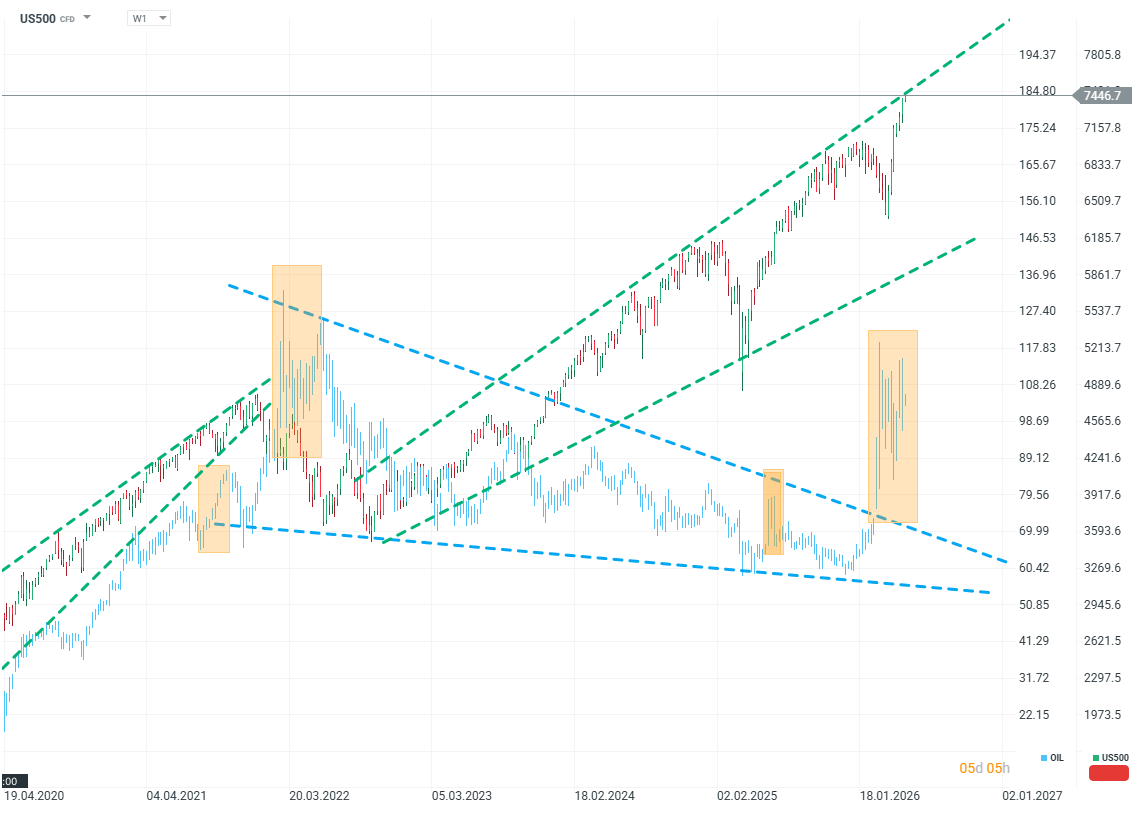
Commodity analysts are sounding the alarm and warning of a catastrophe stemming from the loss of around 20% of global oil and fuel supply. At the same time, equity analysts are explaining successive upward revisions to EPS forecasts. Who is right?
US500 vs OIL (W1)
Source: xStation5
For now, a mysterious stalemate can still be observed - indices and stock prices are setting new records even though oil prices are far above the levels expected just a few months ago.
Saudi Aramco is the world’s largest energy company, controlling an industry built around crude oil in Saudi Arabia. The company’s CEO has commented on the market situation.
The CEO uses strong language. According to Amin Nasser, the market is in a period of deep imbalance between supply and demand. He estimates that even if the Strait of Hormuz were reopened tomorrow, the market would need about a year to normalize. The company’s president speaks of a loss of one billion barrels of oil supply and points out that the scale of the crisis is unprecedented.
It is also hard to say that the current situation is not beneficial for the company. Saudi Arabia built the powerful “East–West” pipeline across the Arabian Desert precisely for a scenario like the one unfolding now. At the same time, the company’s results show that the surge in oil prices drove net profit up by nearly 25% in Q1 2025.
What could be the reason why oil prices seem to be reacting rather cautiously to a crisis of this magnitude?
Source: Bloomberg Finance Lp
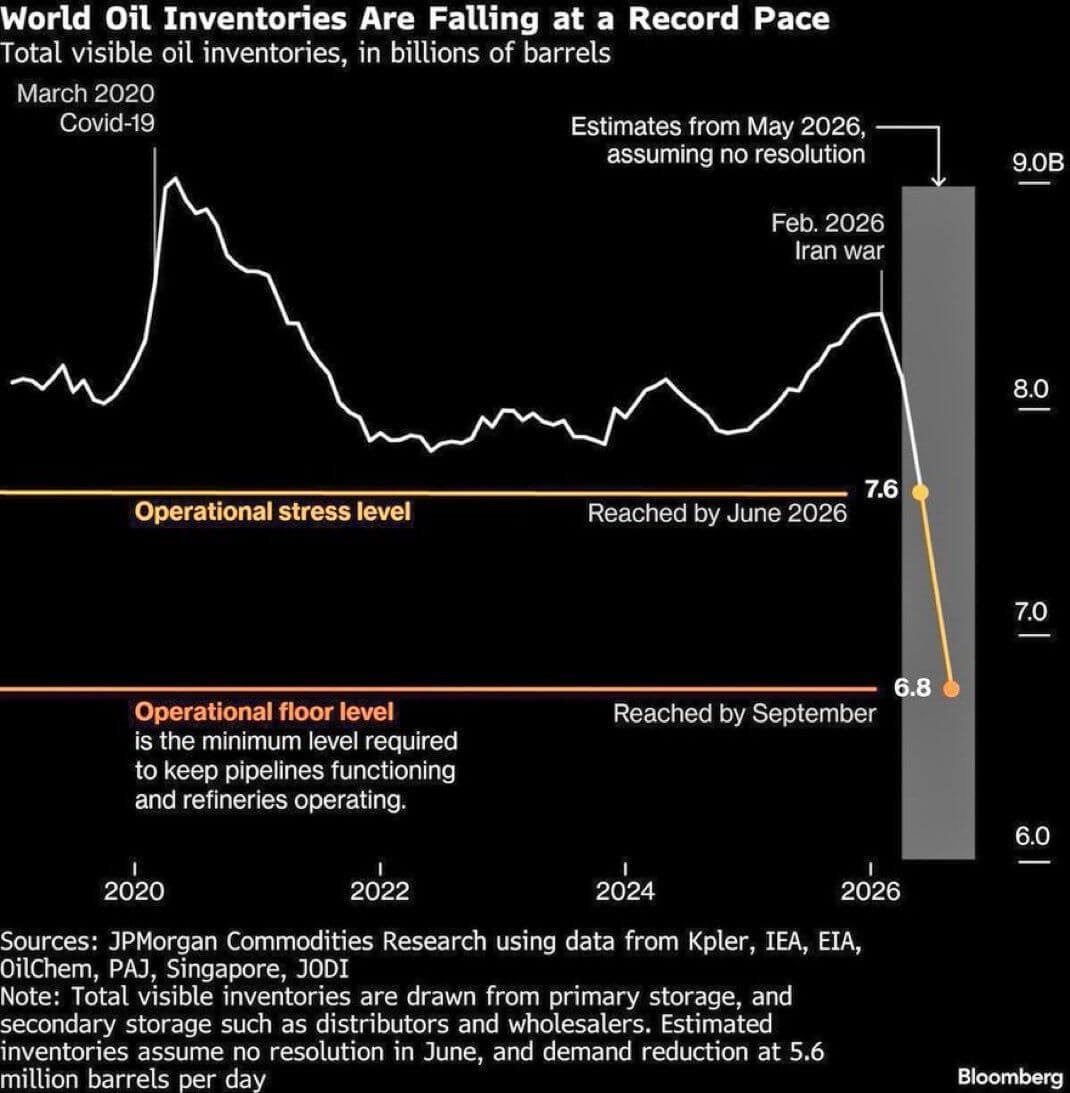
One factor highlighted by both Morgan Stanley and Bloomberg analyses is inventories - oil stockpiles are among the most important elements.
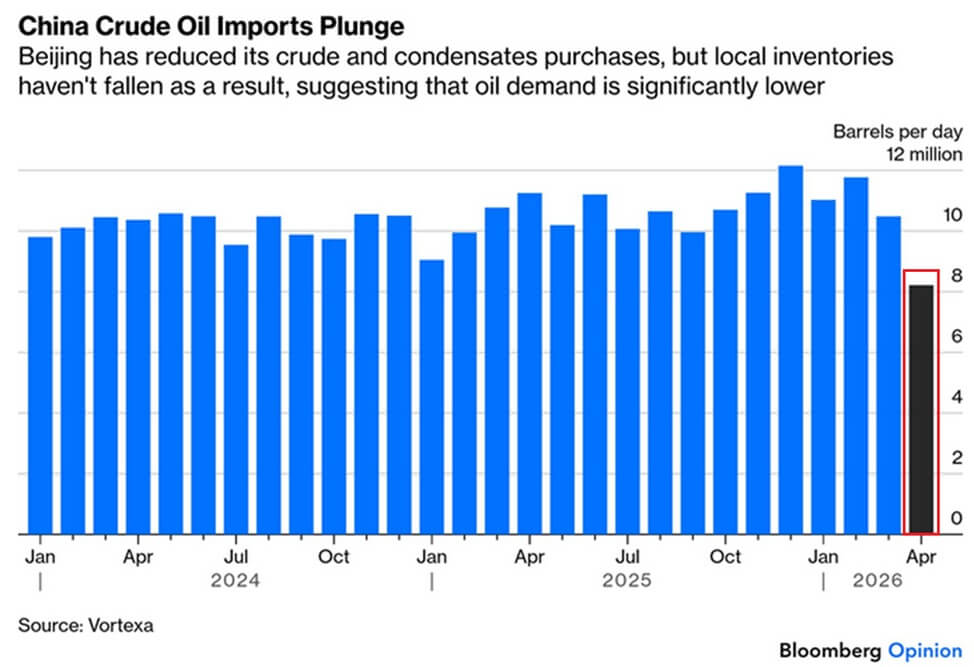
The most important player in this context is China. China imported about 25–35% of its oil from the Persian Gulf. At the same time, the latest data show that China’s oil imports fell from 12 million barrels to just over 8 million—a drop of more than 3 million barrels, or over 30%. This is no coincidence: China used falling oil prices in 2025 to build a huge stockpile of crude. Were these stockpiles built precisely for such a contingency?
Source: Bloomberg Finance Lp
It’s impossible to say - and in practice it doesn’t matter. What it effectively means is that, due solely to China’s actions, we may see a significant delay in how reduced supply feeds through into prices. China is absorbing shortages and inflationary pressure—and has a strong incentive to do so. Chinese industry remains in a slowdown phase, while maintaining trade with the West is an imperative for China.
Higher domestic inflation could, under current circumstances, help reduce the real burden of rising debt and stimulate consumption and investment. Meanwhile, the West avoids a recession - sone that would be just as painful for China as it would be for the West itself. What's crucial to understand is that this market freeze will persist as long as China continues to de facto subsidize global disinflation. This may be one of the key yet rarely mentioned issues in the context of the upcoming Trump-XI meeting.
Kamil Szczepański
XTB Financial Markets Analyst


Daily Summary: Oil at five-month highs, indices under pressure (23.10.2026)


BREAKING: France slows down, Germany holds on. Euro falls below 1.12



Daily Summary: Valuations Under Pressure, Capital Moves Away From Technology

Market Wrap: "Decent" results are not enough – tech stocks fall further; oil highest since May (22.10.2026)
This content has been created by XTB S.A. This service is provided by XTB S.A., with its registered office in Warsaw, at Prosta 67, 00-838 Warsaw, Poland, entered in the register of entrepreneurs of the National Court Register (Krajowy Rejestr Sądowy) conducted by District Court for the Capital City of Warsaw, XII Commercial Division of the National Court Register under KRS number 0000217580, REGON number 015803782 and Tax Identification Number (NIP) 527-24-43-955, with the fully paid up share capital in the amount of PLN 5.869.181,75. XTB S.A. conducts brokerage activities on the basis of the license granted by Polish Securities and Exchange Commission on 8th November 2005 No. DDM-M-4021-57-1/2005 and is supervised by Polish Supervision Authority.