


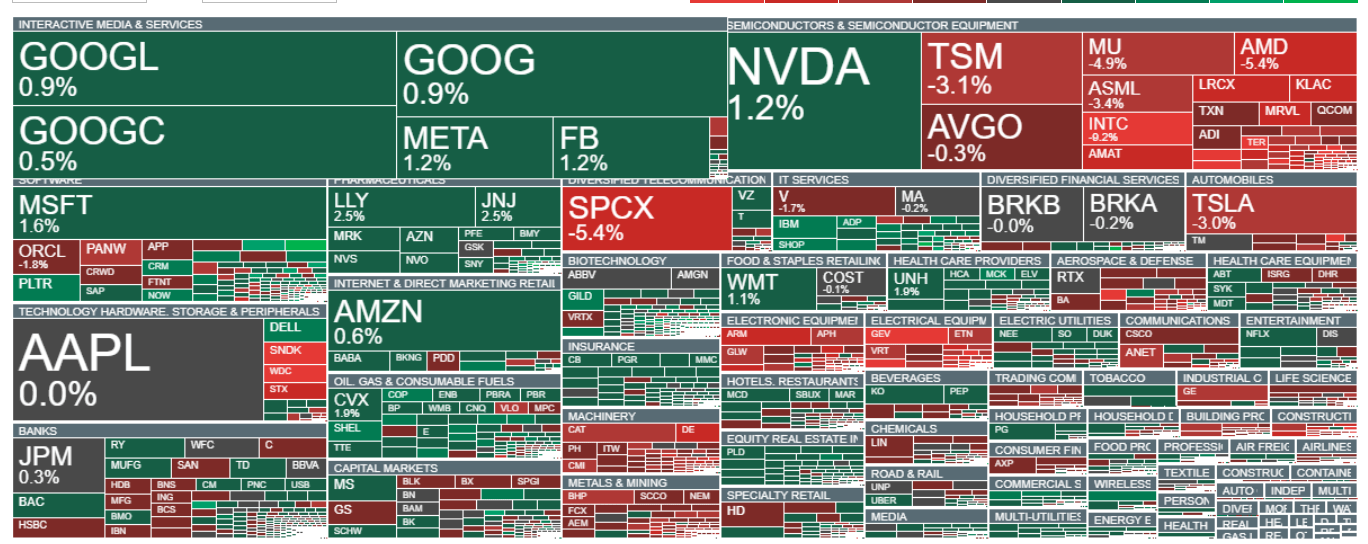
- Falling semiconductor stocks are dragging both the Nasdaq 100 and the S&P 500 lower.
- Big Tech and software companies are outperforming AI infrastructure giants in today's session.
- Oil prices are up more than 3%, supporting the U.S. dollar, while precious metals are trading lower.
- The latest ADP report showed U.S. private-sector employment increased by 21,000 jobs, down from the previous gain of 30,750.

- Falling semiconductor stocks are dragging both the Nasdaq 100 and the S&P 500 lower.
- Big Tech and software companies are outperforming AI infrastructure giants in today's session.
- Oil prices are up more than 3%, supporting the U.S. dollar, while precious metals are trading lower.
- The latest ADP report showed U.S. private-sector employment increased by 21,000 jobs, down from the previous gain of 30,750.
Following declines across Asian markets, where Japan’s Nikkei fell more than 2% and South Korea’s KOSPI dropped nearly 5%, as well as weakness in Europe, with the DAX and Euro Stoxx 50 down around 1.3%, Wall Street indices are under pressure from a selloff in semiconductor and AI infrastructure stocks. Some names have recovered from their initial steep losses, with Nvidia turning positive and gaining more than 1% after falling nearly 2% at the start of the U.S. session.
- Despite positive comments from JPMorgan, Citi, and Bank of America, which maintain SpaceX price targets well above $200 per share, the stock is down nearly 5.5% today after its debut in the prestigious Nasdaq index. Shares of Musk’s space business have retreated close to their June 12, 2026 opening price.
- European equities ended the session in negative territory. Germany’s DAX and the Euro Stoxx 50 both lost around 1.3%, following the earlier selloff in Asia, where South Korea’s KOSPI fell nearly 5%.
- The selloff in U.S. equities was partly driven by Reuters reports that Chinese startup DeepSeek is developing its own AI chip, which could, over the longer term, reduce its reliance on Nvidia and Huawei processors and increase competition in the AI accelerator market.
- Another source of weakness was the market reaction to Samsung’s earnings. Despite reporting a record 19-fold increase in operating profit, the company failed to provide fresh arguments for another leg higher in AI-related stock valuations.
- Samsung released only preliminary results and did not provide detailed guidance for its semiconductor division, leaving investors with unanswered questions about the durability of the current AI investment boom.
- After the sector’s powerful rally, some investors chose to take profits amid concerns over elevated valuations and the prospect of greater volatility ahead of the upcoming earnings season.
- Sentiment is also being shaped by preparations for SK Hynix’s Nasdaq debut and by expectations for the release of minutes from the first Fed meeting chaired by Kevin Warsh, encouraging some investors to reduce risk exposure.
- Despite the current correction, analysts stress that it does not signal a collapse in demand for AI infrastructure, but rather a reassessment of valuations and expectations for companies that have been among the biggest beneficiaries of the artificial intelligence boom in recent quarters.
- At the same time, German macroeconomic data surprised to the upside. Seasonally adjusted industrial production rose 0.11% year-over-year, compared with market expectations for a 0.6% decline and a previous reading of -0.54%. On a monthly basis, industrial production increased by 0.9%, well above the 0.1% consensus and the previous 0.4% reading.
- Silver is down nearly 2%, while gold has pulled back 0.6% as U.S. Dollar Index futures (USDIDX) rebound after Brent crude futures gained more than 3% on renewed tensions between the U.S. and Qatar on one side and Iran on the other. The main concerns were triggered by damage to a Qatari LNG tanker and a Saudi oil supertanker off the coast of Oman, although no casualties or commodity leaks have been reported.
- Qatar accused Iran of violating international law and threatening global energy supplies, while Tehran has not admitted responsibility for the attacks, though it had previously warned vessels against using certain routes. The market is not yet pricing in a lasting disruption to supply, but any further escalation in the Strait of Hormuz could quickly lift the geopolitical risk premium in oil and gas prices
Source: xStation5
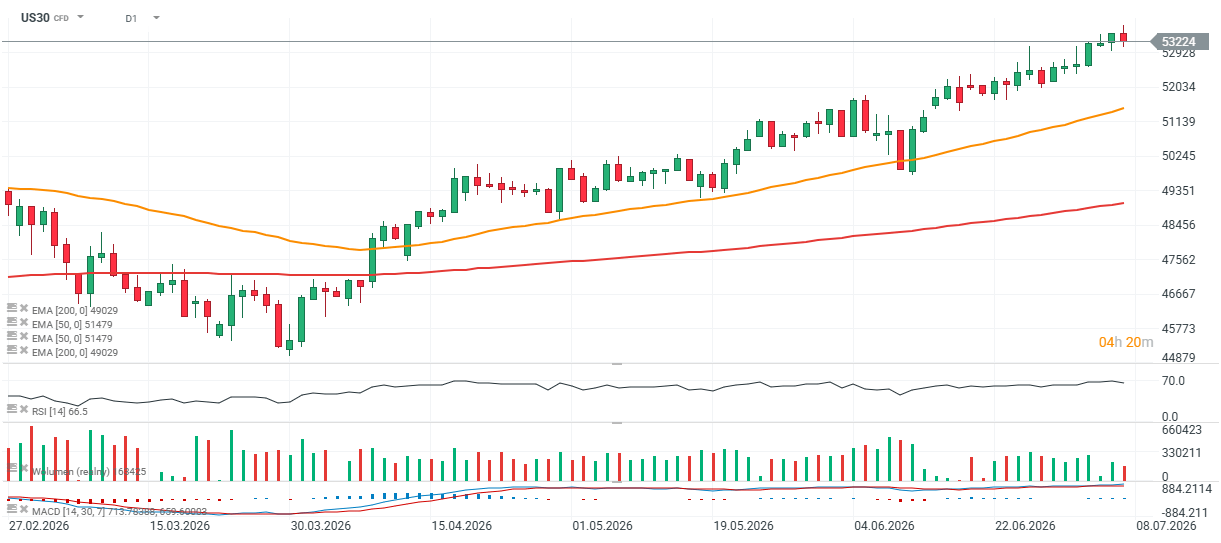
US30 chart (D1 interval)
The Dow Jones Industrial Average futures contract continues to significantly outperform the technology-heavy Nasdaq. After reaching a new all-time high near 53,500 points, the index is down only around 0.5% today.
Source: xStation5
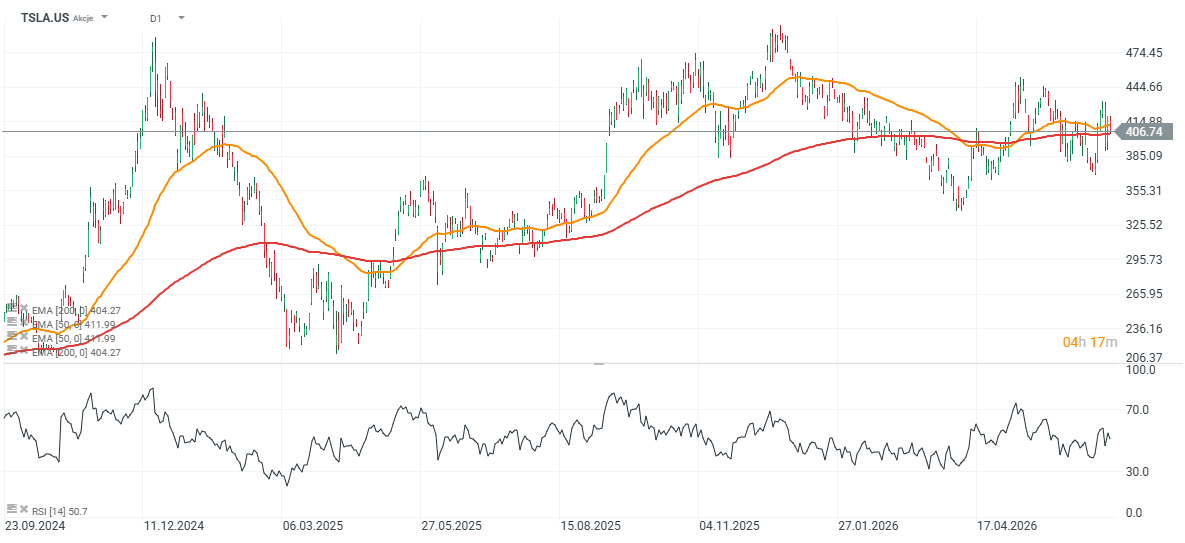
Tesla (TSLA.US) chart (D1 interval)
Tesla shares are down more than 3% today and are testing the 200-day exponential moving average (red line). Selling pressure has been testing buyers' conviction for some time. A break below $400 could increase the probability of a move toward the next major support area near $330 per share.
Source: xStation5



Market Wrap: Rebound in China and Falling Oil Prices, France Leads EU Declines


Chart of the Day: What’s next for tech stocks after the deepest sell-off since April 2025? (19.10.2026)



Optimism Returns to Asia❔

Economic Calendar: Big tech earnings week and test for the AI rally (19.10.2026)
This content has been created by XTB S.A. This service is provided by XTB S.A., with its registered office in Warsaw, at Prosta 67, 00-838 Warsaw, Poland, entered in the register of entrepreneurs of the National Court Register (Krajowy Rejestr Sądowy) conducted by District Court for the Capital City of Warsaw, XII Commercial Division of the National Court Register under KRS number 0000217580, REGON number 015803782 and Tax Identification Number (NIP) 527-24-43-955, with the fully paid up share capital in the amount of PLN 5.869.181,75. XTB S.A. conducts brokerage activities on the basis of the license granted by Polish Securities and Exchange Commission on 8th November 2005 No. DDM-M-4021-57-1/2005 and is supervised by Polish Supervision Authority.