



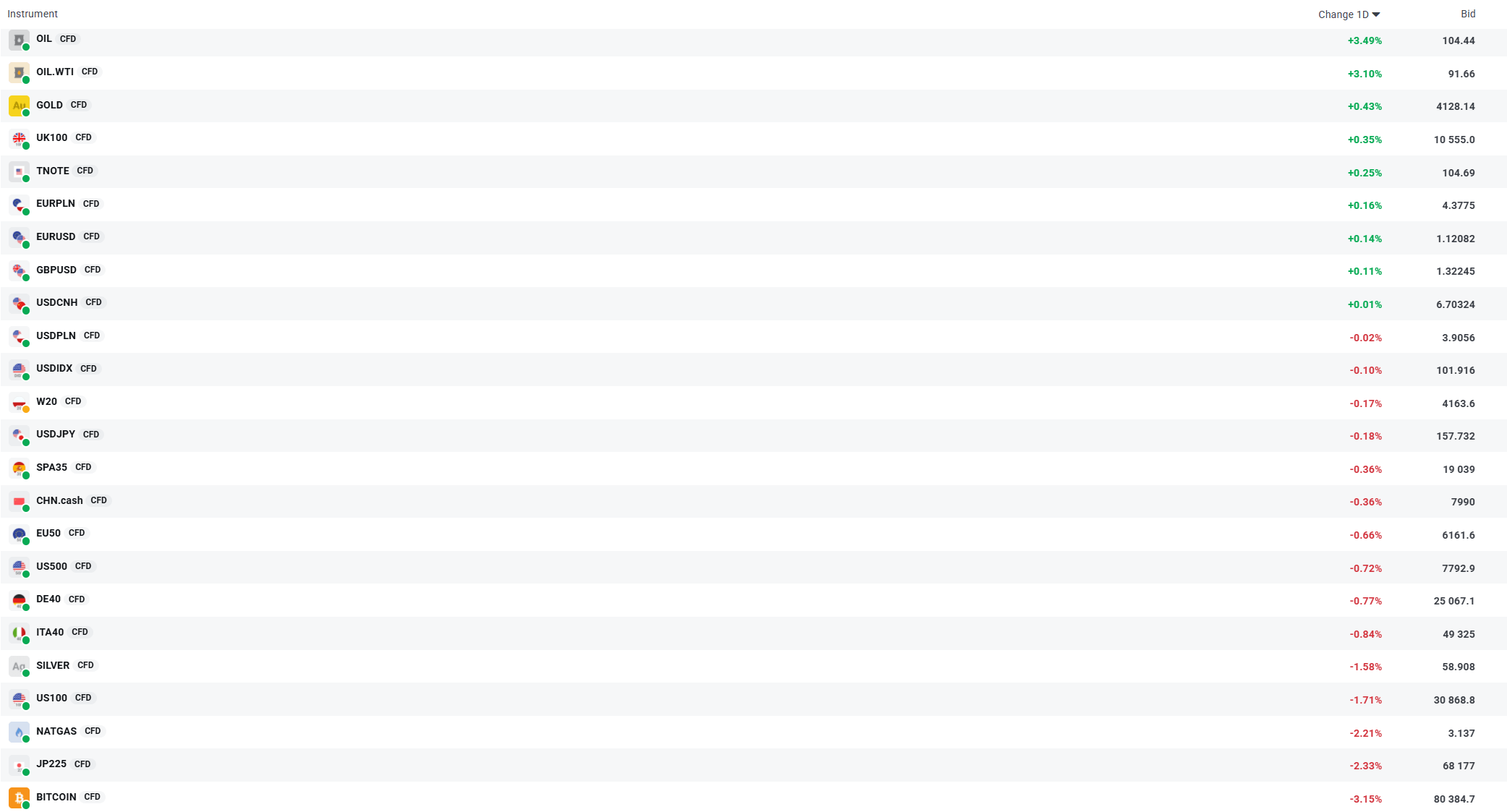
Volatility currently observed in selected instruments. Source: XTB
- The main driver of volatility. Market sentiment was dampened by a combination of soaring oil prices and a sell-off in technology shares, which pushed the main indices lower. US bond yields remained an additional drag, having reached their highest levels in 24 years this week, although they retreated slightly today following a successful auction of 30-year bonds. Investors fear that persistent price pressure from the energy sector will force the Fed to implement further interest rate rises. As a result, the market has entered a correction phase following a series of record highs at the start of the week.
- Geopolitics. Contradictory signals regarding the war in the Middle East proved crucial, as President Trump first suggested a lack of willingness to reach an agreement with Iran and preparations for strikes, only to then announce that the US would not attack Iran before the November by-elections. Tensions were fuelled by intensified attacks on oil tankers in the Strait of Hormuz and Houthi missile strikes targeting Riyadh. Off the US coast of the Gulf of Mexico, the season’s first hurricane, Isaias, was menacingly gaining strength, approaching Category 3. In Europe, concerns continued to linger over France’s public finances and the risk of tensions spilling over into Italy and Spain.
- Macroeconomic data. The minutes from the Fed’s September meeting showed that most members consider a further rate rise by the end of the year to be likely, with inflation seen as the main risk. However, Fed Governor Christopher Waller left the door open for a pause as early as the October meeting, pointing to flexibility in the pace of tightening. Weekly claims for unemployment benefit fell by 2,000 to 197,000, confirming the stability of the labour market. Markets are currently pricing in a chance of just under 20 per cent of a rate rise in October, but nearly 88 per cent of a move in December.
- Indices. On Wall Street, the S&P 500 was down by around 0.6 per cent, the Nasdaq was down by 1.2 per cent, and the Dow Jones remained close to its opening level. In Europe, the broad-based STOXX 600 fell by 0.7 per cent, dropping to its lowest level in nearly three months amid concerns over French debt. In Asia, Japan’s Nikkei lost 1.4 per cent, whilst South Korea’s KOSPI fell by as much as 2.6 per cent. In the CFD markets, technology and Asian indices suffered the heaviest losses, with the JP225 down 2.28 per cent and the US100 falling by 1.65 per cent, whilst the UK100 gained 0.41 per cent.
- Shares. Pressure on the technology sector was triggered by a Financial Times report stating that OpenAI’s revenues are around $20 billion lower than previously indicated, which dragged Oracle down by over 5 per cent, as well as chipmakers Nvidia and AMD. In addition, the administration has suspended Microsoft and Adobe from the work certification programme for foreign workers. Chipotle performed spectacularly, rising by over 6 per cent following reports of a possible takeover by Starbucks, whilst Haemonetics saw a 16 per cent surge. Also bucking the market trend were Palantir, following a recommendation from Goldman Sachs; GlobalFoundries, following an agreement with TSMC; and energy companies and PepsiCo, following strong results.
- Currencies. The euro remained close to a 17-month low, falling to around 1.117 before recovering some of its losses to around 1.1216 as eurozone bond yields retreated. The dollar gave up some of its gains, with its index falling to around 102 points, whilst remaining close to multi-year highs. The pound strengthened following comments by the Bank of England governor on the need to put public finances in order. The zloty market showed signs of stabilisation.
- Commodities. It was a day dominated by oil, which rose by over 5 per cent at its peak on the back of supply concerns, before giving up some of those gains following Trump’s statement that there would be no attack on Iran before the election. On the CFD markets, Brent crude rose by 3.40 per cent and US WTI by 3 per cent, also supported by the suspension of around a quarter of production in the Gulf of Mexico due to the hurricane. Gold remained stable at around $4,130 per ounce, gaining slightly despite pressure from high yields. Silver, however, fell sharply by nearly 1.5 per cent, whilst natural gas lost over 2 per cent.
- Cryptocurrencies. The digital assets market was dominated by a sell-off following a deterioration in sentiment surrounding the technology and artificial intelligence sectors. Bitcoin fell by nearly 2.9 per cent, slipping to around $80,600. Cryptocurrency mining companies such as Riot, Hut 8 and Cipher were also heavily sold off, each losing around 10 per cent against the backdrop of Bitcoin’s weakness and concerns over costly investments in AI infrastructure.

Gold struggling as oil prices pick up



U.S. attacks on Iran suspended 💥



Market Wrap: A 4% surge in oil prices weighs on indices (08.10.2026)
EURUSD falls below 1.12 amid hawkish Fed's Waller remarks
This content has been created by XTB S.A. This service is provided by XTB S.A., with its registered office in Warsaw, at Prosta 67, 00-838 Warsaw, Poland, entered in the register of entrepreneurs of the National Court Register (Krajowy Rejestr Sądowy) conducted by District Court for the Capital City of Warsaw, XII Commercial Division of the National Court Register under KRS number 0000217580, REGON number 015803782 and Tax Identification Number (NIP) 527-24-43-955, with the fully paid up share capital in the amount of PLN 5.869.181,75. XTB S.A. conducts brokerage activities on the basis of the license granted by Polish Securities and Exchange Commission on 8th November 2005 No. DDM-M-4021-57-1/2005 and is supervised by Polish Supervision Authority.