



Alberto Musalem, President of the St. Louis Federal Reserve, delivered an exceptionally hawkish message today, suggesting that the US economy may require several additional interest rate hikes before spring 2027. In his view, inflation is likely to remain persistently elevated unless the Federal Reserve tightens monetary policy further. This scenario is supporting the US dollar today and weighing on EURUSD, which is extending its decline below 1.10. His comments come at a difficult time for Wall Street, following a sharp sell-off in technology stocks and ahead of Nvidia's earnings release later today, after the US market close. The growing risk of persistently high borrowing costs could add further pressure to US equity valuations, particularly in the artificial intelligence sector.
-
Musalem believes several additional interest rate hikes before spring 2027 will likely be necessary to bring inflation back to the Fed's 2% target. He still considers current monetary conditions too accommodative.
-
According to the St. Louis Fed President, the real interest rate should rise to 2–2.5%, compared with its current estimated level at the lower end of the 1–1.5% range. Musalem argues that most of this adjustment may need to come through higher nominal interest rates.
-
Musalem remains optimistic about US economic growth, which he believes could continue to exceed the economy's long-term potential. Strong consumer spending, AI investment and a resilient labor market give the Fed room to tighten monetary policy further.
-
The equity market is simultaneously facing deteriorating sentiment toward technology stocks. The Nasdaq 100 has lost approximately 6% over two sessions, while investors await Nvidia's earnings, which could determine the direction of the AI sector in the coming days.
The Fed is unwilling to tolerate persistent inflation
The most important takeaway from Musalem's remarks today is his conviction that keeping interest rates at their current level will probably not be enough to contain inflationary pressures. The St. Louis Fed President emphasized that inflation remains elevated and broad-based, while a return to the 2% target without additional rate hikes appears less likely. Importantly, he does not consider current monetary policy sufficiently restrictive, despite the previous tightening of financial conditions.
Musalem also stressed that acting promptly could allow the Fed to bring inflation under control without causing significant deterioration in the labor market. In his view, delaying action increases the risk of inflation expectations becoming entrenched, while a loss of central bank credibility could push Treasury yields even higher. This would be particularly unfavorable for companies financing investment through debt and technology businesses whose valuations are sensitive to changes in long-term interest rates.
Wall Street under pressure: AI and higher interest rates
Musalem's hawkish comments coincide with a significant deterioration in sentiment toward the US technology sector. Yesterday's session saw the S&P 500 decline by approximately 1.9%, while the Nasdaq 100 lost around 2.7%, although futures are staging a modest rebound today. Nvidia remains in the spotlight as the company prepares to release its quarterly earnings amid concerns about the future of its AI business, export restrictions and leadership changes following Jensen Huang's departure.
For investors, the key risk is the simultaneous deterioration of two factors that have supported technology valuations: expectations for future earnings growth and the cost of capital. Higher bond yields increase discount rates, reducing the present value of future cash flows. At the same time, rising financing costs could undermine the economic viability of some multibillion-dollar investments in data centers and artificial intelligence infrastructure.
However, a strong US economy does not necessarily mean that the Wall Street sell-off will continue. Sustained corporate earnings growth could partially offset the pressure from higher interest rates. The challenge is that, amid growing uncertainty surrounding the profitability of AI investments, investors may become increasingly selective when valuing technology companies.
EURUSD chart (D1 and W1 timeframes)
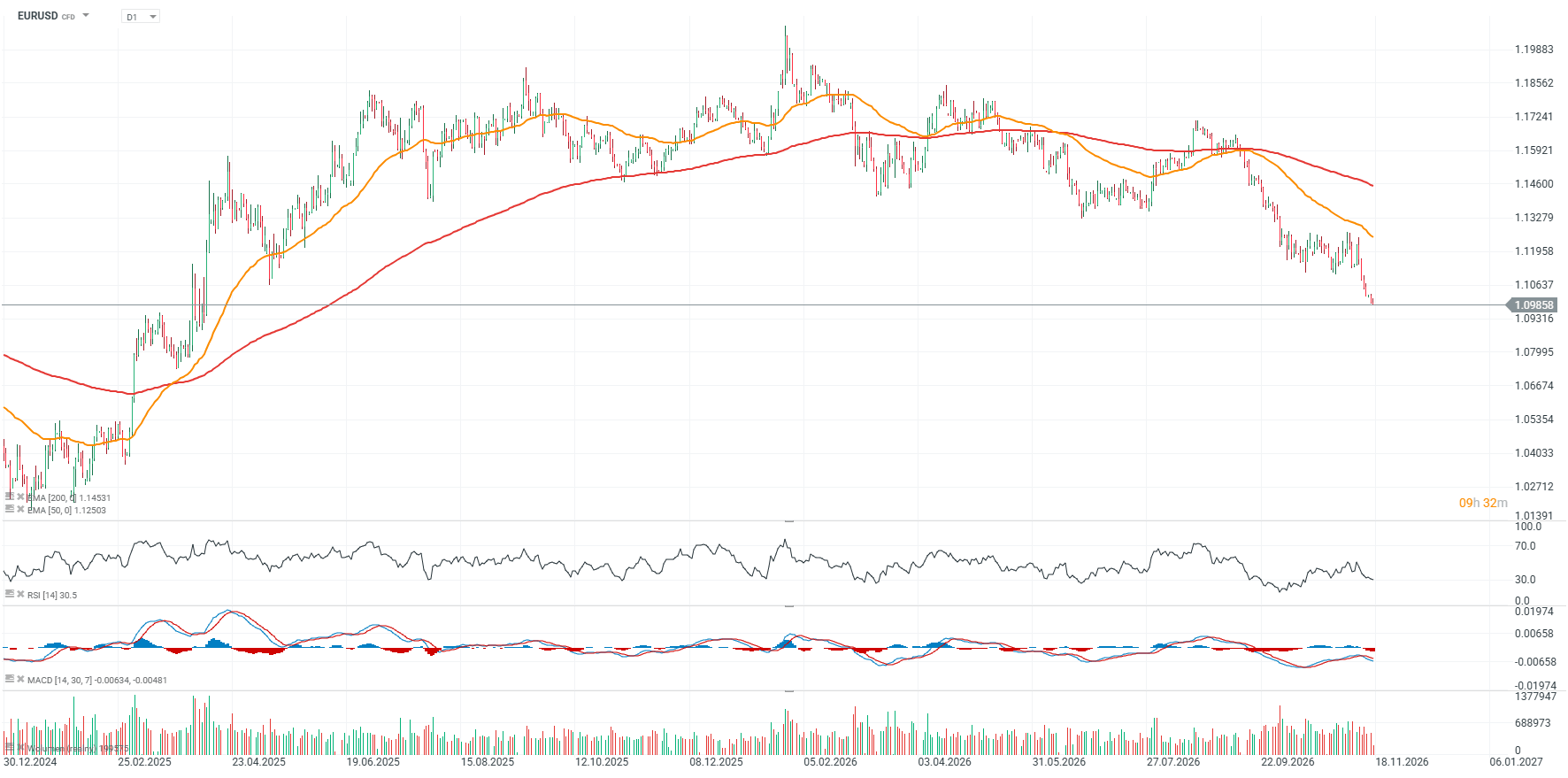
The US dollar is strengthening significantly today, pushing EURUSD to its lowest level since April 2025. The daily RSI stands at 30, while the latest rebound has proved short-lived and weak. The MACD lines have once again formed a bearish configuration, with the nearest potential support around 1.08, where previous price reactions have occurred. Key technical resistance levels can be identified near 1.12 and 1.14.
 Source: XTB
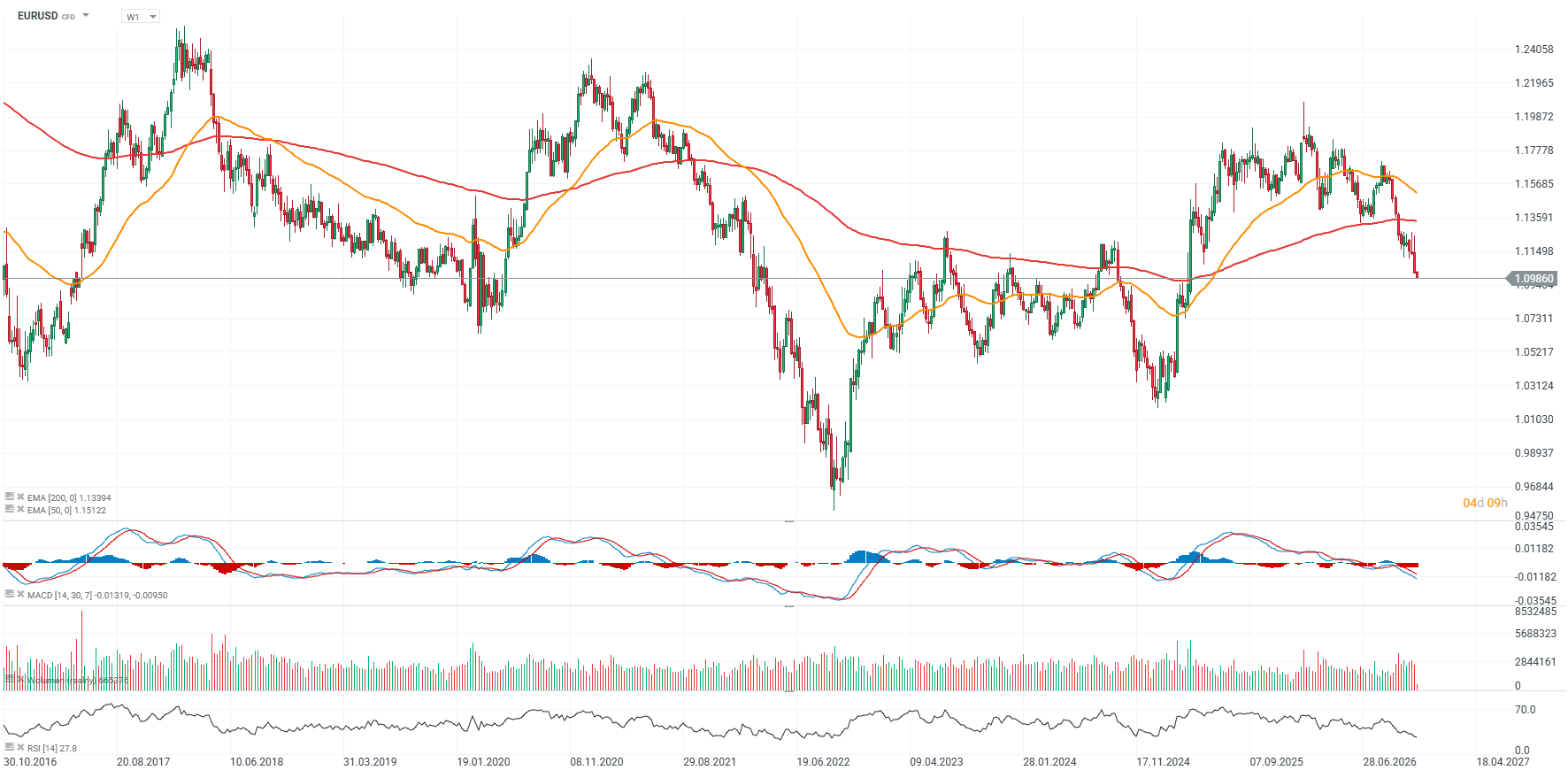
On the weekly timeframe, EURUSD is now heading for its fourth consecutive week of declines. The pair has not traded this far below its weekly 200-period exponential moving average (EMA200, red line) since late 2024 and early 2025.
 Source: XTB

Chart of the Day: EURUSD at its Lowest Levels of the Year



Nvidia stabilises ahead of earnings, but the AI outlook remains unclear


Economic Calendar: Nvidia in focus as markets await key US Data


Morning Wrap: The Tech frenzy is cooling, and Wall Street is bleeding. All eyes on Nvidia.
This content has been created by XTB S.A. This service is provided by XTB S.A., with its registered office in Warsaw, at Prosta 67, 00-838 Warsaw, Poland, entered in the register of entrepreneurs of the National Court Register (Krajowy Rejestr Sądowy) conducted by District Court for the Capital City of Warsaw, XII Commercial Division of the National Court Register under KRS number 0000217580, REGON number 015803782 and Tax Identification Number (NIP) 527-24-43-955, with the fully paid up share capital in the amount of PLN 5.869.181,75. XTB S.A. conducts brokerage activities on the basis of the license granted by Polish Securities and Exchange Commission on 8th November 2005 No. DDM-M-4021-57-1/2005 and is supervised by Polish Supervision Authority.