


EURUSD is up 0.5%, attempting to recover from yesterday's sharp sell-off as the pair rebounds from a local low near 1.0880 to around 1.0950. The recovery is supported by improving sentiment in the German economy, reflected in today's stronger-than-expected Ifo Business Climate Index, as well as dollar weakness following comments from the Fed's John Williams and BlackRock analysts. John Williams, President of the Federal Reserve Bank of New York, suggested yesterday that US inflation could slow significantly in 2027, although it currently remains too high.
-
Germany's Ifo Business Climate Index rose to 90.6 points in November from 90.1, slightly exceeding the consensus forecast of 90.5. The Current Assessment Index improved from 88.8 to 89.4, while the Expectations Index increased from 91.5 to 91.9.
-
BlackRock believes markets may be pricing in excessive monetary tightening in 2027, suggesting that expectations for future US interest rates could be due for a reassessment.
-
The Fed's John Williams expects US inflation to decline from approximately 3.5% in 2026 to slightly above 2% in 2027, before reaching the Fed's inflation target in 2028. At the same time, he emphasized the need for continued efforts to contain price pressures.
-
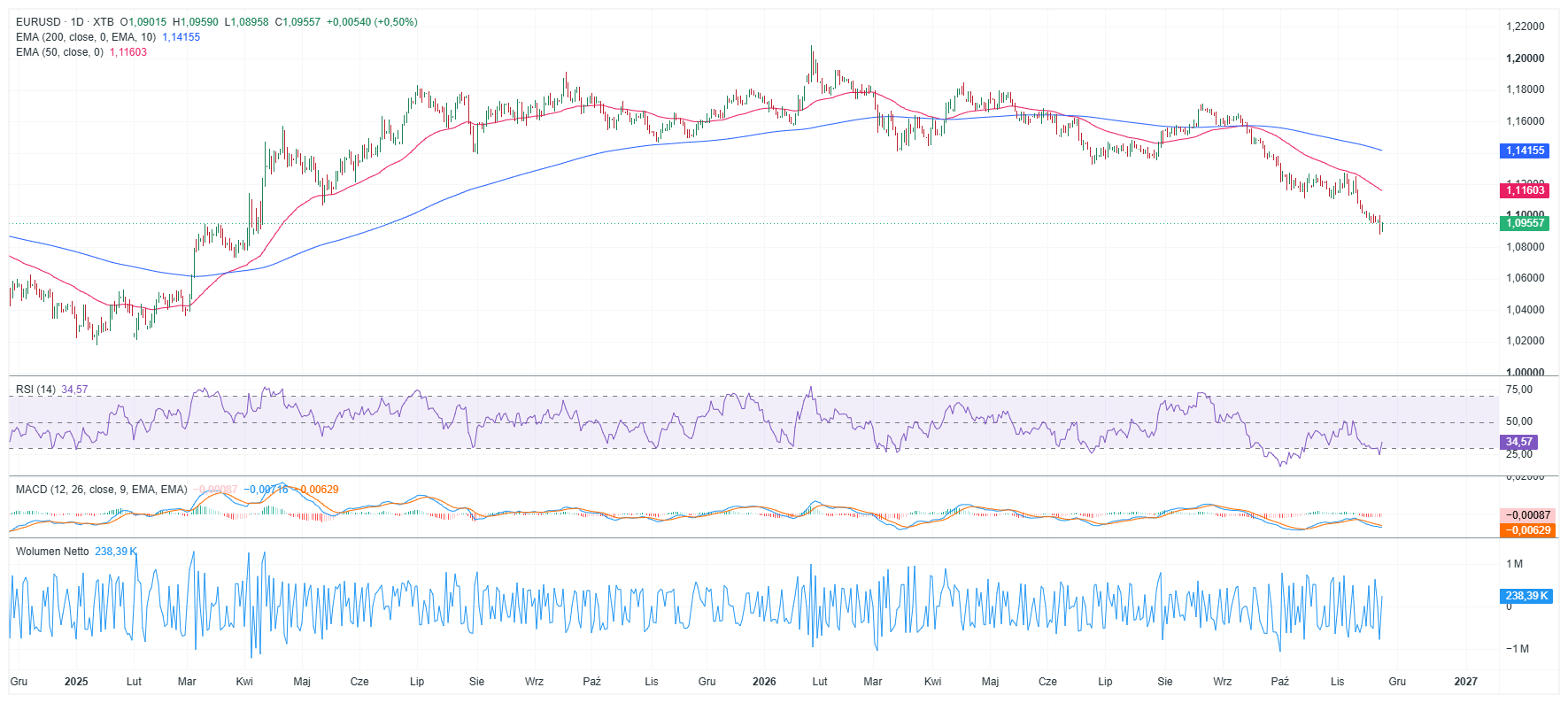
EURUSD remains in a downtrend, despite rebounding from the 1.0880 area. The nearest resistance levels are 1.0950 and 1.1000, while a return below 1.0900 would increase the risk of retesting recent lows.
-
US Dollar Index futures (USDIDX) are down 0.3% today, while investors have increased their exposure to US Treasuries, with bond prices rising across the yield curve, suggesting growing risk aversion and demand for safer assets.
Brent crude futures (OIL) are also trading near $80 per barrel, their lowest levels since August, indirectly supporting the euro's recovery. Despite the rebound, the outlook for EURUSD remains uncertain, as the persistent risk of further monetary tightening by the Fed continues to support the dollar, while the pair remains below the psychologically important 1.1000 level.
Germany's economy is regaining momentum, but the recovery remains uneven
The latest Ifo data suggest a gradual improvement in economic conditions in the eurozone's largest economy. Importantly, November's increase extends the recovery in business sentiment observed since the spring, with the index now reaching its highest level in more than three years. ING analysts note that improving sentiment may reflect the positive impact of Germany's fiscal stimulus. At the same time, stronger assessments among companies in services and trade contrast with continued weakness in manufacturing and construction.
From an EURUSD perspective, the key question now is whether improving business confidence will translate into stronger investment, industrial production, and consumption over the coming quarters. The reading exceeded expectations by just 0.1 points, making it premature to interpret the improvement as a fundamental turning point. However, a more sustained recovery in the German economy could reduce pressure on the European Central Bank to ease monetary policy, particularly if accompanied by a stabilization in industrial activity. This could create a more favorable interest rate outlook for the euro, although the market's ultimate response will also depend on inflation developments across the eurozone.
Fed's Williams expects inflation to decline in 2027. Could the dollar lose support?
Yesterday's remarks from John Williams revealed an interesting contrast between his assessment of near-term inflation and his expectations for the coming years. The New York Fed President acknowledged that inflation remains significantly too high, but according to his projections, it should decline to just above 2% in 2027. He also expects the US economy to grow by approximately 2.75% in both 2026 and 2027, with the unemployment rate falling toward 4%. Williams therefore anticipates the possibility of disinflation without a severe economic slowdown, a scenario that would be relatively favorable for US assets, while clearly indicating that next year could bring substantially lower inflation in the United States.
From a foreign exchange perspective, however, it is equally important that Williams did not signal any willingness to cut interest rates rapidly. Instead, he emphasized the need to bring inflation back to target and noted that the full effects of monetary policy typically take between one and two years to materialize in the economy. This is an important distinction: declining inflation expectations do not automatically imply a weaker dollar if the Fed maintains restrictive interest rates for longer than the ECB. For EURUSD, the key factor therefore remains changes in the expected interest rate differential between the United States and the eurozone, rather than the inflation outlook in either economy in isolation.
EURUSD chart (1D timeframe)
From a technical perspective, the EURUSD rebound currently appears to be a correction of the previous sell-off rather than a confirmed trend reversal. The pair remains below its former consolidation range between 1.1110 and 1.1265, with the breakdown from this area having accelerated the decline. The first test of buying momentum will be a sustained move above 1.0950 and 1.1000, while a renewed decline below 1.0900 could open the way for a retest of 1.0880, followed by the 1.0850 area.
Tomorrow's release of the US core PCE price index, one of the Federal Reserve's most closely watched inflation indicators, will be particularly important. A higher-than-expected reading could strengthen the case for maintaining restrictive monetary policy and provide renewed support for the dollar. Conversely, softer inflation, combined with improving economic conditions in Germany, could increase the likelihood of a more sustained stabilization in EURUSD. The key question, however, is whether the data will prompt investors to reassess the expected path of Fed interest rates relative to the ECB.
 Source: XTB



Why it matters if Anthropic falls below its IPO price

Markets cool down after yesterday's surge 💥

Chart of the Day: EURUSD Under Pressure from a Strong Dollar. Fed Prepares Markets for Further Rate Hikes


Economic Calendar: After Wall Street’s Rally, Markets Turn Their Attention to Ifo and US Consumer Confidence
This content has been created by XTB S.A. This service is provided by XTB S.A., with its registered office in Warsaw, at Prosta 67, 00-838 Warsaw, Poland, entered in the register of entrepreneurs of the National Court Register (Krajowy Rejestr Sądowy) conducted by District Court for the Capital City of Warsaw, XII Commercial Division of the National Court Register under KRS number 0000217580, REGON number 015803782 and Tax Identification Number (NIP) 527-24-43-955, with the fully paid up share capital in the amount of PLN 5.869.181,75. XTB S.A. conducts brokerage activities on the basis of the license granted by Polish Securities and Exchange Commission on 8th November 2005 No. DDM-M-4021-57-1/2005 and is supervised by Polish Supervision Authority.