


Intel shares are surging strongly at the open of Monday’s session following reports that Google and Nvidia are considering using the U.S. manufacturer as an alternative supplier of advanced chips.
According to Reuters, the talks are primarily aimed at securing manufacturing capacity outside of TSMC, whose production lines and advanced packaging remain heavily loaded. Technology sector leaders are increasingly concerned that delivery timeliness from Taiwanese facilities may turn out to be worse than market expectations.
The key point in the discussions is the report that Google is said to have placed an order with Intel to manufacture more than 3 million TPU (Tensor Processing Unit) chips in 2028.
TPUs are Google processors designed for training and running AI models. The order reportedly came after months of testing Intel’s advanced packaging technology. Morgan Stanley estimates that Google could produce a total of more than 6 million TPUs in 2027–2028. This represents a consistent effort by one of the technology giants, which has long been trying to diversify its component supply to reduce dependence on Nvidia.
In Nvidia’s case, the statements are much more cautious. The company has reportedly not placed an order yet, but it is testing Intel’s capabilities for manufacturing future chips. According to the report, Nvidia is evaluating, among other things, a technology that would allow four graphics chips to be combined into a single unit, which is expected to be related to the Feynman architecture planned for 2028.
Nvidia is also conducting early trials on the “18A” process - Intel’s most advanced manufacturing technology.
For Intel, these reports are important because they strengthen the narrative of rebuilding the company’s market position, or even of a more distant expansion. At the same time, valuations have already seen a powerful growth wave, and the market should not interpret this information as a straightforward replacement of TSMC.
Intel is expected to serve as an additional and/or backup source of manufacturing capacity and supply-chain security. Intel’s production capabilities are still in their infancy relative to the company’s forecasts, and from an accounting perspective the business is still operating at a loss.
INTC.US (D1)
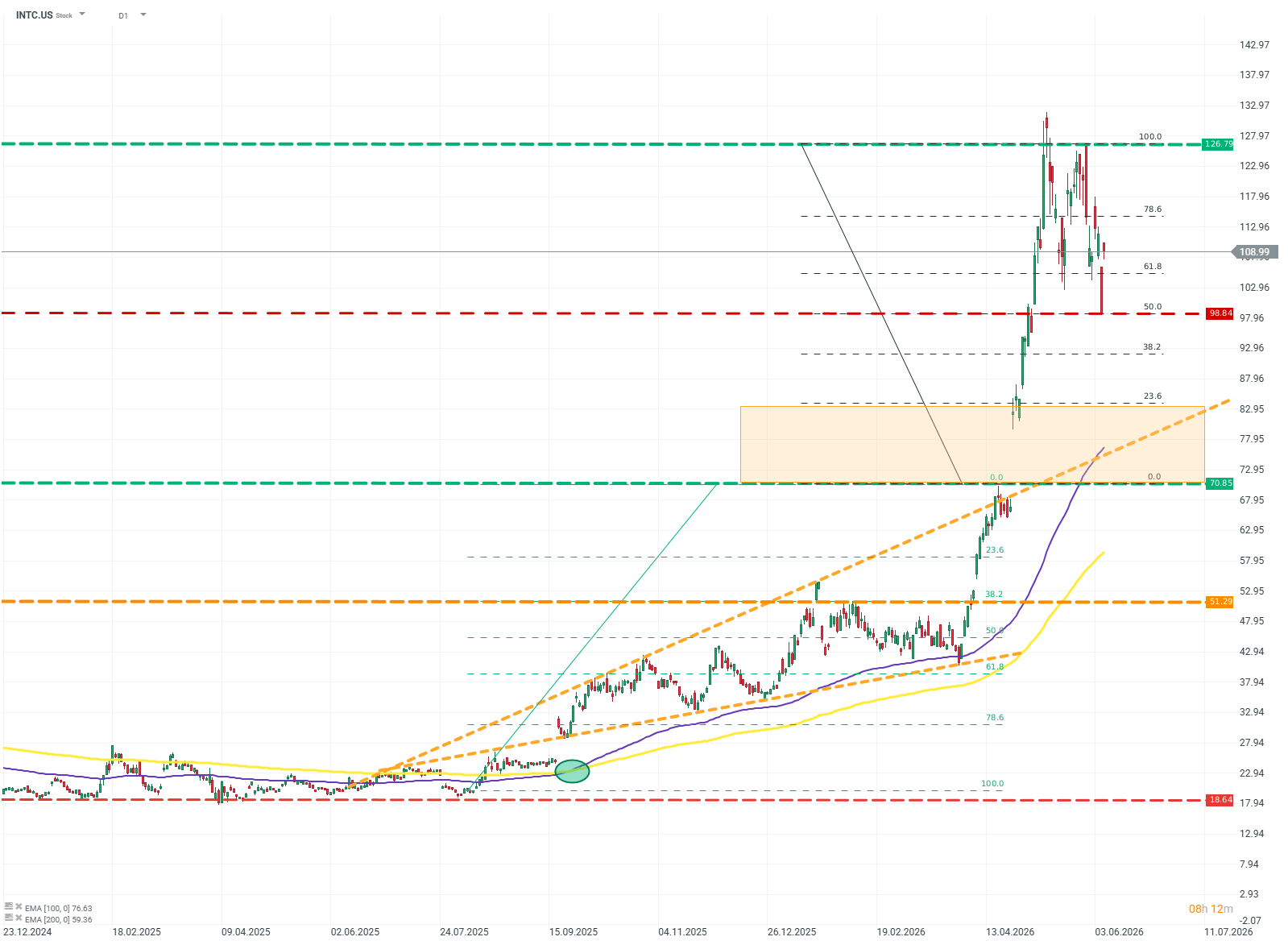
During the latest correction, the price stopped at the 50% Fibonacci level, from which it rebounded and is now heading toward a test of the resistance zone between the 61.8% and 76.4% Fibonacci levels. Source: xStation 5.



Morning Wrap: Oil cheaper despite attacks on Saudi Arabia, markets await CPI (12.10.2026)



Daily Summary: A Shallow Rebound Ahead of Earnings Season


Lumentum: Demand for AI infrastructure exceeds capacity

Marvell: Memory-market problems and opportunities
This content has been created by XTB S.A. This service is provided by XTB S.A., with its registered office in Warsaw, at Prosta 67, 00-838 Warsaw, Poland, entered in the register of entrepreneurs of the National Court Register (Krajowy Rejestr Sądowy) conducted by District Court for the Capital City of Warsaw, XII Commercial Division of the National Court Register under KRS number 0000217580, REGON number 015803782 and Tax Identification Number (NIP) 527-24-43-955, with the fully paid up share capital in the amount of PLN 5.869.181,75. XTB S.A. conducts brokerage activities on the basis of the license granted by Polish Securities and Exchange Commission on 8th November 2005 No. DDM-M-4021-57-1/2005 and is supervised by Polish Supervision Authority.