



- Asian stock markets are extending their losses as investors continue to reduce their exposure to technology stocks amid concerns over the profitability of artificial intelligence investments. The MSCI Asia Pacific Index is down 2.1%, with South Korea (-6.3%) and Taiwan (-4.8%) suffering the sharpest declines, reflecting their heavy exposure to the semiconductor and AI industries. Meanwhile, the MSCI All Country World Index is falling 0.4%, heading for its eighth declining session in the past ten trading days.
- Selling pressure continues on Wall Street, with even stronger-than-expected earnings from Dell (DELL.US), another major beneficiary of the AI investment boom, failing to improve market sentiment. S&P 500 futures are down nearly 0.6%, while Nasdaq 100 (US100) futures are losing 1.5%, pointing to a potential second consecutive session of losses for US technology stocks. Yesterday's sell-off was driven by capital outflows from the AI sector, with the S&P 500 closing 0.8% lower. European equities are also expected to open in negative territory, although the anticipated declines remain relatively modest.
- Investors are shifting capital from equities into US Treasuries and the dollar, reinforcing signs of growing risk aversion across financial markets. The US 10-year Treasury yield has fallen 4 basis points to 4.89%, reflecting rising bond prices. Meanwhile, the US Dollar Index (DXY) has strengthened by 0.2% to 106 points. Simultaneous gains in Treasuries and the dollar suggest that investors are increasing their exposure to assets traditionally perceived as safer during periods of market uncertainty.
- Brent crude oil is falling nearly 1% to $87.80 per barrel, despite persistent supply disruption risks amid escalating attacks on vessels near the Strait of Hormuz. The decline suggests that concerns over weakening global demand and deteriorating economic conditions may currently outweigh the geopolitical risk premium embedded in oil prices.
- Gold is also facing selling pressure, declining 1.1% to $3,516 per ounce. The precious metal is heading for its seventh losing session in the past eight trading days, highlighting that not all traditional safe-haven assets are attracting capital despite deteriorating equity market sentiment. The strengthening US dollar may be adding further pressure to gold prices.
- Dell (DELL.US) delivered stronger-than-expected third-quarter results, beating Wall Street estimates for both revenue and earnings. Robust demand for AI infrastructure servers remained the primary growth driver, helping the company's total revenue more than double year over year. Dell also issued an optimistic fourth-quarter outlook and announced a $25 billion share repurchase program. Management highlighted the company's competitive advantage in rapidly deploying IT infrastructure, with customers potentially able to bring newly delivered systems online within hours.
- Dell's third-quarter revenue surged 103% year over year to $54.9 billion, while adjusted earnings per share jumped 265% to $9.45, significantly exceeding analysts' expectations of $6.59. The Infrastructure Solutions Group was the main growth engine, with revenue tripling to $42 billion. Sales of AI-optimized servers soared 291% to $22 billion, while new AI infrastructure orders reached $60.2 billion. The company's AI order backlog climbed to a record $132.3 billion, providing substantial visibility into future revenue. However, the PC business remained a relative weak spot, with consumer sales declining 15% year over year and segment operating income falling 6% to $704 million.
- Workday (WDAY.US) reported an 11.2% year-over-year increase in third-quarter revenue to $2.71 billion, exceeding Wall Street expectations of $2.69 billion, while adjusted earnings per share rose 21.6% to $2.82, beating forecasts of $2.74. Subscription revenue increased 12.8% to $2.53 billion, while the total subscription backlog reached $27.55 billion, up 6.1% year over year. AI adoption is becoming an increasingly important growth driver, with AI products generating nearly $150 million in new annual contract value, more than triple the year-earlier level. Over 2,200 customers have already purchased at least one AI product. Workday also raised its fiscal 2027 subscription revenue guidance to $9.96 billion and increased its adjusted operating margin outlook to 31.5%, highlighting improving profitability alongside continued investment in AI.
- Australian inflation is accelerating again, increasing pressure on the Reserve Bank of Australia (RBA). Headline CPI inflation rose to 4.9% year over year from 4.3%, exceeding market expectations of 4.7%. Underlying inflation, measured by the trimmed mean CPI, accelerated to 3.8% from 3.6%, also coming in above forecasts of 3.6%. Meanwhile, construction work done increased 0.9% quarter over quarter, compared with expectations of 0.7% and a previous decline of 2.1%. The figures point to persistent inflationary pressures and relatively resilient economic activity, limiting the RBA's room to ease monetary policy.
- The latest American Petroleum Institute (API) report showed an increase in US crude oil inventories, alongside a decline in inventories at the Cushing storage hub. Crude oil stocks rose by just 0.126 million barrels, compared with expectations of a 0.9 million-barrel increase and the previous week's build of 5.3 million barrels. Gasoline inventories increased by only 0.047 million barrels, while distillate stocks climbed by 1.647 million barrels. Meanwhile, crude inventories at Cushing fell by 0.666 million barrels. Overall, the report presents a mixed picture for oil markets, although the smaller-than-expected crude inventory build and declining Cushing stocks could provide some support for WTI prices.
US500 Chart (Hourly Timeframe)
Already in October, the index was struggling to remain above the 200-period exponential moving average (EMA200, red line), signaling weakening momentum and fading buying pressure. Following the euphoric rally triggered by Jensen Huang’s return to Nvidia, the index has given back a significant portion of its gains and is now testing a key price action support level around 7,150 points. A break below this level could pave the way for another wave of selling, potentially pushing the index below 7,000 points, while the key resistance level stands near 7,300 points, corresponding to Monday’s local high.
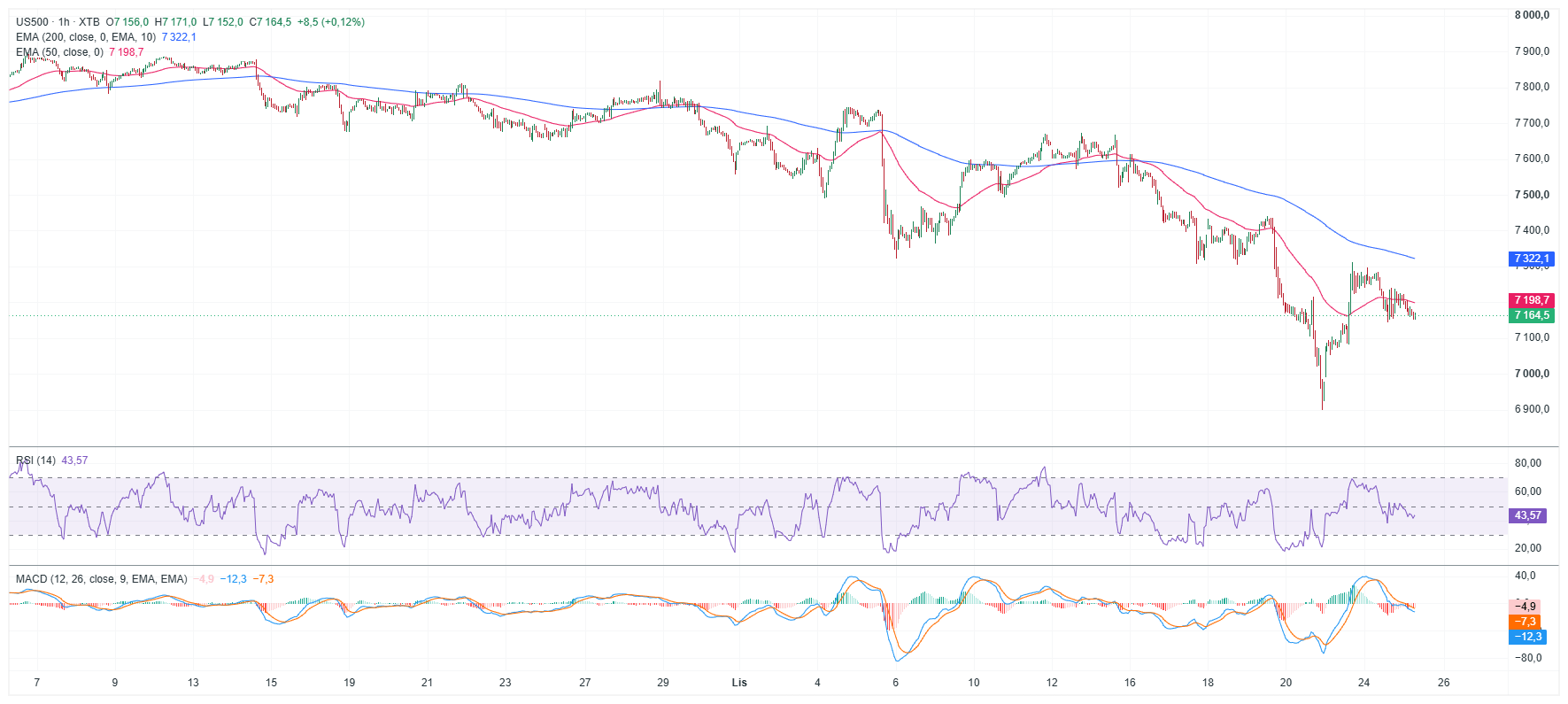 Source: XTB



Daily Summary: Fleeting gains and chronic fear



📉Precious metals return to local lows



US OPEN: Market gives back some of the gains, the dollar extends losses

BREAKING: US threatens to spark Trade War 2.0 🚩 Wall Street reacts
This content has been created by XTB S.A. This service is provided by XTB S.A., with its registered office in Warsaw, at Prosta 67, 00-838 Warsaw, Poland, entered in the register of entrepreneurs of the National Court Register (Krajowy Rejestr Sądowy) conducted by District Court for the Capital City of Warsaw, XII Commercial Division of the National Court Register under KRS number 0000217580, REGON number 015803782 and Tax Identification Number (NIP) 527-24-43-955, with the fully paid up share capital in the amount of PLN 5.869.181,75. XTB S.A. conducts brokerage activities on the basis of the license granted by Polish Securities and Exchange Commission on 8th November 2005 No. DDM-M-4021-57-1/2005 and is supervised by Polish Supervision Authority.