



Brent crude climbed above $100 a barrel on Wednesday, September 9, reaching its highest level in around six weeks as renewed fighting in the Middle East raised concerns about energy supplies. The latest escalation comes after months of disrupted exports and inventory drawdowns, leaving the market more vulnerable to further supply losses. For consumers and businesses, a prolonged period of triple-digit oil prices could mean higher fuel, transport and manufacturing costs. It could also revive inflationary pressures and keep interest rates elevated for longer.
- Brent briefly reached $101 a barrel. The move extended a rally that has lifted Brent by roughly 26% since early August, as hopes for a lasting resolution to the six-month-old US-Iran conflict have faded.
- Prices remain below the April peak of $126 a barrel. However, the market is now facing renewed disruption with smaller inventories and limited spare production capacity.
- The concern is therefore not just how far prices have risen, but how little flexibility remains if another major source of supply is interrupted.
- We can see a structural problem rather than a one-off shock as prices increasingly reflect a premium for supply security. That premium is likely to grow if geopolitcal tensions persist rather than disappear quickly.
Fresh attacks put energy infrastructure and tankers at risk
The latest wave of violence has broken roughly a month of relative calm. On Tuesday, Yemen’s Iran-backed Houthi movement struck several Saudi cities, increasing pressure on a key US ally. Attacks on Saudi energy facilities set oil installations ablaze, accelerating this week’s rally and raising fears that disruptions could spread more widely across the Gulf. Military, shipping and energy infrastructure have all come under renewed threat.
Separately, US Central Command said American forces had destroyed five Iranian oil tankers in retaliation for an earlier ballistic missile attack by Iran’s Islamic Revolutionary Guard Corps on a US Navy warship. Speaking during a visit to Colombia, US Secretary of State Marco Rubio said Iran continued to target American naval vessels and warned that further attempts would lead to additional Iranian tanker losses.
The IRGC subsequently announced that it had launched ballistic missiles at a US military base in Jordan and attacked ten ships, including two US vessels and eight oil tankers, in a prohibited area of the Strait of Hormuz. Jordanian authorities said they intercepted 18 of the 20 missiles fired at the country, with the remaining two landing in uninhabited areas and causing no casualties. The United States described the attack in Jordan as ineffective.
Disrupted shipping keeps millions of barrels off export markets
The shipping threat extends beyond the latest exchanges in Hormuz. Warnings have also highlighted risks to tankers in Kuwaiti and Bahraini ports. Reuters, citing a maritime security source, reported that an LNG tanker was damaged in Khor Fakkan in the United Arab Emirates, with no group claiming responsibility for the attack.
The scale of the existing disruption is substantial. Oil shipment tracker Vortexa estimates that around 10 million barrels a day of exports remain missing because of the Iran war, a volume equivalent to approximately 10% of global oil demand. This is a measure of disrupted exports, rather than a calculation of the net global supply shortfall after other sources of production and inventory releases are taken into account.
Producers including the United States, Canada and Guyana have increased output, but those gains have not removed the broader supply pressure. In August, the International Energy Agency forecast that global oil supply would fall by 4.3 million barrels a day in 2026, or around 4%. With millions of barrels already unavailable and emergency stocks drawn down, analysts see less capacity to absorb fresh disruption than at the beginning of the war.
Emergency reserves provide a smaller cushion
Six months of reduced Middle Eastern exports have helped deplete inventories in several major consuming countries. The US Strategic Petroleum Reserve now holds 289.7 million barrels, its lowest level since 1982, following years of releases under both Joe Biden and Donald Trump intended to shield consumers from high fuel prices. That leaves a smaller emergency reserve available should supply conditions deteriorate further.
The IEA announced the release of 400 million barrels from emergency reserves in March, and roughly three-quarters of that amount has already been released. Nevertheless, the agency argues that global stocks remain substantial when commercial inventories, the US strategic reserve, Chinese holdings and oil stored or transported at sea are considered together. Its assessment is therefore more reassuring than the decline in any single category of reserves might suggest.
The complication is that a large headline inventory figure does not necessarily translate into oil that can be made available immediately. Some barrels are still in transit, others are already committed to buyers, and some are held in countries such as China that disclose relatively little information about available reserves. The distinction between total stocks and readily accessible supplies becomes more important as disruptions persist.
Higher oil prices add to inflation and political pressure
Sustained prices above $100 would have consequences well beyond the oil market. More expensive energy could lift transport and manufacturing costs, squeeze household and business budgets, and make inflation harder to contain. That would reinforce the risk of interest rates staying higher for longer.
In the United States, the national average gasoline price had been expected to reach $4.03 a gallon over the Labor Day weekend. That figure was a forecast rather than a confirmed price reading, but it sits just above the $4 level that analysts identify as particularly painful for many consumers.
High pump prices also create a political challenge for Trump’s Republican Party ahead of November’s midterm elections. Republicans will be seeking to defend narrow majorities in both chambers of Congress, making the cost of fuel a potential vulnerability as the campaign progresses.
The rally reflects a clear judgment by investors about the consequences of renewed escalation. He argues that supply and demand are unlikely to come back into balance in the foreseeable future unless the Strait of Hormuz reopens and oil shipments resume without interruption. His assessment places the recovery in physical trade, rather than a brief easing of tensions, at the center of the outlook.
OIL chart (D1 interval)
The current technical picture shows that the RSI has moved above 70, entering overbought territory. Oil is rising for a third consecutive session and, after breaking above the 61.8% Fibonacci retracement at $98, is approaching the 71.6% retracement of May’s last downward move, near $102.50. A break above this level could increase volatility in both directions, potentially paving the way for a push towards new all-time highs or, alternatively, triggering profit-taking that could pull prices back towards the $95.50–$98 range. In the medium term, $87 remains a key support level, reinforced by the 38.2% Fibonacci retracement and the 200-period EMA (red line).
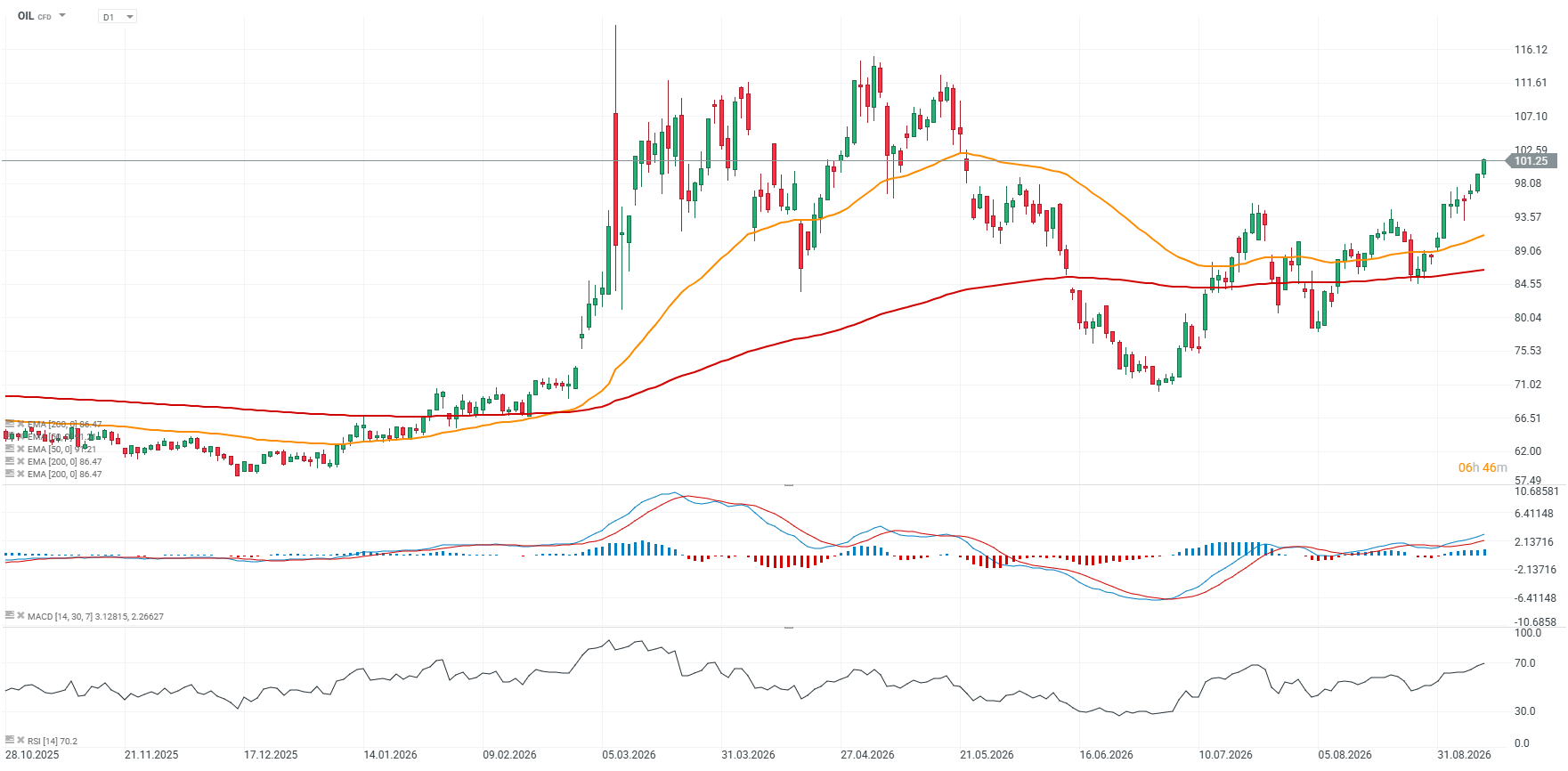
Source: xStation5


RBA turns increasingly hawkish as markets reprice November rate hike expectations ⚔️



Daily Summary: Buyers Refuse to Give In

US Natural gas extends declines 🔥📉



US OPEN: The wave of AI concerns is building again, oil returns near highs
This content has been created by XTB S.A. This service is provided by XTB S.A., with its registered office in Warsaw, at Prosta 67, 00-838 Warsaw, Poland, entered in the register of entrepreneurs of the National Court Register (Krajowy Rejestr Sądowy) conducted by District Court for the Capital City of Warsaw, XII Commercial Division of the National Court Register under KRS number 0000217580, REGON number 015803782 and Tax Identification Number (NIP) 527-24-43-955, with the fully paid up share capital in the amount of PLN 5.869.181,75. XTB S.A. conducts brokerage activities on the basis of the license granted by Polish Securities and Exchange Commission on 8th November 2005 No. DDM-M-4021-57-1/2005 and is supervised by Polish Supervision Authority.