



As reported by The Wall Street Journal, OpenAI is said to be considering significant price cuts for its AI services—particularly token fees (i.e., the units used to bill for model usage).
According to the report, the move would be a response to growing competition from Anthropic, which is gaining an increasingly strong position in the (mainly) enterprise segment thanks to its Claude Code tool.
Lower prices could accelerate AI adoption among companies, but at the same time they would increase pressure on margins in a sector that still requires massive spending on computing infrastructure and continuous funding.
At the same time, OpenAI CEO Sam Altman is expected to meet with representatives of Samsung Electronics next week during a visit to South Korea. According to Yonhap, the talks are set to focus on broader use of artificial intelligence in Samsung’s operations.
The visit is part of OpenAI’s broader strategy to strengthen relationships with the largest technology groups in Asia.
SMSN.UK (D1)
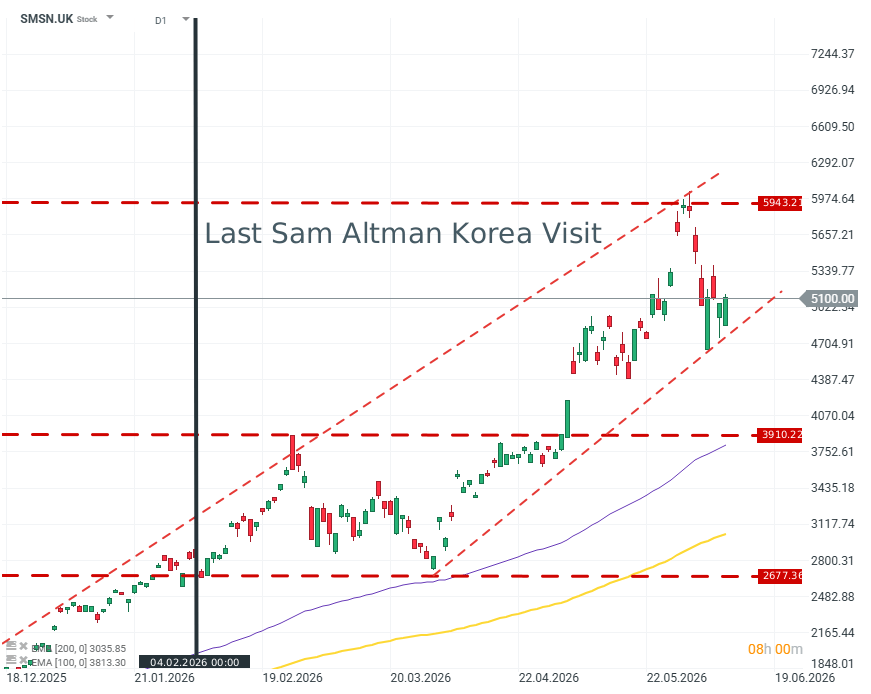
Source: xStation5
During Altman’s previous visit to South Korea, OpenAI held talks, among others, with Samsung and SK Group, and later signed letters of intent regarding cooperation on developing AI infrastructure. It’s worth closely following news from this sector, because this visit could also end with lucrative agreements.
What could a potential price war mean?
The most likely motivation is the upcoming IPO of both companies. Before sector leaders publish their prospectuses, they may want to boost subscriber numbers and token usage. This would mean short-term financial losses, but they could use higher figures and faster AI adoption growth as an argument for increasing scale and operating leverage. In an IPO context, that would raise expectations and valuations, while pushing the burden of delivering on those promises into the future.
For the stock market, a potential AI price war sends a mixed signal.
- A possible price war between OpenAI and Anthropic could paradoxically benefit the entire AI ecosystem. Lower token prices would reduce the barrier to entry for companies that have so far limited model usage due to cost. However, this is the optimistic scenario, because investors have so far assumed that AI leaders would be able to monetize their technological advantage with high margins.
- A price war would undermine that thesis and increase the risk that part of the value is captured by end customers rather than model providers. In addition, margin compression could make it harder for these companies to access the financing they need to continue operating—given the huge losses they are still generating.



Daily Summary: Rising inflation weighs on markets, semiconductors suffer most (14.10.2026)


US Open: CPI reading weighs on American indices (14.10.2026)


POET: A “meme stock” in photonics, is there still hope?


US Open: Earnings season kicks off on a high note (13.10.2026)
This content has been created by XTB S.A. This service is provided by XTB S.A., with its registered office in Warsaw, at Prosta 67, 00-838 Warsaw, Poland, entered in the register of entrepreneurs of the National Court Register (Krajowy Rejestr Sądowy) conducted by District Court for the Capital City of Warsaw, XII Commercial Division of the National Court Register under KRS number 0000217580, REGON number 015803782 and Tax Identification Number (NIP) 527-24-43-955, with the fully paid up share capital in the amount of PLN 5.869.181,75. XTB S.A. conducts brokerage activities on the basis of the license granted by Polish Securities and Exchange Commission on 8th November 2005 No. DDM-M-4021-57-1/2005 and is supervised by Polish Supervision Authority.