


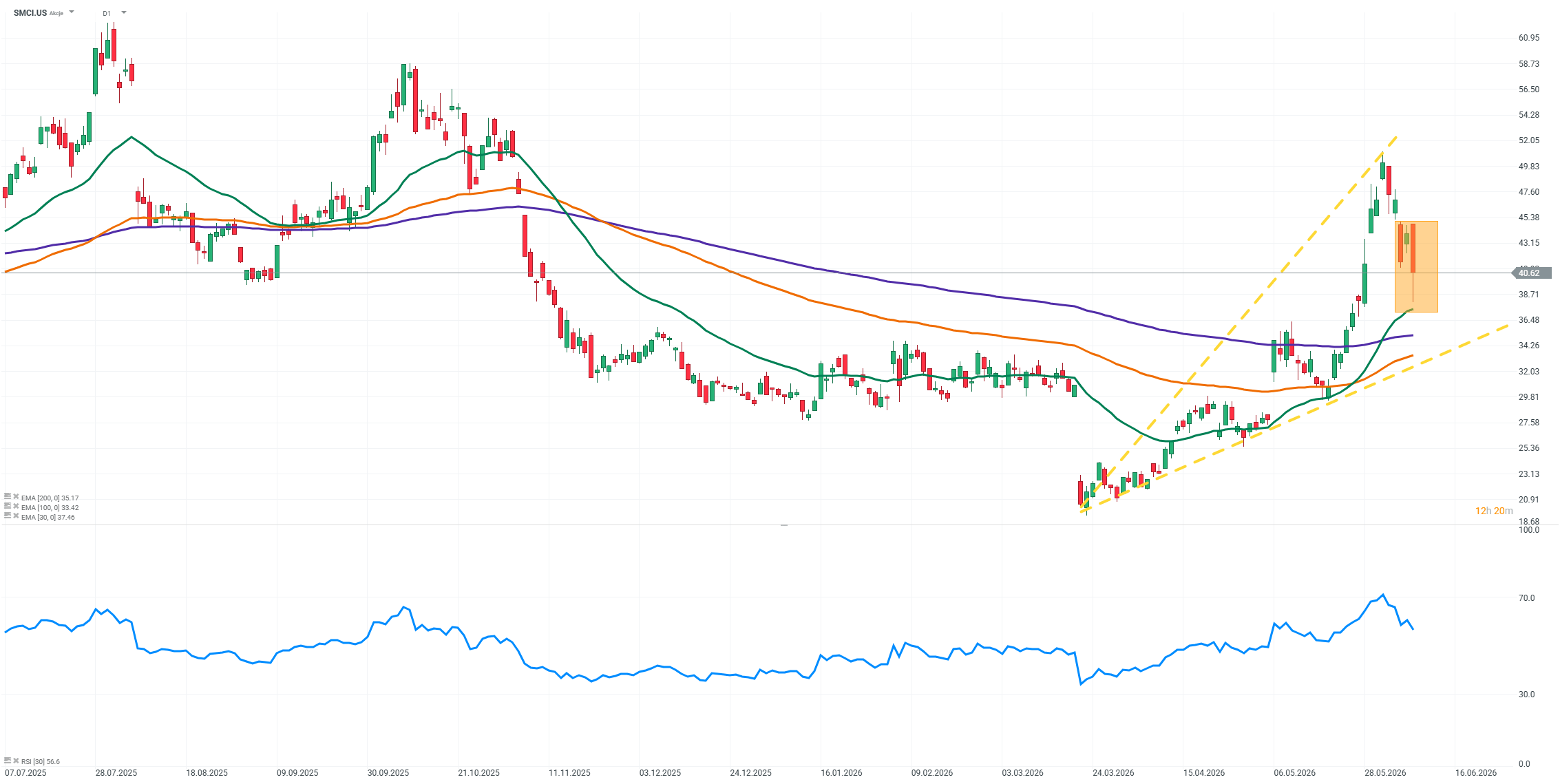
Super Micro Computer has found itself in the spotlight of investors following the announcement of one of the largest capital raises in its history. The manufacturer of servers used in data centers and artificial intelligence infrastructure plans to raise as much as $7 billion through the issuance of shares and equity-linked instruments. The market’s initial reaction was immediate and clearly negative. In pre-market trading, the company’s shares are down more than 9%, as investors began to assess the scale of dilution for existing shareholders.
At first glance, such a reaction appears entirely justified. A capital raise of this magnitude implies an increase in the number of shares outstanding, and consequently a lower earnings per share. Depending on the final structure of the transaction, the impact on financial metrics could be significant, which naturally raises concerns among investors focused on the next few quarters.
The issue, however, is that in the case of Super Micro Computer, it is worth looking not only at the capital raise itself, but above all at its purpose. The company is not raising funds to address liquidity problems or patch gaps in its balance sheet. On the contrary, management has taken this significant step because the company holds an enormous order backlog for AI servers and needs capital to purchase the components required to fulfill these orders.
And this is the key point from a long-term perspective. Super Micro finds itself in a situation where the constraint is not demand, but the ability to finance very rapid growth. Demand for AI solutions remains strong enough that the company must secure billions of dollars for processors, memory, and other infrastructure components before delivering finished systems to customers.
In the short term, the market will of course focus primarily on the negative consequences of the offering. Beyond shareholder dilution, investors are also paying attention to rising competition in the AI server segment. Major IT infrastructure players are competing for the same customers, and recent financial results have shown that even amid the AI boom, challenges are emerging around timely order fulfillment and customer readiness to accept hardware deliveries.
Additional pressure comes from regulatory and reputational concerns. In recent months, unfavorable information has emerged around proceedings involving one of the company’s co-founders. Although the company itself has not been charged, the matter continues to generate uncertainty and may weigh on investor sentiment.
Looking beyond the next few weeks, however, the picture becomes considerably more interesting. The $7 billion capital raise is effectively a confirmation of the scale of demand the company is currently facing. Such a large offering would not make sense if management were not confident that the market can absorb additional billions of dollars in AI infrastructure. It signals that investment in data centers and artificial intelligence remains very strong, and that demand for servers shows no clear signs of slowing.
If the company successfully deploys the raised capital, it could translate into accelerated revenue growth in the coming years. In that scenario, the current share dilution could be offset over time by a significantly larger scale of operations, higher revenues, and a stronger competitive position in the AI infrastructure market.
It is also worth noting that part of the proceeds may be used to strengthen the balance sheet, fund further investments, and reduce debt. From a long-term perspective, this could improve the company’s financial stability and enhance its ability to benefit from future waves of growth in artificial intelligence.
Today’s market reaction shows that investors are primarily focused on the costs of the offering. However, financial history has repeatedly shown that some of the most compelling growth opportunities emerge precisely when companies raise capital not to survive, but to take advantage of exceptional market conditions. Super Micro is currently sending a clear signal that the AI boom is still ongoing, and that the scale of orders requires multi-billion-dollar financing.
Ultimately, the key question is not the extent of shareholder dilution. The crucial issue is whether the company can turn its massive order backlog into real revenue and earnings. If the answer proves positive, this capital raise may be remembered as the moment Super Micro laid the foundation for the next stage of its expansion in the era of artificial intelligence.
Source: xStation5



UK the harbour in the storm as tech bloodbath continues


TSMC breaks records once again driven by the AI boom



🚨Morning Wrap: A weaker dollar, strong gold, and a tech sector in free fall—what’s driving the market❓

Daily Summary: Rising inflation weighs on markets, semiconductors suffer most (14.10.2026)
This content has been created by XTB S.A. This service is provided by XTB S.A., with its registered office in Warsaw, at Prosta 67, 00-838 Warsaw, Poland, entered in the register of entrepreneurs of the National Court Register (Krajowy Rejestr Sądowy) conducted by District Court for the Capital City of Warsaw, XII Commercial Division of the National Court Register under KRS number 0000217580, REGON number 015803782 and Tax Identification Number (NIP) 527-24-43-955, with the fully paid up share capital in the amount of PLN 5.869.181,75. XTB S.A. conducts brokerage activities on the basis of the license granted by Polish Securities and Exchange Commission on 8th November 2005 No. DDM-M-4021-57-1/2005 and is supervised by Polish Supervision Authority.