



U.S. index futures are attempting to rebound, led by the Dow Jones Industrial Average (US30), which is up nearly 1%, and the Russell 2000 (US2000), the index most sensitive to changes in U.S. yields and interest rates, which is gaining around 0.8%. U.S. Treasury yields have pulled back slightly after their recent sharp rise, providing some relief to equity indices.
The U.S. 4-week Treasury bill auction was solid: the bid-to-cover ratio rose to 2.56 from 2.40, pointing to clearly stronger investor demand despite as much as $110 billion of debt being sold. The stop-out yield came in at 4.% versus 3.98% previously, meaning financing costs increased slightly, but given such strong auction coverage, the data do not suggest any difficulties in absorbing short-term U.S. government debt.
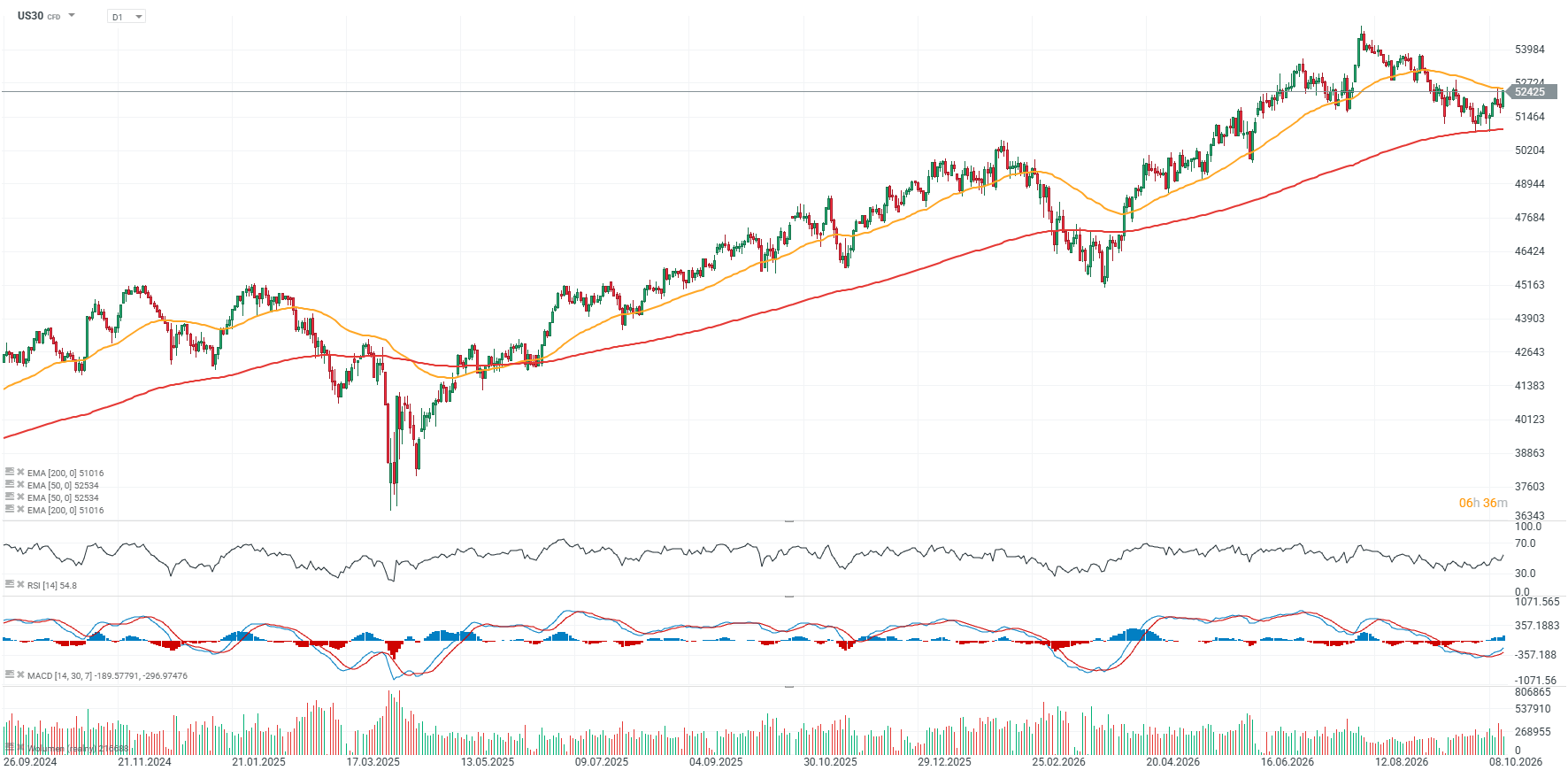
US30 (D1 interval)
The DJIA futures contract is approaching the 50-session exponential moving average, EMA50 (orange line). In recent days, the benchmark came close to testing the key EMA200 support level (red line), but that support held and bulls are now attempting to regain control and restore upward momentum. The absence of companies focused exclusively on AI and the relatively limited weighting of semiconductor stocks act as a stabilising factor for the benchmark amid the ongoing sell-off in the technology sector.
Source: xStation5
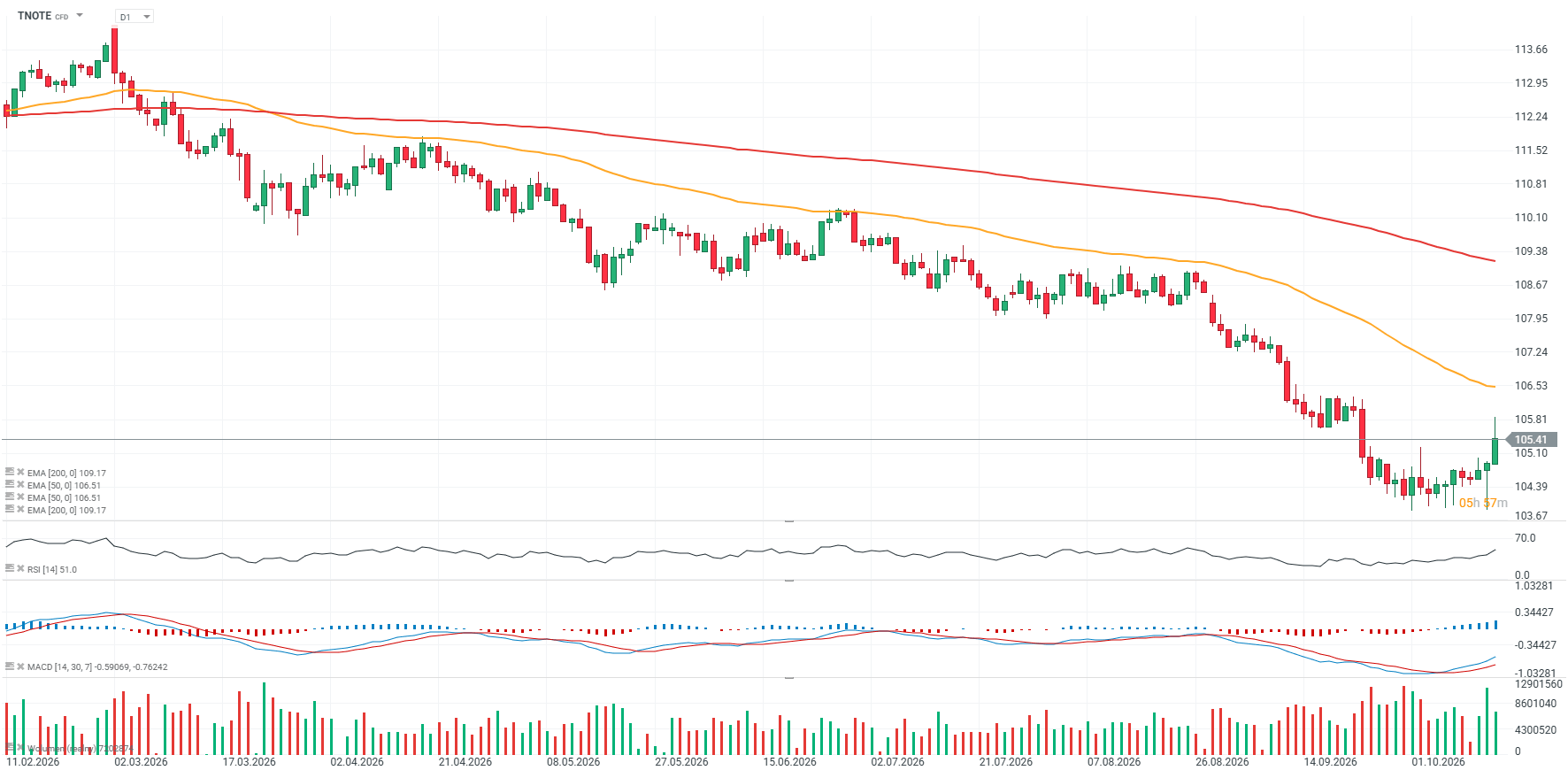
The rise in U.S. 10-year Treasury futures confirms that yields are giving back some of their recent gains and retreating from record levels. Today, the yield on the U.S. 10-year Treasury stands at 5.1%, compared with around 5.3% observed several hours earlier.
 Source: xStation5
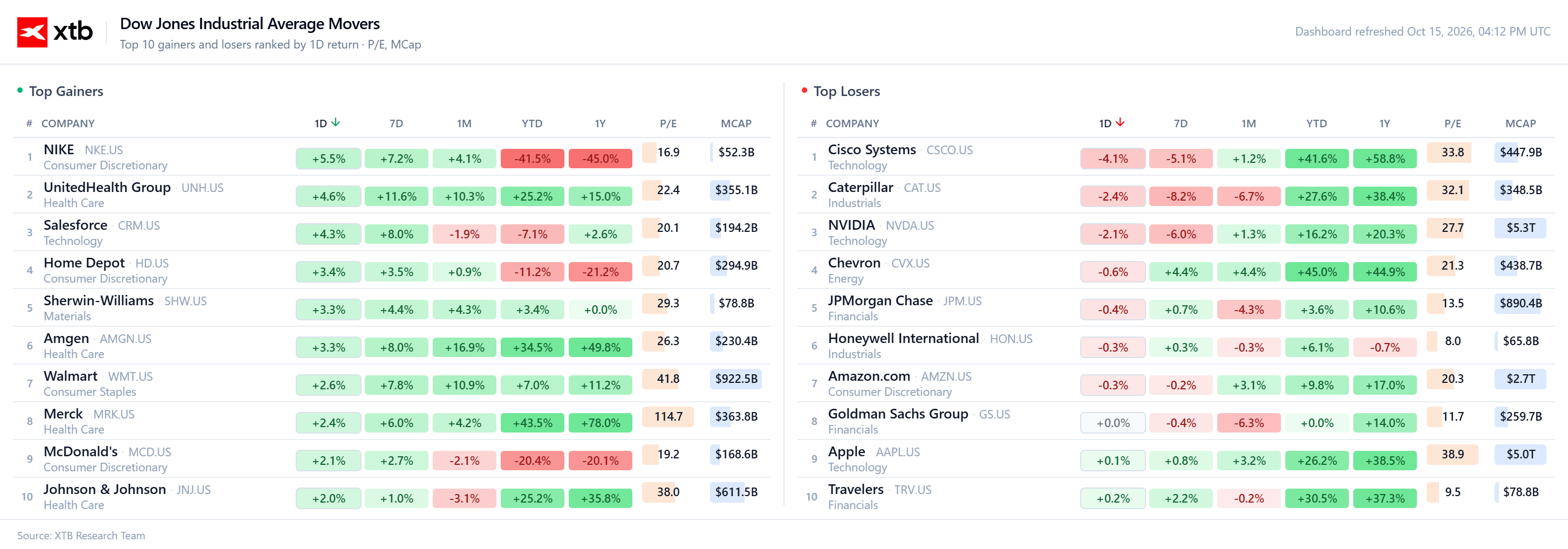
Today’s Dow Jones performance shows a clear rotation toward more defensive and consumer-oriented stocks, while pressure remains concentrated in parts of the technology and industrial sectors. Nike leads the gains, rising around 5.5%, although the scale of the earlier sell-off remains substantial, with the stock still down about 41.5% YTD and 45% over the past year. UnitedHealth (+4.6%), Salesforce (+4.3%) and Home Depot (+3.4%) are also posting strong gains, suggesting that the rebound is not limited to a single sector. On the downside, Cisco stands out with a 4.1% decline, while NVIDIA is down around 2.1%, despite still being up roughly 16.2% year-to-date and remaining one of the biggest beneficiaries of the structural AI trend. Valuations also vary significantly across the index: JPMorgan and Goldman Sachs trade at P/E ratios of around 13.5x and 11.7x, respectively, while Walmart trades at approximately 41.8x. Overall, today’s session points less to a broad trend reversal in the Dow Jones and more to a short-term rotation of capital between sectors and companies with very different growth profiles, valuations and sensitivity to interest rates.
Source: XTB
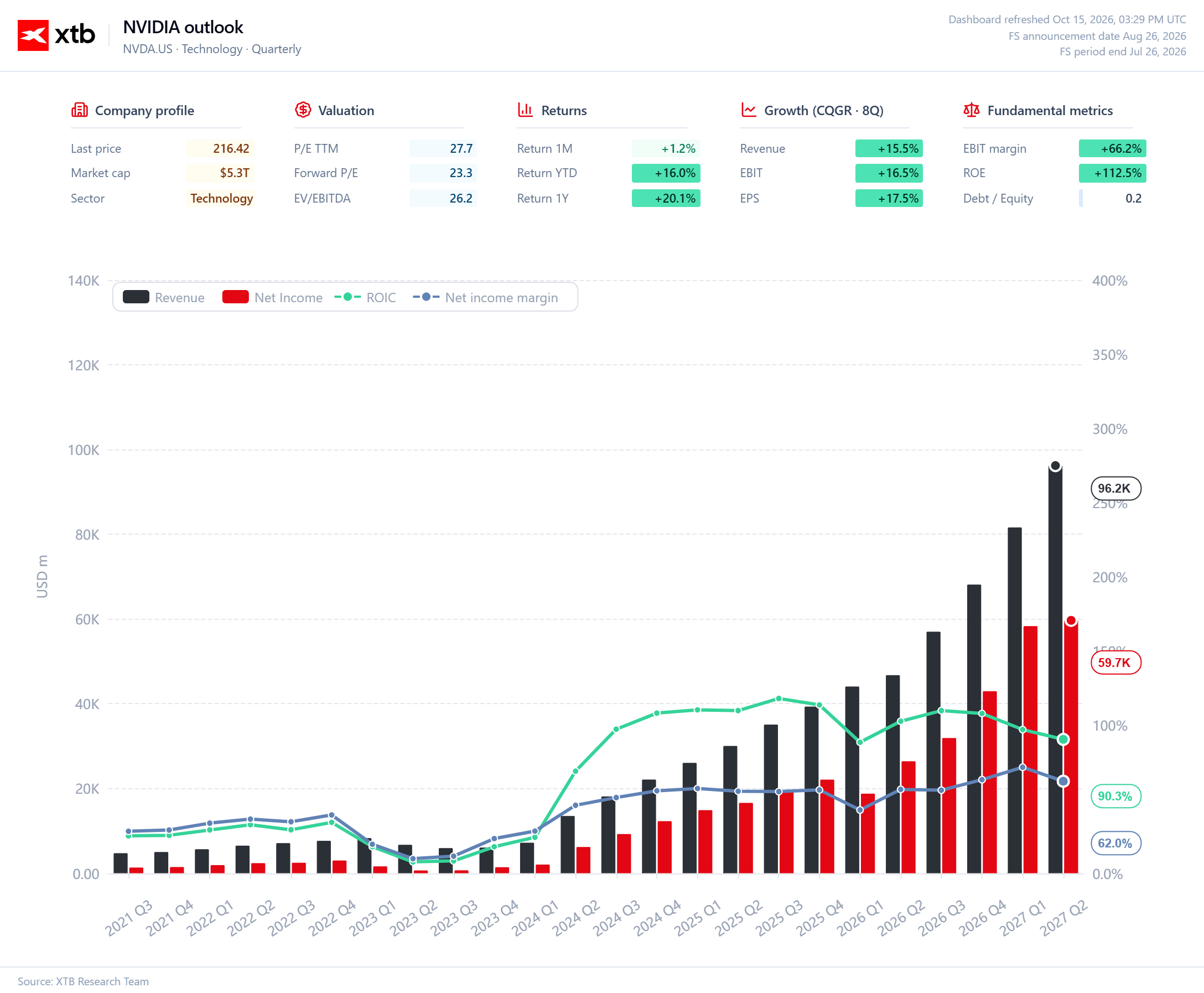
Looking at the leading stock of the AI bull market in recent years, we can see that revenue growth has been accompanied by an even faster increase in profits and exceptionally high capital efficiency. Quarterly revenue rose to approximately $96.2 billion, while net income reached nearly $59.7 billion, implying a net margin of around 62% — an extraordinarily high level even by the standards of the most profitable technology companies. At the same time, ROIC stands at around 90.3%, suggesting that NVIDIA continues to generate returns on incremental capital many times higher than the typical cost of capital for a large technology company; this spread between ROIC and WACC remains one of the key sources of its valuation.
Importantly, this level of profitability has not been achieved through aggressive leverage. Debt/Equity stands at just 0.2x, meaning NVIDIA’s growth model is financially far more resilient to higher interest rates than that of infrastructure-heavy companies that rely more heavily on debt-financed expansion. Momentum also remains strong: the CAGR over the past eight quarters is approximately 15.5% for revenue, 16.5% for EBIT and 17.5% for EPS, indicating that earnings are still growing somewhat faster than sales.
With a market capitalisation of around $5.3 trillion and valuation multiples of approximately 27.7x earnings, 23.3x price-to-12-month forward earnings and 26.2x EV/EBITDA, the market is clearly paying a premium for quality. However, that valuation is backed by real profitability and cash flows generated by the business rather than solely by a distant promise of future earnings. The main fundamental risk today is therefore not NVIDIA’s ability to generate profits itself, but rather the potential normalisation of margins and ROIC. Even if revenue continues to grow, a material decline in returns on capital could reduce the value created by each additional dollar of reinvestment and make current valuation multiples more difficult to justify.
 Source: XTB


US Open: Nasdaq 100 extends losses 🚩 AI stocks under pressure, CoreWeave falls 8%


Hot inflation data from the US🔥📈 PPI and retail sales are rising!


Nickel market panic 🚩 INSG revises forecast, surplus in 2027?



Market Wrap: Tech Sell-Off Hits Europe, Gold Shines Again
This content has been created by XTB S.A. This service is provided by XTB S.A., with its registered office in Warsaw, at Prosta 67, 00-838 Warsaw, Poland, entered in the register of entrepreneurs of the National Court Register (Krajowy Rejestr Sądowy) conducted by District Court for the Capital City of Warsaw, XII Commercial Division of the National Court Register under KRS number 0000217580, REGON number 015803782 and Tax Identification Number (NIP) 527-24-43-955, with the fully paid up share capital in the amount of PLN 5.869.181,75. XTB S.A. conducts brokerage activities on the basis of the license granted by Polish Securities and Exchange Commission on 8th November 2005 No. DDM-M-4021-57-1/2005 and is supervised by Polish Supervision Authority.