


- TSMC increased second-quarter revenue by 36% year over year to $40.2 billion, while net income surged 77%, confirming exceptionally strong demand for AI chips.
- Despite record financial results, the semiconductor industry may be approaching the peak of its earnings growth cycle, increasing the risk of weakening market momentum.
- The fundamentals of both TSMC and ASML remain strong, but investors are increasingly valuing these companies based on their future growth trajectory rather than record revenue and earnings alone.

- TSMC increased second-quarter revenue by 36% year over year to $40.2 billion, while net income surged 77%, confirming exceptionally strong demand for AI chips.
- Despite record financial results, the semiconductor industry may be approaching the peak of its earnings growth cycle, increasing the risk of weakening market momentum.
- The fundamentals of both TSMC and ASML remain strong, but investors are increasingly valuing these companies based on their future growth trajectory rather than record revenue and earnings alone.
For years, Wall Street has expected more from semiconductor companies than just record-breaking results—it has demanded an ever-accelerating pace of revenue and earnings growth. However, a growing number of signals suggest that the semiconductor sector may be approaching the peak of its current earnings and revenue growth cycle. That, in turn, could gradually weaken the powerful market momentum typically seen during major bull market cycles. Paradoxically, even TSMC's record financial results and exceptionally strong AI outlook may not be enough if investors conclude that the industry's fastest growth is already behind it.
Key takeaways
- Wall Street expects S&P 500 companies to deliver approximately 23.6% year-over-year earnings growth in the second quarter, although historically the final growth rate has often risen to nearly 29%.
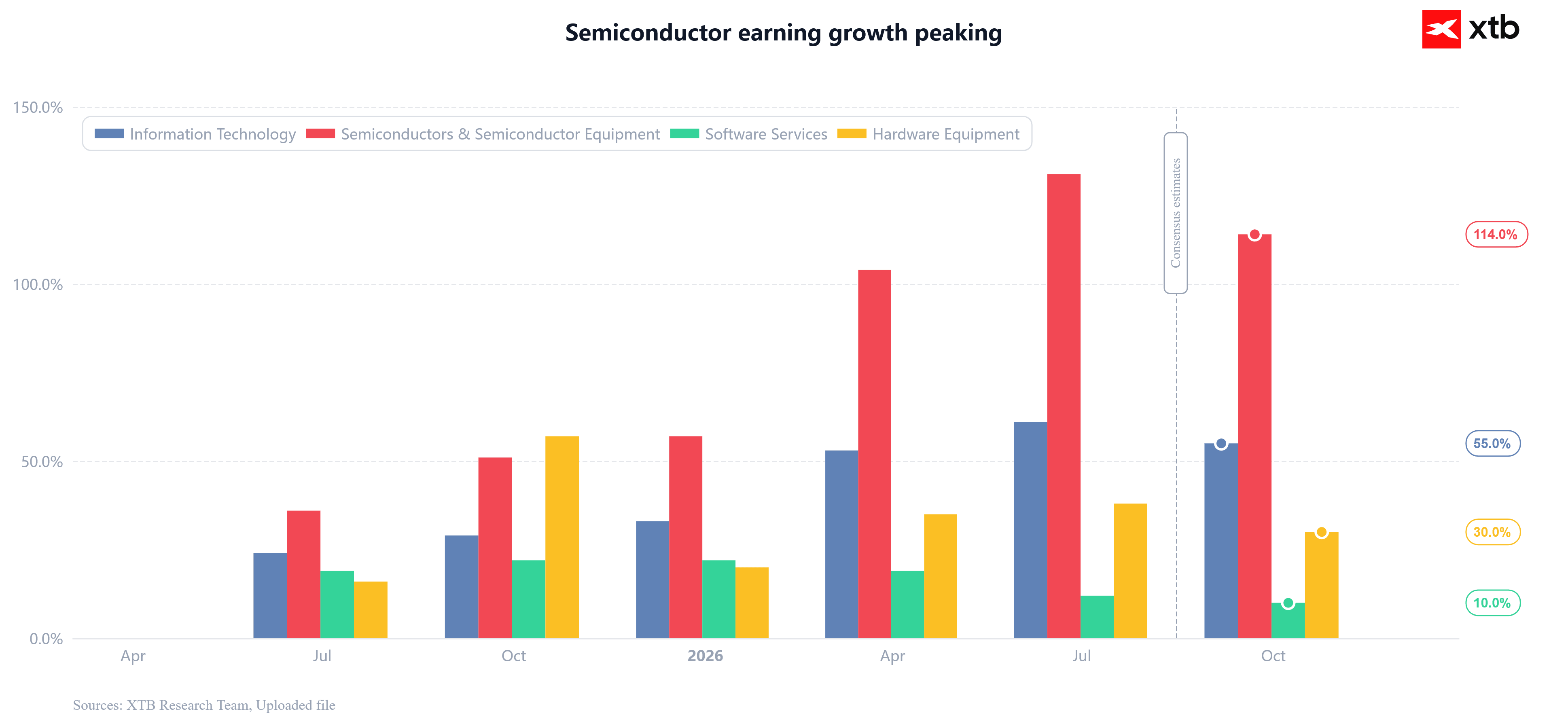
- The semiconductor industry remains the leading earnings growth sector, but current forecasts suggest Q2 2026 could mark the peak of the current cycle.
- TSMC reported record quarterly results and raised its Q3 guidance, confirming exceptionally strong demand for advanced AI chips.
- Despite robust fundamentals, the market reaction has been mixed, highlighting that investors are increasingly focused on future growth rates rather than record earnings alone.
Record earnings may no longer be enough
The U.S. earnings season has started on a very strong note. According to FactSet, analysts currently expect S&P 500 companies to deliver 23.6% year-over-year earnings growth in the second quarter. If the historical pattern of positive earnings surprises continues, the final growth rate could exceed 29%—the strongest quarterly performance since late 2021.
At the same time, 89% of the companies that have reported so far have beaten EPS estimates. The challenge, however, is that markets have already priced in an exceptionally optimistic scenario. Expectations are especially elevated in the sectors driving most of the index's earnings growth—particularly semiconductors.
As a result, even 30% earnings growth could disappoint investors if they believe the industry's growth momentum is beginning to peak. Wall Street forecasts currently suggest that semiconductor earnings growth could reach its high point in the second quarter of 2026.
Although analysts still expect chipmakers to deliver approximately 114% year-over-year earnings growth, subsequent quarters are projected to show a gradual slowdown. This does not imply deteriorating fundamentals, but rather reflects increasingly difficult comparisons following the AI-driven boom. Investors will therefore focus not only on whether companies beat expectations, but also on whether they can once again raise guidance for future quarters.
Source: XTB Research, Bloomberg Finance L.P., Apollo Global Management
TSMC demonstrates AI's strength—but also raises expectations
Last week, the world's largest contract chip manufacturer once again demonstrated why it remains one of the biggest beneficiaries of the global AI boom. TSMC increased second-quarter revenue by 36% year over year to $40.2 billion, while net income surged 77%. Management also raised third-quarter guidance, forecasting revenue of $44.6–45.8 billion and a gross margin of 65–67%.
TSMC's CEO also emphasized that demand for the most advanced AI chips is expected to remain very strong at least through 2029–2030. Fundamentally, there are still few signs of any slowdown in the company's operating performance.
Ironically, however, such exceptional results also raise the bar for the entire semiconductor industry. The stronger the market leaders perform, the harder it becomes for future quarters to deliver meaningful upside surprises.
ASML and TSMC show AI continues to drive industry fundamentals
TSMC's results also confirm that the industry's highest-value revenue continues to come from its most advanced manufacturing technologies. The 3nm process already accounts for roughly 30% of company revenue, while technologies below 7nm generate approximately 77% of total sales. At the same time, TSMC has begun rolling out its 2nm process, expected to become another major growth driver in the coming years—further demonstrating that AI demand continues translating into tangible business results.
A similar picture emerges from ASML's results. The lithography equipment leader remains a critical supplier to the global semiconductor industry, benefiting from record demand for equipment used to manufacture the world's most advanced AI chips. Both ASML and TSMC continue to stress that the industry's main constraint is no longer demand, but the speed at which production capacity can be expanded.
The evidence therefore suggests that semiconductor fundamentals remain exceptionally strong. Nevertheless, markets are increasingly rewarding companies not simply for delivering better results, but for sustaining extraordinary growth rates over multiple years. That distinction may determine which companies continue leading the AI bull market—and which begin to lose market momentum. It is also worth remembering that Cisco's shares declined following the 2000 dot-com bubble, even as the company continued reporting record revenue and earnings, illustrating that outstanding fundamentals do not always translate into rising stock prices.
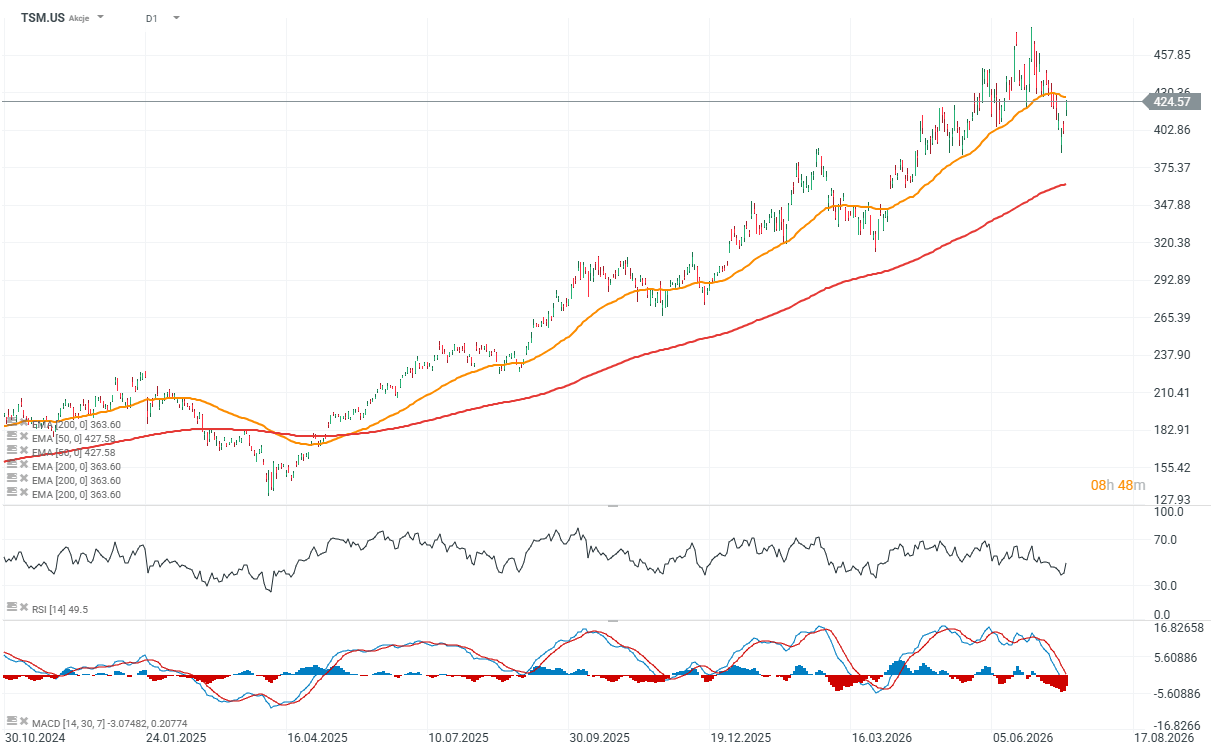
TSMC shares (TSM.US, D1 interval)
Source: xStation5
Eryk Szmyd XTB Financial Markets Analyst



US Open: CPI reading weighs on American indices (14.10.2026)



Inflation data causes market havoc

POET: A “meme stock” in photonics, is there still hope?



Market Wrap: ASML lifts tech sentiment, EU yields pull back
This content has been created by XTB S.A. This service is provided by XTB S.A., with its registered office in Warsaw, at Prosta 67, 00-838 Warsaw, Poland, entered in the register of entrepreneurs of the National Court Register (Krajowy Rejestr Sądowy) conducted by District Court for the Capital City of Warsaw, XII Commercial Division of the National Court Register under KRS number 0000217580, REGON number 015803782 and Tax Identification Number (NIP) 527-24-43-955, with the fully paid up share capital in the amount of PLN 5.869.181,75. XTB S.A. conducts brokerage activities on the basis of the license granted by Polish Securities and Exchange Commission on 8th November 2005 No. DDM-M-4021-57-1/2005 and is supervised by Polish Supervision Authority.