Trading in the commodity market is an interesting and specific type of investment, which is in many respects similar to stock trading.
Trading in the commodity market is an interesting and specific type of investment, which is in many respects similar to stock trading.
Commodity trading is the buying and selling of standardised raw materials through financial derivatives or exchange-traded instruments without taking physical delivery of the underlying assets. The global commodities market sees trillions of dollars in daily trading volume, providing essential liquidity for producers hedging physical output. Investors use these markets to navigate macroeconomic shifts, combat inflation, and capitalise on geopolitical supply constraints. This guide breaks down the essential asset classes, market mechanisms, and risk management tools required to start navigating global resource markets effectively.
Key Takeaways
-
Commodity trading involves exchanging contract rights to raw materials rather than handling the physical goods.
- The market divides assets into hard commodities like gold and crude oil, and soft commodities like agricultural crops and livestock.
- Traders utilise tools like contracts for difference (CFDs) and exchange-traded funds (ETFs) to hedge against inflation and diversify traditional equity portfolios.
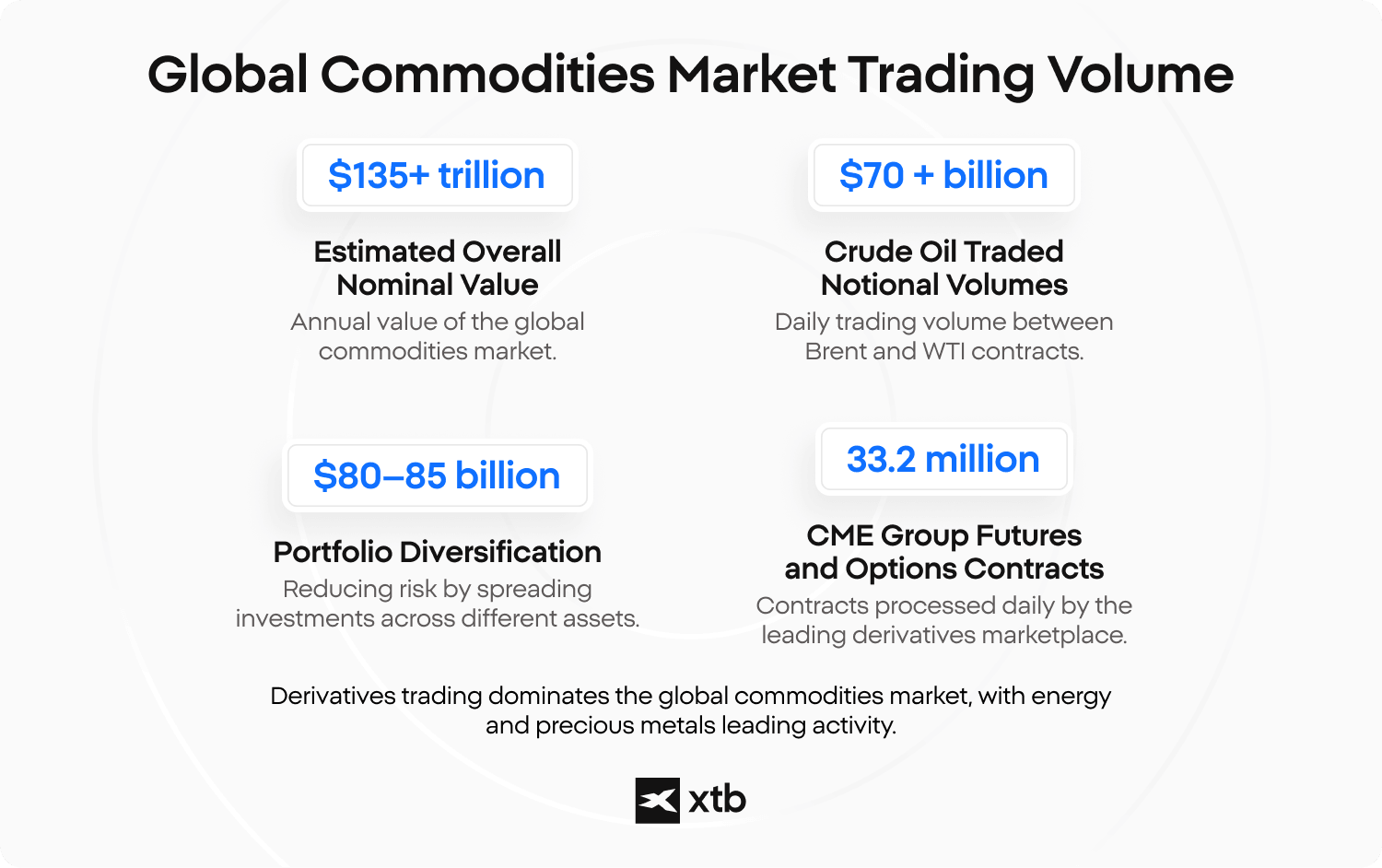
- The global commodities have an estimated nominal value of almost $135.5 trillion according to the Bank of International Settlements, and the United States is the largest market, capturing accounting for $62.75 trillion
What Is Commodity Trading and How Does It Work?
Commodity trading allows market participants to exchange financial contracts tied to the value of raw materials instead of managing the logistical burdens of physical ownership. Individual market participants execute these transactions to capitalise on price fluctuations or hedge existing commercial exposure. Because physical delivery is absent in most speculative accounts, traders settle transactions cash-independently through brokers on centralised derivative platforms.
Liquidity in commodity trading relies fundamentally on the economic concept of fungibility, meaning that individual units of an asset are perfectly interchangeable regardless of their specific origin. For example, one troy ounce of refined gold or one barrel of Brent Crude oil possesses identical commercial value and quality standards on the global market as any other unit within that contract specification. This standardisation eliminates the need for visual inspection, allowing global market participants to execute high-volume orders instantaneously.
High-volume financial transactions take place on specialised global derivatives exchanges such as the New York Mercantile Exchange (NYMEX), the Chicago Mercantile Exchange (CME), and the London Metal Exchange (LME). These regulated environments maintain strict contract specifications, guarantee settlement, and collect margin requirements from institutional clearing members. Consequently, retail investors can trade alongside multinational corporations with transparent pricing data.
What Are the Main Types of Commodities?
Understanding what commodities in trading are requires breaking down the global marketplace into hard and soft categories, which encompass energy resources, industrial metals, agricultural crops, and livestock assets. Each sector responds to distinct macroeconomic forces, supply chain dynamics, and capital requirements.
Market operators utilise the hard versus soft commodity distinction as a natural organising principle to categorise goods based on their extraction or cultivation methods. Hard commodities consist of natural resources that must be mined or extracted from the earth, such as industrial crude oil, refined copper, and gold bullion. Conversely, soft commodities comprise agricultural products or livestock that are actively grown or raised over a seasonal cycle, including roasted coffee beans, bulk wheat, and lean hogs.
Each category exhibits distinct market behaviour shaped by its supply and demand dynamics. Energy markets react sharply to sudden geopolitical events and production limits set by international cartels. Precious metals function primarily as safe-haven assets driven by interest rate fluctuations and global inflation worries, showing gold is a good investment characteristic during crises. Agricultural markets remain highly sensitive to local weather patterns, planetary climate shifts, and annual crop production cycles.
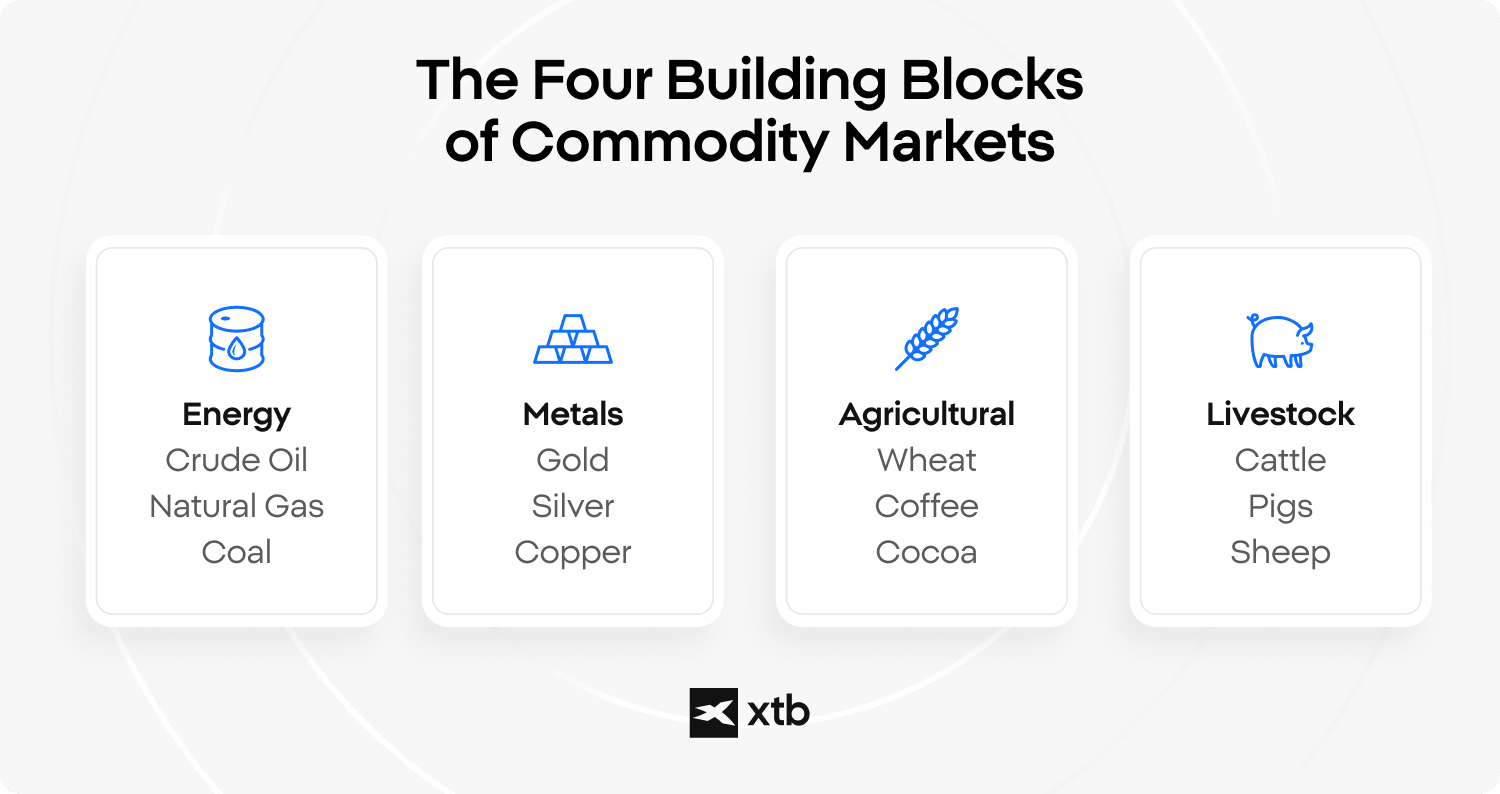
Investors tracking global raw materials typically categorise assets into four main blocks:
- The energy sector includes Brent crude oil, heating oil, and natural gas, which form the foundation of global industrial power grids.
- The metals sector includes industrial copper, aluminium, and precious gold, which serve both manufacturing needs and investment demand.
- The agricultural sector includes soft commodities like soybeans, corn, and wheat, which are highly vulnerable to crop cycles.
- The livestock sector includes live cattle and lean hogs, which are driven by processing costs and global food demand.
Why Do Investors Trade Commodities?
Investors integrate commodity trading into their broader financial strategies to achieve robust portfolio diversification, hedge against rising inflation, and gain direct exposure to shifting global supply-demand dynamics. Historically, physical assets tend to appreciate when fiat currencies lose purchasing power, offering an alternative mechanism for wealth preservation.
The important function of commodities as an inflation hedge becomes evident when rising consumer price index (CPI) prints devalue traditional fixed-income cash flows. When inflation accelerates, the structural cost of raw production inputs naturally increases, which drives up the spot price of global materials. For instance, physical assets like gold often experience capital inflows when global central banks increase the money supply, serving as a historic monetary anchor.
Portfolio managers rely on the historically low or negative correlation between commodities and traditional equities to minimise overall drawdown volatility during market corrections. Because raw material prices respond directly to immediate physical supply constraints rather than corporate earnings reports, they frequently move counter-cyclically to stock indices. To optimise risk-adjusted returns, many strategists explore whether gold is a good investment during prolonged equity bear markets.
Beyond portfolio construction and trading, commodity markets play a critical role in the functioning of the global economy through price discovery and risk transfer. Futures exchanges allow producers, consumers, and traders to continuously assess the fair market value of raw materials based on available information about supply, demand, inventories, weather conditions, and geopolitical developments. Speculators are an important part of this process because they willingly assume price risk that commercial participants often seek to hedge. By providing additional market depth and liquidity, they help facilitate transactions between producers and end-users while contributing to more efficient price formation.
What Are the Ways to Trade Commodities?
Market participants can access raw material markets through four primary avenues, consisting of contracts for difference (CFDs), standardised futures contracts, exchange-traded funds (ETFs), and equities of raw material producers. Selecting the correct investment vehicle depends heavily on an individual's operational time horizon, personal risk tolerance, and available investment capital.
Market infrastructure provides diverse tools tailored to different styles of market participation. Short-term speculative participants often prefer derivative contracts that offer flexible exposure without delivery obligations, whereas long-term allocators favour equity-based alternatives.
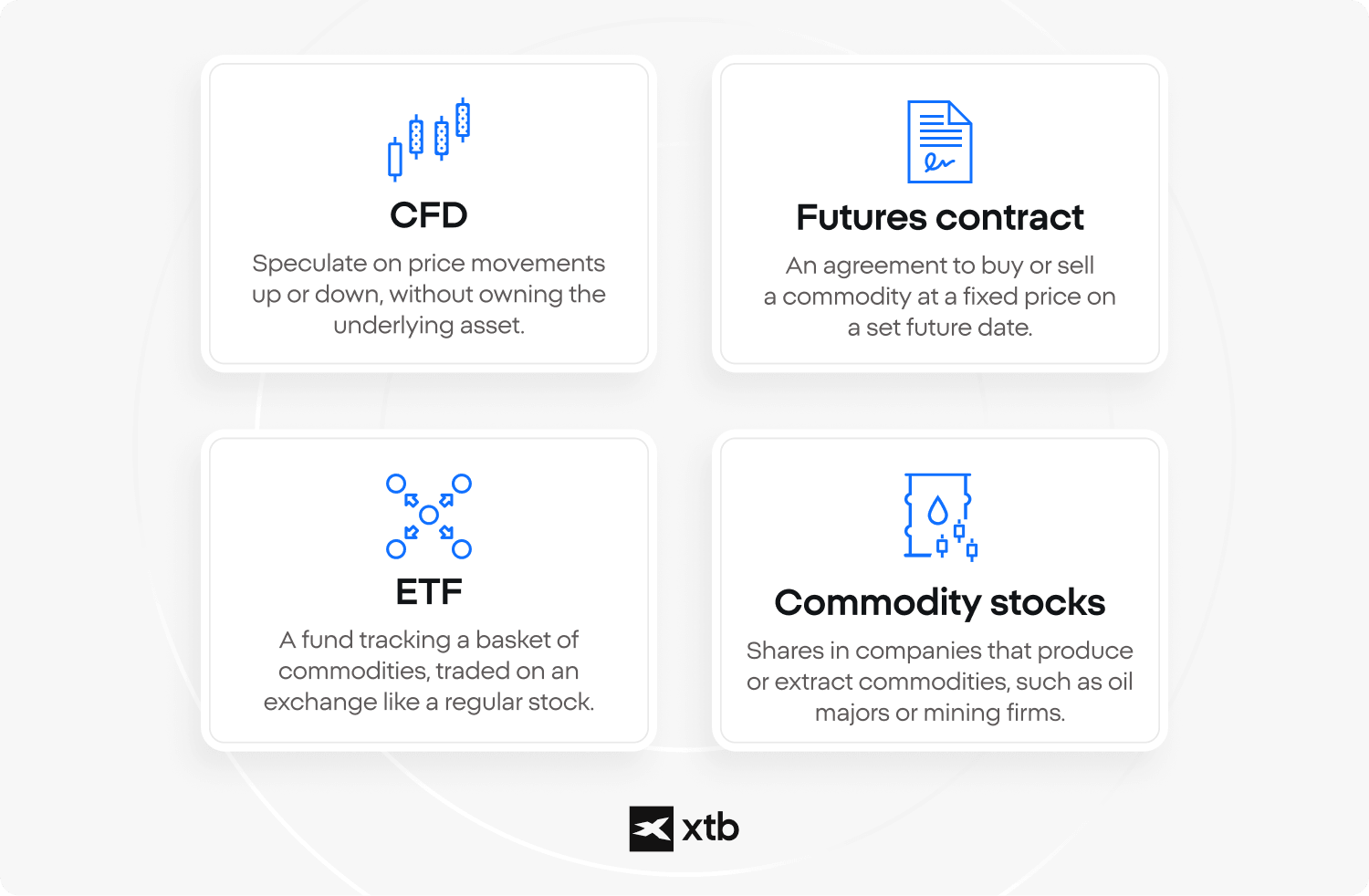
The four main instruments for accessing commodity trading include:
-
Via a CFD allow investors to speculate on real-time price movements with built-in leverage, meaning you do not own the underlying physical asset.
- Using futures contracts requires participants to buy or sell a specified asset size at a fixed execution date on regulated exchanges.
- Through exchange-traded funds (ETFs) pool investor capital to track specific underlying spot indices or physical baskets directly on public stock exchanges.
- Purchasing commodity stocks gives investors indirect exposure via corporate entities, such as oil producers or mining companies, whose revenues depend on raw asset prices.
Trading a commodity differs fundamentally from owning a physical asset or a dedicated commodity ETF due to the contract structure and leverage mechanics.
- A contract for difference is an over-the-counter derivative agreement where the investor and the provider agree to exchange the price difference of an asset between the opening and closing positions. This instrument allows for short-selling and margin trading. Remember - trading CFD is risky, volatile and may lead to capital losses.
- Standard ETFs typically require full capital funding and are designed for holding long-term directional trends. Also, investing in commodities by acquiring equities is dedicated to long-term investors rather than short-term speculators.
How Do Commodity Prices Move — and What Drives Them?
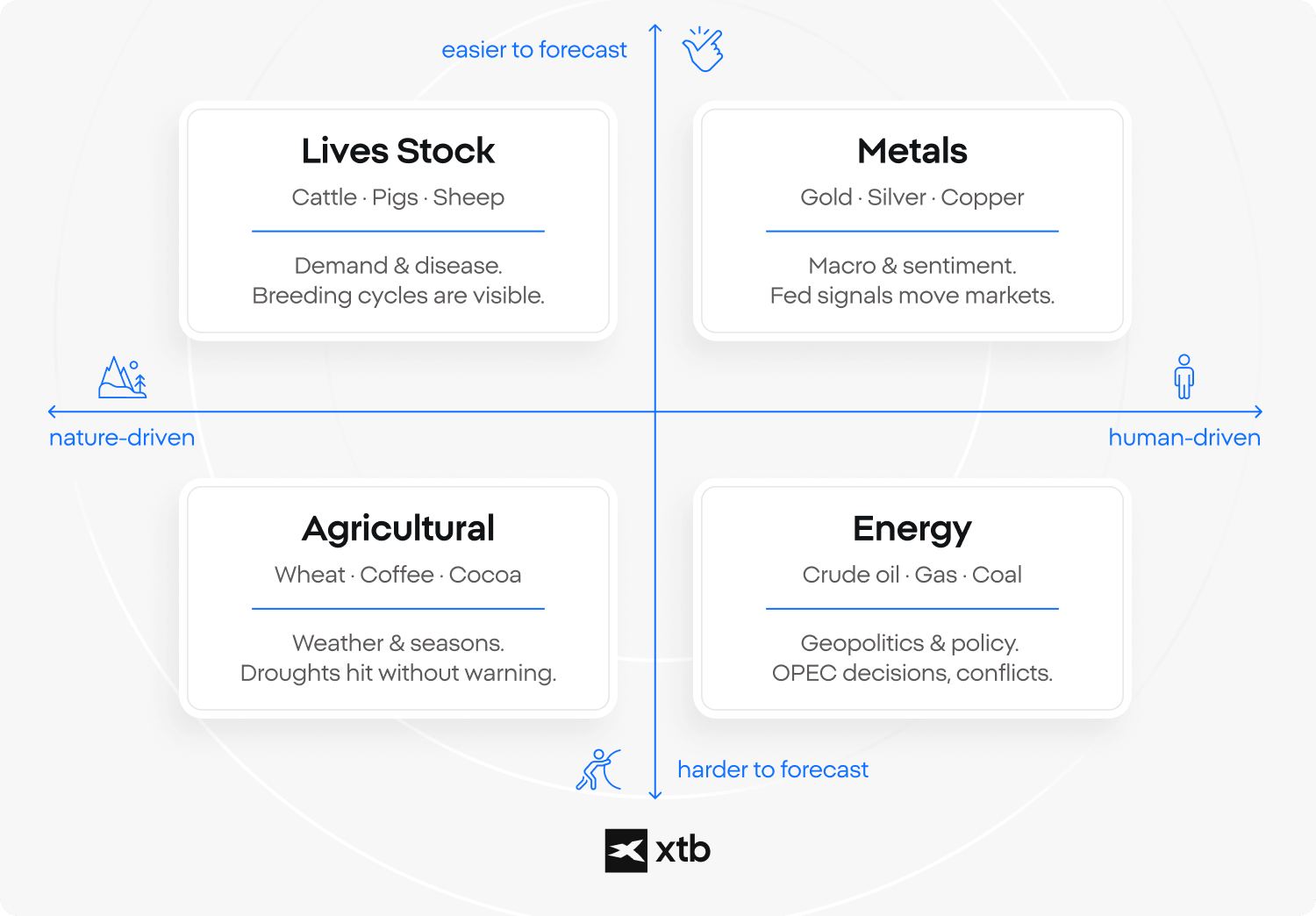
Global commodity prices fluctuate continuously based on the core interaction of macroeconomic supply and demand, seasonal weather developments, geopolitical events, and high-impact macroeconomic data releases. These volatile components create unique trading opportunities while simultaneously amplifying the operational risks for market participants.
Environmental shocks and physical supply bottlenecks serve as prime drivers for sudden market movements, as demonstrated by the historic spike in global cocoa prices in 2024. Severe crop diseases and adverse weather conditions in West Africa triggered massive structural deficits in major producing nations, forcing global processors to bid prices to record highs. This rapid price appreciation illustrates how real-world agricultural constraints directly translate into financial market volatility.
|
|
What Are the Risks of Trading Commodities?
Executing trades in raw materials exposes capital to significant systemic risks, primarily driven by intense asset price volatility, leverage amplification effects, stark liquidity variances across contracts, and unpredictable external geopolitical or weather shocks. Understanding these structural dangers is vital for maintaining long-term account survival.
Margin-based trading instruments significantly increase an investor's vulnerability to sudden adverse price swings. Because derivatives allow for disproportionate exposure relative to the initial deposit, small underlying market movements can lead to rapid capital depletion.
- Risks increase significantly when traders use leverage beyond what their capital can realistically support.
- Long-term positions can become riskier when traders ignore financing costs, such as overnight swap fees, which may reduce net returns over time.
- Opening a position without a clear stop-loss order can expose traders to uncontrolled losses.
- Concentrating too much capital in a single instrument increases portfolio risk, especially when it is not balanced with exposure to uncorrelated markets or a diversified long-term portfolio.
How Can You Start Trading Commodities as a Beginner?
Beginners who want to learn how to trade commodities must systematically select a strictly regulated financial institution, carefully evaluate the applicable transaction cost structures, and practice risk execution inside a risk-free demo account environment. Taking these deliberate foundational steps ensures that capital remains protected while building essential market experience.
Evaluating broker cost structures requires analysing the bidirectional bid-ask spreads and the rolling overnight swap financing fees associated with derivative contracts. High transaction fees can significantly reduce the statistical edge of short-term trading models over time. Beginners should prioritise platforms where capital works within a fully transparent pricing schedule and comprehensive multi-asset access.
Utilising a demo account allows new investors to test technical execution speeds, understand margin calculations, and observe real-time volatility without risking real money. This practical phase serves as the ideal testing environment to refine stop-loss placements, calculate contract sizes, and establish sound portfolio rules before deploying live capital onto global markets. By learning to navigate natural price cycles systematically, beginners can transition to live trading with heightened confidence and a sustainable risk management framework
FAQ
Commodity trading means gaining exposure to the price of raw materials like oil, gold, or wheat through financial markets instead of buying and storing them physically. In practice, it usually involves contracts or instruments that reflect price changes. For a beginner, it helps to think of it as following how the value of essential resources moves over time, rather than owning the resources themselves.
Commodities are standardised raw materials used across the global economy, which makes them widely traded and comparable. Their importance comes from the fact that they sit at the foundation of production and consumption—energy powers industries, metals build infrastructure, and agricultural goods feed populations. Because of this, their prices often reflect broader economic conditions.
The main difference lies in what drives value. Stocks are linked to company performance, while commodities are tied to physical supply and demand conditions. This means a commodity price might move due to weather or geopolitical events, whereas a stock price typically reacts to earnings or business outlook.
Prices are influenced by a mix of production levels, consumption patterns, and external events. For example, a poor harvest, a disruption in energy supply, or changes in global demand can all affect pricing. These factors often interact, which is why movements can sometimes appear complex.
They can be understood at a basic level, but they involve factors that may not be immediately obvious, such as external shocks or structural price drivers. For that reason, learning how these markets function is usually considered an important first step before any deeper involvement.
Some of the most actively traded commodities include crude oil, gold, natural gas, wheat, and copper. These markets tend to have higher liquidity and more consistent activity compared to smaller or more specialised commodities.
Price changes can occur quickly when new information enters the market, especially if it affects supply expectations. Even rumours or early reports can trigger reactions, as participants adjust their expectations before official data is released.
Yes, global events can play a major role. Political decisions, trade policies, and international conflicts can all influence supply chains and market sentiment. This connection to real-world developments is one of the defining features of commodity markets.
There are models and forecasts, but outcomes are not certain. Markets often react to new information in ways that are difficult to anticipate. Forecasts and past performance are not reliable indicators of future results, which is why uncertainty remains a constant factor.