
The reader wants to understand how compound interest works and what drives long-term compound growth. They may have a savings amount or time horizon in mind and want to see how the mechanism plays out through clear explanations and
worked examples. The article satisfies both the conceptual question of what compound interest is and why it matters, and the practical follow-up questions about the formula, the factors that affect growth, and where compounding applies.
The reader wants to understand how compound interest works and what drives long-term compound growth. They may have a savings amount or time horizon in mind and want to see how the mechanism plays out through clear explanations and
worked examples. The article satisfies both the conceptual question of what compound interest is and why it matters, and the practical follow-up questions about the formula, the factors that affect growth, and where compounding applies.


Compound interest allows money to grow over time by adding interest or returns not only to the original amount, but also to previously accumulated growth. The process depends on factors such as time, annual rate, and compounding frequency, which together shape the final balance. While the compounding interest calculation itself is straightforward, the long-term effect can become significant because growth builds on an increasingly larger balance.
Key takeaways
● Compound interest increases the growth base over time because interest or returns are repeatedly added to the balance.
● Time horizon often has the largest effect on compound growth, since longer periods allow more compounding cycles to occur.
● Compound growth projections are hypothetical estimates and do not guarantee future returns, especially for market-based investments.
What Is Compound Interest?
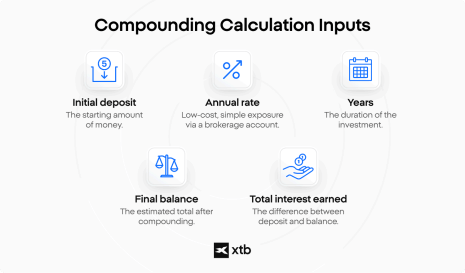
Compound interest is the process by which interest or investment returns are added to the existing balance, allowing future growth to be calculated on a progressively larger amount. Instead of earning growth only on the original deposit, compound interest also generates growth on previously accumulated interest. This creates a cumulative effect that can become more noticeable over longer periods, even when investing with little money
The concept is different from simple interest. With simple interest, returns are calculated only on the initial amount and do not build on past gains. Compound interest continuously updates the growth base, which is why the difference between the two methods can widen significantly over time.
A simple example helps illustrate the mechanism. If 1,000 earns 5% annually, the first year adds 50. In the second year, the 5% is no longer calculated on 1,000 alone, but on 1,050. This means the amount earned in the second year is slightly higher because the balance has increased.
The long-term effect of compound interest depends mainly on time, rate, and consistency. Even relatively small annual differences can produce meaningfully different outcomes when the calculation continues over many years. However, this does not mean growth is guaranteed, particularly in investments where returns can fluctuate or become negative. Learning how to save money is still intact.
|
|
What Is the Compound Interest Formula?
The compound interest formula shows mathematically how a balance can grow when interest is repeatedly added over time. It explains exactly how compound growth is calculated. While the formula may initially appear technical, each variable represents a straightforward part of the calculation.
The standard compound interest formula is:
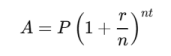
● A — the final balance after interest has been applied.
● P — the principal, or starting amount.
● r — the annual interest rate written as a decimal.
● n — the number of times interest compounds per year.
● t — the total number of years.
A practical example makes the calculation easier to follow. Assume an initial deposit of 5,000 with a 5% annual rate compounded once per year over 10 years. In this case:
● P = 5,000
● r = 0.05
● n = 1
● t = 10
The formula becomes:
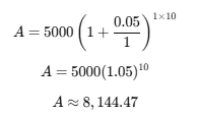
The estimated final balance would be approximately 8,144.47 before taxes, fees, or inflation adjustments. Compounding frequency also changes the result. Interest may compound annually, quarterly, monthly, or daily, depending on the product or account structure. More frequent compounding generally produces a slightly higher final balance because interest is added to the balance more often throughout the year.
|
|
|
|
What Factors Have the Biggest Impact on Compound Growth?
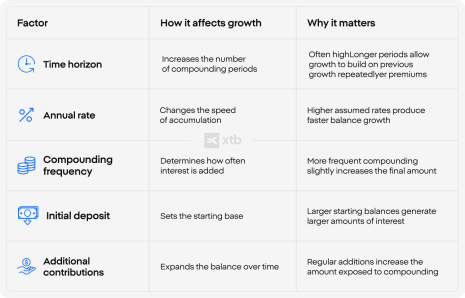
The biggest factors in compound growth are time horizon, annual rate, and compounding frequency. Time is often the most powerful variable because it gives returns more periods to build on previous returns. This is why compounding interest is usually more visible over longer periods than over short ones. The annual rate determines how quickly the balance grows in the calculation. A small difference in the assumed rate may not seem important at first, but over many years it can create a much wider gap between final balances.
This is also why growth projections should be read as estimates, not as guaranteed outcomes. Compounding frequency shows how often interest is added to the balance. Annual, quarterly, monthly, or daily compounding can produce different results, even when the annual rate is the same. This helps explain what compound interest in practice is: growth is not only about the rate itself, but also about how often and how long that rate is applied.
Where Can Compound Interest Work for You?
Compound interest can apply in several financial contexts where interest or returns remain invested instead of being withdrawn. The common feature is that growth continues, building on an expanding balance over time. Depending on the product, this may come from fixed interest payments or from reinvested investment returns.
Savings accounts and bonds are common examples because interest is usually added at regular intervals. Bonds may also involve compounding when interest payments are reinvested rather than taken out. In investment accounts, compounding often occurs through reinvested dividends or returns generated by assets such as ETFs, although investment values can also decline.
The way compound growth works depends on the underlying financial instrument and its level of risk. Savings products may offer more stable interest calculations, while market-based investments involve changing prices and uncertain future returns. For this reason, compound growth can amplify gains over time, but it can also magnify the effect of losses during weaker market periods.
|
|

FAQ
Compound interest allows returns to generate additional returns over time. Instead of earning growth only on the original deposit, future gains are calculated on an expanding balance that already includes previous interest or investment returns. Over long periods, this creates exponential rather than linear growth.
In many long-term scenarios, time has the biggest impact. A higher rate can accelerate growth, but longer periods allow compounding to repeat many more times. This is why starting earlier often matters more than starting with a larger amount later.
Simple interest is calculated only on the original amount invested or deposited. Compound interest continuously recalculates growth on the updated balance, which includes previously earned interest. The gap between the two methods usually becomes much larger over longer time horizons.
No. Compound growth can occur in many financial products where returns remain invested rather than withdrawn. Common examples include savings accounts, bonds with reinvested interest, dividend-paying stocks, ETFs, retirement accounts, and long-term investment portfolios.
Compounding frequency determines how often interest is added to the balance. Annual, quarterly, monthly, or daily compounding can produce different final amounts even when the annual rate is identical. More frequent compounding slightly increases the growth rate because gains are added back into the calculation sooner.
Yes. Compounding amplifies losses as well as gains. During weak market periods, negative returns reduce the balance, which can slow future growth. This is why investment-based compounding always involves risk, and future results are never guaranteed.
Reinvesting allows dividends, interest, or profits to remain inside the growth process instead of being withdrawn. Over long periods, reinvestment can become one of the biggest drivers of portfolio growth because future returns continue building on earlier gains.
No. Compound growth projections are educational estimates based on assumptions such as the starting amount, rate, and time horizon. Real-world results may differ due to changing interest rates, investment performance, inflation, taxes, fees, or market volatility.