The reader wants an answer to how much Jeff Bezos is worth today, paired with enough context to understand where that number comes from. Beyond the figure itself, they are curious about the structure of his wealth, how Amazon turned a garage startup into a $200B+ fortune, and what Bezos does with his money. The article bridges that curiosity toward Amazon as a publicly traded company, converting interest in a billionaire's wealth into awareness of an investable asset.
The reader wants an answer to how much Jeff Bezos is worth today, paired with enough context to understand where that number comes from. Beyond the figure itself, they are curious about the structure of his wealth, how Amazon turned a garage startup into a $200B+ fortune, and what Bezos does with his money. The article bridges that curiosity toward Amazon as a publicly traded company, converting interest in a billionaire's wealth into awareness of an investable asset.


Jeff Bezos net worth is estimated at around $285 billion, according to Bloomberg’s Billionaires Index as of May 12, 2026, making the Amazon founder one of the four richest people in the world. Most of that fortune is not held as cash, but is linked to Amazon shares, alongside private assets such as Blue Origin, The Washington Post, real estate, and other investments. That makes Bezos’ wealth both extraordinary and fluid, because even small changes in Amazon’s share price can move his estimated net worth by billions of dollars.
Key takeaways
- Jeff Bezos’ fortune is still built mainly on Amazon. Bloomberg estimates that he owns about 9% of the company, making Amazon stock the largest single driver of his net worth.
- Bezos’ net worth changes because much of it is equity-based. Bloomberg updates billionaire wealth after the New York market closes, using market prices for publicly traded stakes, so the figure can rise or fall with Amazon’s share price.
- Amazon is only part of the wider Bezos wealth structure. His assets also include Blue Origin, The Washington Post, Bezos Expeditions, real estate, and past Amazon share-sale proceeds, which help explain why his fortune is larger than one company stake alone.
What Does Jeff Bezos Own? Amazon, Blue Origins, Real Estates & Beyond
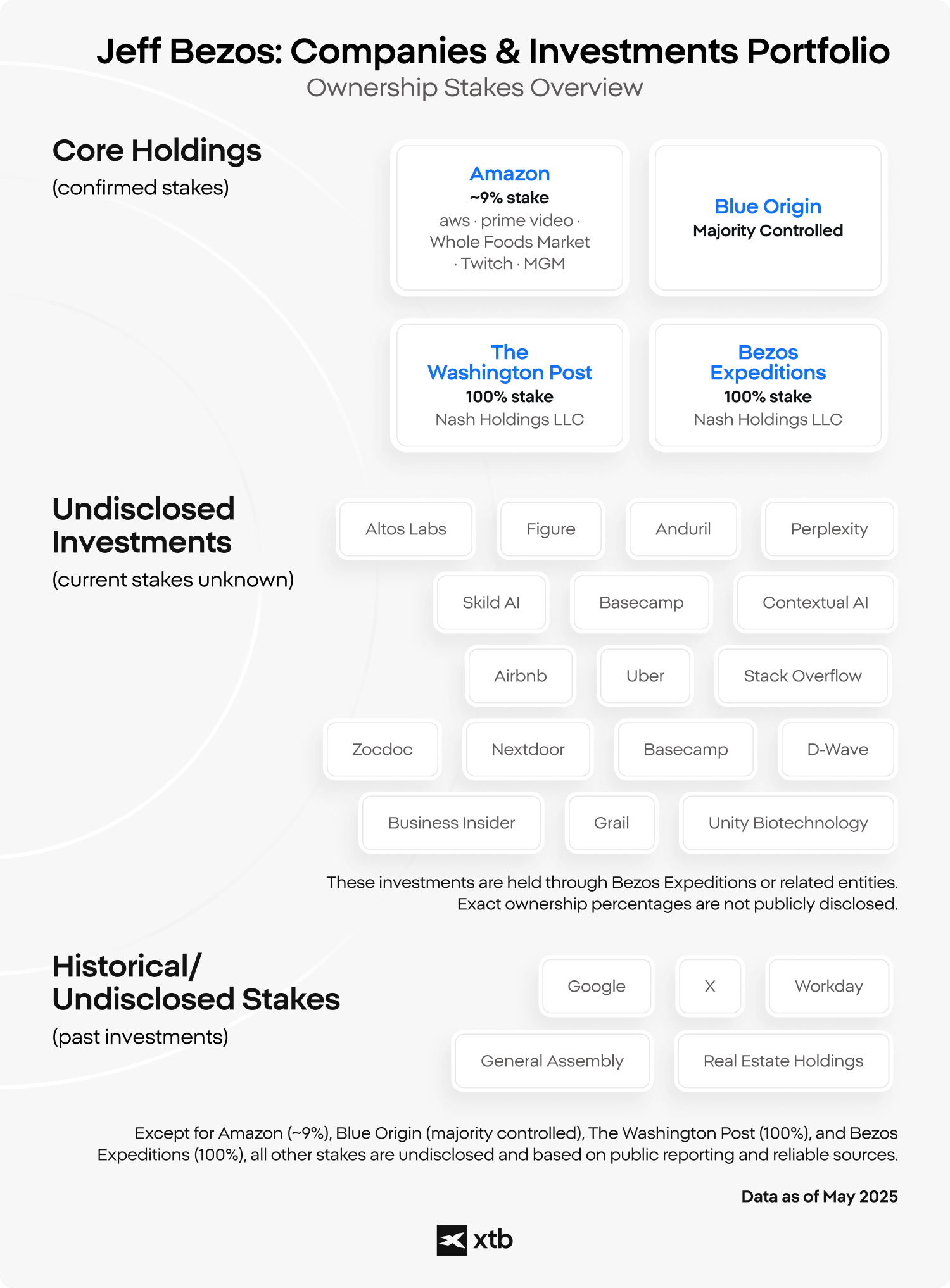
Jeff Bezos’ fortune is built around a mix of public-company ownership, private businesses, media assets, venture investments, and real estate. Although Amazon remains the foundation of his wealth, Bezos also controls assets connected to space exploration, technology investing, and luxury property. This structure helps explain why his net worth extends far beyond the value of a single company stake. The largest part of Bezos’ wealth still comes from Amazon shares. Bloomberg estimates that he owns roughly 9% of the company, making him one of the largest Amazon shareholders despite years of stock sales. So what does Jeff Bezos own? His wealth is tied to several major assets and businesses.
- Amazon shares (9% stake) remain the core of Bezos’ fortune; Amazon also owns or operates businesses such as AWS, Prime Video, Whole Foods, Twitch, and MGM, making it one of the world’s largest corporate ecosystems.
- Blue Origin (majority controlled, private stake) is Bezos’ privately owned aerospace company focused on reusable rockets and long-term space infrastructure - the business has expanded its NASA and defense partnerships while continuing development of the New Glenn rocket system.
- The Washington Post (100% stake) became part of Bezos’ portfolio in 2013 when he purchased the newspaper through a personal acquisition separate from Amazon.
- Bezos Expeditions (100% stake) serves as his private investment vehicle and includes stakes in technology and media companies such as Airbnb, Uber, and Stack Overflow.
But Bezos may also own undisclosed stakes in other businesses such as:
- Altos Labs is a longevity-focused biotech company researching cellular rejuvenation and anti-aging technologies.
- Perplexity AI is an AI-powered search and answer engine competing in the generative AI market.
- Figure AI develops humanoid robots designed for industrial and commercial use cases.
- Skild AI focuses on robotics foundation models and embodied artificial intelligence systems.
- Physical Intelligence develops AI systems that allow robots to interact with the physical world more autonomously.
- Contextual AI builds enterprise-focused generative AI infrastructure and language model solutions.
- Anduril is a defense-tech company specializing in autonomous military and surveillance systems.
- Airbnb is a global online marketplace for short-term rentals and travel accommodation.
- Uber is a ride-hailing and mobility platform operating globally across transport and delivery services.
- Stack Overflow operates one of the world’s largest online communities for software developers.
- Basecamp develops project management and workplace collaboration software.
- D-Wave focuses on quantum computing systems and quantum optimization technology.
- Grail develops blood-based cancer detection and early diagnostic technologies.
- Unity Biotechnology researches therapies targeting aging-related diseases and cellular senescence.
- Zocdoc is a digital healthcare marketplace for booking doctors and medical services online.
- Nextdoor operates a neighborhood-focused social networking platform.
- Business Insider is a digital media company focused on business, technology, and financial news. and historical, undisclosed stakes in:
- Google / Alphabet received one of Bezos’ earliest and most successful pre-IPO technology investments.
- Twitter/X was part of Bezos Expeditions’ technology investment portfolio before Elon Musk’s acquisition.
- Workday develops enterprise cloud software for finance and human resources management.
- General Assembly provides technology and digital skills education programs worldwide.
- Real estate holdings with properties across Florida, New York, Washington, Texas, Hawaii, and California, including several estates that ranked among the most expensive residential purchases in their regions.
“Get Big Fast” & Jeff Bezos Philosophy
Jeff Bezos built Amazon around determination, urgency, and the belief that early market leadership could create a lasting competitive advantage. The company’s “Get Big Fast” mindset, cited in “A view on transformational leadership: The case of Jeff Bezos” by Catalin Gradinaru (2020) encouraged rapid expansion, even when it required intense work and major operational pressure. The Jeff Bezos approach helped Amazon capture territory in the early internet economy.
How Did Jeff Bezos Build His Fortune Through Amazon?
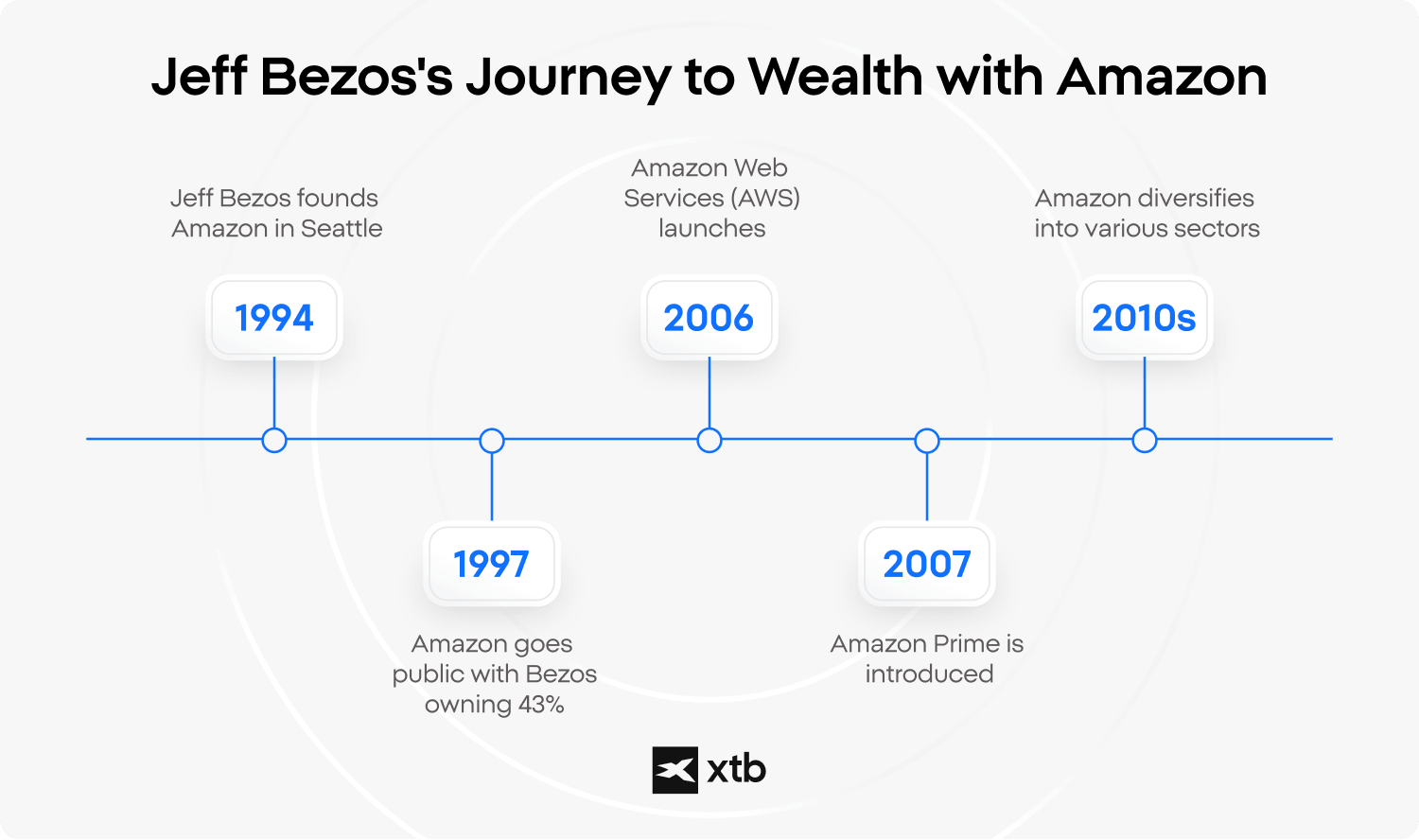
Jeff Bezos built most of his fortune by keeping a large Amazon ownership stake as the company grew from an online bookstore into a global technology business. He founded Amazon in 1994 in Seattle after leaving D.E. Shaw, then took the company public in 1997 while owning roughly 43% of its shares. That founder stake became increasingly valuable as Amazon expanded across e-commerce, logistics, cloud computing, subscriptions, advertising, and digital media.
The main mechanism was long-term equity ownership. Bezos’ wealth did not come mainly from salary, but from the rising market value of Amazon shares. Prime strengthened customer loyalty, while AWS became a major profit engine and changed how investors valued Amazon beyond retail alone. Several factors turned Bezos’ original stake into one of the largest fortunes in modern business.
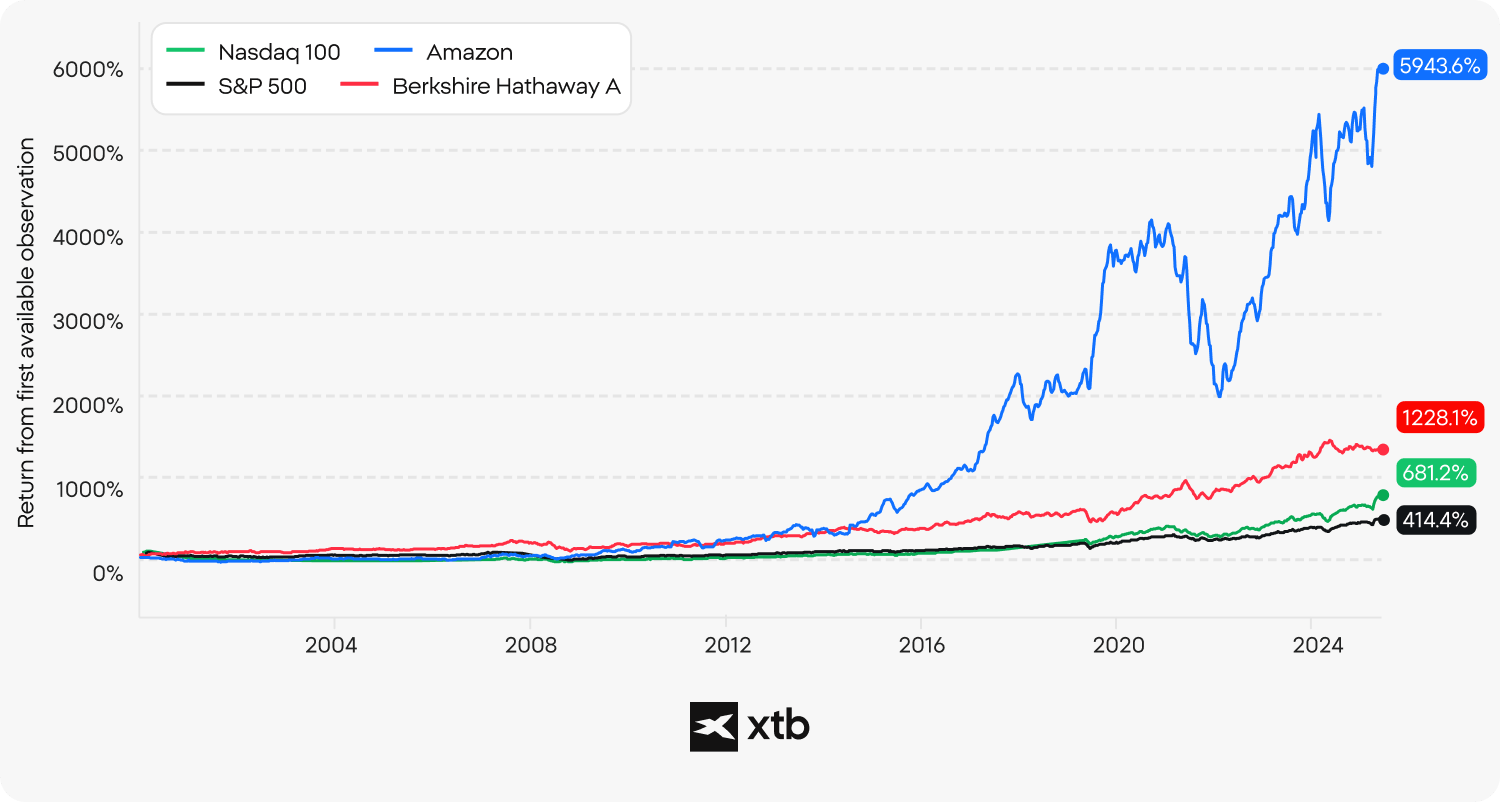
Amazon shares cumulative return at 5943% outperformed Nasdaq 100, S&P 500 and even Buffet’s Berkshire Hathaway by a huge margin from the beginning of 2000 to May 2026 period. Remember that past market performance and historical changes in Amazon’s share price do not constitute reliable indicators of future results.
How Much Does Jeff Bezos Earn Per Day and How Is That Even Calculated?
Jeff Bezos does not “earn per day” in the normal salary sense; most daily estimates measure changes in his net worth, not wages. Amazon’s proxy materials show that Bezos historically received a relatively small fixed salary compared with the size of his fortune, while Bloomberg estimates that he still owns about 9% of Amazon. That means the widely shared figures for “per day,” “per hour,” or “per second” are usually based on movements in Amazon’s share price rather than regular income.
For readers asking how much does Bezos make an hour or how much does Jeff Bezos make a second, the calculation is simple but often misunderstood. If Bezos owns a large Amazon stake and Amazon’s market value rises or falls during a trading day, the estimated value of his holdings changes with it. For example, if a roughly $200 billion fortune increased by 1% over a year, that would equal about $2 billion in paper gains. Spread across a full year, that would translate to approximately:
- $5.5 million per day
- $228,000 per hour
- $3,800 per minute
- $63 per second
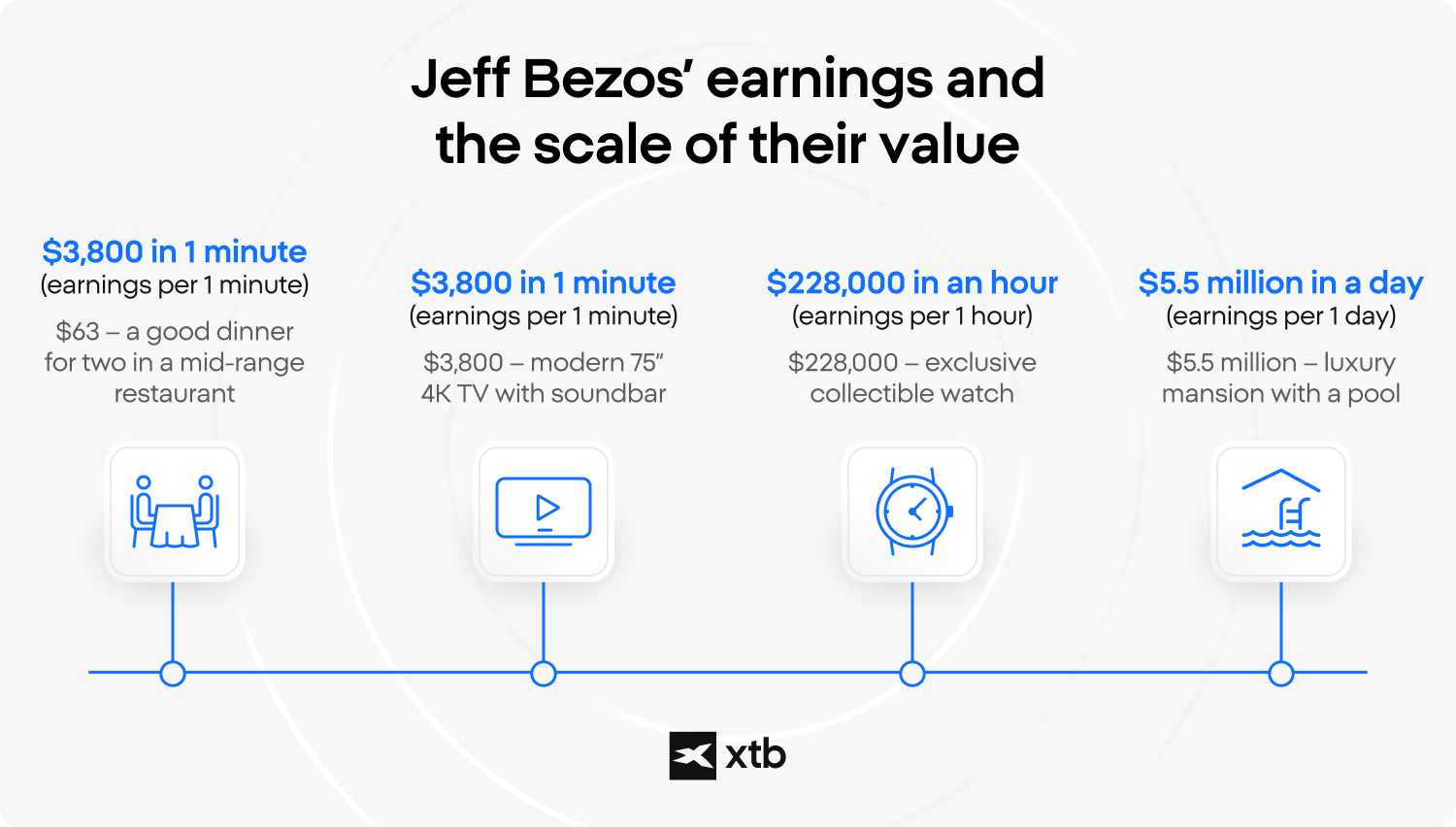
These figures are only illustrative because Amazon’s share price does not move in a straight line and billionaire wealth can fluctuate sharply within short periods. This is why headlines claiming that “Jeff Bezos earns thousands per second” should be treated as simplified estimates rather than guaranteed income. They describe changes in market value tied to Amazon stock ownership, not salary payments or fixed cash earnings.
How Big Is Bezos Annual Income?
Jeff Bezos’ annual income is not fixed and is difficult to measure precisely because most of his wealth is tied to Amazon share sales and other assets rather than traditional salary. However, excluding changes in Amazon’s stock price, his recurring cash income is relatively small compared with his total net worth.
- Amazon salary almost doesn’t exist. Bezos historically received a base salary of about $81,840 per year as Amazon CEO and did not regularly take large stock bonuses. After stepping down as CEO in 2021, he no longer receives CEO compensation in the same way.
- Amazon dividends are paying him approximately $0, because Amazon does not pay dividends.
- Bezos likely earns substantial income from private investments, interest, real estate, and venture holdings through entities such as Bezos Expeditions, but exact figures are not publicly disclosed.
- The largest source of actual liquidity comes from selling Amazon shares. In some years, Bezos has sold billions of dollars’ worth of stock, although these sales represent asset conversion rather than salary income.
So, Bezos may earn billions of dollars annually - when he sells stock. In previous years, he also sold shares regularly to fund Blue Origin and other ventures. Even answering the question much how much money does Jeff Bezos have is hard, because his wealth is related mostly to equities.
How Does Jeff Bezos Spend and Manage His Fortune?
Jeff Bezos manages his fortune by gradually converting part of his Amazon-linked wealth into private businesses, real estate, philanthropy, and long-term assets. Although Amazon remains the foundation of his net worth, Bezos has regularly sold company shares to finance ventures such as Blue Origin and to diversify portions of his wealth beyond public markets.
One of Bezos’ largest private commitments is Blue Origin, the aerospace company he founded in 2000. The business has required billions of dollars in long-term funding, much of which has reportedly come from Amazon share sales. Bezos also controls an extensive real estate portfolio spanning Florida, California, Washington, New York, Texas, and Hawaii, while reports estimate that he owns or controls roughly 420,000 acres of land across the United States.
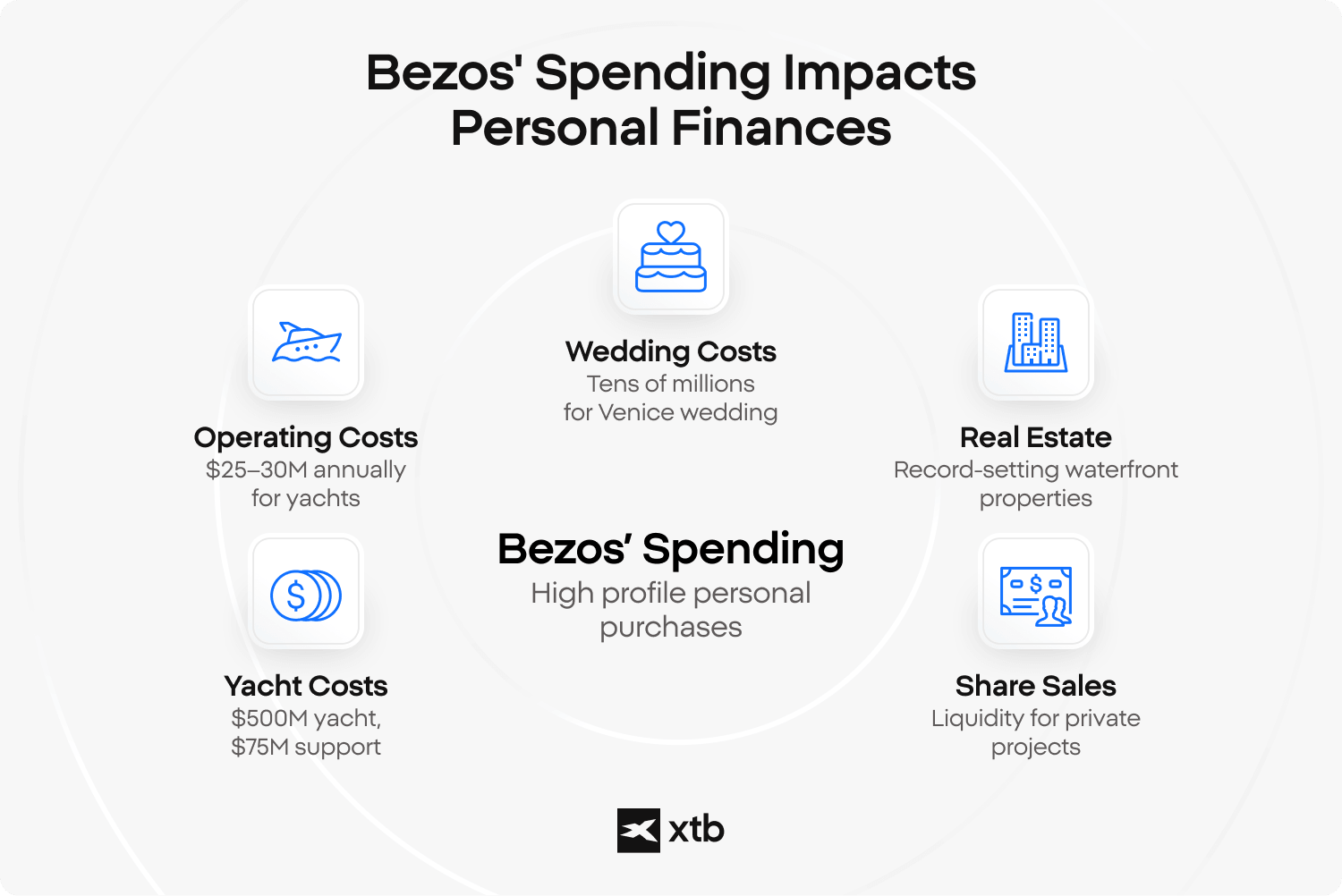
Alongside private investments and property holdings, philanthropy became another major area of capital allocation through the $10 billion Bezos Earth Fund, which focuses on climate and conservation initiatives.Several high-profile purchases also illustrate the scale of Bezos’ personal spending and it shows how rich is Bezos:
- Koru superyacht reportedly cost around $500 million and is accompanied by the support vessel Abeona, estimated at roughly $75 million.
- Annual yacht operating costs for Koru and Abeona together have been estimated at approximately $25–30 million per year.
- Venice wedding celebrations linked to Bezos and Lauren Sánchez were widely reported to cost tens of millions of dollars.
- Luxury real estate acquisitions include record-setting waterfront and Beverly Hills properties purchased over multiple years.
- Amazon share sales continue to provide liquidity for private projects, philanthropy, and asset diversification outside Amazon stock.
Amazon as an Investment: What Investors Should Know
Bezos’ fortune is closely linked to the market value of Amazon shares. The company is no longer only an online retailer: in 2025, Amazon reported $717 billion in revenue across North America, International, and AWS. AWS remains especially important because cloud computing has historically contributed a large share of Amazon’s operating income, while advertising, Prime, logistics, and AI infrastructure increasingly shape how the market values the company.
Amazon is usually discussed around several growth drivers: e-commerce scale, AWS, digital advertising, AI infrastructure, data centers, logistics services, and subscriptions. The risks are equally important. Amazon operates in highly competitive markets, requires high capital expenditure, and its valuation can be sensitive to interest rates, regulation, margins, and investor expectations. In Q1 2026, Amazon highlighted 28% AWS growth and an advertising revenue run rate above $70 billion, while also pointing to continued investment in AI infrastructure.
For readers, the key point is not whether Amazon stock belongs in a portfolio, but how founder’s wealth, company valuation, and public markets are connected. Bezos’ net worth rises and falls largely because Amazon is a publicly traded company whose share price changes daily. Past performance and historical valuation changes do not constitute reliable indicators of future results, and any investment decision should be based on individual objectives, risk tolerance, and independent analysis.
FAQ
Jeff Bezos is the founder of Amazon and one of the world’s richest entrepreneurs. He launched Amazon in 1994 as an online bookstore and later expanded the company into a global technology business operating across e-commerce, cloud computing, streaming, logistics, advertising, and artificial intelligence.
Jeff Bezos’ net worth is estimated at around $285 billion according to Bloomberg’s Billionaires Index as of May 2026. The exact figure changes frequently because most of his wealth is linked to Amazon shares, whose market value fluctuates daily.
Jeff Bezos became rich primarily through Amazon stock ownership. After founding Amazon in 1994 and taking the company public in 1997, he retained a large ownership stake as Amazon expanded into one of the world’s most valuable public companies.
Yes, Jeff Bezos still owns a significant stake in Amazon even after stepping down as CEO in 2021. Bloomberg estimates that he remains the company’s largest individual shareholder with ownership of roughly 8% of Amazon shares.
Jeff Bezos’ portfolio includes Amazon shares, Blue Origin, The Washington Post, Bezos Expeditions, and extensive real estate holdings. Through Bezos Expeditions, he also invested in companies such as Airbnb, Uber, and Stack Overflow.
Jeff Bezos does not earn a fixed daily income in the traditional sense. Most estimates of his “daily earnings” reflect changes in the market value of his Amazon stake rather than salary payments. Because Amazon shares fluctuate constantly, those estimates can rise or fall significantly within short periods.
Jeff Bezos’ net worth changes because it is largely tied to Amazon stock performance. When Amazon’s share price rises or falls, the estimated value of Bezos’ ownership stake changes as well. Billionaire wealth rankings therefore reflect market valuations rather than fixed cash balances.
Blue Origin is Jeff Bezos’ privately owned aerospace company focused on reusable rockets and long-term space infrastructure. Founded in 2000, the company develops launch systems such as New Shepard and New Glenn while working with commercial and government partners.
Jeff Bezos spends and allocates wealth across private businesses, philanthropy, real estate, and personal assets. Public reports link him to projects such as Blue Origin, the Bezos Earth Fund, luxury properties, and the Koru superyacht.
The ranking between Jeff Bezos and Elon Musk changes frequently because both fortunes are heavily tied to publicly traded company shares. Their positions among the world’s richest people can shift depending on movements in Amazon, Tesla, and SpaceX-related valuations.
Yes, Amazon stock performance is the biggest factor influencing Jeff Bezos’ net worth. Because he still owns a large Amazon stake, changes in the company’s market value can increase or reduce estimates of his wealth by billions of dollars.
No, Amazon operates across multiple industries beyond online retail. Its businesses include AWS cloud computing, Prime subscriptions, digital advertising, logistics, streaming services, artificial intelligence infrastructure, and entertainment assets such as MGM Studios and Twitch.