USD/INR

Trade USD/INR CFD

Past performance is not necessarily indicative of future results, and any person acting on this information does so entirely at their own risk.

Fees

Less costs, more investments

Competitive fees

Trade with leverage and keep costs low

Free deposits and withdrawals

Manage funds without costs using selected payment methods

Free account opening

Complete the process in 15 minutes without unnecessary formalities.

Learn

What is CFD trading?

New to CFDs? Learn how CFD trading works and how you can trade on both rising and falling prices without owning the underlying asset. We explain the basics, financial leverage, potential benefits and risks in simple terms.

Read the Beginner’s Guide

Create an account

Open your XTB account in just a few simple steps. Get access to global markets and a wide range of investment opportunities.

Make a deposit

Add funds to your account using one of the available payment methods. Once your funds are available, you’re ready to start investing.

Trade USD/INR

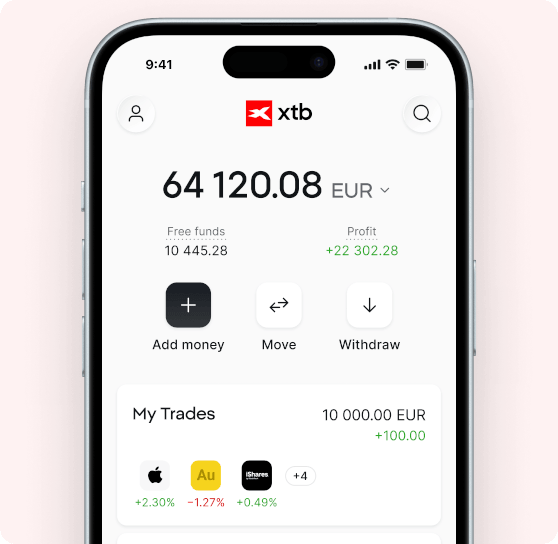
Find USD/INR in XTB App, choose how much you want to invest and place your order. Start building your portfolio on your terms.

And make your money work in many ways

Explore more ways to put your money to work - from global stocks, ETFs and more. Discover Investment Plans while you wait for your next investment opportunity.

Popular in the markets

Most traded CFDs

Discover where CFD traders are most active. Explore some of the most traded CFDs across global markets and see which instruments are in focus.

News

Keep your finger on the pulse with our latest market news

We are regulated by leading financial regulatory authorities across multiple markets worldwide.

About instrument

Trade USD/INR CFD

The USD/INR currency pair reflects the price of the US dollar in Indian rupees – a dance between one of the world’s most influential reserve currencies and one of the largest emerging market currencies. From Wall Street to Mumbai, this pair links two economies moving at very different speeds. 📉📈

In the XTB offer, USD/INR is available as a CFD instrument, allowing traders to speculate on the pair without directly holding any currency. However, trading CFDs carries high risk due to the volatile nature of the forex market.

✅ Key Takeaways

  • ⚙️ USD/INR is a heavily managed pair, influenced by India’s central bank (RBI).
     
  • 🏦 Heavily driven by US interest rates, oil prices, and foreign capital flows into India.
     
  • 💼 The rupee often responds to India’s current account and trade balance.
     
  • 🔁 The pair has a historical upward drift due to India’s inflation differential and dollar strength.
     
  • 🌍 Traded globally, but with most liquidity during Indian and London sessions.
     
  • 🔒 Less volatile than exotic pairs but prone to sharp moves on RBI intervention or geopolitical risks.

🏗 Economies Model

The US economy is consumption-driven and finance-heavy. It's backed by global trust in the dollar and a Federal Reserve that controls liquidity with precision. India, meanwhile, is a rising giant powered by services, IT exports, agriculture, and a massive labor force – but it relies heavily on oil imports and capital inflows to finance growth.

India’s macro framework still carries elements of currency management and capital controls. In contrast, the US runs a free-floating currency regime.

📊 Key Macro & Data Affecting the Pair

🔧 RBI Policy Interventions:
The Reserve Bank of India actively intervenes in the FX market to stabilize the rupee. Any hint of intervention (or lack thereof) can create sharp shifts.

🛢 Oil Prices:
India imports over 80% of its crude. Rising oil prices weaken the rupee due to a wider current account deficit and increased dollar demand.

🏦 US Federal Reserve Decisions:
Rate hikes by the Fed attract capital back to the US and pressure emerging market currencies, including INR.

📉 Indian Trade Balance:
Persistent trade deficits put downward pressure on the rupee and widen the USD/INR gap.

📈 FDI & Portfolio Flows:
India’s ability to attract foreign investment through its capital markets influences rupee strength.

📣 Geopolitical or Credit Risk Events:
India-Pakistan tensions or sovereign credit rating changes can spook markets and trigger rupee sell-offs.

🧭 Trading Characteristics

The USD/INR pair trades at the crossroads of emerging market complexity and developed market liquidity. It's not your average dollar pair—it's a slow burner 🔥. Known for moderate volatility, USD/INR tends to react more to policy decisions and capital flows than to headlines or speculative surges.

🪙 Liquidity is lower compared to G10 pairs, especially outside of Indian trading hours. It's tightly managed by the Reserve Bank of India (RBI), which frequently intervenes to stabilize sharp moves. Traders often find momentum shifts muted—making this a “watchful eye” kind of pair 👁️. Range-trading setups tend to prevail, though breakouts do occur during fiscal events or oil shocks.

Ideal for: Traders seeking exposure to India’s economic path, and who favor structured, macro-based strategies over noise-driven action.

🌐 Major Catalysts & Risks

🛢️ Oil Prices ⛽ – As a major oil importer, India's trade deficit—and by extension, the rupee—can suffer when crude prices rise sharply. Watch Brent and WTI trends closely.

🏦 RBI Intervention 🧊 – The central bank doesn't shy away from stepping in. Surprise moves or heavy forex market activity by the RBI can lead to sudden reversals.

📉 US Rate Policy & Bond Yields 📈 – USD strength often depends on Fed expectations. A hawkish Fed usually pressures INR due to capital outflows.

🌎 Global Risk Sentiment 📉 – As an EM currency, the INR is vulnerable to risk-off sentiment. Geopolitical tensions, sudden USD spikes, or credit tightening globally can trigger rupee weakness.

📊 India’s Fiscal Data 🧾 – Budget deficits, inflation releases, and GDP prints hold high weight in shaping expectations around monetary policy and long-term INR valuation.

🪙 Capital Controls & Regulations ⚖️ – India maintains a semi-managed exchange rate regime. Sudden tweaks in capital rules or FDI flows can cause structural shifts in demand for INR.

🕰 Short History & Major Milestones

  • 1991: India liberalized its economy, shifting from a fixed to a partially convertible rupee.
     
  • 2008–2013: Capital flight during the financial crisis and taper tantrum weakened INR significantly.
     
  • 2020–2022: COVID-19 volatility and Fed hikes pressured INR to record lows vs the dollar.
     
  • Today: USD/INR is actively watched for signs of RBI moves, global capital flow shifts, and oil-linked pressures.


Standard Transaction Spread

0.015

Margin

2.50%

Leverage

40

Commission

-

Market hours

4:30 am - 10:00 pm

Interesting Facts

What to know before investing in USD/INR

💹 RBI’s Shadow: The Indian rupee is one of the most closely managed emerging market currencies, with the Reserve Bank of India quietly stepping into markets to smooth volatility and influence price movements.

🌏 Limited Convertibility: Unlike major currencies such as the USD or EUR, the Indian rupee is not fully convertible, creating unique restrictions and considerations for global traders and institutions operating in INR markets.

💰 India’s IT Shield: India’s booming technology sector acts as a stabilizing force for the rupee, with export revenues creating a steady flow of dollars that can help offset pressure during crises.

📉 Dollar-Rupee Correlation: The rupee’s sensitivity to global risk events makes USD/INR a key sentiment indicator. During crises, capital flows into the dollar can push the pair higher as investors seek safety.

🕐 Trading Hours Matter: USD/INR is most active when Indian markets are open and global liquidity increases through the London session. By the New York hours, price action often becomes quieter with fewer major moves.

🇺🇸 USD Is King Here: India’s heavy reliance on the U.S. dollar for global trade keeps USD at the center of this currency relationship, making USD/INR a key reflection of dollar strength versus the rupee.

FAQ

Do you have more questions?

Find answers to our most commonly asked questions. Still have a question? Please contact our customer support team.

The Reserve Bank of India (RBI) actively manages the rupee to control volatility. It buys or sells dollars to ensure orderly movement. While not publicly disclosed, these interventions are evident in price action, especially around key levels. Traders should watch for sudden spikes or drops, which may signal RBI's quiet presence.


India imports most of its oil, which must be paid for in dollars. When oil prices rise, Indian refiners need more USD, weakening the rupee. The effect can be sudden and significant, especially if global oil markets are tight or there’s a geopolitical event in oil-producing regions.


When the Fed raises rates, capital tends to flow back into the US. This “flight to safety” drains liquidity from emerging markets. Since India depends on foreign portfolio investment (FPI), this flow reversal hits the rupee, especially when paired with trade or fiscal deficits.

Not in the short term. The rupee is still not fully convertible on the capital account, meaning it’s controlled for foreign investment purposes. India would need to liberalize its financial system and improve global confidence in its currency to compete on the global FX stage.


Liquidity and price movement peak during the overlap of India’s market hours with Europe (10:00 to 14:00 IST). The pair sees less volatility during the late US session unless there’s a Fed announcement or oil price shock.


Keep an eye on:

  • RBI meetings and commentary
     
  • US CPI, NFP, and Fed minutes
     
  • Indian inflation and trade data
     
  • Crude oil inventories
     
  • US-India geopolitical or credit headlines

It is best to proceed trading in FOREX with proper education - you can start with the Knowledge base we have prepared for you. Once you have the proper knowledge you should open a demo account to get a feel for the market and practice your trading strategy before investing real money. Remember that you can never have to much knowledge and you should constantly educate yourself during your presence on the financial markets.

There is no recipe for success in the FOREX market. However, there are some aspects that will help you become a better trader. Here are some tips: start with demo account (before risking real money - get a feel for the market and practice your trading strategy), develop a trading plan (it's important to have a clear plan in place before starting trading), use risk management tools (manage your risk when trading, through eg. Stop Loss orders), do not overtrade (it's easy to get caught up in the excitement of trading, but it's important to stick to your plan and not overtrade).

Financial markets are a very complex topic, as they are influenced by various factors, such micro- and macroeconomic events, policies or social changes. You should start your trading experience with proper education about the concepts, assumptions and laws that govern the markets - you can start with the Knowledge base we have prepared for you. Once you have the proper knowledge you should open a demo account to get a feel for the market and practice your trading strategy before investing real money. Remember that you can never have to much knowledge and you should constantly educate yourself during your presence on the financial markets.

Yes, FOREX investing can be risky. The value of currencies can fluctuate significantly due to a variety of factors, including economic conditions, political events and market speculation. It is important for individuals to carefully consider their own financial situation and risk tolerance before investing in FOREX.

When choosing a broker, you should consider a number of aspects related to its activity and offer. These things you should definitely consider: credibility of the invesment firm, cost and fees, instruments offered, investment platform, customer support and additional benefits. If you want to learn more about how to choose your broker visit: investresponsibly.com.

When choosing a FOREX platform there are several factors you should consider: platform ownership (proprietary platform are usually designed in the most intuitive way), availability of DEMO account (where you can test your knowledge practice strategies before risking real money), fees (commissions, spreads etc.), access to educational materials and market news . Before commiting to one platform you should carefully consider all above-mentioned aspects, as they will particulary contribute to the effectiveness of your trading.

The financial instruments we offer, especially CFDs, can be highly risky. Fractional Shares (FS) is an acquired from XTB fiduciary right to fractional parts of stocks and ETFs. FS are not a separate financial instrument. The limited corporate rights are associated with FS.
This page was not created for investors residing in Brazil. This brokerage is not authorized by the Comissão de Valores Mobiliários (CVM) or the Brazilian Central Bank (BCB). The content of this page should not be characterized as an investment offer in Brazil or for investors residing in that country.
Losses can exceed deposits