



15:00 - US ISM and Factory Orders Data (April/May)
ISM Data (May)
-
ISM Non-Manufacturing Prices: 71.3 (Previous: 70.7)
-
ISM Non-Manufacturing PMI: 54.5 (Expected: 53.7; Previous: 53.6)
-
ISM Non-Manufacturing Employment: 47.9 (Previous: 48.0)
-
ISM Non-Manufacturing Business Activity: 57.7 (Previous: 55.9)
-
ISM Non-Manufacturing New Orders: 57.3 (Previous: 53.5)
Factory Orders (April)
-
Factory Orders: 4.8% (Expected: 4.6%; Previous: 1.8%)
-
Factory Orders ex Transportation: 1.3% (Previous: 1.8%)
-
Durable Goods Orders ex Transportation: 1.1% (Previous: 1.1%)
-
Durable Goods Orders ex Defense: 8.1% (Previous: 8.1%)
Market Commentary
The data turned out to be positive for the overall picture of US economic activity, but at the same time unfavorable from the perspective of inflation and expectations for rapid interest rate cuts.
Key Takeaways:
-
Service Sector Acceleration: The most important reading was the ISM Non-Manufacturing PMI at 54.5 points, clearly above expectations of 53.7 points and the previous result of 53.6 points. This indicates that the US service sector is not only remaining in expansionary territory but is likely accelerating.
-
Persistent Inflationary Pressure: On the other hand, the most problematic element is the ISM Non-Manufacturing Prices Index at 71.3 points, up from the previous 70.7 points. This is a very high level and a signal of sustained price pressure in services. For the Federal Reserve, this is crucial, as services inflation is typically stickier than goods inflation.
-
Strong Demand Components: Looking inside the ISM report, demand components look robust. Business activity rose to 57.7 points from 55.9 points, and new orders increased to 57.3 points from 53.5 points. This is significant because it demonstrates that growth in services is driven by real demand, not just rising prices.
-
Weak Spot in Employment: The weak link remains services employment at 47.9 points, slightly below the previous 48.0 points.
-
Solid Factory Orders: Industrial orders data are also solid. Factory orders grew by 4.8% month-on-month, beating expectations of 4.6% and the previous result of 1.8%. Notably, orders excluding transportation grew by only 1.3% compared to the previous 1.8%. While this still represents growth, it is softer once stripped of the most volatile category.
Despite these major surprises, the market reaction remains moderate. EURUSD is trading within a narrow price channel.
Figure: EURUSD (M1)
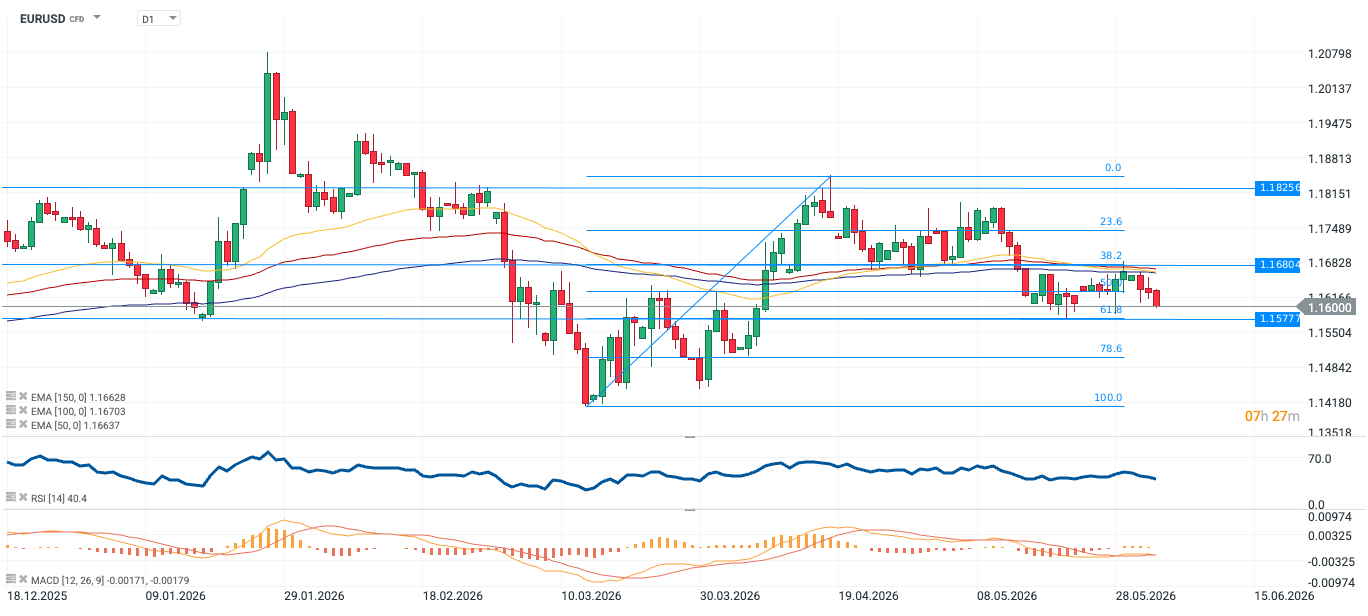 Source: xStation5, 03.06.2026



Three markets to watch next week (23.10.2026)



Daily Summary: Oil at five-month highs, indices under pressure (23.10.2026)

US Open: Further declines on Wall Street, Brent above 111 USD, AI correction continues (14.10.2026)

BREAKING: France slows down, Germany holds on. Euro falls below 1.12