



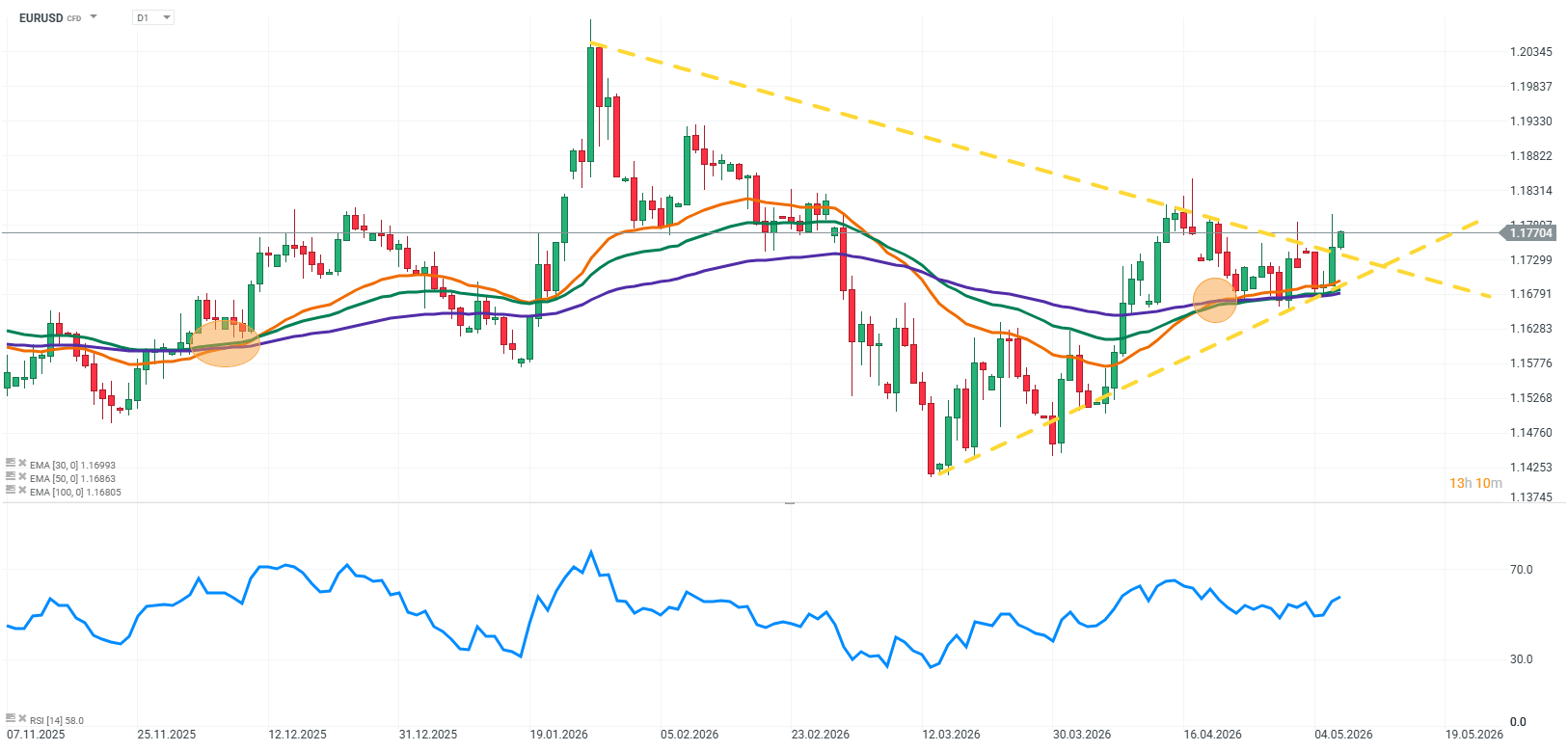
In today’s session, EUR/USD is strengthening around the 1.17 area, but the move is not driven by a single dominant factor. Instead, it reflects a combination of several parallel impulses, including unchanged policy rates from both the Fed and the ECB, improving sentiment linked to potential de-escalation of tensions around Iran, and stronger-than-expected German industrial data. It is important to stress that the current appreciation looks more like a repricing of expectations than a durable shift in underlying fundamentals.
Source: xStation5
What is shaping EUR/USD price action?
Fed on hold, but the market is already pricing rate cuts
The Federal Reserve kept interest rates unchanged, while signalling a gradual slowdown in economic momentum and increasing sensitivity in the labour market. At the same time, inflation in the US is still not fully under control, particularly in services and core inflation, where price pressures remain persistent. Despite this, markets are increasingly pricing in future rate cuts, not as a response to rapidly falling inflation, but rather as a reaction to a potential weakening in economic activity. This scenario reduces the attractiveness of the US dollar and gradually supports EUR/USD through expectations of a narrowing interest rate differential.
The ECB remains cautious, with no automatic path to hikes
The European Central Bank also left rates unchanged, maintaining a cautious and data-dependent communication stance. While some forecasts still allow for further tightening, the dominant view remains one of stabilisation and inflation-driven decisions rather than an aggressive hiking cycle. At the same time, improving real economy data, especially from Germany, is limiting earlier expectations of a deeper slowdown in the euro area, supporting the single currency through the activity channel rather than monetary policy expectations alone.
Geopolitics and hopes for an Iran agreement
Reports of potential de-escalation in tensions surrounding Iran are improving global risk sentiment. A decline in the geopolitical risk premium reduces demand for the US dollar as a traditional safe-haven currency, while benefiting risk-sensitive assets such as the euro. In addition, a potential easing of tensions in the Middle East lowers pressure on energy prices, which in the medium term could reduce inflationary pressures and strengthen expectations of a more accommodative Fed stance.
Germany surprises to the upside, lifting European sentiment
Stronger-than-expected German industrial data is an important element of today’s market picture. Against the backdrop of earlier concerns about stagnation in Europe, this release is helping stabilise perceptions of the euro area. As a result, the euro is increasingly seen not only through the lens of cyclical weakness, but also as a relatively stable alternative to the US dollar, particularly in an environment of shifting monetary policy expectations.
What else is influencing the market in the background
Beyond central bank decisions and macroeconomic data, the key driver remains the pace of change in market expectations regarding future Fed and ECB policy. The market is currently in a repricing phase rather than a full economic cycle shift. This makes EUR/USD particularly sensitive to incoming data and central bank communication that could either confirm or challenge the scenario of faster US easing combined with relatively stable policy in Europe. In such an environment, even moderately positive European data can support the euro in the short term, but the sustainability of the trend will ultimately depend on whether the Fed actually moves towards more decisive monetary easing.


Oil gains as U.S. crude inventories fall


U.S. indices attempt to rebound after recent losses


Hot inflation data from the US🔥📈 PPI and retail sales are rising!


Nickel market panic 🚩 INSG revises forecast, surplus in 2027?