



Brent crude (OIL) started today’s session with gains above $110 per barrel, but downside pressure has since re-emerged - partly driven by ongoing Iran–US negotiations following Trump’s ultimatum. At the same time, Citrini released an OSINT-based analysis built on observations collected directly from the Strait of Hormuz. According to the report, the fund deployed a local source to monitor tanker traffic in the strait in order to verify whether real-world flows align with the datasets used by global funds, algorithms, and analysts to estimate oil supply disruptions and other key variables.
What does the Citrini report suggest?
- According to Citrini, most hedge funds, macro desks, and media commentators assess Hormuz-related risk using AIS data, i.e. transponder signals broadcast by vessels.
- The fund claims its analyst signed a declaration at an Omani checkpoint stating no data would be collected, and subsequently smuggled in equipment including a gimbal, microphone kit, and a 150x zoom Leica camera despite inspection.
- Citrini argues that AIS-based datasets may not reflect the full picture. Their findings suggest that as much as 50% of actual vessel traffic through the strait may be missing from standard tracking systems on any given day.
- Some vessels are reportedly disabling transponders, spoofing destinations, or inputting misleading identification data to reduce traceability and mitigate targeting risk. The report also references the presence of an Iranian “shadow fleet” operating with transponders switched off.
- According to these claims, more than 29 fully loaded tankers have been transporting crude in this manner, with an estimated $3 billion worth of oil shipped to Malaysia since the conflict began.
- That said, the reliability of these findings remains difficult to independently verify at this stage.
- If accurate, the implications are material: the market may be mispricing the scale of supply disruptions in the Strait of Hormuz. Oil market models, supply forecasts, and broader macro analysis could be based on systematically incomplete data.
- The core thesis is that market participants may be conflating AIS visibility with actual physical flows. In an environment where signals are deliberately obscured, dashboard-based analysis may lag real conditions on the ground.
- Citrini concludes that the gap between AIS-reported traffic and actual tanker movement may currently represent one of the most underappreciated variables in the global energy market.
OIL chart (D1 timeframe)
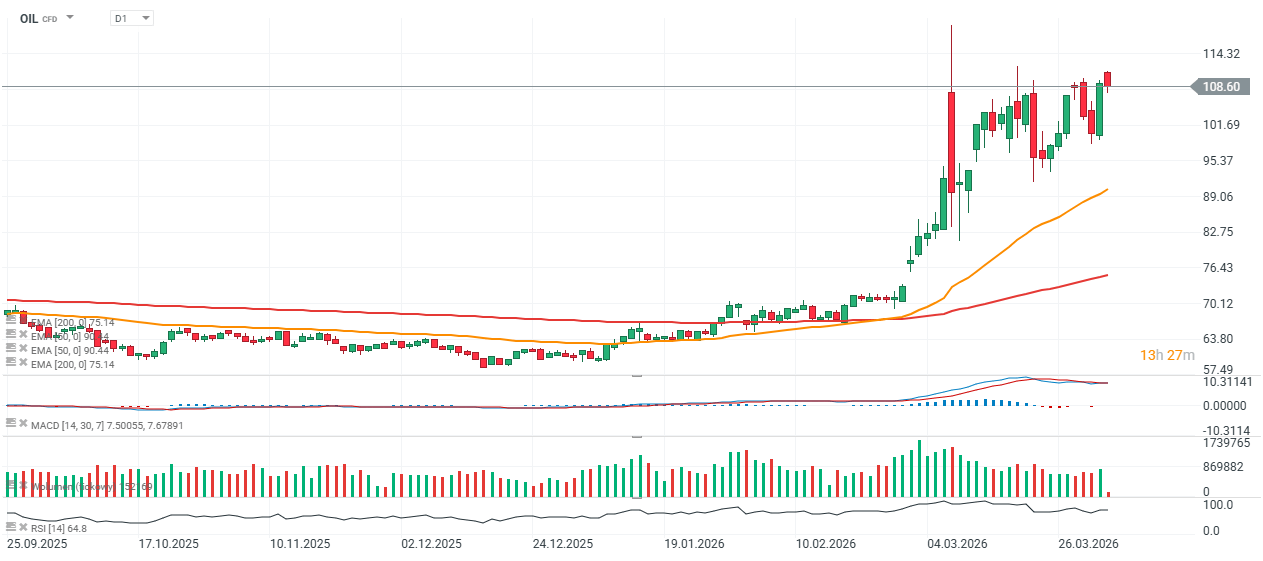
Source: xStation5



Daily Summary: Oil at five-month highs, indices under pressure (23.10.2026)


US Open: Further declines on Wall Street, Brent above 111 USD, AI correction continues (14.10.2026)


Chart of the Day: Is USDJPY running out of road? Inflation forces the BoJ to act, but the Fed could spoil the Yen’s rally



Macro Calendar: Preliminary PMI Readings and Earnings Ahead