

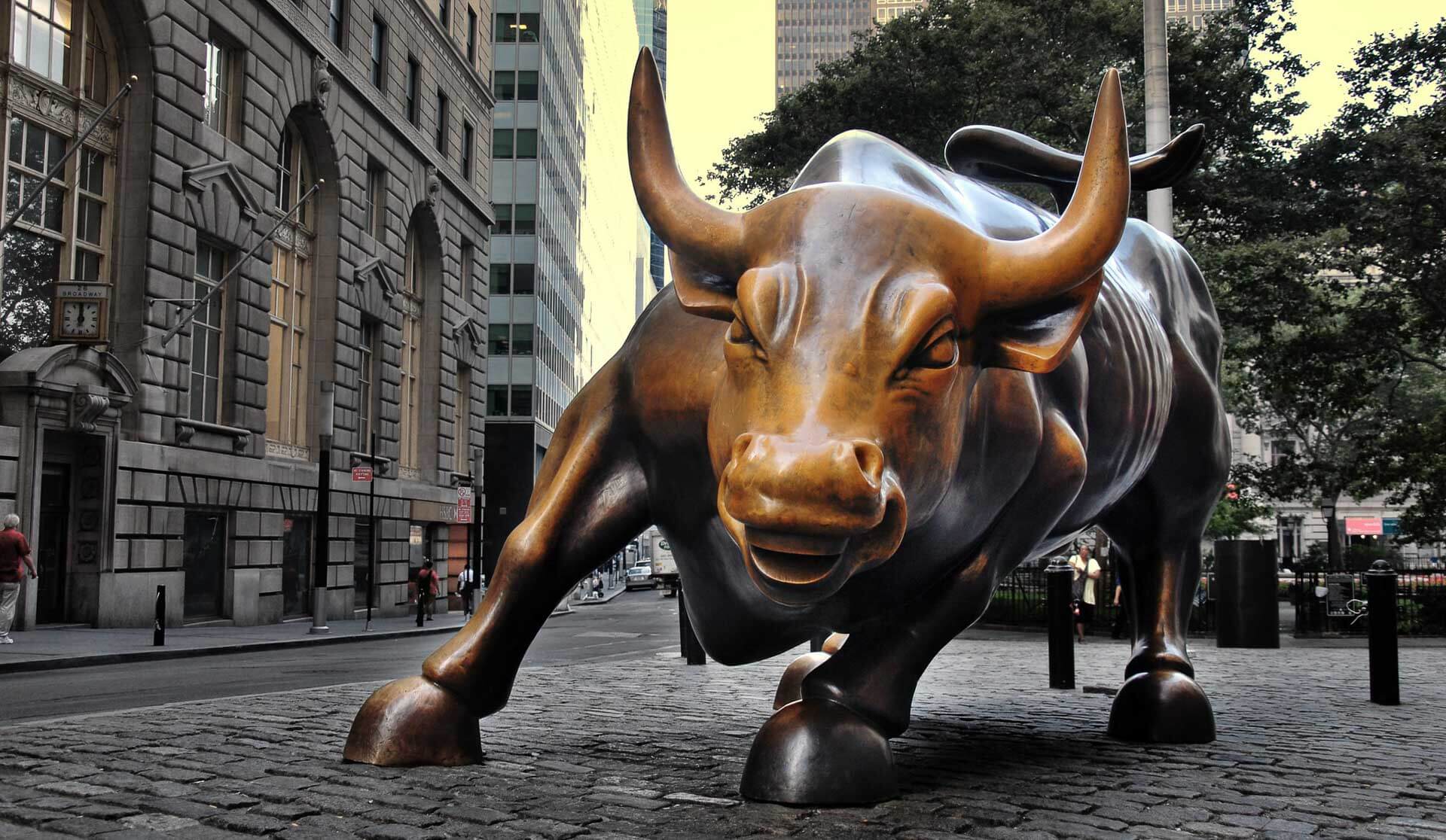

The Nasdaq 100 is rising by over 3% today, recording one of the strongest gains this year. This is supported by both lower oil prices, following statements from Scott Bessent, and excellent results from companies – including Palantir, whose shares are up by nearly 30% today.
Equities
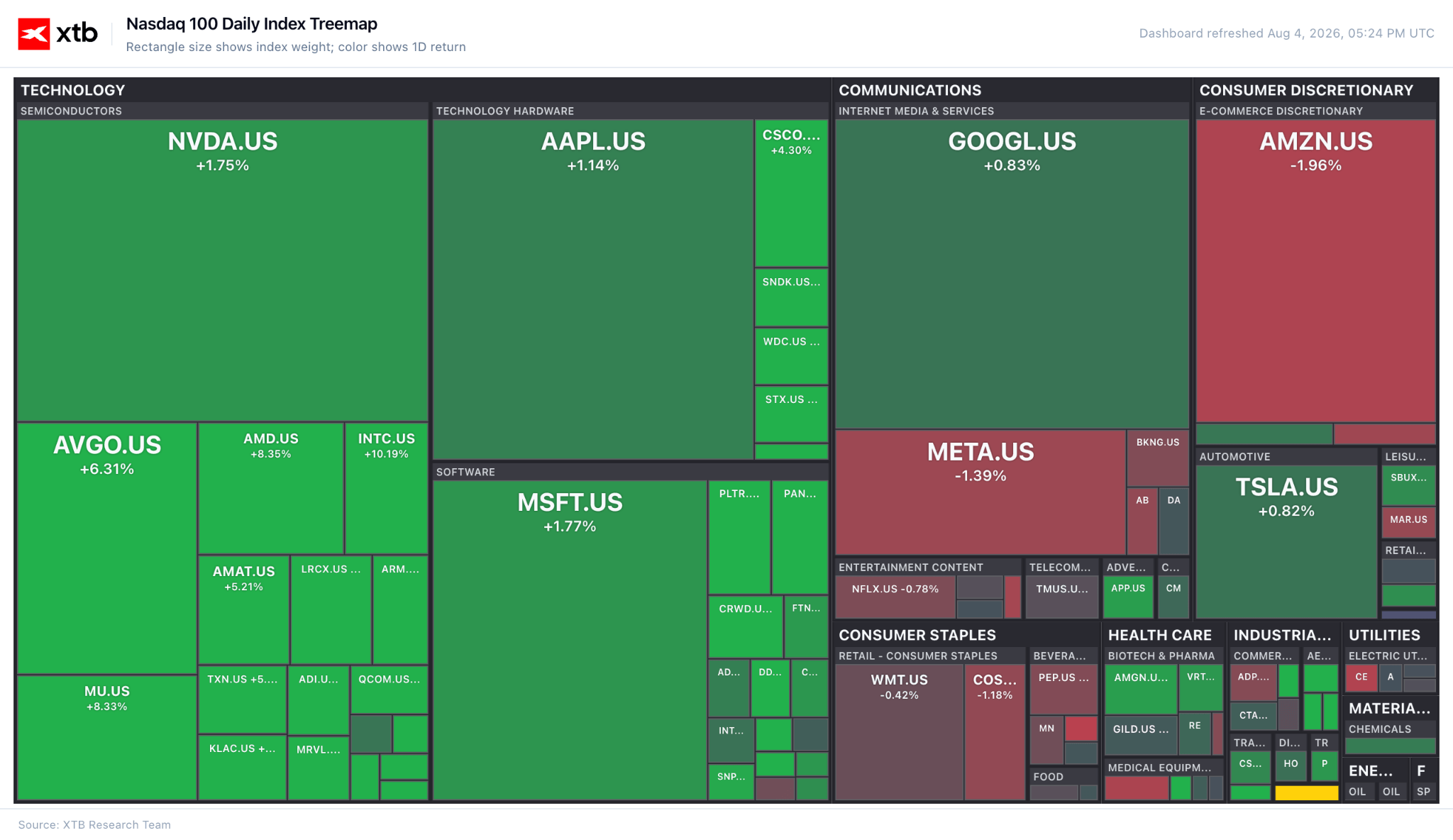
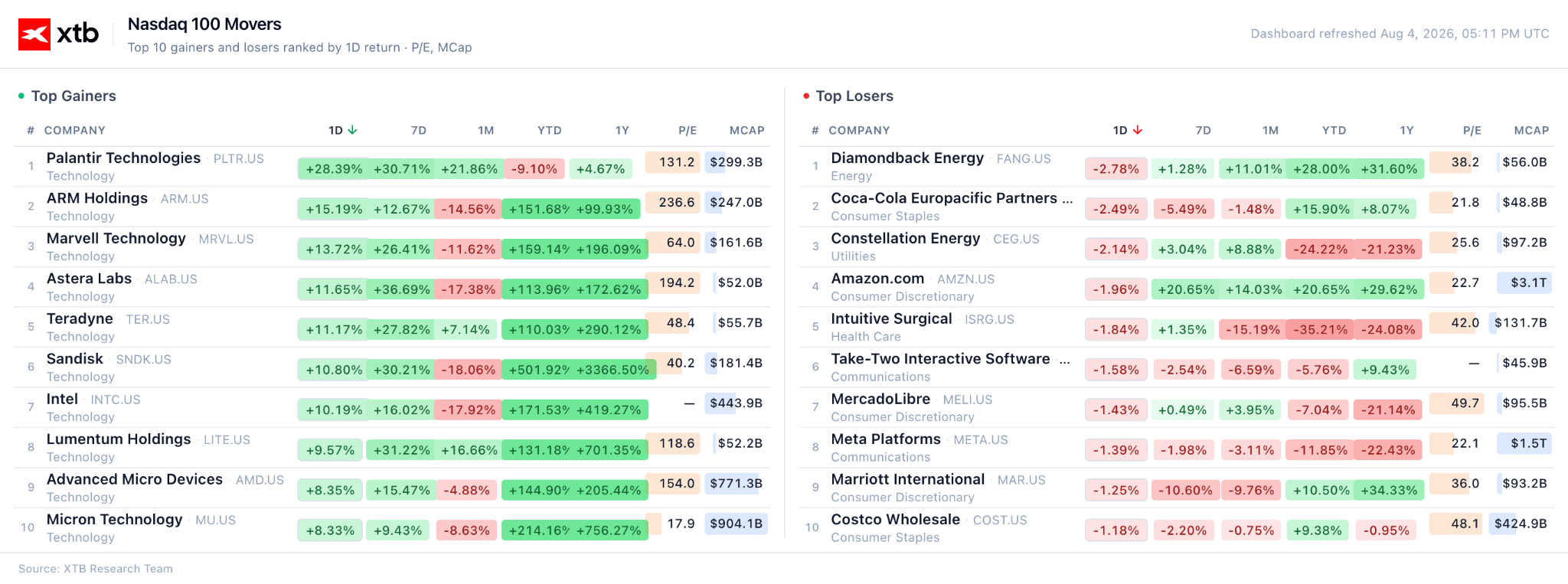
Aside from Palantir, the top performers are from the semiconductor sector, which suffered a very deep correction in July. ARM shares are up by 15%, Marvell by 14%, Astera Labs by 12%, Sandisk by 11%, and Intel by 10%. AMD is also performing well (+8%), awaiting the publication of quarterly results, which will take place today after the US market closes.
Figure 1: Heatmap for the Nasdaq 100 (04.08.2026)
 Source: XTB Research, 04.08.2026
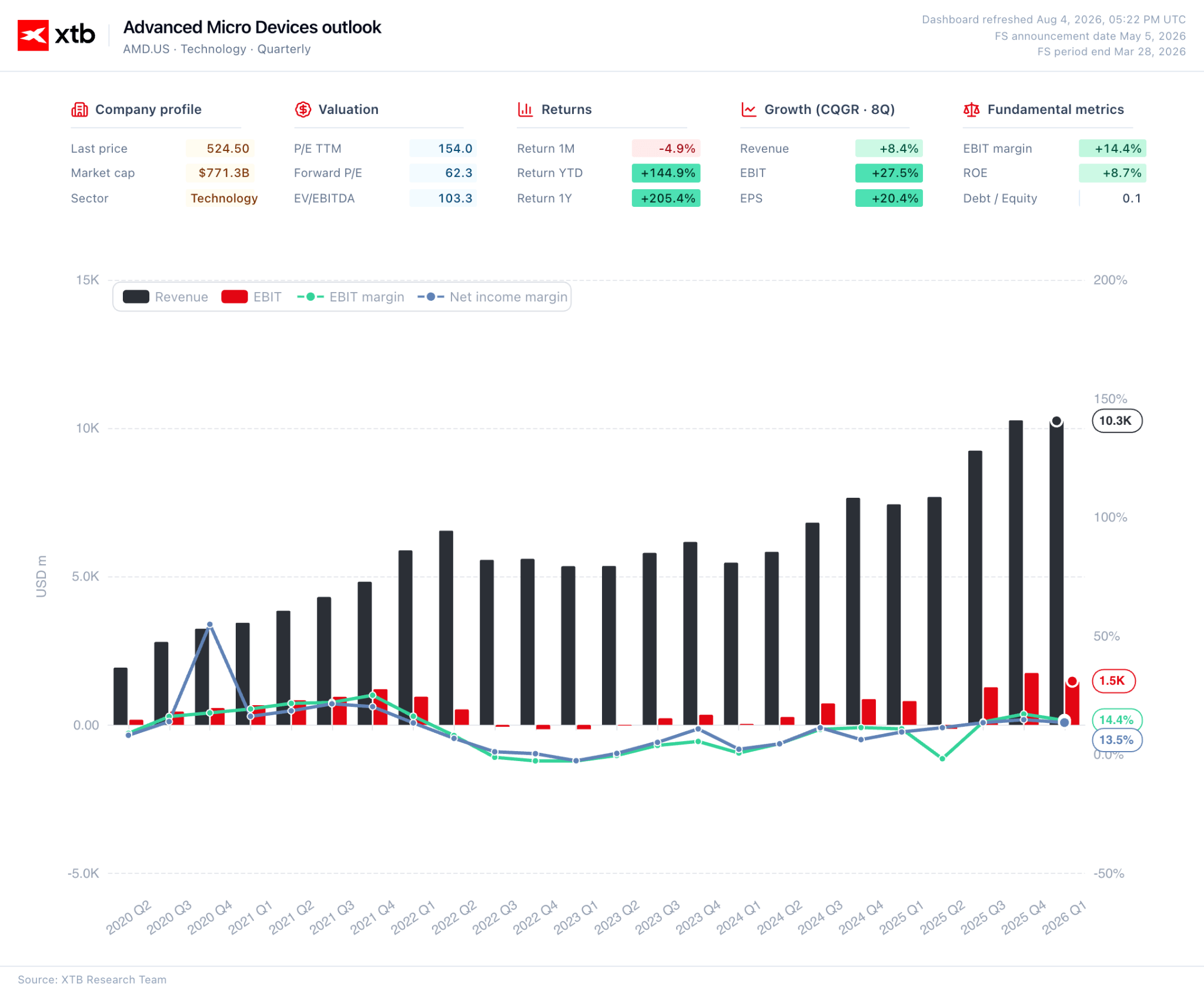
The market has already largely priced in future profits from the AI revolution to justify current valuations; therefore, the producer cannot simply meet analysts' expectations, but must clearly exceed them and present very optimistic forecasts for the coming months. Investors will pay attention primarily to the results of the rapidly growing Data Center segment and the profitability and development of new solutions for artificial intelligence. Any disappointment with growth dynamics or more cautious management estimates could lead to profit-taking, weighing on sentiment across the entire sector.
Figure 2: Dashboard for AMD
 Source: XTB Research, 04.08.2026
In recent days, AMD, like other companies in the semiconductor sector, has received support from hyperscalers whose quarterly reports showed unceasing capital expenditure. In the case of Alphabet, CAPEX is expected to reach 200 billion dollars in 2026. Decreasing concerns about dynamic monetary policy tightening by the Fed after the last FOMC meeting were also favourable.
Figure 3: Winners and Losers on the Nasdaq 100 (04.08.2026)
 Source: XTB Research, 04.08.2026
All of the above-mentioned companies are, however, deep below their June peaks. On a monthly basis, losses for Sandisk or Intel oscillate around 18%.
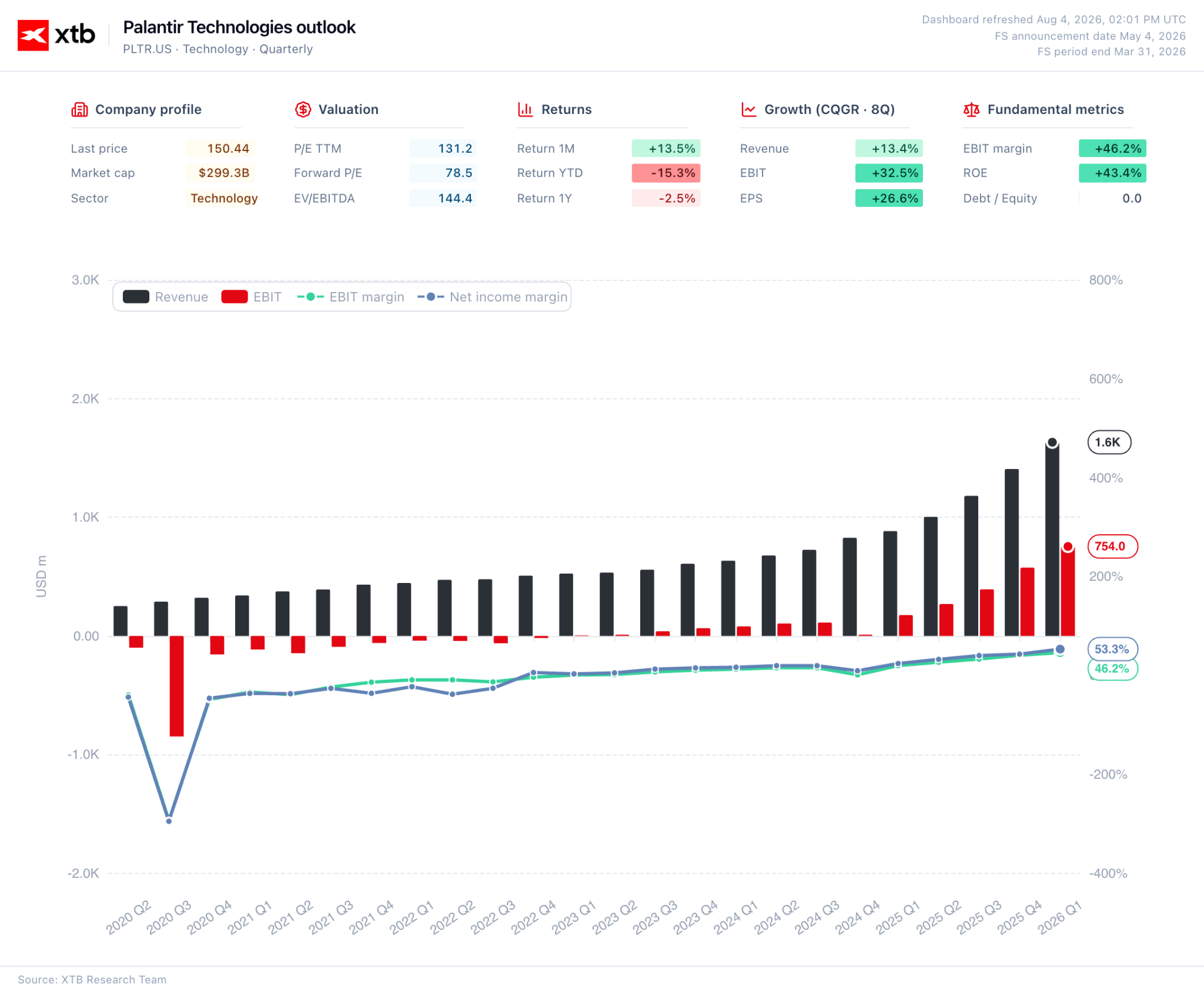
Returning to the topic of Palantir, which is driving today's broad index gains (and also remains significantly below recent peaks):
- Sentiment before the report's publication was not the best – there were concerns about, among other things, the sale of shares by Alex Karp or Peter Thiel (although it is worth noting that this is a regular occurrence in Palantir's case).
- The results published by the company turned out to be far better than expectations, showing revenue growth to 1.94 billion dollars (a 94% year-on-year increase) and EPS at 0.41 dollars (an improvement of 256% relative to Q2 2025).
- Palantir's products are no longer just a narrow niche for government contracts, but a powerful business tool for the private sector.
- The company's development dynamics remain extremely impressive. In Q3, the company expects revenue growth at a level of 2.16 billion dollars.
Figure 4: Dashboard for Palantir
 Source: XTB Research, 04.08.2026
Upcoming publications include those from SpaceX and AMD. Both will be released after the US market closes. The former will be the first serious test for the company, which debuted on the US market in June.
On the European market, the main indices also ended in the green.
- The Polish WIG20 gained 1.4%.
- The Italian MIB FTSE ended the day 1.3% up.
- The pan-European Euro Stoxx 50 strengthened by 0.9%.
- The German DAX ended the day 0.8% higher.
Commodities
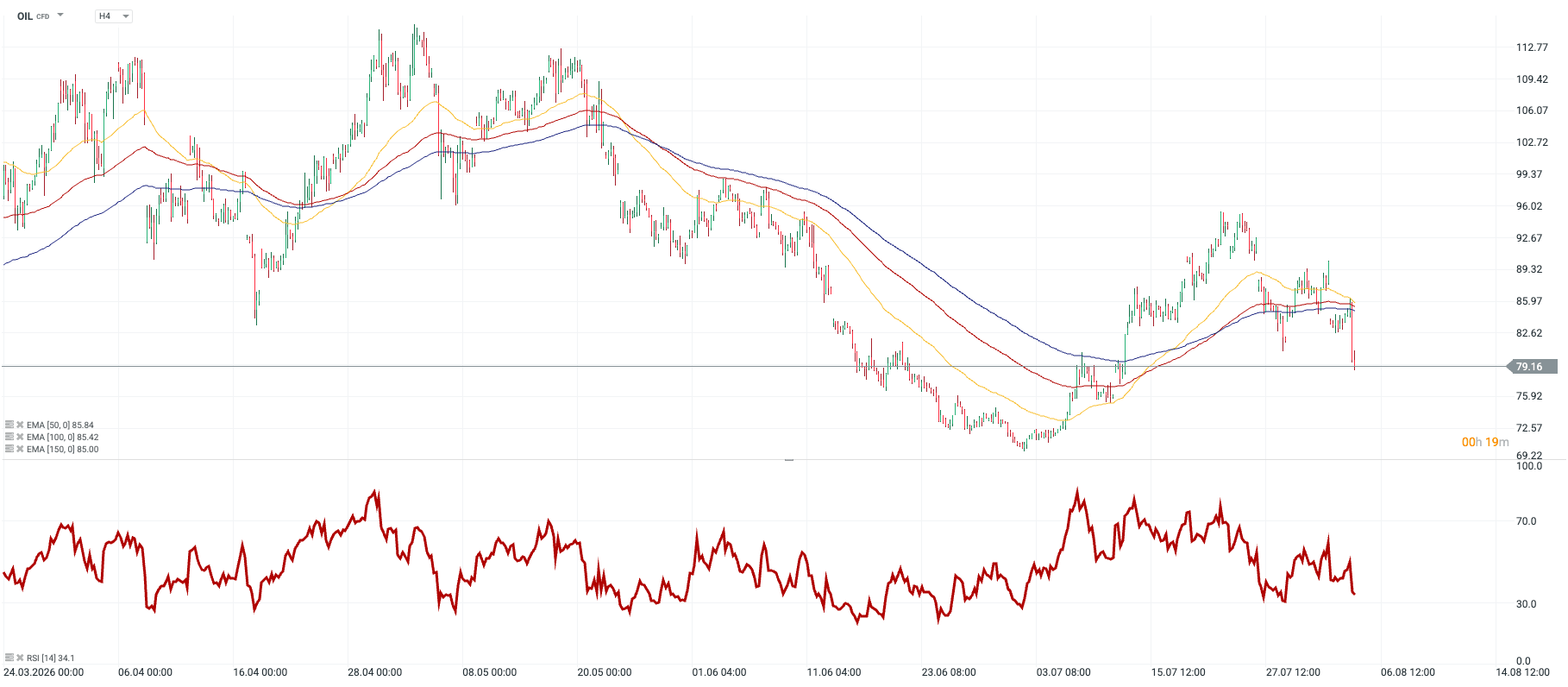
One of the main topics in the markets today was the fall in energy prices after Scott Bessent, the US Treasury Secretary, announced on CNBC that an agreement regarding the opening of the Strait of Hormuz could be reached today or tomorrow:
- "There is a chance that we will be able to reach an agreement on opening the strait either today or tomorrow and take steps towards greater normalisation of the situation in this conflict."
- "It is not just about energy. It is about fertilisers, refined products and various industrial gases."
- "As these prices fall, we could see a significant increase in demand resulting from price relief."
Figure 5: OIL [H4] (24.03.2026 - 04.08.2026)
 Source: xStation, 04.08.2026
We currently have to pay less than 80 dollars for a barrel of Brent, which is over 20% less than it was less than two weeks ago. We see a slightly smaller decline in LNG – MWh TTF currently costs a little over 54 dollars (14% down relative to the local peak from 24 July).
Precious metals are rising, which can be linked to, among other things, the decline in 10-year bond yields in major economies.
- We will currently pay less than 4,100 dollars for a troy ounce of gold (+1%), and 60 dollars for silver (+3%).
- Copper prices are also rising (+0.7%).
Macroeconomic data
Data publications were scarce today. Attention was focused on the US labour market, which will dominate the macroeconomic calendar until the end of the week.
- The JOLTS report for June published today brought a slight decline in the number of job openings in the US to a level of approx. 7.36 million, slightly missing the market consensus (7.45 million). The rate of layoffs and voluntary departures, however, remained at very stable levels.
- Ahead of us is the publication of the ADP report (Wednesday), weekly unemployment claims (Thursday), and the NFP report (Friday). The latter, in particular, will be the centre of attention – it may help determine the further path for the Fed and the dollar.
Currencies
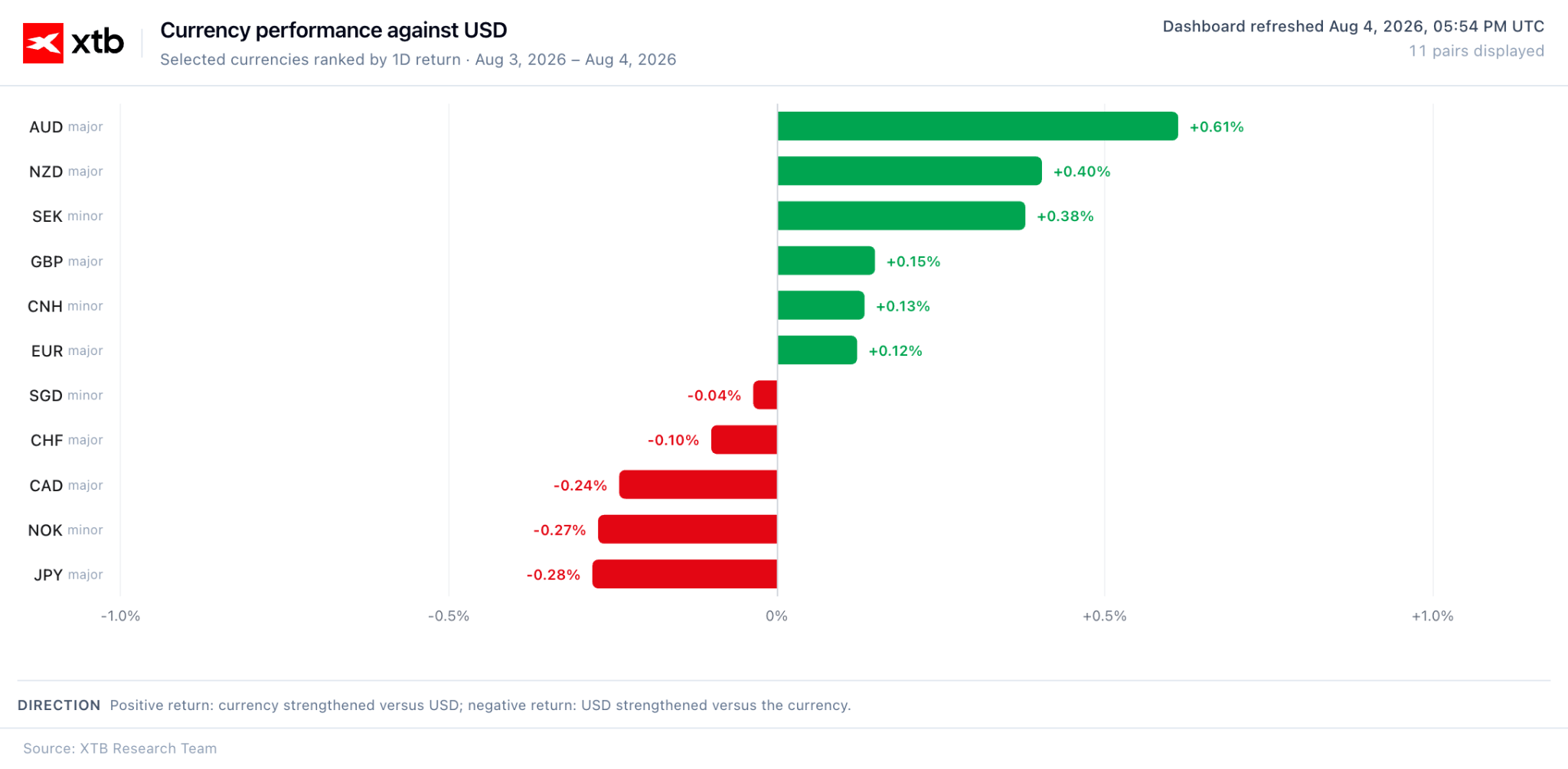
The dollar remains under pressure. This is not helped by the decline in energy prices (the US is a net exporter in this regard) and the improvement in risk sentiment. The EURUSD exchange rate is oscillating around the 1.152 level.
Figure 6: Selected Currency Quotes (04.08.2026)
 Source: XTB Research, 04.08.2026
Lower oil prices are weighing on the Norwegian krone and the Canadian dollar, currencies of countries highly dependent on its export. The Japanese yen is also weakening – the USDJPY exchange rate is returning to an upward trend after the recent joint intervention by the US and Japan.
According to data provided by the Bank of Japan, the scale of intervention on the Japanese side could have reached as much as 59 billion dollars, which would be an unprecedented action (looking at the scale of a 1-day intervention).
Although we cannot estimate the scale of US actions using official data, there are many indications that it reached 5-10 billion dollars. That is suggested at least by a note left by Scott Bessent during a meeting in Maryland.
Due to the cooperation from the US side in the recent intervention aimed at strengthening the yen, the issue of broader White House policy is returning to the table. A return to actions aimed at weakening the US currency, which would be intended to support domestic exports, does not seem impossible. At the beginning of 2025, such actions were termed the "Mar-a-Lago Accord", meaning a modern attempt to repeat the assumptions of the Plaza Accord of 1985.
—
Michał Jóźwiak, Financial Markets Analyst at XTB



Market Wrap: A 4% surge in oil prices weighs on indices (08.10.2026)


Market Wrap: Oil rises again, French fiscal concerns weigh on euro (07.10.2026)


Marvell: Memory-market problems and opportunities

Oil falls below $100🚨