


UK FTSE100 index hit historic high yesterday, driven by mining and metals sectors and aerospace & defense. London stocks are slightly lower today, with the FTSE 100 expected to give back a small portion of its strong year-to-date run after hitting fresh records on Tuesday 30 December. The rally in 2025 has been powerful. The FTSE 100 is up roughly 22% year-to-date, following a more modest appx. 5% gain in 2024.
-
Precious metal miners have been standout winners, led by Fresnillo, which is up roughly five-fold this year on the back of surging commodity prices. Fresnillo also hit a record high on Tuesday, underscoring how dominant the metals theme has been.
-
Aerospace and defence stocks have enjoyed a strong year, with Babcock and Rolls-Royce roughly doubling and BAE Systems up around 50%. The sector remains supported by broader geopolitical trends and rising defence spending.
-
UK banks have also contributed significantly to performance: LLoyds and Barclays gained almost 80% while Standard Chartered and HSBC gained 85% and 50% respectively
Will FTSE100 outperform UK mid and small stocks?
-
2026 is increasingly looking like another year where the FTSE 100 beats the FTSE 250. The large-cap index has the wind at its back, while UK-focused mid-caps face a tougher domestic backdrop.
-
The performance gap is already massive. Over the last five years, the FTSE 100 is up roughly 50%, around five times more than the FTSE 250.
-
The “UK reopening” story that helped the FTSE 250 in 2021 is gone, back then, the domestically-driven index benefited from post-lockdown momentum — but heading into 2026, there’s no similar feel-good catalyst.
-
Both indices show similar earnings growth expectations (~9%), but the risk profile isn’t equal, the FTSE 250 looks more exposed to earnings downgrades given signs of weakness in the UK economy.
-
UK consumer data is a warning signal; Barclays data suggests UK households are entering 2026 on a weaker footing, which doesn’t bode well for the more domestic FTSE 250.
-
The FTSE 100’s structure is simply more attractive right now; it leans more international and defensive (with sectors like health care), which tends to hold up better when economic momentum softens.
-
Even for mid-cap exposure, the FTSE 250 doesn’t stack up well versus Europe, the index lags European peers in expected earnings growth next year.
-
Bloomberg Intelligence expects FTSE 100 earnings momentum to stay stronger than the Stoxx 600, which strenghthens the case for large-cap UK exposure vs broader Europe.
-
Mining exposure is a major wildcard advantage for the FTSE 100, and if metals keep rallying, FTSE 100 names may benefit disproportionately. Fresnillo has already surged ~450% year-to-date, underlining how powerful this theme can be.
-
Rising global defense spending continues to favor names like BAE Systems and Rolls-Royce, adding structural support to the FTSE 100.
-
Limited room for BOE cuts is a tailwind for FTSE 100 banks. That setup tends to favor bank-heavy exposure, while it works against the FTSE 250’s heavier weighting in interest-rate-sensitive real estate.
UK100 (D1 interval)
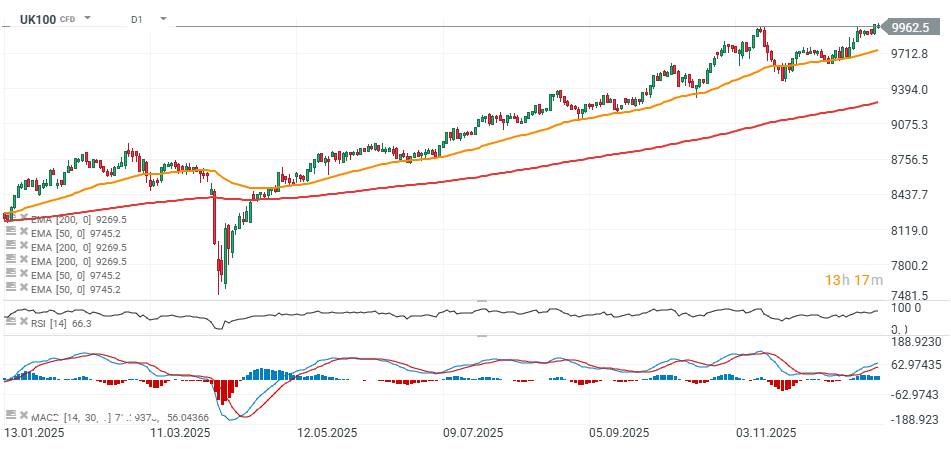
Source: xStation5



Daily Summary: New Records on Wall Street. Markets Await the New Earnings Season

S&P 500 Hits New Record High



US Open: Wall Street Pushes Back Expectations of Another Fed Hike

US trade deficit larger than expected 🗽 US indices hit all-time high