


Current situation:
- The situational context, the nature of the assets involved, Iran’s own response, and a series of events both before and during the strike on Iran support the thesis that the primary objective of the U.S. and Israeli operation is regime change in Iran.
- Iran’s religious fundamentalist government will never abandon its ambition to acquire nuclear weapons, an objective it has been steadily approaching in recent years despite recurring attacks on its infrastructure.
- In light of Iran’s deepening economic and financial collapse—further reinforced by another wave of protests, the United States has undertaken an attempt to eliminate the Islamic Republic of Iran as a state entity.
- Preparations for the campaign, including the deployment of, among other things, carrier strike groups and hundreds of combat aircraft (including specialized platforms), as well as the volume of munitions stockpiles transported between December and February, suggest that the intended duration of the operation is approximately 4–12 weeks.
- Iran’s stockpiles of ballistic missiles are limited, amounting to roughly several hundred units. The regime is not able to sustain the current scale of strikes, but it can slowly and steadily replenish part of these capabilities even after existing stocks are exhausted. Many facilities producing air-attack assets are underground or concealed. In 2025, Russia and China delivered thousands of tons of chemical prefabricates used for fuel and explosives production, and may continue to do so on a limited scale, including via the Caspian Sea route.
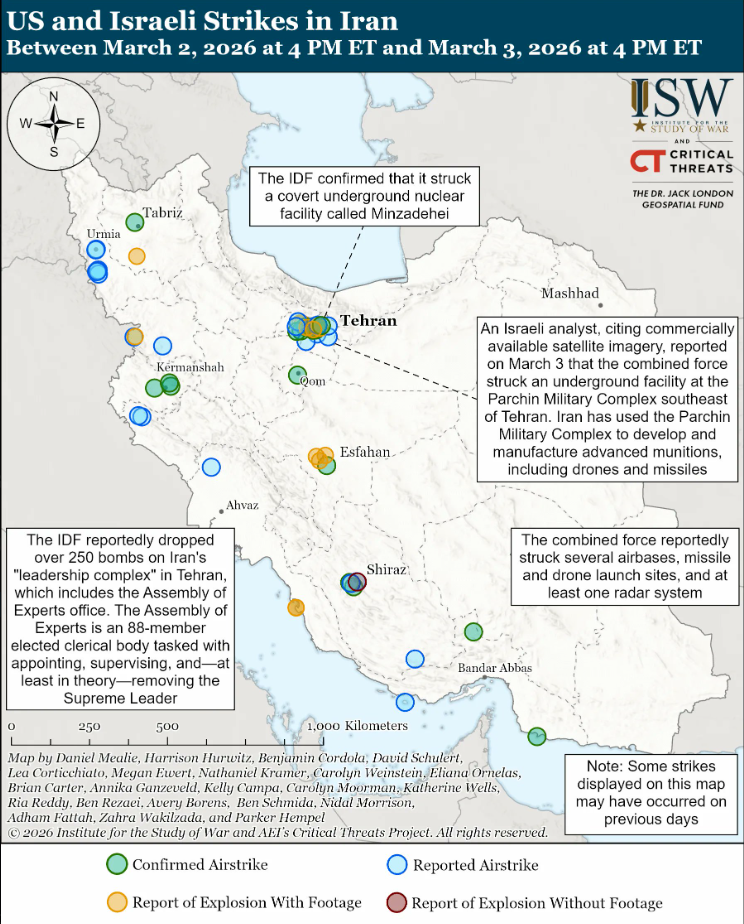
- Iran’s ability to conduct retaliatory ballistic missile strikes appears to be degrading faster than even optimistic U.S.-leaning estimates assumed. Iran’s ballistic missile strike capability should fall close to zero within 14 days from the start of the operation; however, given the nature of Iranian forces, eliminating the threat with complete certainty is difficult.
Source: ISW
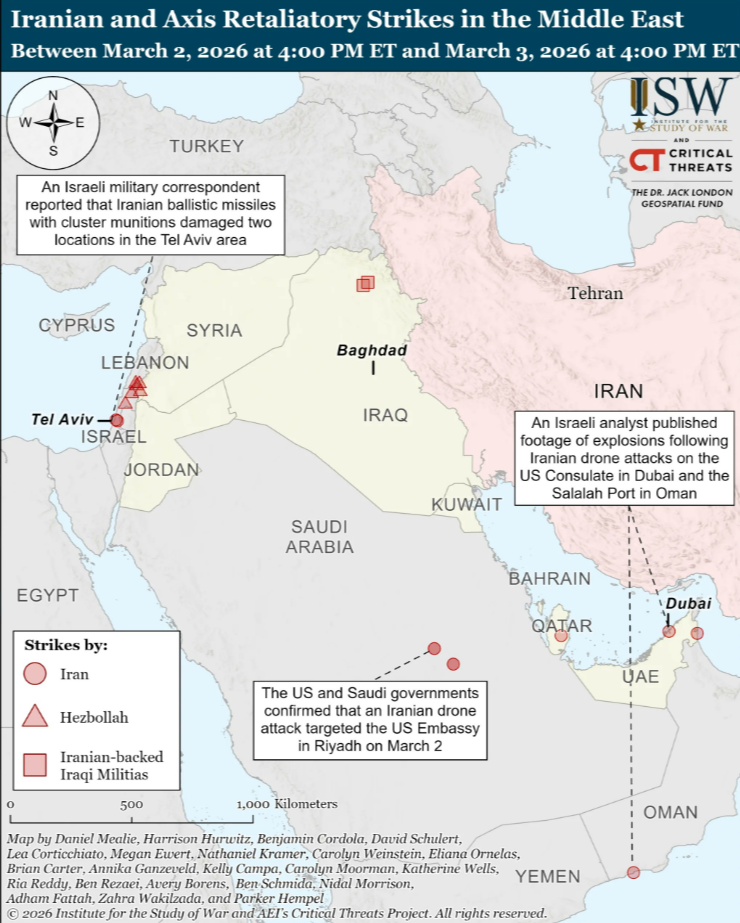
- The pattern of target selection by Iranian forces indicates that, consistent with U.S. declarations, a significant portion of the Islamic Republic’s leadership has been eliminated or cut off from command structures. Strikes are conducted in an ill-considered and chaotic manner; they generate public anxiety and logistical disruption, but their material and military impact remains negligible.
Source: ISW
- Iran’s command structure has shifted into an “autonomous” mode, with local commanders, deprived of a chain of command, deciding on objectives and execution. This further degrades Iran’s capacity to act effectively, while increasing the risk of an unforeseen escalation beyond the region.
- Iran possesses significant stocks of “Shahed”-type drones, potentially ranging from several hundred to several thousand units. These inventories enable strikes against large, stationary/slow-moving, and vulnerable targets in the Persian Gulf for several months, and their production is an order of magnitude easier than that of ballistic missiles.
- At the same time, it is worth noting that the United States, Israel, and the Persian Gulf states are rapidly depleting their stocks of anti-air/interceptor missiles. If the U.S. does not change its operating approach or procurement of air-defense assets, advanced air-defense munitions may reach a critical level in the region after roughly 20–30 days of fighting. This would likely lead to a breach of air defenses that currently intercept about 90% of missiles and drones launched from Iran.
- Based on satellite imagery and materials released by the Pentagon, all indications are that Iran’s navy has ceased to exist. Iran has also lost most, if not all, of its air forces.
Assumed (further) course of the operation:
- Given the declared intent and the operational context and profile, the baseline scenario is likely an attempt at regime change in Iran, relying primarily on the efforts of the local population.
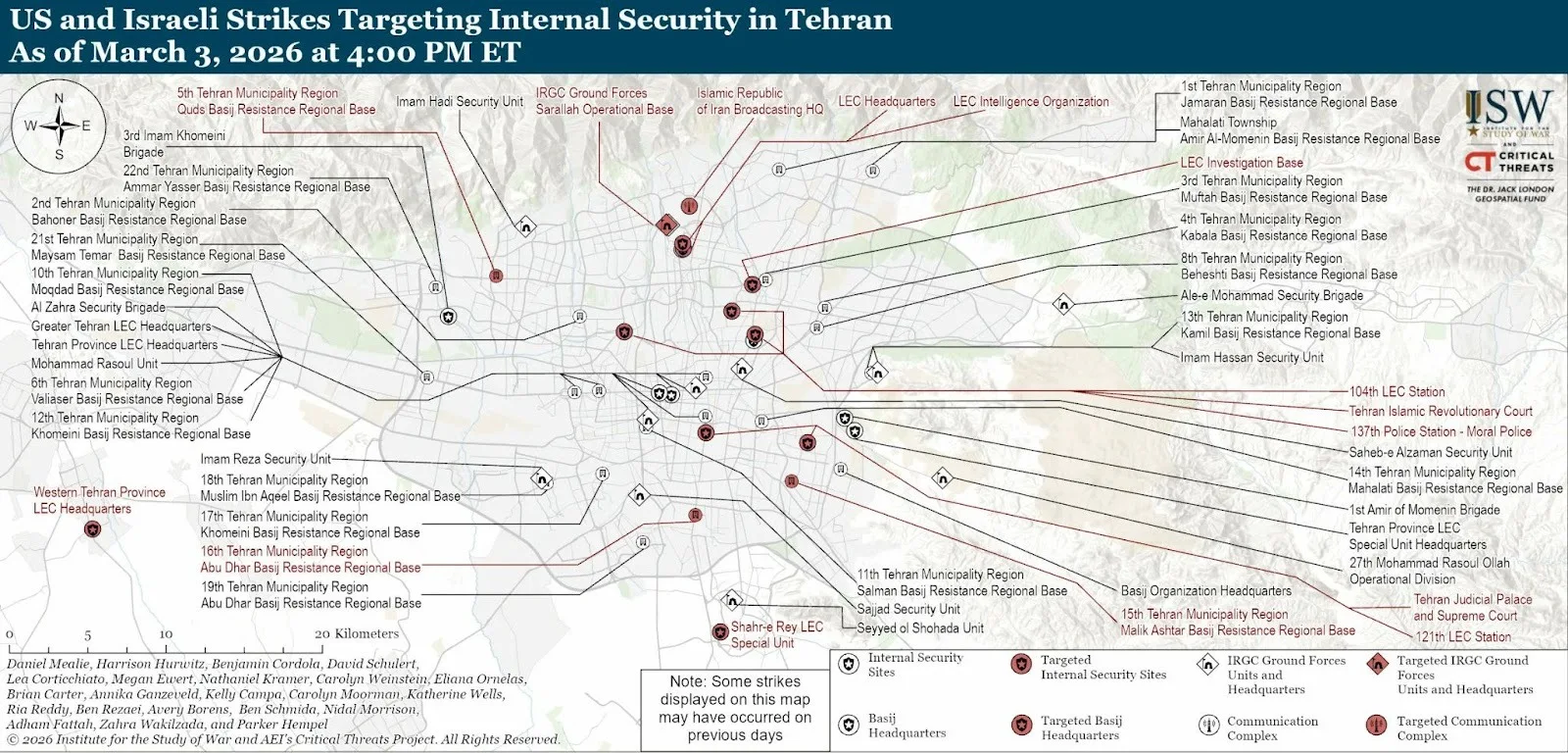
- U.S. and Israeli strikes, beyond military targets and elements of the nuclear program, show a concentration on leaders of the Islamic Republic and the regime’s coercive apparatus. The U.S. appears to aim to deprive Iran’s government of the ability to project force within its own territory and to continue suppressing protests. All available information indicates that the U.S. and Israel limit attacks on civilian targets and infrastructure to the operationally necessary minimum, suggesting the war is intended to be relatively short and/or to avoid antagonizing civilians.
- Given the large number of stealth infiltration aircraft and the numerous and serious acts of sabotage inside Iran many weeks before the invasion, this suggests the U.S. currently has a network of operators on the ground in Iran who can, in a coordinated manner, intensify and support protests at key times and locations. Protesters, supported by special operations personnel, may be able to seize critical facilities and urban centers, leading to the collapse of the Iranian state’s ability to mount an organized defence and retain power.
- Iranians traditionally celebrate the new year on March 20 under the name “Nowruz.” Historically, this date has also served as a pretext for gatherings and the escalation of protests and demonstrations. It falls one day after the end of “Ramadan,” the period of religious fasting among Muslims. After the end of fasting and the arrival of Nowruz, an intensification of protests should be expected, protests the Iranian government ultimately will not be able to suppress, leading to the overthrow of the Islamic Republic. In the final phase of such a scenario, a limited ground invasion/occupation is possible, for example in Khuzestan or around Bandar Abbas.
- Iran’s ethnic composition is also significant and not homogeneous. Western Iran, where protests of recent years were concentrated, is inhabited by, among others, Kurds, Lurs, and Azeris. In the north of the country, there is a large concentration of Mazandaranis and Turkmen. The southeastern part, near the border with Pakistan, is inhabited by Baluch people. All of these groups have a history of uprisings against Tehran’s authority, and the U.S. has—already at early stages of the operation, expressed a willingness to use these populations against Iran’s central government.
- The greatest unknown remains who would replace the Ayatollahs. Iran’s opposition is divided, poorly organized, and politically weak. External figures such as Reza Pahlavi may face serious challenges to their mandate to govern the country, something that is difficult to assess at present due to the extreme isolation Iran entered after the start of protests in December 2025.
Source: ISW
Source: Bloomberg Finance L.P
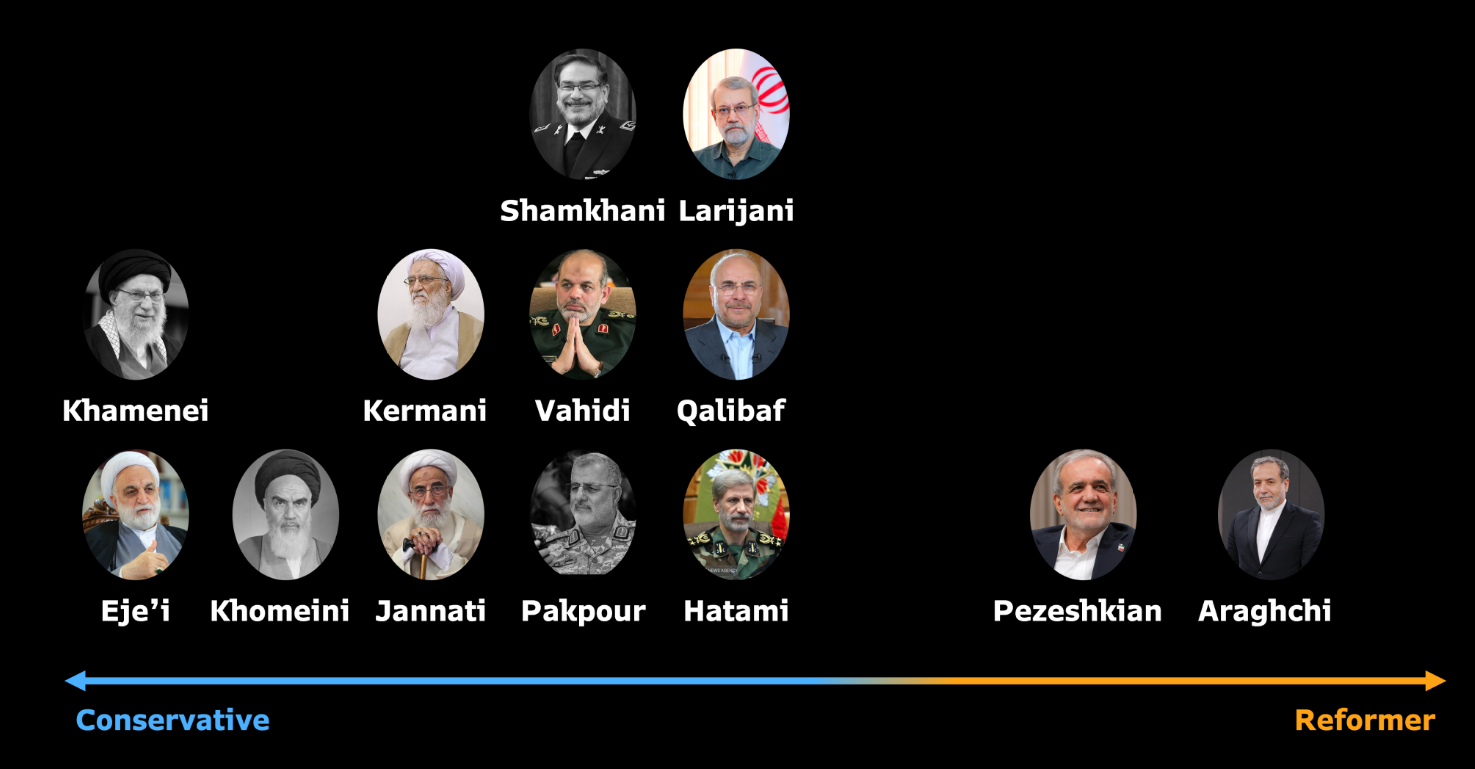
- There is also a scenario similar to Venezuela’s, whose probability is currently significant, though lower than that of the current “baseline” scenario of regime overthrow. After conservative military and political actors are eliminated, some form of settlement modeled on Venezuela could become possible, in which the regime remains in power but is forced into major concessions. At present, the odds are limited: power has been genuinely dispersed, Iran is much larger and relatively stronger, and a large share of decision-makers in Iran remain extremely hostile to the United States. A possible role could be played by military figures outside the IRGC, or groups clustered around the president or parliament.
External intervention:
- It is highly likely that French and British forces will become involved in the operation. Both countries possess expeditionary forces capable of projecting power in the region. European states have a vital interest in reopening the Strait of Hormuz as quickly as possible.
- If a Kurdish uprising is ignited in western Iran, limited involvement by Turkey, or even Syria, is possible.
- Iran itself remains isolated; Russian and Chinese support remains largely declarative; and Iranian proxies in the region were mostly neutralized even before the escalation of hostilities. The threat from the Houthis in Yemen still exists, but is currently marginal.
Market perspective:
- The Persian Gulf is extremely important not only because of oil and gas, but also because of refined hydrocarbon products and aluminium. In the Strait of Hormuz, smelters and refineries account for roughly 6–8% of the global aluminium market, critical for the automotive and aviation industries, especially in Europe.
- Further harming the aviation industry is the fact that a significant portion of jet fuel was produced in the Strait area, and shortages began to emerge rapidly in Europe and Asia.
- Inflation may hit Europe and the U.S. via an “indirect” channel. Even if Europe contains the energy-supply shock, shortages in Asia will drive up the prices of raw materials and industrial goods imported into Europe.
- Disruptions to the flow of oil, gas, and aluminium through the Strait should fully or partially subside within approximately 3–6 weeks.


Daily Summary: Oil at five-month highs, indices under pressure (23.10.2026)


BREAKING: France slows down, Germany holds on. Euro falls below 1.12



Daily Summary: Valuations Under Pressure, Capital Moves Away From Technology

Market Wrap: "Decent" results are not enough – tech stocks fall further; oil highest since May (22.10.2026)