


European indices opened Thursday's session slightly higher, with sentiment supported primarily by US inflation data that came in broadly in line with expectations. July CPI rose by 0.1% month-on-month, while core inflation stood at 2.5% year-on-year, easing concerns over another near-term tightening move from the Federal Reserve. In response, futures markets cut the implied probability of a 25-basis-point Fed rate hike in September to around 40%, from nearly 67% a week earlier. Improved sentiment lifted most major European indices, while UK GDP growth of 0.4% in the second quarter provided an additional macroeconomic signal for British assets. Investors are now focused on further European macro releases, corporate earnings and oil prices, which are edging lower but remain above $80 per barrel.
- The Stoxx Europe 600 is up around 0.2%, moving back towards its all-time highs. Gains are relatively broad-based, suggesting that the improvement in sentiment is not confined to a single sector or market.
- The DAX and CAC 40 are gaining around 0.3%. German and French equities are benefiting primarily from reduced concerns over further increases in US borrowing costs. Lower expectations for Fed rates can support equity valuations by reducing interest-rate risk premia.
- The FTSE 100 is trading lower despite stronger UK GDP data. The British economy expanded by 0.4% in the second quarter, in line with consensus expectations. The reading reduces concerns about a sharp deterioration in economic activity despite still-elevated interest rates.
- US inflation remains the key catalyst for market sentiment. July CPI increased by 0.1% month-on-month, while core inflation stood at 2.5% year-on-year. Combined with earlier signs of weakness in the US labour market, the data reduce pressure on the Fed to raise rates again as early as September.
- Oil continues to carry a geopolitical risk premium, reflecting tensions between the US and Iran and concerns over shipping security through the Strait of Hormuz. Later in the European session, investors will turn their attention to Spain's final CPI reading and eurozone industrial production for further clues on the regional economy and the ECB's policy outlook.
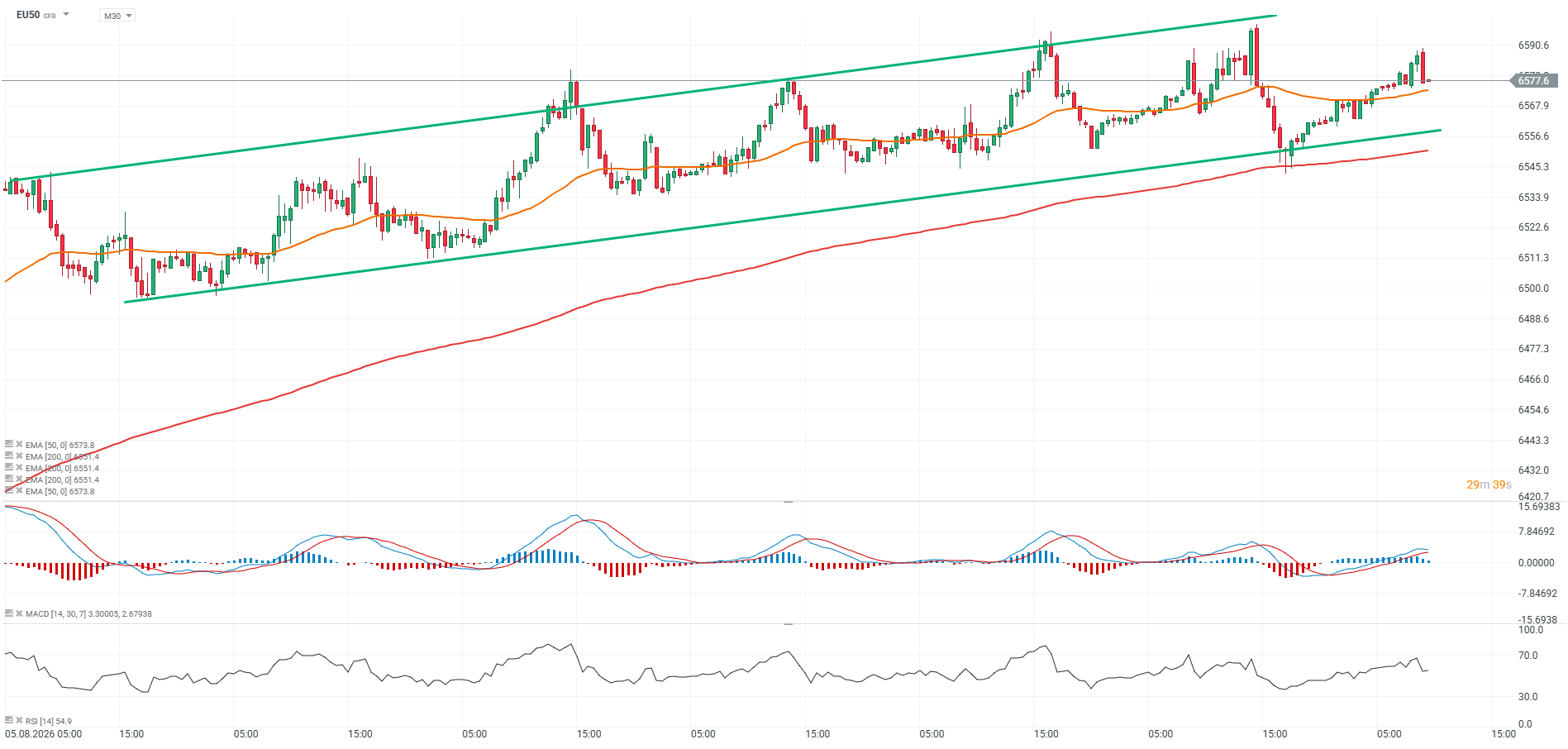
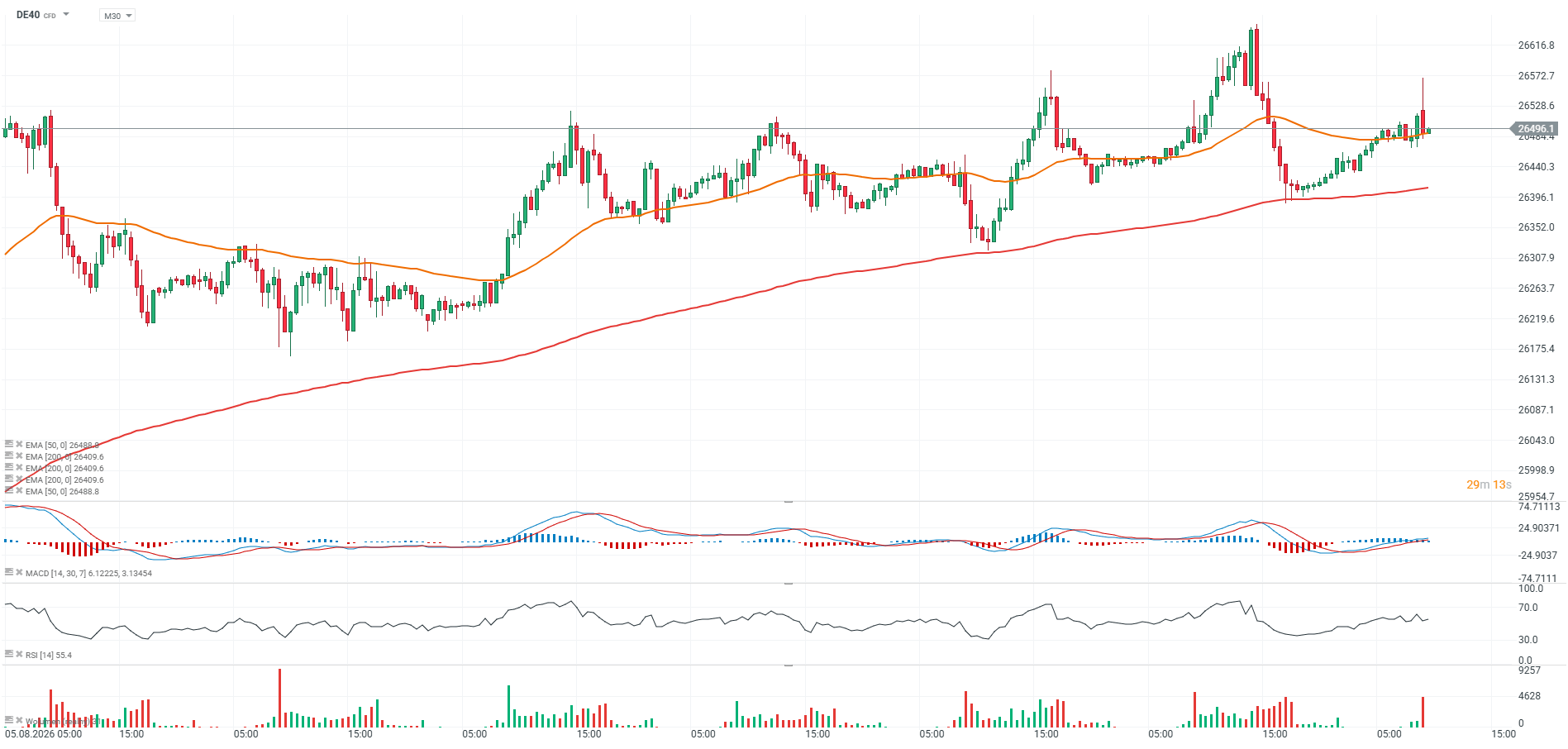
EU50 and DE40 Charts (M30 Interval)
Looking at Euro Stoxx 50 futures, the price is trading roughly in the middle of its upward-sloping price channel. The 50-period EMA (orange line) remains an important momentum support – in the previous two bearish impulses, a break below this average preceded a stronger move to the downside. The key resistance level is around 6,600 points, corresponding to the recent local highs.
 Source: xStation5
DAX futures are attempting to hold above the 50-period EMA (orange line), while the key resistance level is located around 26,600 points. The index is also trading relatively close to the 200-period exponential moving average near 26,400 points.
 Source: xStation5
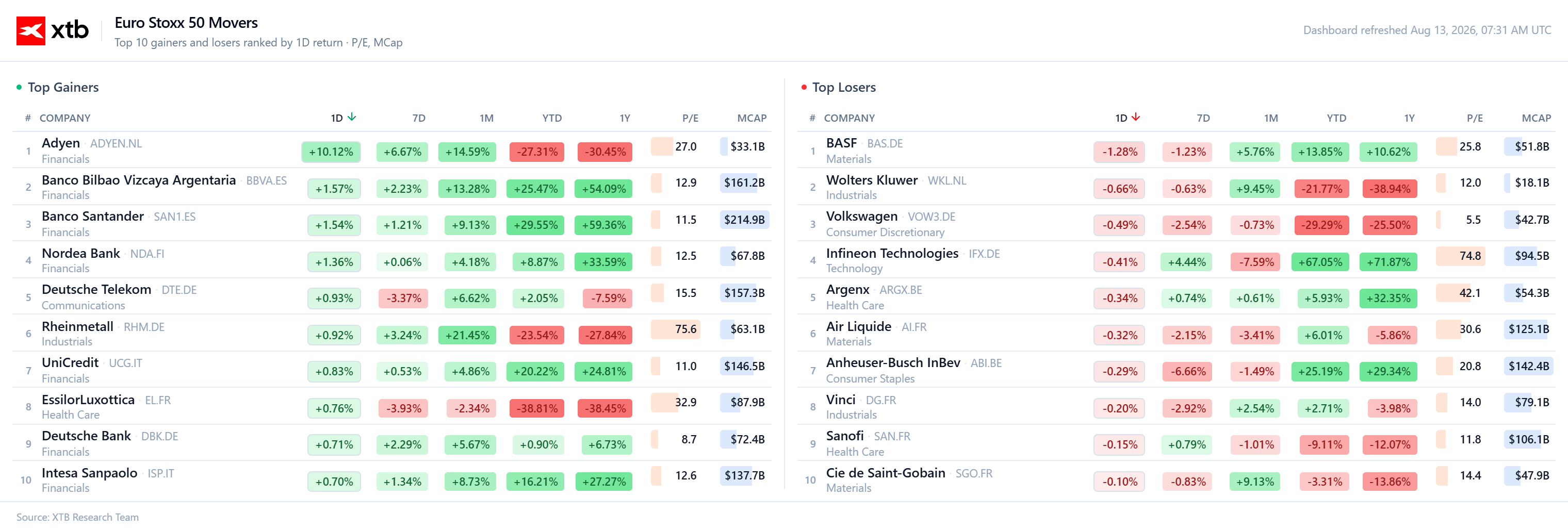
Adyen is by far the strongest performer in the Euro Stoxx 50, with shares surging 10.1%, significantly outperforming the rest of the index. European banks are also among the leaders: BBVA gains 1.6%, Santander 1.5%, Nordea 1.4%, while UniCredit, Deutsche Bank and Intesa Sanpaolo advance by around 0.7–0.8%, highlighting the relative strength of the financial sector. Deutsche Telekom and Rheinmetall are also performing well, both gaining around 0.9%. At the opposite end of the market, BASF is the weakest performer, falling around 1.3%, while Wolters Kluwer (-0.7%) and Volkswagen (-0.5%) are also under pressure. Some of today's laggards, however, remain exceptionally strong over a longer horizon – Infineon, for example, is down 0.4% today but remains around 67% above its level at the beginning of the year. The distribution of winners and losers therefore points primarily to a rotation of capital towards financials, while materials, industrials and selected consumer stocks face relatively greater pressure.
Source: XTB Research
The Euro Stoxx 50 is trading only around 0.3% below its all-time high, and despite the slight negative return shown for the current session, the broader trend remains clearly bullish: the index is up 4.0% over the past month and 12.8% year-to-date. Market breadth remains constructive, with 66% of constituents trading above their 200-day moving average and 64% above their SMA50, suggesting that the rally is not being driven solely by a handful of heavyweight stocks. Sector performance remains highly differentiated, with industrials and financials leading, while communication services and consumer discretionary stocks are the main drags on the index. Technology is particularly notable – the sector is up around 32% year-to-date, but a P/E ratio of roughly 47 indicates that strong share-price momentum is now accompanied by elevated valuation multiples. Infineon and ASML stand out among the longer-term leaders, while the strength of ING, BBVA and UniCredit confirms that banks remain one of the key pillars of this year's European equity rally. Overall, the Euro Stoxx 50 remains technically strong but increasingly demanding from a valuation perspective, meaning that further gains near record highs will depend increasingly on earnings, interest rates and continued broad participation across sectors.
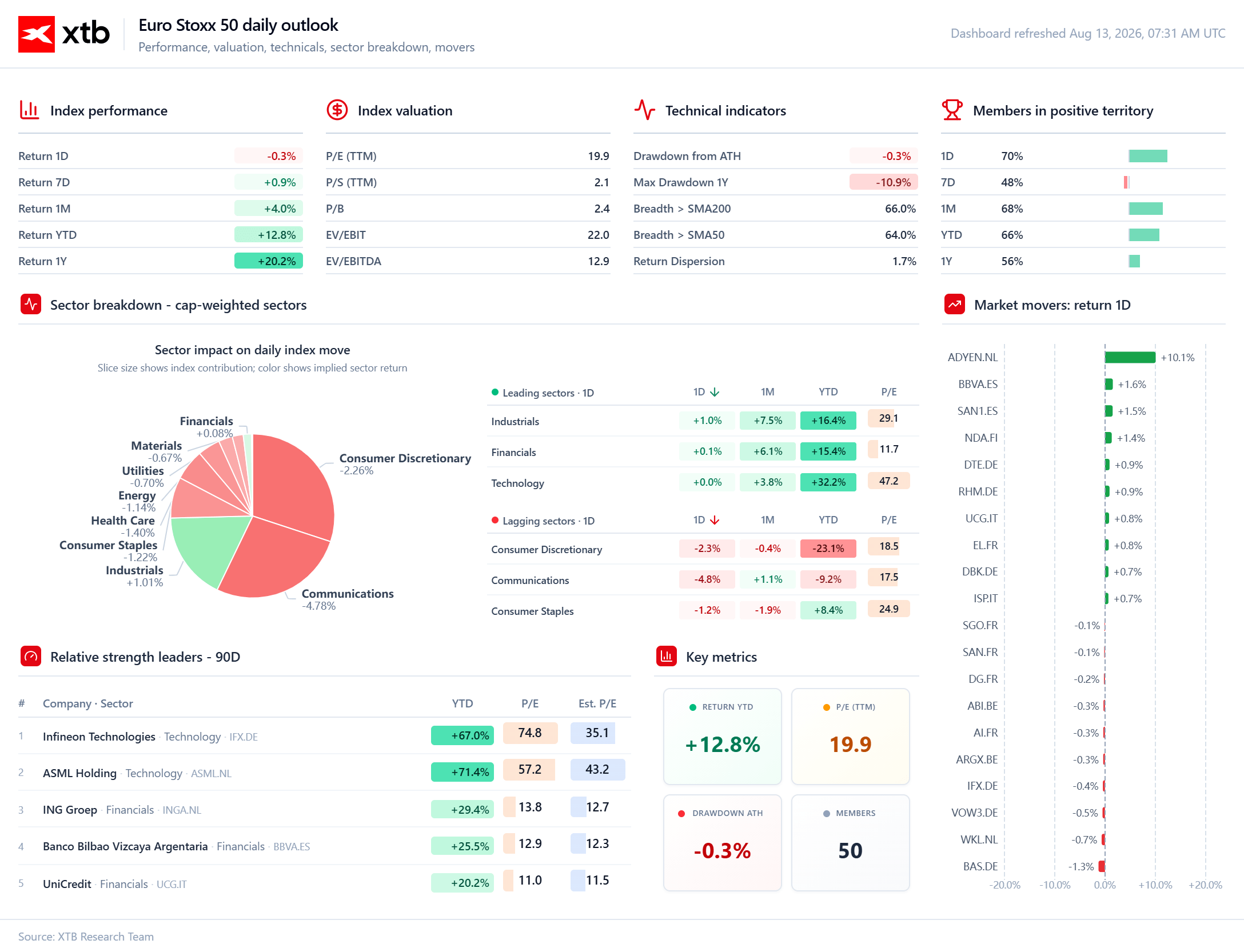
Source: XTB Research
Corporate News
- Adyen is the clear leader in the Euro Stoxx 50, with shares gaining more than 10% after the company raised its 2026 revenue growth outlook. The Dutch payments processor now expects net revenue growth of 21–23%, compared with its previous forecast of 20–22%.
- Pandora shares are gaining around 3% following its earnings release. The Danish company beat second-quarter expectations and raised its earnings outlook. The market reaction suggests that investors continue to reward companies that combine earnings beats with improving forward guidance.
- Thyssenkrupp remains under pressure, falling around 1.5% in early trading. The negative reaction comes despite the company narrowing and raising parts of its 2026 guidance, suggesting that the revision alone was insufficient relative to expectations already embedded in the share price.
Strong Adyen Results Support the Shares
Adyen reported strong first-half 2026 results and raised its revenue growth outlook, sending its shares more than 10% higher during the European session. Net revenue reached €1.30 billion, up 19% year-on-year and 21% at constant currencies, slightly exceeding consensus expectations. Processed payment volume grew even faster, rising 24% to €803.8 billion. Adjusted EBITDA increased 18% to €641.5 million, although the margin declined from 50% to 49% amid higher costs and the acquisitions of Talon.One and Orb. The key takeaway from the report, however, is the upgrade to Adyen's 2026 net revenue growth forecast to 21–23% at constant currencies from the previous 20–22% range.
- Net revenue: €1.303 billion, +19% YoY and +21% at constant currencies, versus market expectations of around €1.29 billion.
- Processed payment volume: €803.8 billion, +24% YoY from €649 billion a year earlier.
- Adjusted EBITDA: €641.5 million, +18% YoY, while the EBITDA margin declined to 49% from 50%.
- Net income: €544.1 million, +13% YoY, while free cash flow increased 17% to €553.4 million.
- 2026 outlook: net revenue growth of 21–23% at constant currencies, compared with the previous 20–22% range.
- Acquisitions: Adyen completed the €750 million acquisition of Talon.One and the $335 million acquisition of Orb. The deals are expected to add around 1 percentage point to 2026 revenue growth while reducing the EBITDA margin by a similar amount.
- Fastest-growing segment: Platforms revenue increased 37% to €165.5 million, while processed volume rose 42% to €135 billion.
Payment Volume Is Growing Faster Than Adyen's Revenue
The strongest operational signal from Adyen's results is the 24% increase in processed payment volume to €803.8 billion. This outpaced the 19% nominal increase in net revenue to €1.303 billion. At constant currencies, net revenue grew by 21%.
The composition of growth remains an important strength of Adyen's business model. Around 70% of growth came from existing customers, indicating that Adyen is scaling alongside its merchants rather than relying exclusively on new client wins. At the same time, 300 merchants accounted for roughly 60% of total growth, down from more than 70% three years ago, pointing to a gradual diversification of the company's growth base.
Platforms recorded the strongest momentum, with revenue rising 37% to €165.5 million and processed volume increasing 42% to €135 billion. Digital remained the largest business, generating €719.7 million in revenue, up 13% year-on-year, while Unified Commerce revenue advanced 25% to €417.7 million.
Higher Costs and Acquisitions Weigh on the EBITDA Margin
Rapid business expansion has been accompanied by cost pressure, pushing the EBITDA margin down to 49% from 50% a year earlier. Adjusted EBITDA still increased by 18% to €641.5 million, but came in slightly below analysts' expectations. Excluding approximately €6 million of one-off acquisition-related costs, the margin would have remained at 50%.
Operating expenses increased 21% to €738 million. Adyen added 249 employees during the first half, bringing its total workforce to 5,020, while employee benefit costs rose 15% to €431.1 million. The company is also accelerating infrastructure investment and expects capital expenditure to reach around 7% of net revenue this year, partly because it is bringing forward spending on a data centre originally planned for 2027.
Despite higher investment, cash generation remains strong. Net income rose 13% to €544.1 million, while free cash flow increased 17% to €553.4 million, equivalent to around 86% of EBITDA. At the end of June, Adyen held €12.4 billion in cash, while operational cash amounted to approximately €4.6 billion after excluding merchant-related balances and short-term receivables.
Adyen Raises Its Outlook and Expands Beyond Traditional Payments
The key element of the report is Adyen's decision to raise its 2026 net revenue growth forecast to 21–23% at constant currencies from the previous range of 20–22%. The revised outlook includes contributions from Talon.One and Orb, the first acquisitions in Adyen's history, while management also points to increasing activity among both new and existing customers.
Adyen acquired loyalty solutions provider Talon.One for €750 million and enterprise billing specialist Orb for $335 million. The transactions are expected to add around 1 percentage point to this year's revenue growth while reducing the full-year EBITDA margin by approximately 1 percentage point, including transaction costs. Strategically, the acquisitions expand Adyen beyond payment processing into loyalty programmes, billing and money-movement services.
From an investor perspective, the report therefore carries a clearly positive growth message while highlighting a short-term trade-off between expansion and profitability. Adyen continues to grow at more than 20% at constant currencies, processed payment volume is expanding even faster, and management has raised its guidance while accepting temporary margin pressure from investment and acquisitions. The company nevertheless maintained its target of achieving an EBITDA margin above 55% by 2028, making the pace of margin recovery towards that level one of the key metrics for investors to monitor over the coming quarters.
Adyen Share Price Chart (ADYEN.NL, D1 Interval)
Adyen shares are gaining more than 10% today and are approaching a test of the 200-day exponential moving average, EMA200 (red line), which could act as an important technical resistance level.
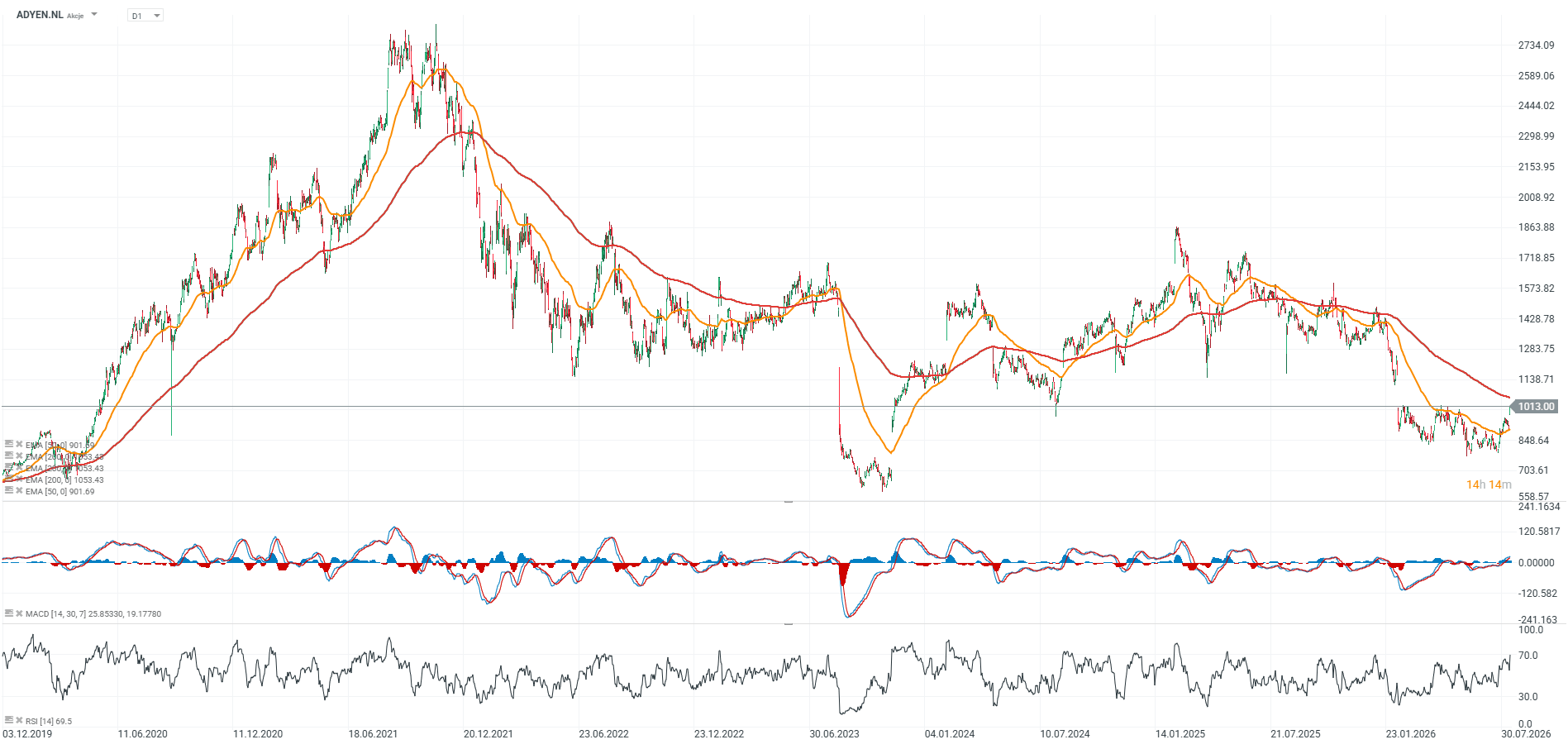
Source: xStation5
Adyen’s fundamentals show strong long-term growth despite significant share price weakness, with the stock down 26.6% YTD and 29.7% over the past year, although it has rebounded 15.7% over the last month. Revenue has delivered an 11.1% four-year CAGR, while EBIT has expanded considerably faster at 18.0%, highlighting the scalability and operating leverage of the company’s payments platform. Profitability remains particularly strong, with an EBIT margin of 43.6%, ROE of 23.4% and virtually no financial leverage, as reflected by a debt-to-equity ratio of 0.0. The latest half-year period shows revenue of around €1.4 billion and net income of €581.6 million, translating into a net income margin of 41.2%, while ROIC stands at 17.9%. From a valuation perspective, Adyen trades at 27.0x trailing earnings and 23.6x forward earnings, with an EV/EBITDA multiple of 14.7x, meaning investors continue to assign a premium to the company’s growth and profitability profile. Overall, the chart highlights a notable divergence between improving earnings fundamentals and weak medium-term share price performance, making the sustainability of double-digit revenue growth and high margins particularly important for the stock’s future valuation.
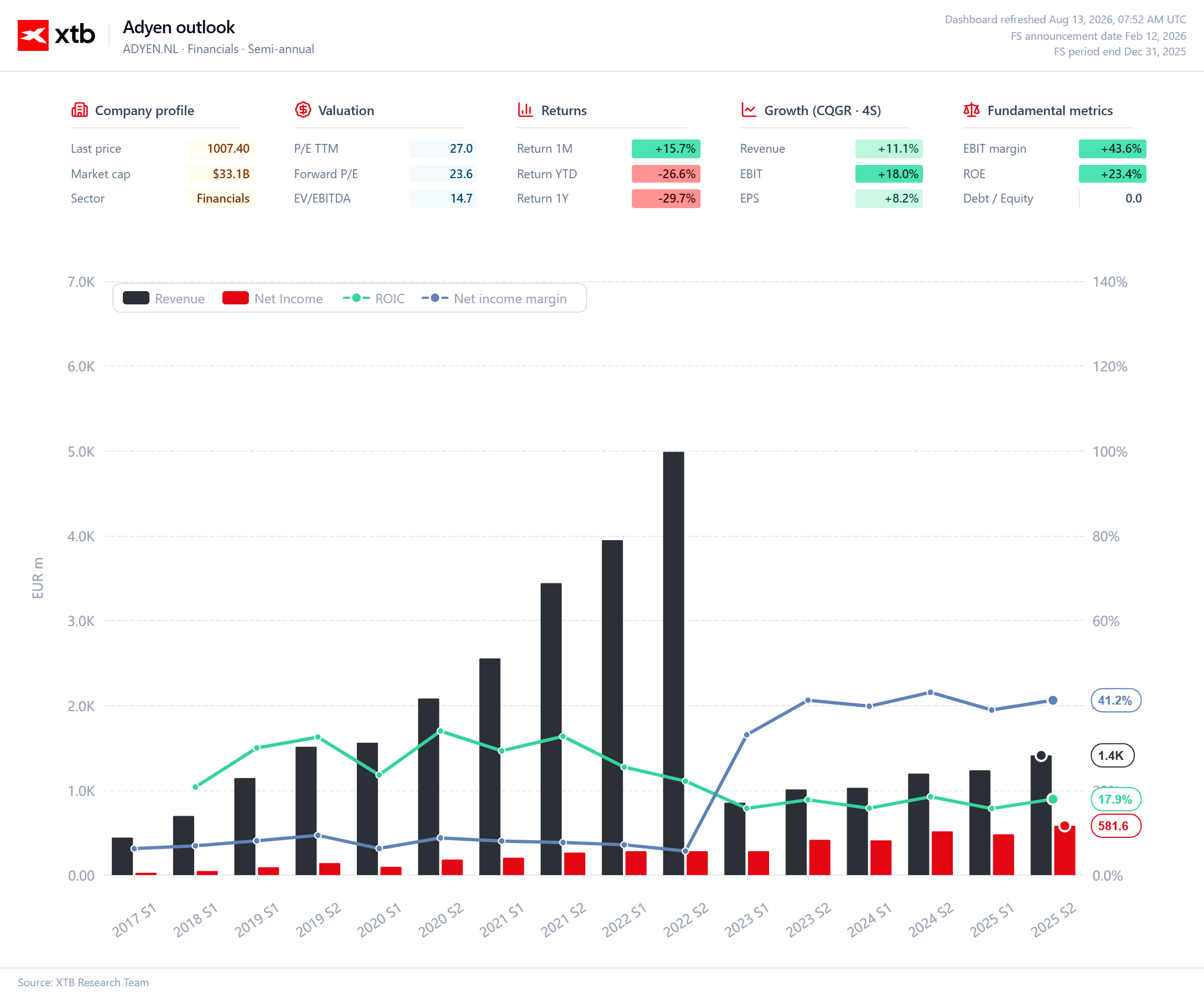
Source: xStation5


Daily summary 📈 Precious metals and stock indices rebound as Treasury yields fall


U.S. indices attempt to rebound after recent losses


US Open: Nasdaq 100 extends losses 🚩 AI stocks under pressure, CoreWeave falls 8%


Market Wrap: Tech Sell-Off Hits Europe, Gold Shines Again