



The escalation in the Middle East is now in its 12th consecutive night — the US and Iran are exchanging strikes, and Trump has threatened that for every attack on a tanker in the Strait of Hormuz, the United States will destroy one Iraqi bridge or power station. Iran responded by saying that, in the event of an attack on its infrastructure, it would retaliate with strikes on energy facilities and bridges in the region, including those linked to US interests. The Revolutionary Guard has declared the Strait of Hormuz “completely closed” and warns that no oil tanker will pass through without their permission, threatening to halt the flow of oil entirely in the event of an attack on Iranian infrastructure.
The Houthis are extending their blockade to the Red Sea — they claim to have attacked the Saudi tankers Layla and Encelia, although the UKMTO has confirmed that only one vessel was hit; around 9–10 ships have abandoned their transit through Bab al-Mandab following the announcement of the blockade of Saudi Arabian ports. Kuwait has reported the interception of drones over its territory, demonstrating that the risk is spreading beyond the two main shipping ‘chokepoints’. The US is deploying special forces, fighter jets and medical personnel to the region, whilst approving an additional $73 billion to fund the war with Iran.
US markets closed lower despite strong corporate results — the indices gave up their earlier gains: Dow -0.01%, S&P 500 -0.14%, Nasdaq Composite -0.57%; futures for Thursday remain under pressure (Dow -0.1%, S&P -0.2%, Nasdaq -0.2%) due to concerns over AI spending and rising oil prices. The yield on 10-year US bonds remains stable at 4.661%, and that on 2-year bonds at 4.304%, with a high probability that the Fed will keep interest rates unchanged at its next meeting.
Asia is rising despite geopolitical tensions, driven by spending on AI — The Kospi gained over 3% (its third consecutive day of gains), the Nikkei rose by around 0.55–1%, and the ASX 200 was up 0.72%; SK Hynix jumped 6.5%, Samsung by 4.8%, thanks to Google’s raised capex forecasts and Tesla’s strong results. South Korea’s Q2 GDP rose by 0.6% q/q (forecast: 0.4%), supported by chip exports, although this increases the likelihood of further monetary tightening by the Bank of Korea.
The Australian labour market delivered a positive surprise — employment rose by 76,300 in June (against a forecast of 15,000), the strongest reading in over a year, whilst the unemployment rate remained unchanged at 4.4%. The AUD and short-term yields rose, boosting (slightly) the chances of an RBA rate rise in August, although high underemployment (6.5 per cent, a 22-month high) complicates an unequivocally hawkish reading.
Dollar slightly weaker; yen and franc under scrutiny — The EUR, CAD, AUD and CHF are gaining against the USD, whilst USD/JPY remains stable; the Japanese finance minister has declared his readiness to take “decisive action” in the foreign exchange market if necessary. Trading platforms show EUR/USD at around 1.1429, GBP/USD at around 1.3382, and USD/JPY close to 163.10.
Oil at 6-week highs — Brent is up by around 2% to nearly $96/bbl (following an attack on a tanker off the coast of Saudi Arabia), whilst WTI is up by around 1.7% to $88.27/bbl. HSBC warns that the future direction of prices depends on whether diplomacy can restore predictability to flows through the Strait of Hormuz. Gold has retreated slightly (-0.23%) despite the tensions, which is unusual, although billionaire Paulson claims that the gold rally is still in the “early stages” of a long-term bull market.
Mixed results for tech companies, with AI spending in the spotlight — Alphabet fell by over 4% after raising its 2026 capex forecast to US$195–205 billion (despite revenue of US$119.8 billion, exceeding the forecast of US$116.93 billion), whilst Tesla fell by around 3–4% following a disappointing EPS ($0.33 vs. the consensus of $0.51) despite revenue exceeding forecasts ($28.24 billion). ServiceNow gained over 2% following better-than-expected results and an upward revision to its subscription outlook, whilst Texas Instruments and IBM fell/rose despite earnings surprises — TI down 3% despite beating forecasts, IBM up 2% despite missing them. Uber cut 10% of its customer service workforce, citing a shift towards AI.
Cryptocurrencies under pressure from a general risk-off sentiment — Bitcoin is down by around 0.67% to a level of around USD 65,488–65,678, amid geopolitical risks and a decline in appetite for risky assets.
In the spotlight during today’s session — ECB decision, US weekly jobless claims data (8.30 am ET, consensus 212,000), results from American Airlines, Dow, T-Mobile, Union Pacific and Norfolk Southern before the market opens, and Intel after the close. In Europe, futures point to slight declines (DAX -0.21%, Eurostoxx50 -0.10%, UK100 flat), and the market will remain dominated by tensions in the Middle East and reactions to the latest wave of Big Tech results ahead of next week’s reports from Meta, Microsoft, Amazon and Apple.
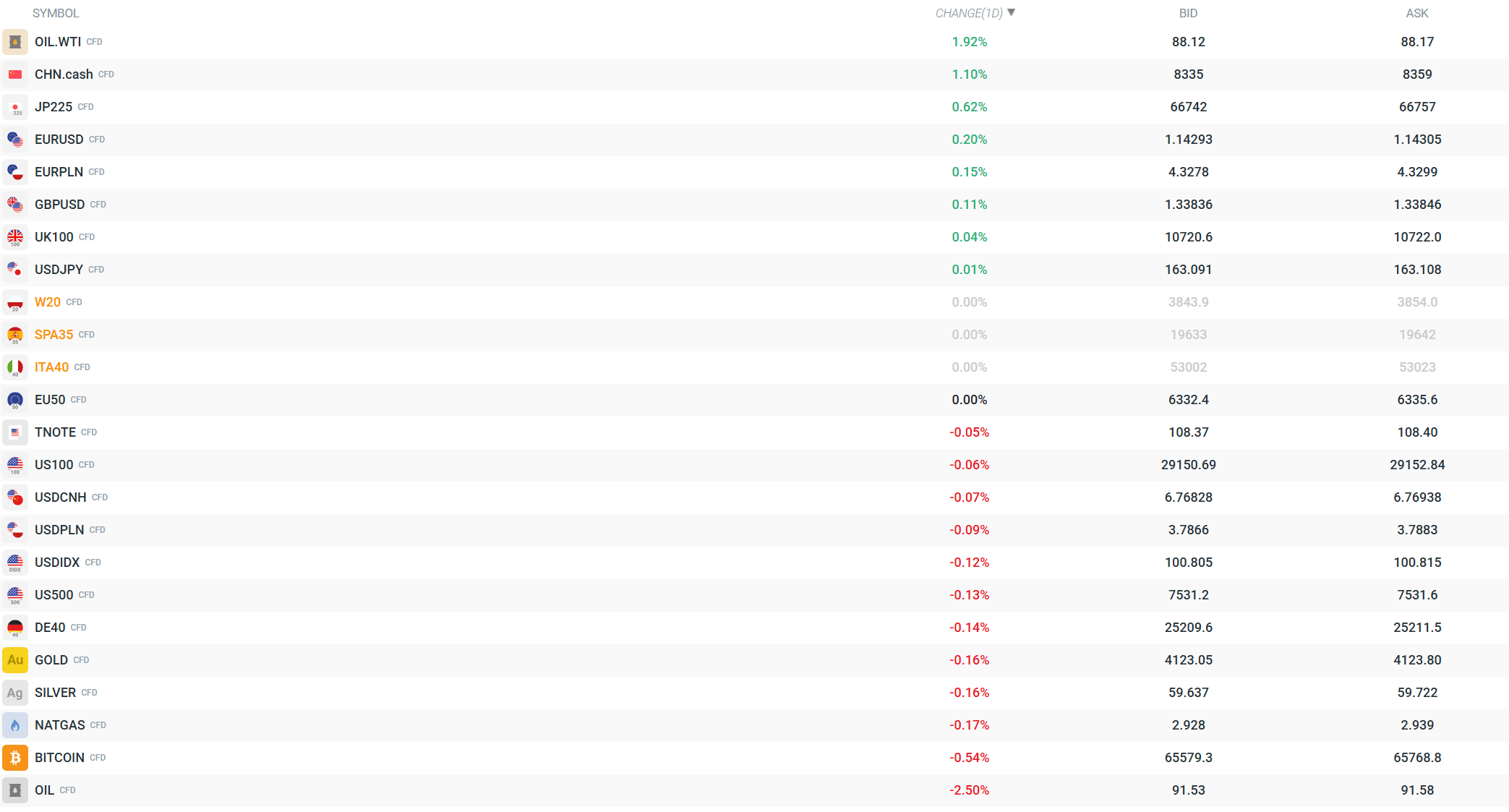
Volatility is currently evident across the main instruments. The divergent behaviour between OIL and OIL.WTI is due to the rollover of the OIL futures contract. Source: xStation



Three Markets to Watch Next Week (09.10.2026)



Daily Summary: A Shallow Rebound Ahead of Earnings Season


Lumentum: Demand for AI infrastructure exceeds capacity

Strong rise in natural gas prices 📈🚨