


Nvidia’s latest investment in Taiwan could become one of the most important geopolitical and technological developments of this decade. Jensen Huang announced that Nvidia plans to increase its Taiwan-related spending to as much as $150 billion annually, while calling the island the “epicenter of the AI revolution.” At first, the market interpreted the announcement as a natural extension of Nvidia’s partnership with TSMC and Taiwan’s semiconductor supply chain. However, the scale of the move suggests something much deeper — a strategic transformation with global implications.
Today, Nvidia is no longer just a graphics card manufacturer or an AI accelerator company. It is evolving into a central pillar of the global technology infrastructure, operating somewhere between a software giant, a cloud infrastructure provider, and a strategic partner for nations building their own AI capabilities. In this context, Taiwan is no longer simply a manufacturing hub for chips. It is becoming the foundation of a new technological order.
The first possible dimension of this investment concerns Nvidia’s business model itself and a potential long-term pivot toward the Chinese market. Recent years have shown how severely U.S. export restrictions limited Nvidia’s ability to sell advanced chips to China. The company lost access to a market that only recently generated billions in revenue. At the same time, China did not slow down its AI ambitions. On the contrary, it accelerated investments into domestic alternatives and local semiconductor ecosystems.
Against this backdrop, Nvidia’s massive expansion in Taiwan may represent an attempt to create a more flexible and regionally balanced operational model. The company could be building a strategic buffer between U.S. political pressure and the broader Asian technology market. Despite its close relationship with the United States, Taiwan remains deeply interconnected with China and the wider Asian economy. That potentially gives Nvidia more room to maneuver in the future if geopolitical tensions eventually soften. In other words, the company may already be positioning itself for a future return to the Chinese market once a political window of opportunity emerges.
The second dimension of this investment is purely geopolitical and may ultimately become even more important than the business itself. The greater the concentration of strategic AI infrastructure in Taiwan, the more critical the island becomes to U.S. national and economic security. In practice, Nvidia is adding another layer to the West’s growing dependence on Taiwan’s stability.
A few years ago, the key strategic argument centered around TSMC’s dominance in advanced semiconductor manufacturing. Today, the stakes are significantly higher. This is no longer just about smartphones or processors. It is about the foundations of the global AI economy: data centers, AI models, autonomous military systems, cybersecurity, and the computational backbone of future industries.
That means any destabilization of Taiwan would no longer be merely a regional crisis. It would become a direct threat to the global technological and financial system. The deeper the involvement of American giants like Nvidia, the harder it becomes to imagine a scenario in which the United States could remain passive toward any attempt by China to gain control over Taiwan — whether through military, political, or economic pressure behind the scenes.
In many ways, Taiwan may emerge as the single biggest beneficiary of this entire development. The island is strengthening its position not only as the world’s semiconductor manufacturing center, but also as one of the most strategically important pillars of the global AI economy. The inflow of capital, infrastructure expansion, rising geopolitical relevance, and growing dependence of global corporations on Taiwan’s ecosystem could create a dynamic that becomes extremely difficult to reverse.
It is also worth noting that Nvidia is sending a very powerful signal to global markets. The company is showing that the future of AI will not be built exclusively in Silicon Valley or inside American hyperscale data centers. The center of gravity is increasingly shifting toward Asia, particularly toward regions that possess real semiconductor manufacturing capabilities and access to the world’s most advanced technological know-how.
For that reason, this investment may become far more significant than just another announcement about rising capital expenditures. It could mark the beginning of a new phase in the global technological race — one in which Taiwan becomes one of the world’s most important strategic assets.
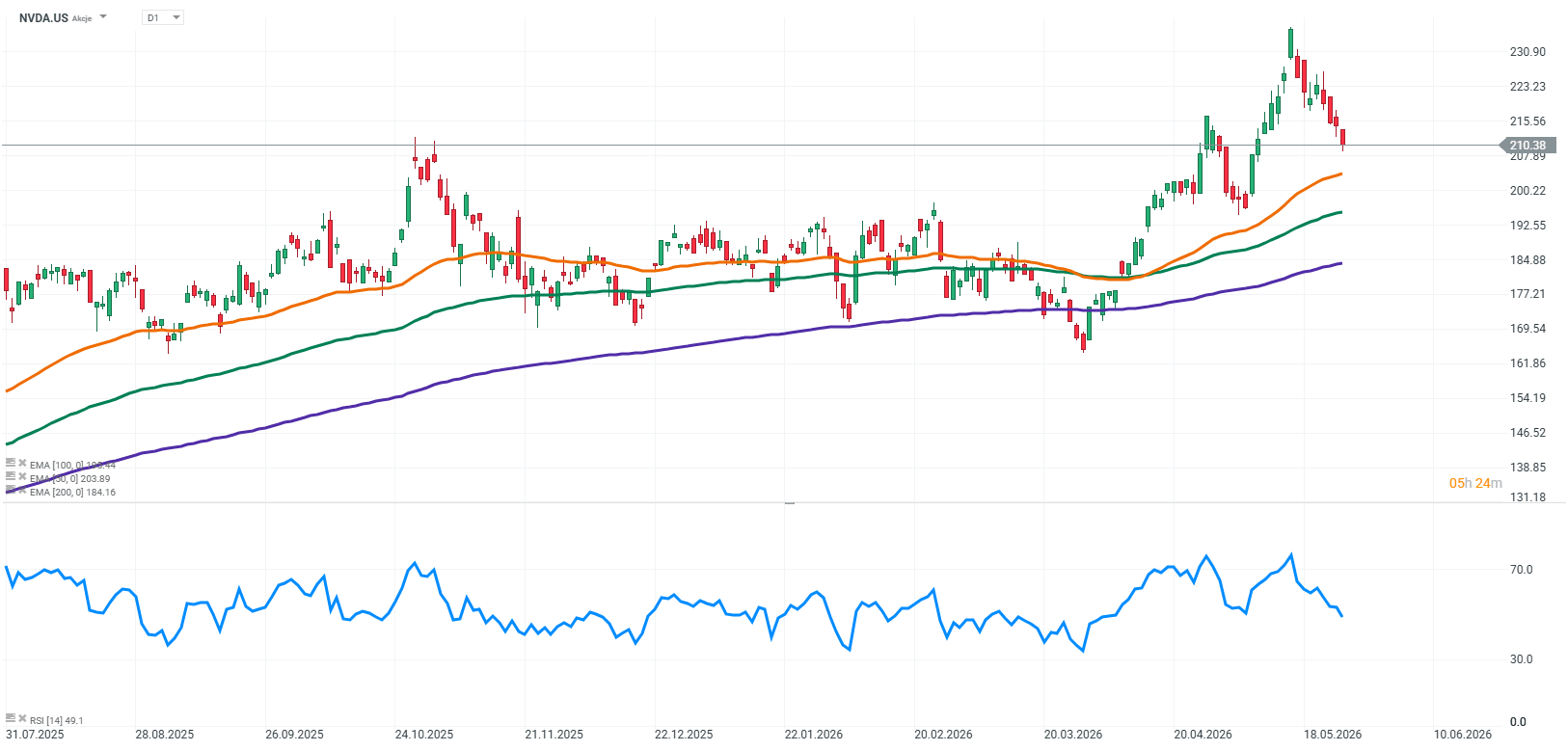
Source: xStation5



Three markets to watch next week (23.10.2026)



Daily Summary: Oil at five-month highs, indices under pressure (23.10.2026)

US Open: Further declines on Wall Street, Brent above 111 USD, AI correction continues (14.10.2026)



Morning Wrap: AI profitability concerns spark market Sell-Off