



Pfizer has posted solid results for Q2 2026, which support the view that the company is becoming less reliant on its Covid-related business and is generating increasing revenue from its other, ‘core’ products.
Quarterly results
-
Revenue: US$15.03 billion vs. consensus of US$14.41 billion (+3% y/y)
-
Adj. EPS: US$0.77 vs. US$0.68 expected
-
GAAP net loss: US$248 million (EPS: US$-0.04), compared with a profit of US$2.91 billion a year earlier – the difference is mainly due to one-off restructuring costs and write-downs of intangible assets
-
Eliquis (an anticoagulant, co-marketed with Bristol Myers Squibb): US$2.43 billion, +19% y/y, well above expectations (US$2.08–2.09 billion est.)
-
Prevnar (vaccines): US$1.34 billion, slightly below the estimate of US$1.38 billion
It’s no longer just about COVID
Key takeaway from the report: revenue from non-COVID products rose by a further US$1.5 billion, enabling the company to raise the lower end of its full-year forecast. At the same time, the company lowered its revenue forecast for the COVID segment (vaccine + Paxlovid) to US$4 billion from the previous US$5 billion.
This shows a clear shift in the revenue structure – Pfizer is offsetting the decline in Covid-related sales by:
-
Eliquis – rising sales thanks to better net prices in the US (lower discounts) and strong global demand
-
Padcev – a targeted cancer drug – also helped to alleviate the strain on the Covid ward
-
Acquired products – revenue from this segment rose by 25% on an operating basis year-on-year
Revision of forecasts
-
Annual revenue: now US$60.5–62.5 billion (previously US$59.5–62.5 billion) – lower limit raised
-
EPS (adjusted): unchanged, US$2.80–3.00 (takes into account the impact of US$650 million relating to the licence agreement with the Chinese company Innovent Biologics, worth up to US$10.5 billion)
-
This range implies that sales will remain virtually flat or fall slightly compared with the US$62.6 billion figure for 2025
Cost-cutting – a new phase
Pfizer has announced an extension of its cost-cutting programme:
-
New target: a total of US$6.7 billion in net savings (an increase on previous levels)
-
A further US$2.5 billion in savings will be achieved between 2027 and 2029
-
Focus on: improvements to the product portfolio, changes to the operational network structure, and further operational efficiency
-
The first phase of the programme (US$1.5 billion) is on track to be completed by the end of 2027
Outlook – growth area: obesity
CEO Albert Bourla emphasised that “launched and acquired products performed well”, and that the obesity programme was “advancing with meaningful momentum”. This refers to the $10 billion acquisition of Metzer – Pfizer hopes this will enable it to establish a strong position in the rapidly growing market for obesity drugs (the GLP-1 segment). Investors are awaiting data from trials combining a GLP-1 injection with an amylin compound – this could be a key catalyst for the share price in the coming quarters.
The market reacted fairly calmly to the results – shares traded flat in pre-market trading, suggesting that the strong results had already been partly priced in, and that investors are waiting for more long-term evidence of the business’s transformation beyond the COVID-19 pandemic.
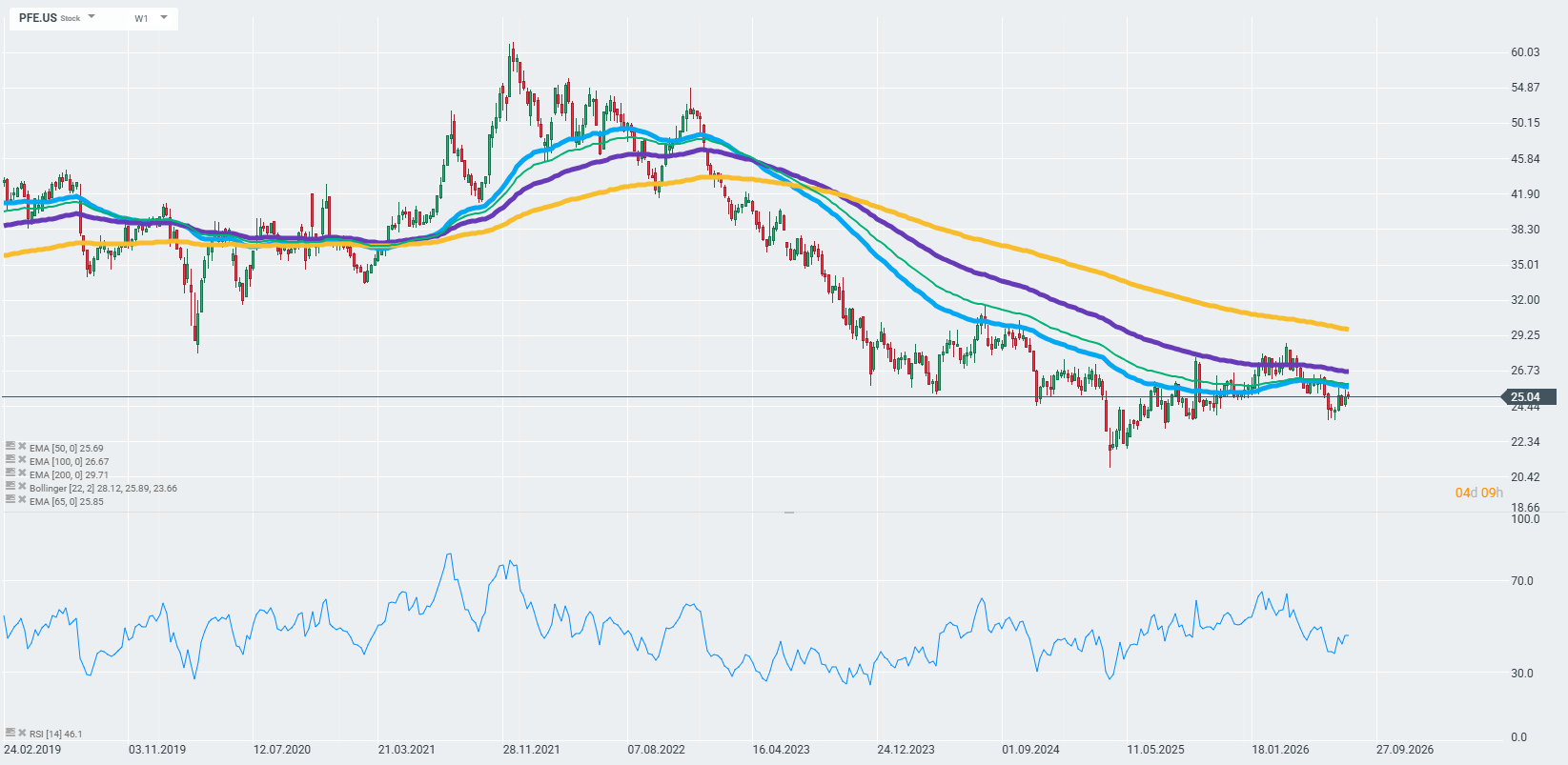
Since the Covid wave, PFE shares have been in a deep downtrend, constrained by exponential moving averages. Source: xStation



Three markets to watch next week (23.10.2026)



Daily Summary: Oil at five-month highs, indices under pressure (23.10.2026)

US Open: Further declines on Wall Street, Brent above 111 USD, AI correction continues (14.10.2026)



Morning Wrap: AI profitability concerns spark market Sell-Off