


Wall Street is trading lower ahead of the Fed decision, with sentiment weighed down by a stronger-than-expected producer inflation print and growing uncertainty over how the central bank will respond to an increasingly challenging inflation backdrop.
The Dow Jones was down 351 points, or 0.8%, while the S&P 500 slipped 0.5% and the Nasdaq Composite declined by 0.5%. This type of move reflects a market that is clearly reducing risk exposure just hours before the Fed announcement.
The key macro surprise came from US producer inflation. PPI rose 0.7% month-on-month in February, well above the 0.3% consensus, suggesting that inflation pressures were already building before the outbreak of the Iran conflict. In other words, the Fed is not entering this meeting with inflation firmly under control.
Tariffs and oil
According to CrossCheck Management, the stronger PPI reading is largely driven by tariffs, which are pushing up the cost of metals, industrial inputs and broader manufacturing expenses. In this view, this is not temporary inflation noise but a more structural price issue that could continue to pressure monetary policy well into the third quarter. The situation is further complicated by energy.
Since the outbreak of the Iran war, oil prices have surged, and this move has not yet been fully reflected in the latest inflation reports. Markets are increasingly concerned that higher energy costs will begin to feed through to consumer prices in the coming months.
These concerns are clearly visible in the commodities market. WTI crude rose more than 2%, approaching $99 per barrel, while Brent gained over 5%, climbing to around $109 per barrel. The latest rally followed reports that Israel struck Iran’s largest gas processing facility in Bushehr Province.
At the same time, Iran threatened attacks on oil infrastructure in Saudi Arabia, the UAE and Qatar, following a fresh wave of strikes on energy facilities in the United Arab Emirates. From a market perspective, the risk is no longer limited to headlines. Investors are increasingly focused on potential disruptions to oil and fuel flows, particularly through the Strait of Hormuz.
Fed and Trump
Oil had already moved higher in the previous session after Donald Trump said in a Truth Social post that the US did not need support from NATO allies in the Middle East. Earlier, he had suggested the possibility of forming a coalition to protect shipping routes through the Strait of Hormuz, although some countries were reportedly reluctant to participate.
Against this backdrop, the market still expects the Fed to leave interest rates unchanged in the 3.5%–3.75% range. However, the real weight of today’s event lies not in the decision itself, but in the tone of the statement and whether Jerome Powell signals that higher oil prices could materially alter the monetary policy outlook.
This is where today’s event risk is concentrated. The market is not expecting a rate move, but it is looking for clarity on how the Fed will frame the new mix of persistent inflation, geopolitical tensions and rising downside risks to growth.
Investors remain cautious
According to Ameriprise Financial, investors remain cautious both ahead of the Fed decision and in the face of elevated oil prices. The key issue will be how policymakers incorporate the Iran conflict into their assessment of inflation risks and the broader growth outlook.
At the same time, equities continue to find support from a relatively solid earnings backdrop. Saglimbene also noted that fundamentals remain constructive for US stocks, even as investors navigate elevated geopolitical uncertainty and concerns related to AI-driven disruption.
Beyond the Fed, market attention is also turning to Micron Technology, which is set to report earnings after the close. The stock has rallied nearly 62% this year, driven by strong demand for high-bandwidth memory, making it one of the more important releases on today’s calendar.
Recent market moves continue to reinforce this narrative. Oil prices are extending gains following Iran’s threats against energy infrastructure in Saudi Arabia, the UAE and Qatar, as well as Israel’s strike on Iran’s largest gas processing facility. For now, this keeps inflation concerns elevated and leaves markets heading into the Fed decision in a clearly more defensive stance.
US30 (H1)
The Dow Jones Industrial Average futures contract (US30) is seeing a strong decline, pulling back toward recent local lows.
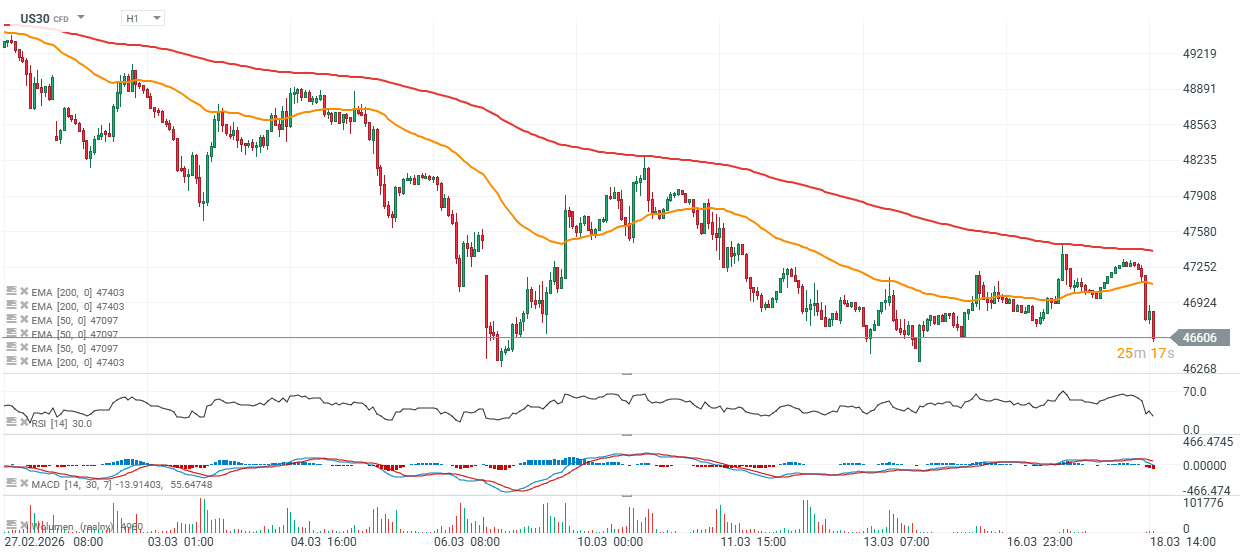
Source: xStation5


US OPEN: Preparations for Tesla's mega-merger with SpaceX. Diplomatic stalemate with Iran cools Wall Street's enthusiasm

RBA turns increasingly hawkish as markets reprice November rate hike expectations ⚔️


Daily Summary: Buyers Refuse to Give In

US Natural gas extends declines 🔥📉