

- SpaceX shares fall more than 6% following the company's quarterly earnings report.
- The company beat Wall Street estimates for both revenue and earnings per share, but the results failed to satisfy investors.
- The report marks SpaceX's first-ever public quarterly financial release.
- Average monthly revenue per Starlink subscriber (ARPU) declined by more than 20% year-over-year.

- SpaceX shares fall more than 6% following the company's quarterly earnings report.
- The company beat Wall Street estimates for both revenue and earnings per share, but the results failed to satisfy investors.
- The report marks SpaceX's first-ever public quarterly financial release.
- Average monthly revenue per Starlink subscriber (ARPU) declined by more than 20% year-over-year.
SpaceX reported strong Q2 2026 results, beating Wall Street expectations on both revenue and operating profitability. The AI segment remained the company's primary growth engine, with revenue nearly tripling year-over-year, while Starlink continued to rapidly expand its subscriber base. SpaceX is becoming increasingly successful at diversifying its revenue streams, narrowing losses in its AI business, and strengthening its position across the space, AI, and connectivity markets. On the other hand, the company's valuation remains extremely demanding.
For a business valued at $1.6 trillion generating roughly $40 billion in annual revenue while still reporting losses per share, there is very little room for execution missteps. Investors will likely need to see hyper-growth metrics sustained for years to justify the current valuation. The company's $47.5 billion backlog also appears relatively modest considering its strong exposure to government contracts. By comparison, Lockheed Martin's backlog exceeds $230 billion, while SpaceX's valuation is several times greater than the combined market capitalization of America's largest defense contractors.
Key highlights from the SpaceX earnings report
- Revenue increased to $7.8 billion, roughly 15% above the $6.82 billion consensus estimate, representing 92% year-over-year and 44% quarter-over-quarter growth.
- Adjusted EPS came in at -$0.09 versus expectations of -$0.29.
- Adjusted EBITDA surged 191% YoY to $3.5 billion, significantly outperforming the $2.0 billion consensus.
- Net loss narrowed to $541 million, substantially better than analysts had expected, reflecting continued improvement in profitability.
- The AI segment's operating loss declined to $1.26 billion from an expected $2.39 billion, highlighting improving operating efficiency.
- AI remained the company's fastest-growing business, with revenue rising 247% YoY to $2.56 billion.
- The Connectivity segment, including Starlink, generated $4.29 billion in revenue, up 66% YoY, remaining SpaceX's largest source of sales.
- The Space segment delivered $962 million in revenue, representing 29% year-over-year growth.
- Starlink subscribers doubled to 12 million, slightly below expectations of 12.19 million, while average revenue per user (ARPU) declined 22% YoY to $66 per month, likely reflecting continued expansion into lower-priced markets.
- Backlog increased to $47.5 billion, providing strong visibility into future revenue.
- SpaceX ended the quarter with $100 billion in cash and investments, maintaining a solid balance sheet.
- Capital expenditures totaled $18.4 billion, reflecting continued aggressive investment in AI infrastructure and space technologies.
- Major corporate developments included the issuance of $25 billion in inaugural senior notes, the announcement of the $60 billion acquisition of Cursor, $14.1 billion in contracted cloud services agreements, and more than $6 billion in multi-year U.S. government Starshield contracts.
- As of the end of June 2026, SpaceX also held 18,712 Bitcoin, worth approximately $1.2 billion at current market prices.
SpaceX nearly doubled revenue while significantly improving profitability despite record investment
The second quarter of 2026 marked another period of exceptional expansion for SpaceX. Revenue nearly doubled year-over-year, comfortably beating analyst expectations, while the company substantially reduced both its net loss and operating loss. Net loss declined to $541 million from more than $1 billion a year earlier, while operating loss narrowed dramatically from $970 million to just $143 million. One of the most impressive metrics was adjusted EBITDA, which surged 191% year-over-year to $3.53 billion, indicating that the core business is scaling much faster than net earnings alone would suggest.
At the same time, SpaceX continues to execute one of the largest investment programs in the technology sector. Capital expenditures increased to $18.3 billion, up from $10.1 billion in the previous quarter and just $2.8 billion a year ago. Most of this spending was directed toward AI infrastructure, which is rapidly becoming one of the company's most important long-term growth pillars. Despite record investment, SpaceX finished the quarter with approximately $100 billion in cash and investments and total assets of $192.7 billion, preserving a comfortable liquidity position. On the other hand, total debt and finance leases increased to roughly $39.3 billion, meaning that sustaining the current pace of investment will require continued rapid growth in revenue and cash generation.
AI and Starlink continue to drive growth, but expectations remain exceptionally high
AI remains SpaceX's fastest-growing business, with revenue increasing 247% year-over-year to $2.56 billion. Equally important, profitability improved significantly as the segment's operating loss nearly halved compared with the previous quarter, while adjusted EBITDA turned positive for the first time, reaching $1.14 billion. Meanwhile, AI computing capacity expanded to 1.4 GW, and the company signed cloud services agreements worth $14.1 billion, suggesting that demand for its AI infrastructure remains exceptionally strong.
Starlink continues to represent the company's second major growth engine. Subscribers doubled to 12 million, the constellation expanded to roughly 10,200 satellites covering 167 countries, and the Connectivity segment generated $4.29 billion in revenue, growing 66% year-over-year. Enterprise and government services remain the fastest-growing areas, supported by new agreements with American Airlines, additional airline partners, SoftBank, NTT Docomo, Spark NZ, and more than $6 billion in multi-year Starshield contracts awarded by the U.S. government.
SpaceX expands its partnership with Nvidia
SpaceX announced a strategic partnership with Nvidia to develop the new Starmind AI-1 computing payload. The project aims to bring data center-class computing capabilities into orbit by utilizing Nvidia's latest Rubin GPUs and Vera CPUs. As a result, the maximum computing capacity of SpaceX satellites is expected to increase to approximately 250 kW, significantly enhancing their ability to process data and run advanced AI models directly in space.
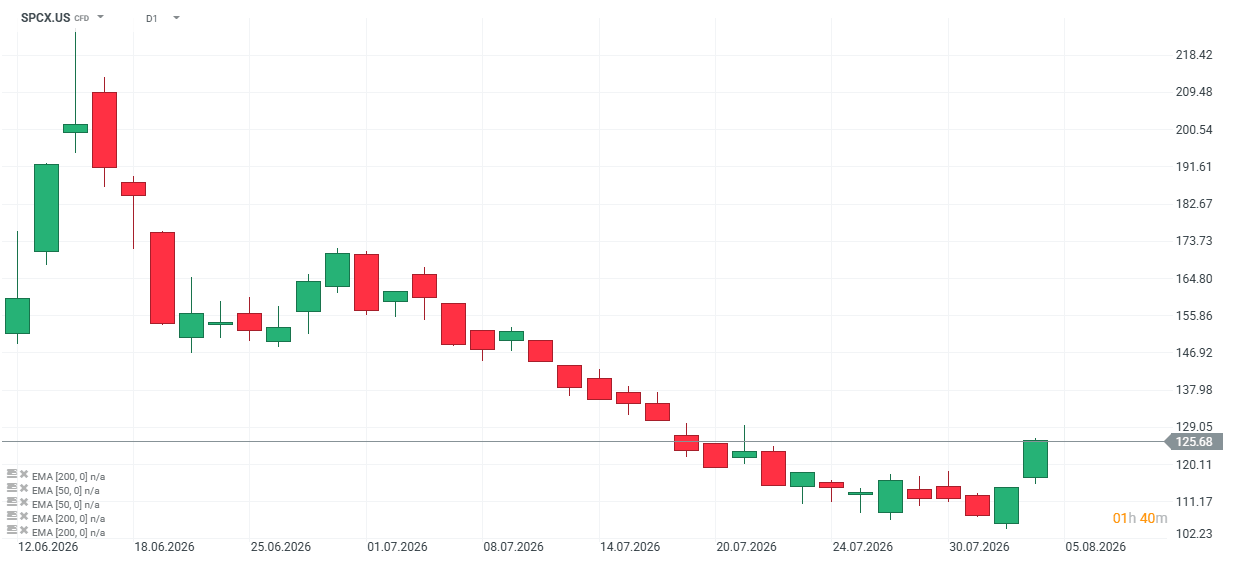
SpaceX shares (SPCX.US), D1 chart
If the stock opens tomorrow near its current after-hours level, it would imply a share price of around $116, approximately 10% above the lows recorded in late July. Even after this rebound, however, the stock remains more than 50% below its post-IPO peak. Data from S3 Partners had already indicated exceptionally heavy short positioning ahead of the earnings release. Around 95% of the shares available for borrowing had been lent to short sellers, with short interest reaching 34% of the free float—an unusually high level of bearish positioning, particularly for one of America's largest publicly traded companies. While such positioning increases the potential for a powerful short squeeze if sentiment improves, the market's initial reaction to the earnings report has been negative. The definitive assessment will come after the regular trading session opens and investors fully digest both the results and management's commentary.
Source: xStation5


🚩 Caterpillar shares extend decline, down 30% from record high


Webull shares down 20% amid fears over potential China ties



US Open: Wall Street in the Red 🚩 Nasdaq Falls 1% From Record Highs, Constellation Brands Back at March 2020 Level



Market Wrap: Oil rises again, French fiscal concerns weigh on euro (07.10.2026)