


The development of artificial intelligence has created a new problem for the semiconductor industry. Increasing the computing power of chips is not enough if data cannot be delivered to them quickly enough. As a result, memory is becoming increasingly important, as is the infrastructure responsible for moving data between memory, compute chips, and the other components of servers. This so-called “memory wall” could become one of the most important constraints on the continued development of AI infrastructure.
This is the problem Marvell Technology aims to capitalize on. The company does not manufacture memory chips themselves, but provides technologies that allow their capacity, bandwidth, and availability to be used more efficiently. Memory controllers, CXL solutions, switches, optical connectivity, PCIe technologies, and custom-designed chips are creating an increasingly important infrastructure layer between memory and compute.
The scale of this business is growing rapidly. In the second quarter of fiscal 2027, Marvell generated $2.74 billion in revenue, up 37% year over year, while data centers already accounted for 79% of sales. The company expects approximately $12 billion in revenue for fiscal 2027 and around $20 billion in 2028. Its long-term ambitions are even greater, with a target of $70 billion to $90 billion in revenue by 2031.
This is where the market’s most important question lies. Will Marvell truly become one of the major beneficiaries of growing demand for memory and data movement in AI infrastructure, or will some of the current expectations prove too optimistic?
Marvell does not need to win the race to build the best AI chip. It only needs to become one of the biggest beneficiaries of the problems that arise around it.
How Marvell Makes Money from AI Infrastructure
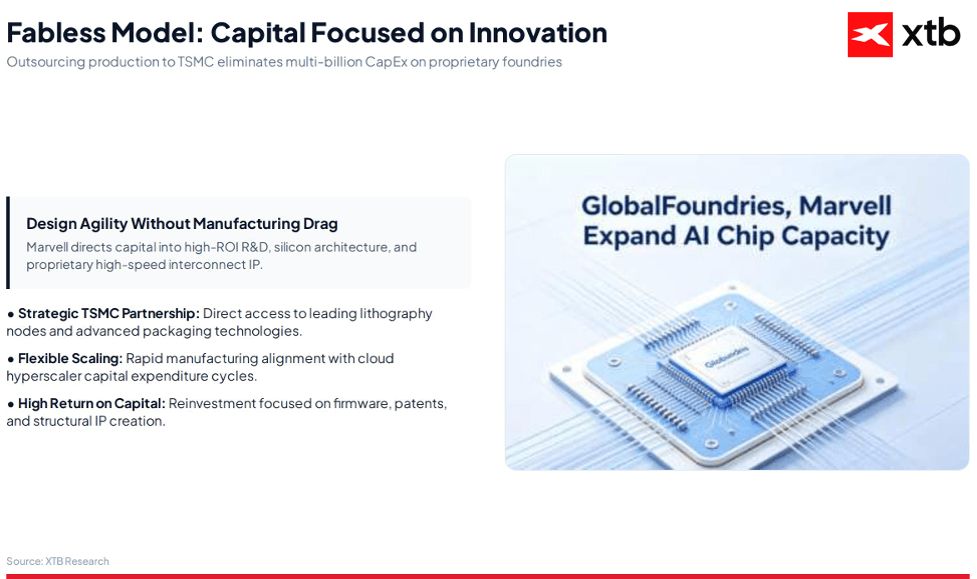
Marvell operates under a fabless model. The company focuses on chip design, architecture, and technology development, while outsourcing manufacturing to external producers, including TSMC. This model allows Marvell to limit spending on its own fabrication facilities and focus capital on designing increasingly advanced chips.
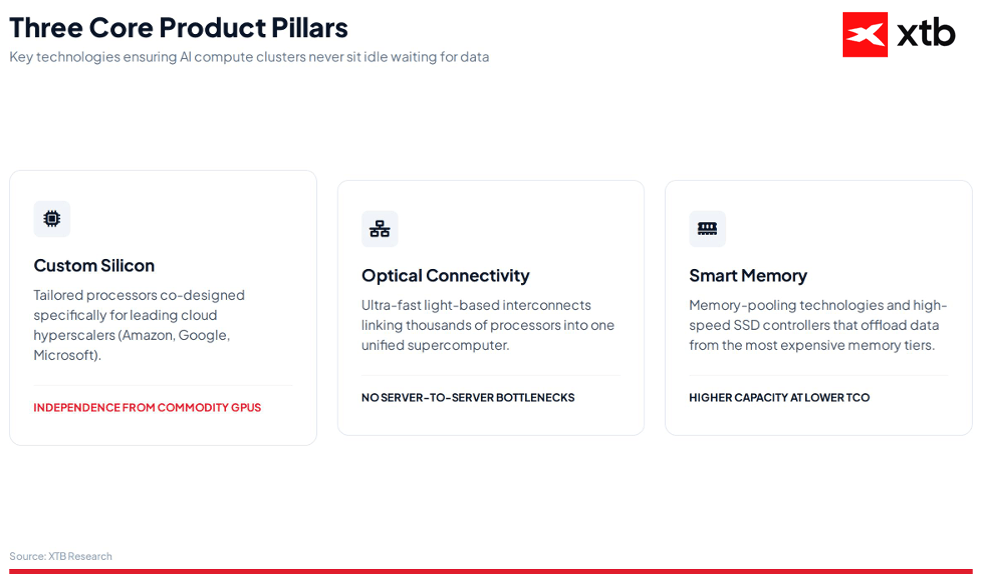
The most important part of the business is becoming custom-designed chips. Marvell works with the largest data-center operators to create solutions tailored to their specific needs. This also includes compute chips designed for artificial intelligence applications. For customers, this provides an opportunity to build their own systems without having to rely exclusively on off-the-shelf solutions from the largest compute-chip manufacturers.
The second major area is technology responsible for moving data. Marvell supplies networking chips, switches, signal processors, and optical solutions. Their importance increases with the number of chips operating within a single system. The larger the computing cluster, the more data must be moved between processors, memory, and additional servers.
The third area is memory and storage. Among other things, Marvell develops CXL solutions that allow memory to be expanded and shared, as well as SSD controllers used in data centers. This directly complements the problem described in the previous section. If memory becomes one of the constraints on AI infrastructure, technologies that allow it to be managed more efficiently and the data stored in it to be moved more effectively become increasingly valuable.
Marvell is therefore present across several layers of the infrastructure. On one hand, it designs custom compute chips; on the other, it supplies components responsible for memory, data storage, and communication between different parts of the system. The story is not about one specific product, but about the growing complexity of the entire AI infrastructure stack.
If data centers require increasingly greater computing power, they will simultaneously require more memory, faster connections, and greater network bandwidth. Marvell can therefore expand its presence alongside the expansion of the entire system, even if it is not the manufacturer of the primary compute chip.
For investors, the key question is therefore how much of the infrastructure required to operate AI systems Marvell will be able to address. This leads directly to the next section, where we can turn to the numbers and examine how quickly the business is growing and what kind of quality lies behind that revenue growth.
The Memory Wall: A New AI Infrastructure Problem
The development of artificial intelligence is increasingly shifting the bottleneck from raw computing power to data delivery. The most advanced AI chips can perform an enormous number of operations, but their capabilities are limited if memory cannot supply data quickly enough. As models grow, demand is increasing not only for computing power but also for memory bandwidth, capacity, and faster communication between different elements of the data center.
This problem is particularly visible during inference. Longer contexts, larger numbers of users, and systems performing multiple sequential tasks increase the amount of data stored while a model is running. Some of that data needs to be located very close to the compute chip, but expensive HBM has limited capacity. This creates demand for additional memory layers, faster storage devices, and technologies that can move data between them without creating bottlenecks.
The company does not manufacture HBM or chips in its own fabs, but it designs a broad range of chips used throughout AI infrastructure. This includes custom-designed chips for the largest data-center operators, as well as solutions responsible for memory, storage, and data movement. Marvell is developing CXL technologies that allow memory to be expanded and shared, storage controllers capable of moving some data away from expensive HBM resources, and optical solutions that enable increasingly large amounts of information to be transferred between chips.
This is important because Marvell does not need to win the race for the fastest AI chip in order to benefit from the growth of this market. Its products include both compute chips designed for specific customers and the entire infrastructure layer surrounding them. The larger an AI system becomes, the more memory, connections, switches, and communication chips are required for the infrastructure to operate efficiently.
Limited memory supply could further increase the importance of these technologies. If HBM remains an expensive and scarce resource, data-center operators will have greater incentives to use it as efficiently as possible and move some data to other memory layers. In such a scenario, Marvell could benefit not only from the growing number of AI chips, but also from the increasing value of the infrastructure required to deliver data to those chips.
This is the core of the current investment thesis surrounding Marvell. The company designs both custom compute chips and technologies responsible for memory, communication, and data movement. The greater the challenge of delivering data to AI chips becomes, the greater the potential value of solutions designed to address that problem.
A Record Quarter
Marvell’s results show that AI-related growth is no longer merely a future expectation. In the second quarter of fiscal 2027, the company generated $2.7 billion in revenue, up 37% year over year. This was the highest level of sales in the company’s history, and the result was $39 million above the midpoint of management’s previous guidance.
Data centers remain the most important source of growth. Revenue from this segment increased 46% year over year and already accounted for the vast majority of sales. Importantly, the growth is not coming from just one type of product. Marvell points to strong demand for both connectivity-related solutions and custom-designed chips. Management also expects its custom-chip business to accelerate further in the second half of fiscal 2027.
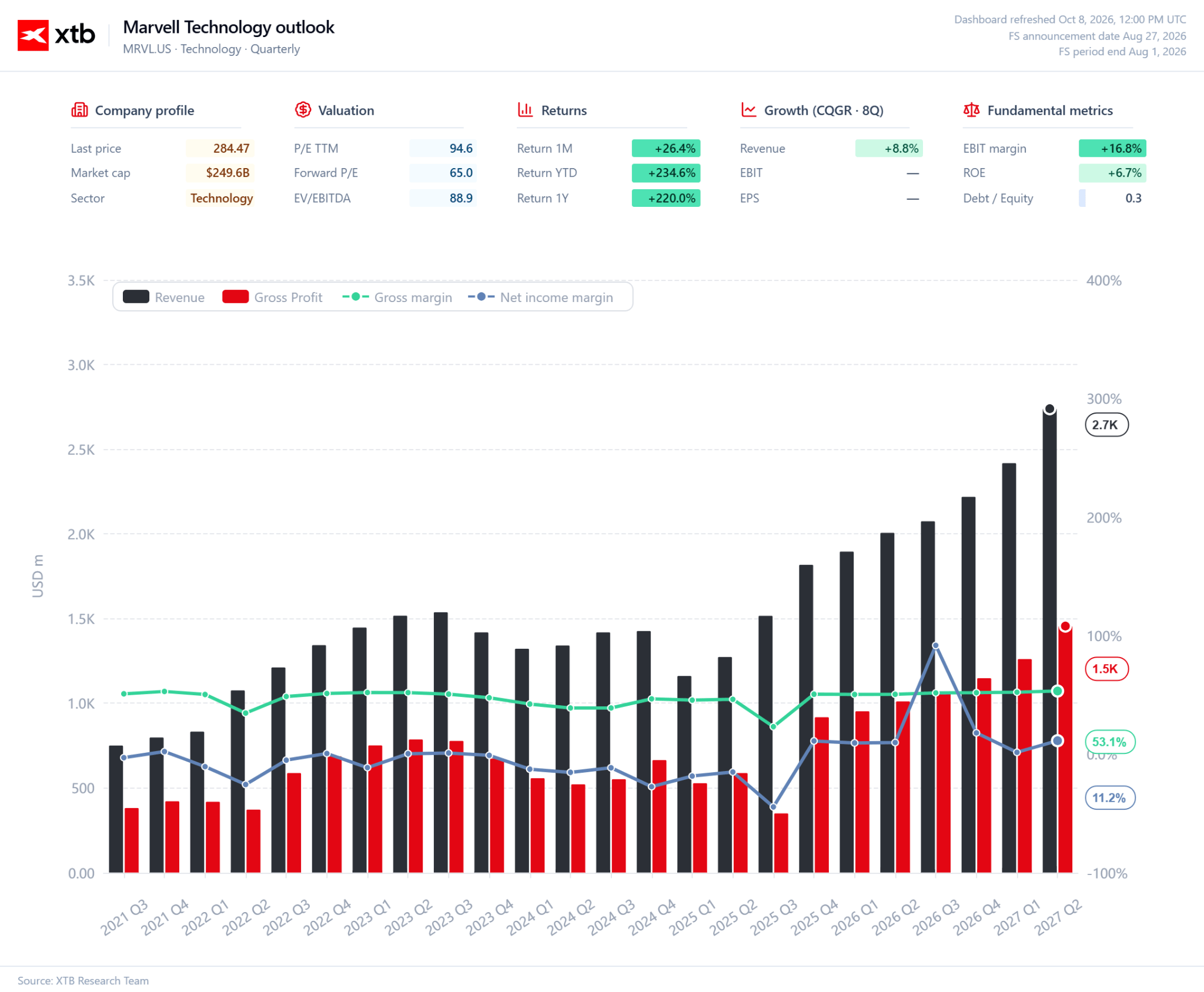
From a profitability perspective, the picture is somewhat more complex. Marvell reported a gross margin of 53.1% under GAAP and 58.9% on an adjusted basis. Net income was $308 million under GAAP and $865.9 million on a non-GAAP basis. The difference is substantial, which means investors cannot evaluate the company solely by looking at earnings per share.
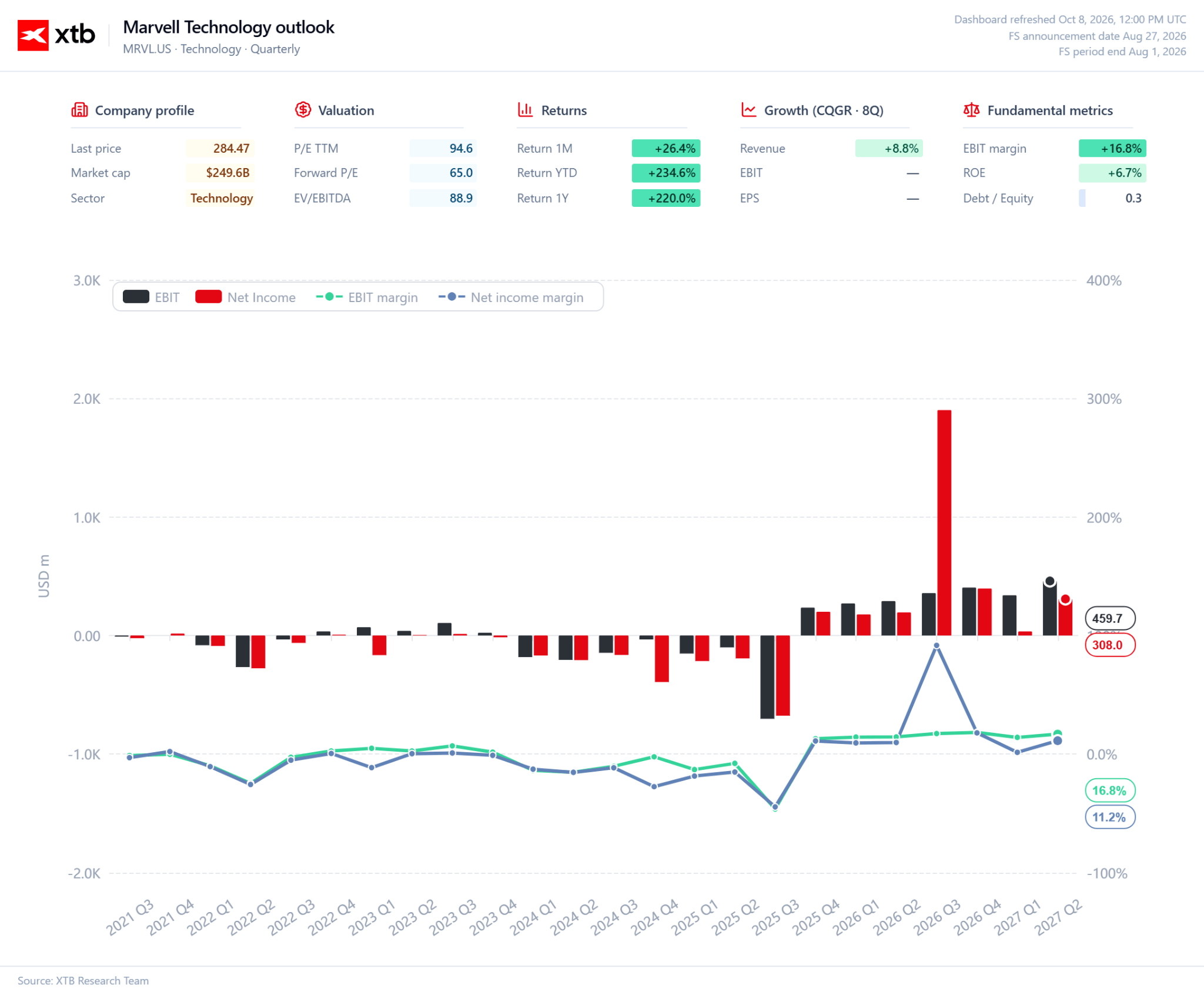
At the same time, the company is generating significant amounts of cash. Operating cash flow totaled $605.5 million during the quarter. This is important because rapid revenue growth in the semiconductor industry can require higher inventories, prepayments, and spending to secure supply. Revenue growth alone would therefore not be a sufficient argument if it did not also translate into cash flow.
Even more important than the results themselves is the outlook for the next quarter. Marvell expects approximately $3.15 billion in revenue, with a potential variance of 5%. The midpoint of the guidance implies further growth from the second quarter. The company also expects a gross margin of between 57.5% and 58.5% and approximately $1.10 in earnings per share.
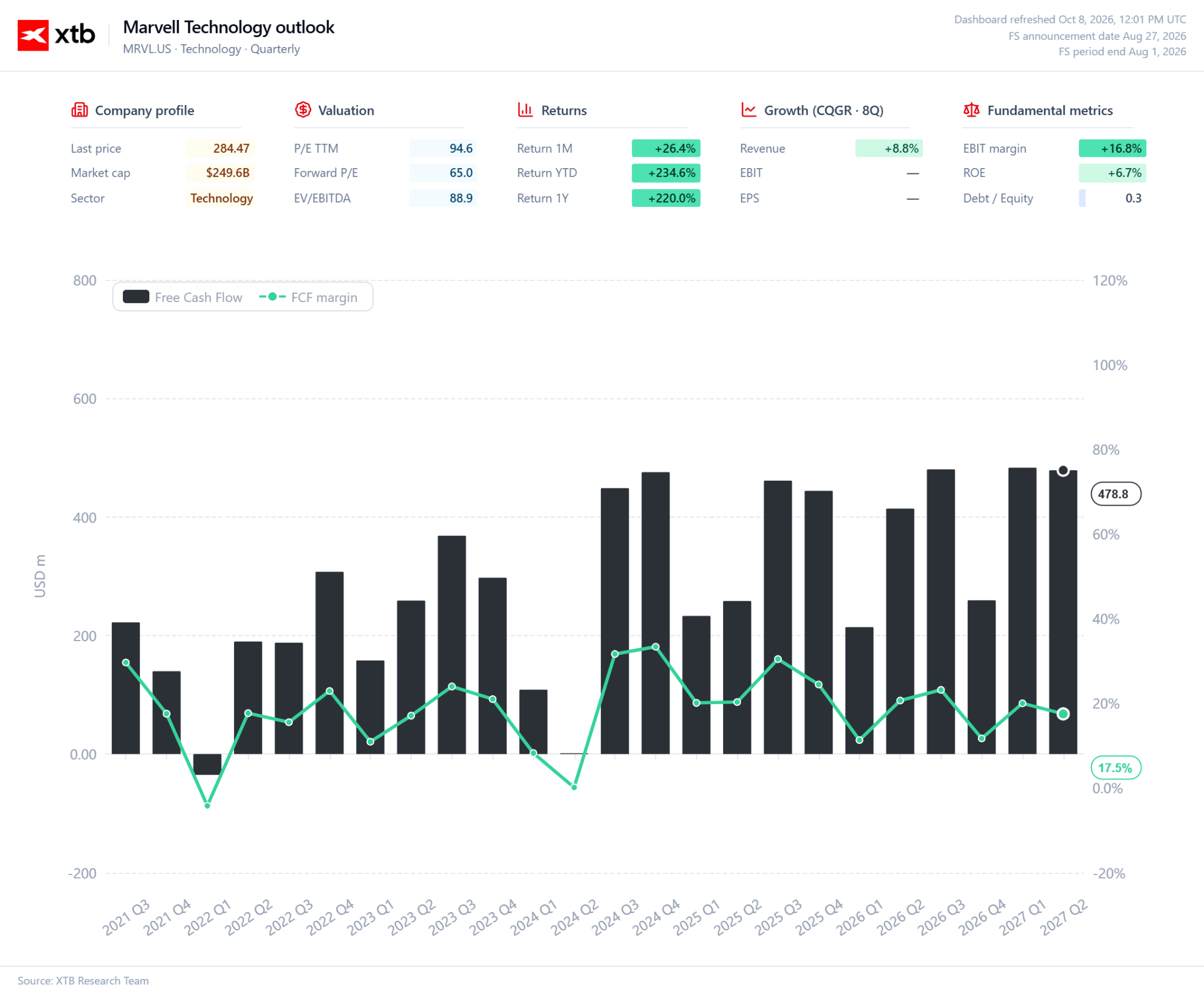
The most important conclusion from these figures is that Marvell is not merely increasing sales; it is currently in a phase of rapid expansion. The question is therefore shifting from whether the company is growing to how long it can sustain its current pace and whether the coming years will deliver equally strong improvements. At the current valuation, the answer to this question will matter much more to investors than the record quarter itself.
Ambitious Targets and Risks
Marvell faces very rapid growth ahead, but some of the current expectations are based on the assumption that spending on AI infrastructure will remain high for years to come. Management expects approximately $12 billion in revenue in fiscal 2027 and around $20 billion in 2028. Its longer-term target is even more ambitious: revenue of $70 billion to $90 billion by 2031.
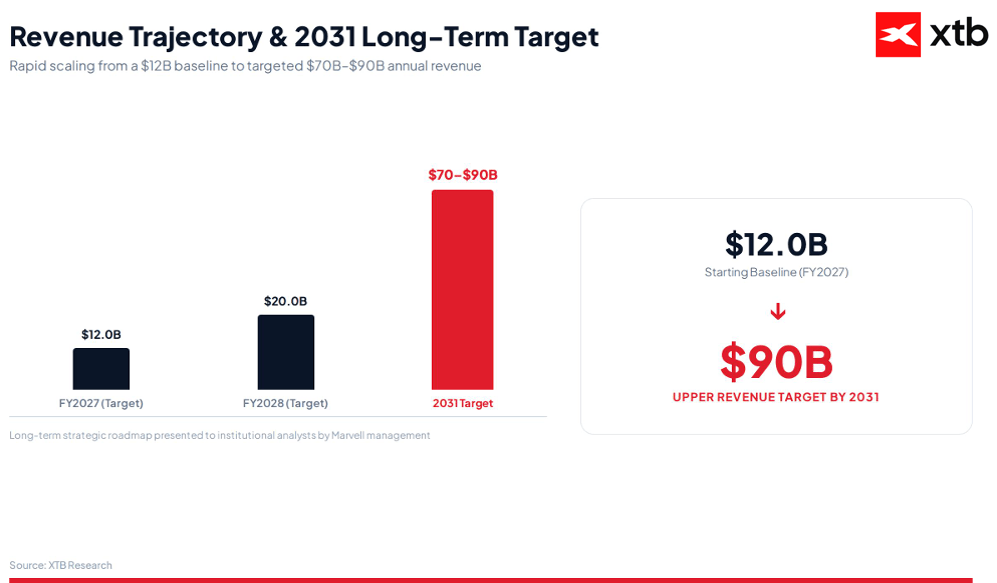
The near-term target is much easier to evaluate than the assumptions for the end of the decade. Marvell already has concrete programs with the largest data-center operators, and growth is expected to come from several areas simultaneously. In addition to custom-designed chips, the company is counting on growth in optical connectivity, switches, and memory-related technologies. This reduces its dependence on any single product, but it does not eliminate the execution risk associated with these plans.
The most important risk is directly connected to the memory wall. If HBM remains an expensive and constrained resource, technologies that improve memory utilization could become increasingly important. If, however, a large amount of new supply comes online over the next few years, memory prices fall, and manufacturers increase HBM availability, the pressure to find alternative ways of using memory could diminish. Improvements in AI-model efficiency, data compression, or shorter context lengths could have a similar effect.
This does not mean demand for Marvell’s products would disappear. Even with cheaper memory, data centers will need faster connections, switches, custom-designed chips, and optical solutions. The issue is rather that some of the current growth expectations could prove too high if the pace of AI infrastructure expansion begins to slow.
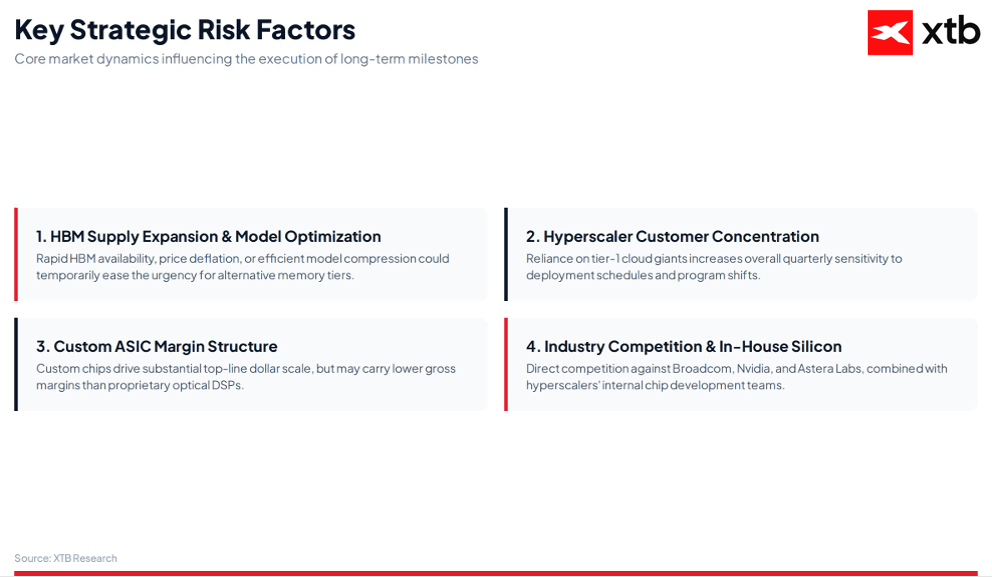
The second risk is customer concentration. Marvell works with the largest data-center operators, providing access to projects of enormous scale, but this also makes a significant portion of its sales dependent on the decisions of a handful of companies. Delays to a single major program could have a noticeable impact on results. Competition is similarly important. Marvell’s largest customers are developing their own solutions, while in some areas the company also competes with Broadcom, Nvidia, and Astera Labs.
Margins also need to be considered. Custom-designed chips can generate very large revenues, but their margins do not necessarily have to be as high as those of some more specialized products. Revenue growth will therefore not be sufficient if profitability deteriorates at the same time. This will be particularly important as the share of large contracts continues to increase.
The biggest uncertainty appears around the $70 billion to $90 billion revenue target for 2031. To reach that level, Marvell must not only maintain its existing programs but also win additional projects, increase its share of AI infrastructure spending, and successfully introduce new technologies. The further we look beyond 2028, the more depends on the company’s future market share in a market whose eventual size cannot yet be determined with precision.
The coming years will therefore primarily be a test of execution. If demand for memory, bandwidth, and data movement continues to grow, Marvell could increase sales across multiple parts of the infrastructure simultaneously. If, however, the memory problem begins to ease faster than the market expects and data-center spending slows, very high expectations for the company could begin to work against it.
Could Marvell Become One of AI’s Biggest Beneficiaries?
Marvell occupies an interesting position in the development of artificial intelligence infrastructure. The company does not have to compete with Nvidia to create the best compute chip. Its products sit around those chips—in memory, networking, switches, storage, and optical connectivity. If AI systems continue to grow, demand for these components should grow as well.
The biggest opportunity is the continued intensification of the memory and data-movement problem. Larger models, longer contexts, and growing numbers of users increase the amount of information that must be stored and transferred. In such an environment, solutions that allow memory to be used more efficiently and data to be moved more quickly could become just as important as computing power itself.
Marvell also has several potential sources of growth. Custom-designed chips can increase sales as the largest data-center operators launch additional projects. Optical and networking solutions can benefit from the growing number of chips operating within a single system, while memory technologies can gain from rising demand for capacity and bandwidth.
This does not mean that achieving the company’s current targets is a foregone conclusion. The coming years will show whether Marvell can actually increase its share of AI infrastructure spending, whether new programs will be launched according to plan, and whether revenue growth will translate into sufficiently high profitability. Conditions in the memory market will also be important. If HBM supply increases rapidly, some of the pressure that currently increases the value of efficient memory utilization could weaken.
At this stage, Marvell primarily looks like a company benefiting from the growing complexity of data centers. Its advantage is not a single breakthrough product, but its ability to supply many of the components required to connect computing power, memory, and networking.
If AI spending remains high and the problem of moving and storing data continues to intensify, Marvell has the potential to grow faster than a traditional semiconductor supplier. If investment slows, memory supply increases rapidly, or the largest customers reduce their purchases, however, the company’s current growth momentum could weaken significantly.
For now, the most important point is that Marvell has exposure to several rapidly growing parts of AI infrastructure simultaneously. This gives the company substantial room for further growth, but given its ambitious financial targets, the market will require those targets to be progressively validated in the coming quarters.
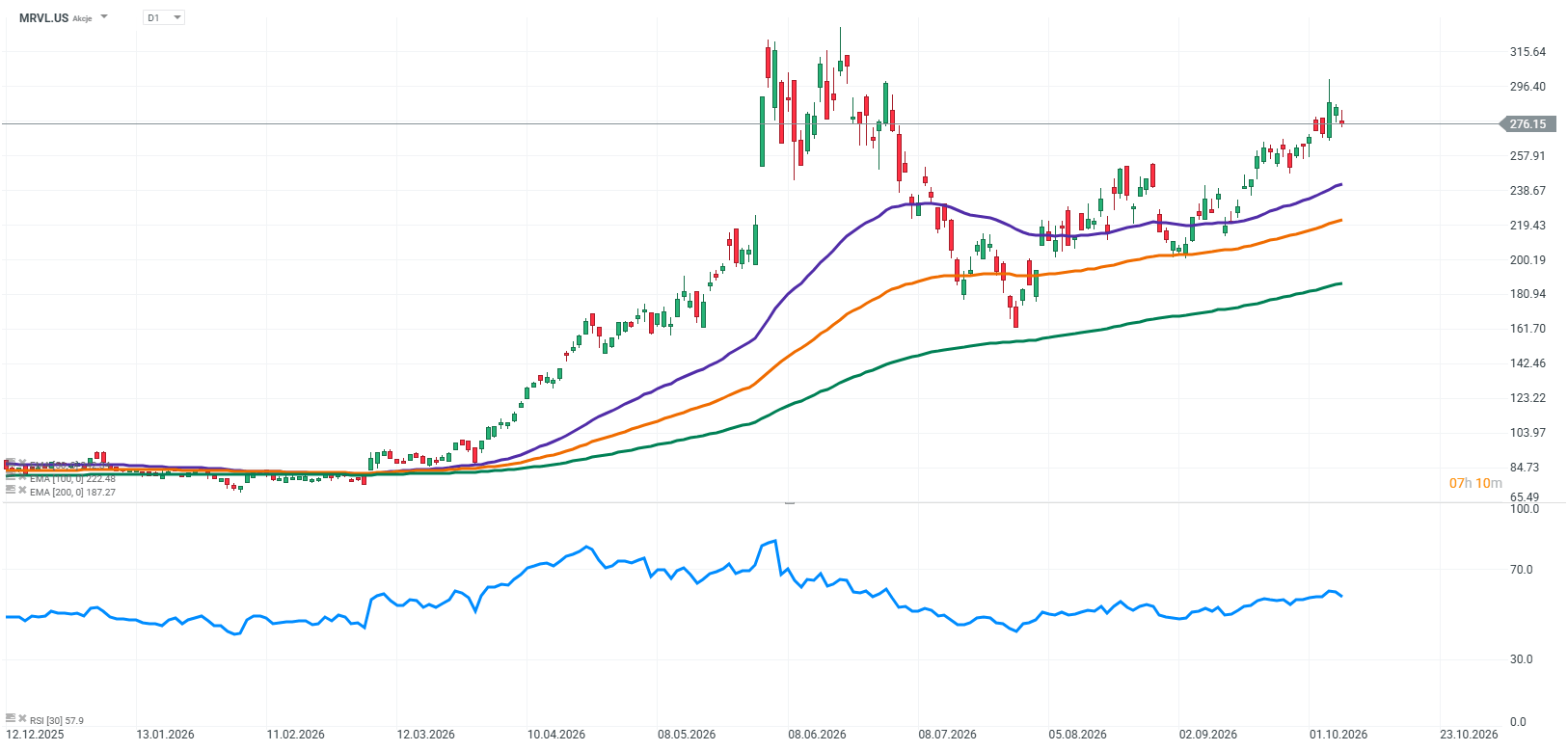
Source: XTB Reserach



Is Starbucks eyeing Chipotle❓ The market reacts nervously to the FT's reports of a takeover🔥



Market Wrap: A 4% surge in oil prices weighs on indices (08.10.2026)


🚩 Caterpillar shares extend decline, down 30% from record high


Webull shares down 20% amid fears over potential China ties