


In recent years, the technology market has focused primarily on companies developing artificial intelligence solutions. Nvidia provides the chips powering modern data centers, Microsoft and Google are investing billions of dollars in computing infrastructure, and countless businesses are trying to integrate generative AI into their products and services. However, behind every major AI success story stands a company whose role often receives far less attention, despite being one of the most important elements enabling the entire industry to grow.
Taiwan Semiconductor Manufacturing Company is where a significant share of the world’s most advanced semiconductors are produced. The chips designed by companies such as Nvidia, AMD, Apple and Broadcom are manufactured in TSMC’s facilities before becoming the foundation of the most important devices, servers and data centers supporting the global economy.
The company’s position is unique because TSMC does not compete with its customers. Unlike traditional semiconductor companies, it does not design its own processors or graphics cards. Instead, it focuses exclusively on the most complex stage of the semiconductor value chain: large scale chip manufacturing. This business model has allowed TSMC to become the critical link between semiconductor design and physical production.
Recent quarterly results showed that the investment cycle connected with artificial intelligence is still accelerating. The company reached record levels of revenue, maintained exceptionally high profitability and presented a very positive outlook for the coming quarters. Particularly important was the growing contribution of the High Performance Computing segment, which includes chips used in artificial intelligence infrastructure and advanced data centers.
For investors, TSMC’s results matter far beyond the performance of a single company. In many technology businesses, a quarterly report mainly reflects the condition of one specific enterprise. TSMC, however, provides one of the clearest signals of real demand for the most advanced technologies. When the world’s largest technology companies increase spending on artificial intelligence development, demand for TSMC’s production capacity rises as well.
The story of TSMC is therefore, in many ways, the story of the entire semiconductor industry. The company is not only benefiting from the growth of artificial intelligence, but also making that growth possible. Every new stage of AI development requires more advanced chips, and their production sits at the very center of TSMC’s business.
The key question for investors is therefore not only how much artificial intelligence can grow, but also who will capture the economic value created by this transformation. TSMC is positioned at one of the most important points in the entire technology ecosystem.
In the following sections, we will examine why the Taiwanese company has built one of the most difficult competitive advantages in the world to replicate, how artificial intelligence is changing the structure of its business and whether the current valuation still leaves room for further growth.
Why TSMC Is One of the Most Important Semiconductor Companies in the World
In the case of TSMC, the greatest advantage is not a single product, but the company’s position within the global technology supply chain. The Taiwanese company created the pure play foundry model, meaning a semiconductor manufacturer that produces chips exclusively for external customers. This approach allows the world’s largest technology companies to design their most advanced chips while relying on a partner with unmatched manufacturing capabilities.
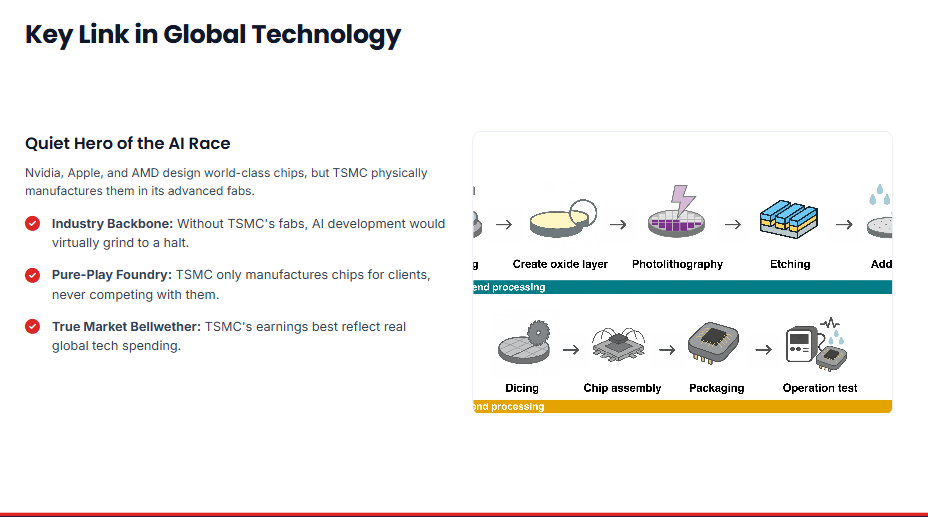
This model has made TSMC one of the most important foundations of the digital economy. The company produces chips used by Nvidia, AMD, Apple and many other technology leaders, while the rise of artificial intelligence has further increased its strategic importance.
The structure of TSMC’s business has clearly shifted toward artificial intelligence and high performance computing. The High Performance Computing segment has become the company’s main growth engine, replacing the previous dominance of consumer electronics. This means the current semiconductor cycle is not driven primarily by smartphone or computer upgrades, but by the long term expansion of infrastructure required to develop and operate AI models.
However, TSMC’s advantage is not based only on scale. Manufacturing the world’s most advanced semiconductors is one of the most complex industrial processes ever created. Building a semiconductor facility is not enough. The real challenge is achieving mass production with the required level of quality, efficiency and consistency.
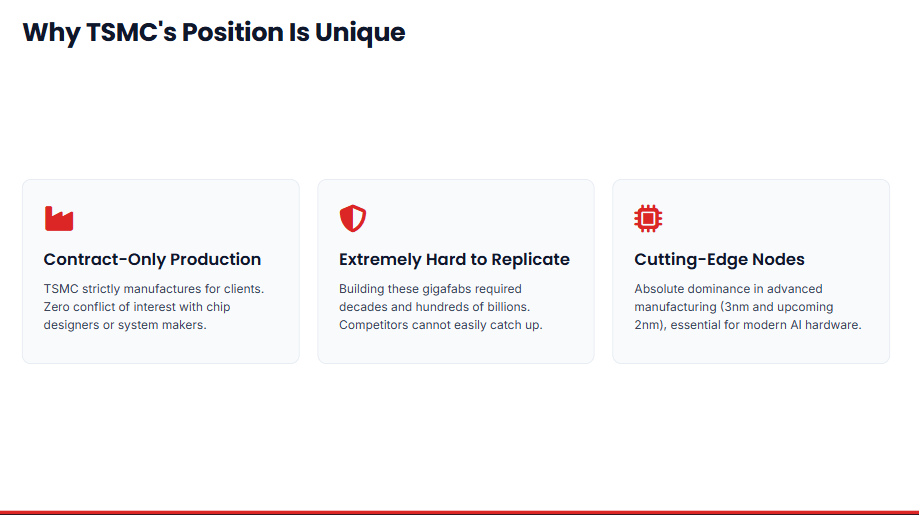
This is exactly why TSMC’s position is so difficult to challenge. Over decades, the company has built relationships with the largest technology companies in the world, developed a powerful supplier ecosystem and invested hundreds of billions of dollars into successive generations of manufacturing technology. Today, TSMC benefits from both rising demand for AI chips and the increasing value of each individual semiconductor produced.
TSMC’s Technological Advantage: From 3nm to the 2nm Era
In the semiconductor industry, developing a new technology is not the biggest challenge. The real difficulty lies in the ability to manufacture that technology at massive scale while maintaining high quality, efficiency and reliability. This is where TSMC has built one of its strongest competitive advantages.
The most advanced manufacturing processes, including 3nm and the upcoming 2nm technology, allow companies to create chips with higher performance and lower energy consumption. This is especially important for artificial intelligence data centers, where even small improvements in efficiency can translate into significant reductions in operating costs across enormous computing infrastructures.
The 3nm process has become one of the key drivers of TSMC’s current growth. As the company moves toward mass production of 2nm chips, it is entering another stage of technological development that should help maintain its leadership in the most demanding segments of the semiconductor market.
At the same time, advanced semiconductor packaging is becoming increasingly important. The future of artificial intelligence is no longer based only on making transistors smaller. The most powerful AI systems require the integration of multiple chips into highly efficient computing systems.
This creates two parallel growth opportunities for TSMC. On one side, demand continues to rise for the most advanced manufacturing processes. On the other side, additional technologies related to chip integration and advanced packaging are becoming increasingly valuable parts of the semiconductor ecosystem.
The Market Received Exactly What It Was Looking For
TSMC’s quarterly results have become one of the most important events during earnings season for the semiconductor industry. The reason is simple. The Taiwanese company sits at the center of the global technology supply chain, meaning its results provide insight not only into its own business performance, but also into the investment activity of the world’s largest companies developing artificial intelligence.
The second quarter of 2026 delivered exactly the type of performance investors were expecting. TSMC exceeded its own forecasts, achieving record revenue levels and maintaining exceptional profitability. Even more important than the headline numbers was management’s commentary regarding future quarters. The company increased its expectations for revenue growth and maintained a highly positive outlook for artificial intelligence and high performance computing demand.
-
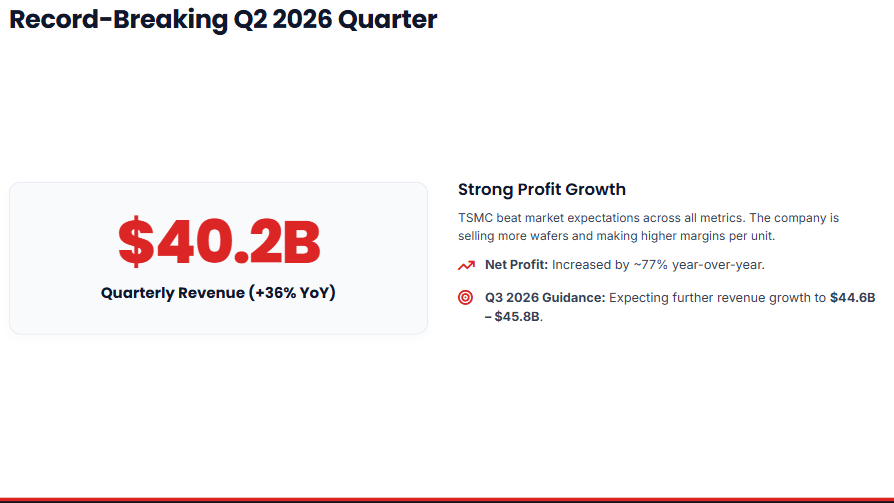
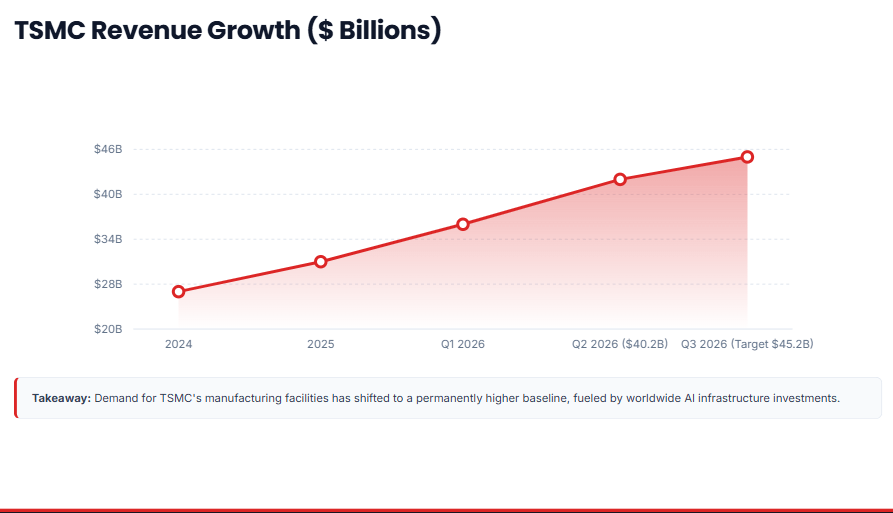
Revenue reached $40.2 billion, representing a 36% increase compared with the previous year and the highest level in the company’s history.
-
Net income increased by approximately 77% year over year.
-
Gross margin reached 67.7%, exceeding previous expectations.
-
The High Performance Computing segment accounted for approximately 66% of total revenue.
-
Technologies based on 7nm processes and more advanced nodes represented around 77% of wafer revenue, while demand for 3nm technology continued to grow rapidly.
The results highlighted several important trends. First, the current semiconductor growth cycle is fundamentally different from previous periods. This time, the main driver is not consumer electronics, but the infrastructure required for artificial intelligence development.
A few years ago, TSMC’s results were strongly connected with the condition of the smartphone market. Today, a much larger role is played by chips used in data centers, AI accelerators and high performance computing systems. This segment has become the largest part of the company’s business and remains its primary source of growth.
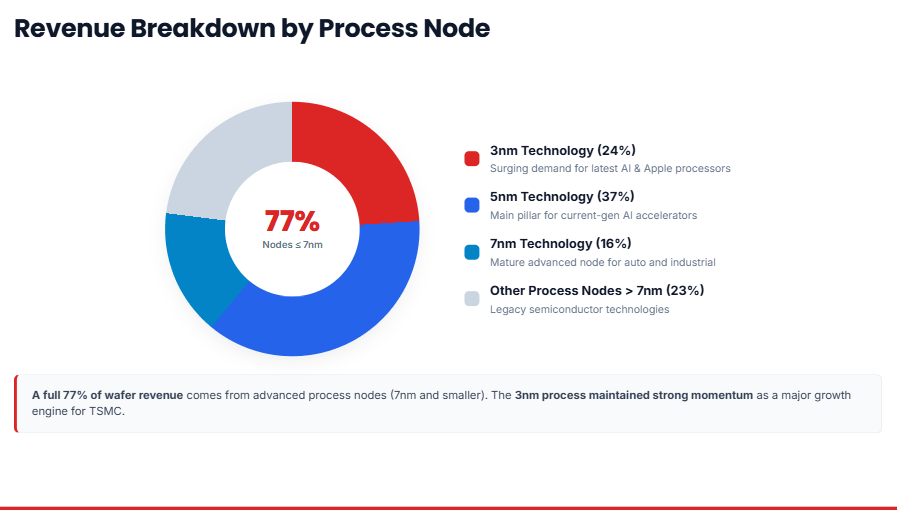
Another important signal is profitability. In the semiconductor industry, rapid growth often requires enormous investments and can create pressure on margins. TSMC demonstrates a different reality. Strong demand for the most advanced chips allows the company to maintain exceptional profitability because customers are willing to pay premium prices for access to limited manufacturing capacity based on the latest technologies.
Importantly, TSMC is not benefiting only from higher production volumes. As customers transition toward increasingly advanced manufacturing processes, the value of each individual order also increases. The production of 3nm chips, development of 2nm technology and expansion of advanced packaging capabilities place the company in the most attractive part of the semiconductor market.
Investors also reacted positively to the company’s outlook for the following quarters. Management expects demand to remain strong, with third quarter revenue projected to increase further to approximately $44.6 billion to $45.8 billion. At the same time, TSMC continues to expect very high margins, confirming that current market conditions remain exceptionally favorable.
However, such rapid expansion requires massive investment. TSMC is increasing spending on new manufacturing facilities, technology development and production capacity expansion to meet demand from customers such as Nvidia, AMD and Apple. The scale of these investments represents both the company’s greatest strength and one of its biggest challenges. They allow TSMC to maintain its technological advantage, but they also require significant capital and careful management of the investment cycle.
The quarterly report confirmed the central part of the TSMC investment thesis. The company is not simply benefiting from the artificial intelligence boom. It occupies a position where this boom must physically take place. Every new stage of AI development requires greater computing power, more advanced chips and increasingly complex semiconductor manufacturing.
Financial Analysis: Turning Technological Leadership Into Record Results
A dominant technological position alone is not enough to define an exceptional business. The key question is whether a company’s competitive advantage translates into superior financial performance. In the case of TSMC, recent years have shown that the company has become not only the world’s largest semiconductor manufacturer, but also one of the biggest beneficiaries of the artificial intelligence infrastructure boom.
The first factor that stands out is revenue growth. After a weaker period across the semiconductor industry caused partly by inventory corrections following the pandemic, TSMC returned to a strong growth trajectory. In the second quarter of 2026, revenue reached a record $40.2 billion, representing a 36% increase year over year. This recovery demonstrates that the company is positioned directly at the center of the current AI investment cycle.
Even more impressive is the structure of this growth. It is not driven only by higher production volumes, but mainly by a shift toward the most advanced technologies. The High Performance Computing segment, which includes AI chips and processors used in data centers, now represents around two thirds of company revenue. This is a fundamental change compared with previous semiconductor cycles, when consumer electronics played a much larger role.
TSMC’s strongest financial characteristic remains its profitability. Semiconductor manufacturing requires enormous capital expenditure, which means many companies in the sector struggle with margin pressure. TSMC operates in a completely different environment. Thanks to technological leadership, high utilization rates and strong negotiating power with customers, the company maintains margins rarely seen in traditional manufacturing businesses.
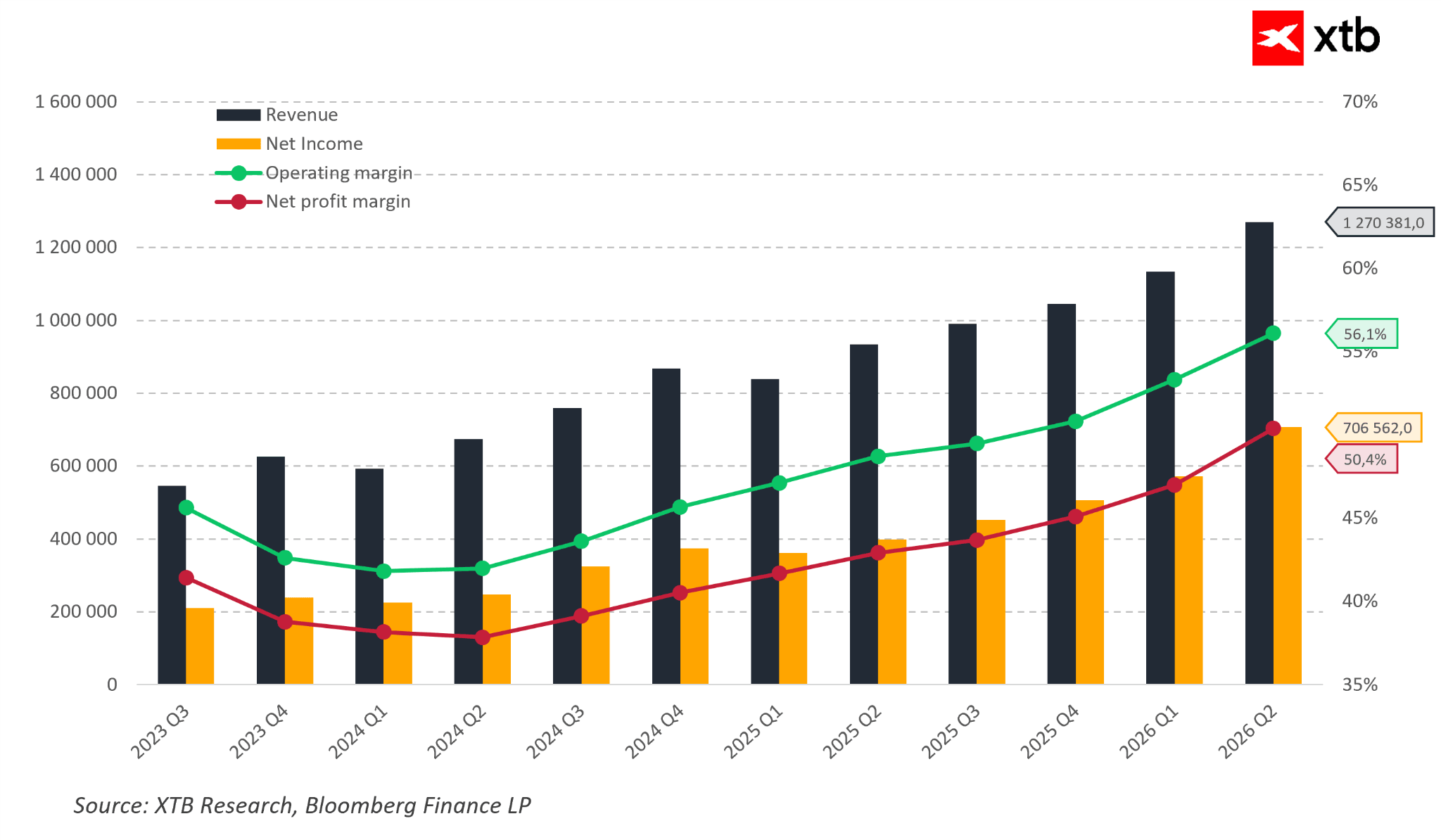
In the second quarter of 2026, operating margin reached 56.1%, while net margin stood at 50.4%. Such profitability demonstrates that TSMC is not competing only through manufacturing scale. The highest value comes from the most advanced technologies, where the number of potential competitors is extremely limited.
One of the most impressive aspects of TSMC’s business model is its ability to maintain high margins despite record investment levels. Every year, the company spends tens of billions of dollars on new factories, research and development, and production capacity expansion. In theory, such aggressive expansion could reduce returns on capital, but the current market structure allows TSMC to successfully monetize these investments.
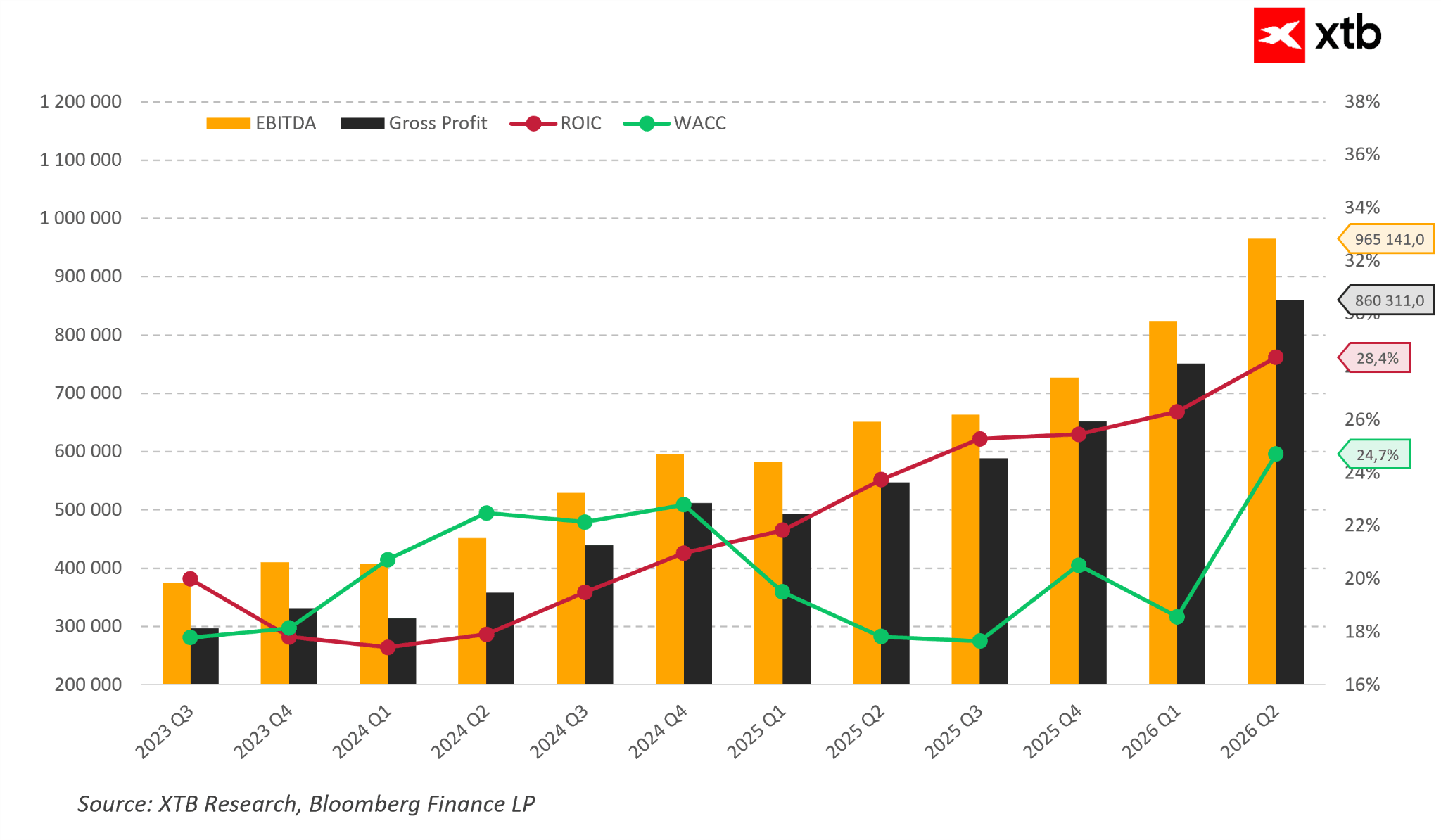
A key measure of business quality is return on invested capital. A strong ROIC demonstrates that TSMC’s enormous investments are not simply costs, but assets generating long term value for shareholders.
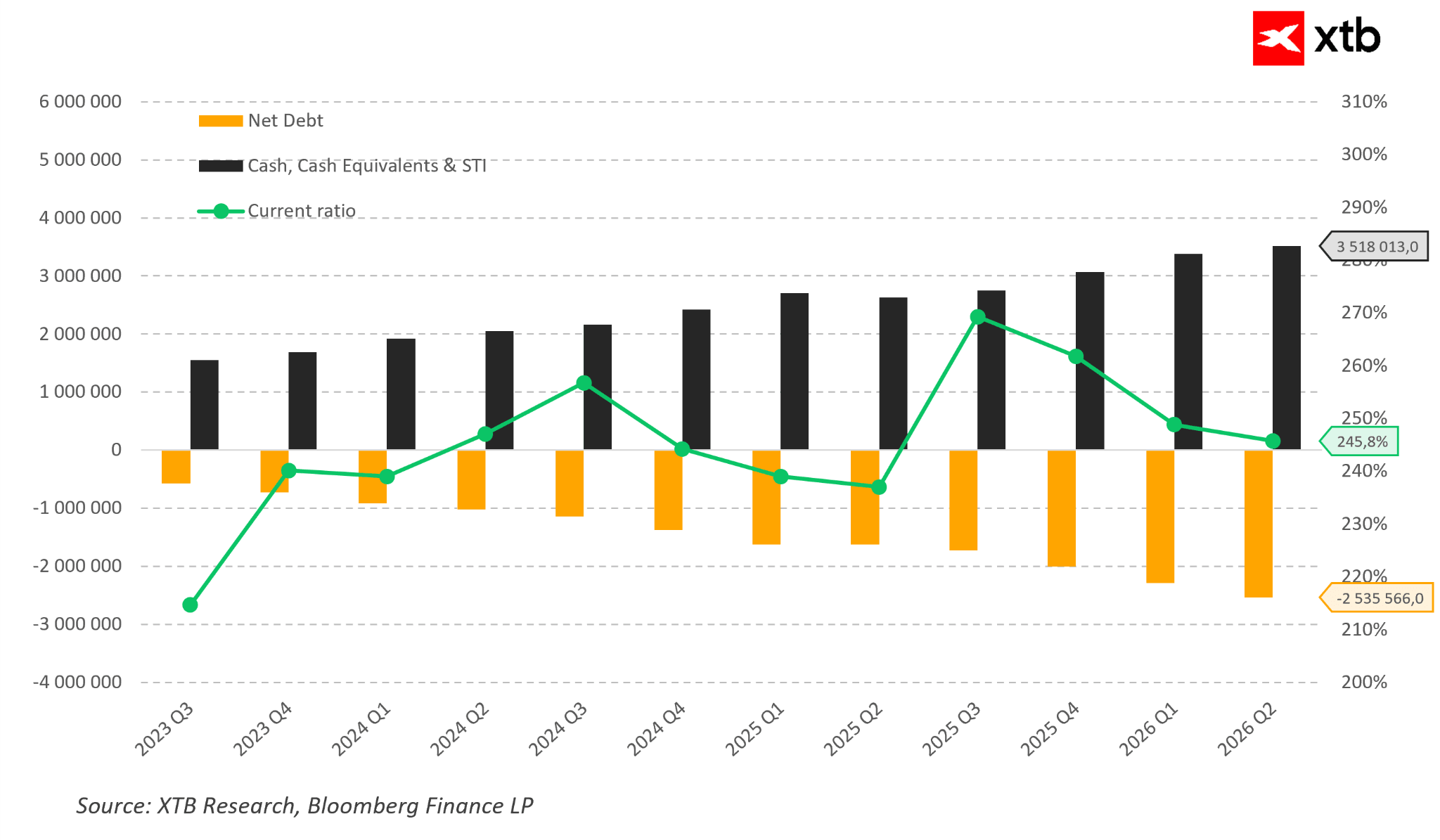
The company’s financial position is also extremely strong. TSMC maintains a solid balance sheet, giving it significant flexibility to execute future investment projects. This is especially important in an industry where maintaining competitive advantage requires constant spending on research, new facilities and next generation technologies.
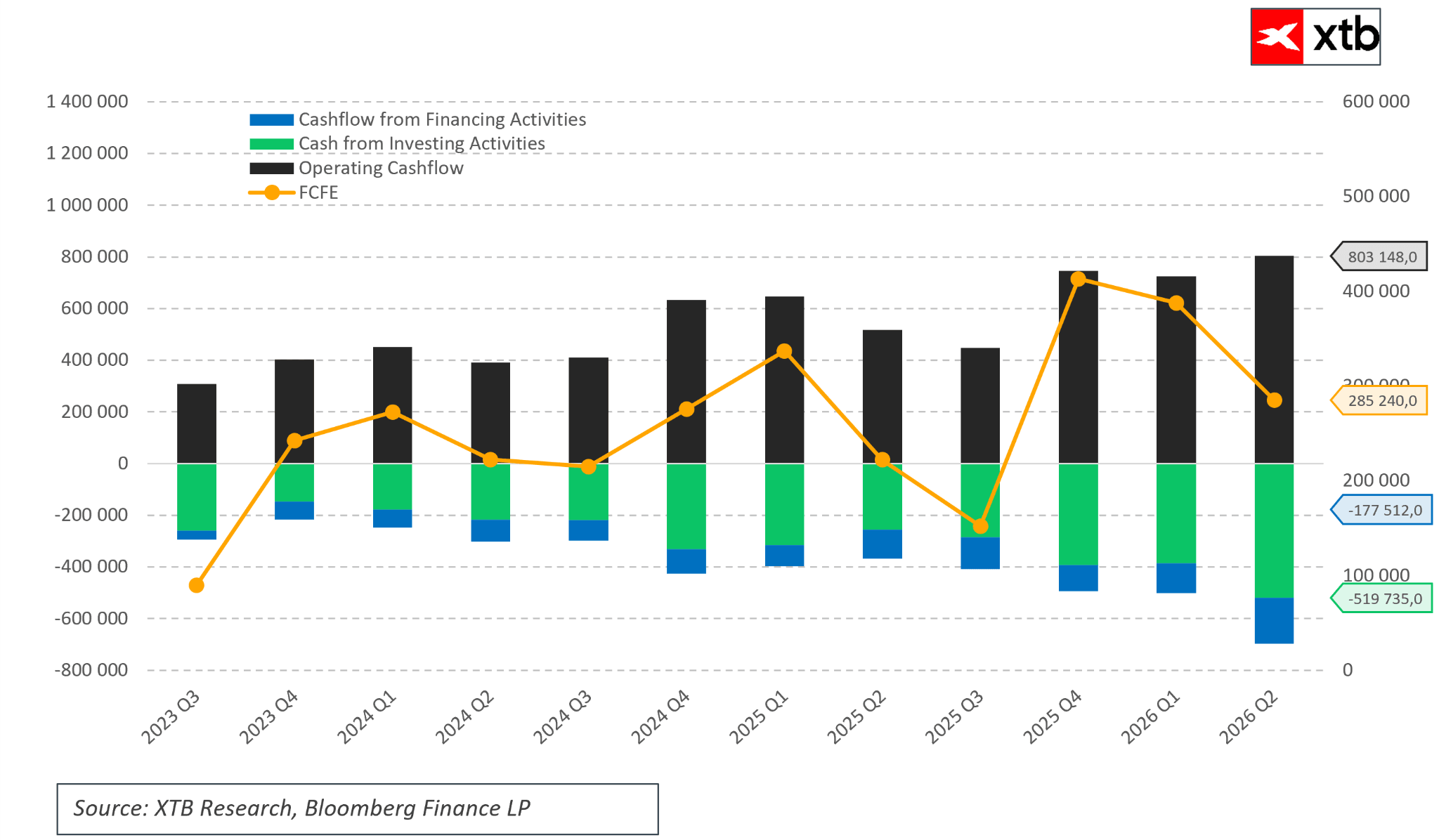
Cash flow generation is another important strength. Despite enormous capital expenditures, TSMC remains a business capable of generating substantial amounts of cash. The company finances its expansion primarily through the strength of its own operations, reducing dependence on external financing and preserving strategic independence.
The greatest proof of TSMC’s business quality is therefore not only its growth rate, but its ability to combine several difficult characteristics at the same time. The company is expanding its scale, investing record amounts into the future and maintaining some of the highest margins in the entire technology sector.
This combination is what makes TSMC far more than just a chip manufacturer. It is one of the most important companies supporting the development of the global artificial intelligence infrastructure.
What Will Drive TSMC in the Coming Years?
For TSMC, the most important question is not whether the company is currently the leader of the semiconductor market. Its position remains exceptionally strong. The much more important question is whether the current pace of growth can continue in the coming years and whether today’s investments will translate into further financial expansion.
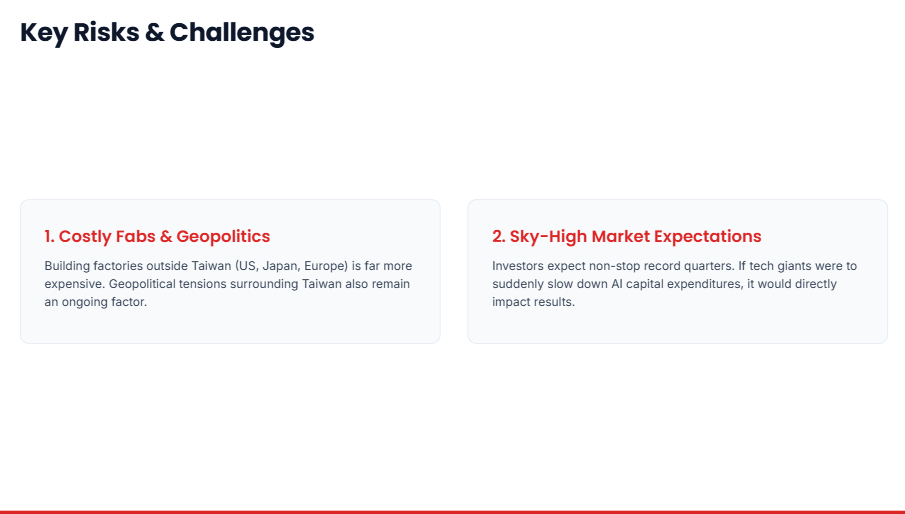
The biggest growth driver remains artificial intelligence. The current investment cycle is different from previous semiconductor upcycles because it is not driven mainly by consumer device upgrades. This time, the key factor is the construction of the entire infrastructure required to develop AI models, operate data centers and support systems that require enormous computing power.
This is exactly where TSMC occupies a unique position. The company manufactures some of the most advanced chips for the largest technology companies in the world, and growing demand for AI accelerators and server processors directly translates into higher orders. The High Performance Computing segment has become the most important part of TSMC’s business, and everything indicates that its importance will continue increasing.
Another major growth factor is the development of new generations of manufacturing technology. The transition to the 2nm process will be one of the most important milestones in TSMC’s history because it should allow the company to maintain its leadership in the most demanding areas of the semiconductor market. For companies developing artificial intelligence systems, every improvement in chip performance and energy efficiency has enormous importance, especially as data centers consume increasing amounts of electricity.
At the same time, advanced semiconductor packaging is becoming an increasingly important source of competitive advantage. Modern AI systems are no longer built only around individual chips produced using the newest manufacturing processes. The ability to combine multiple components into a single, highly efficient computing system is becoming equally important.
Technologies such as CoWoS are therefore becoming another pillar of TSMC’s advantage and an additional source of revenue growth. As artificial intelligence models become more complex, demand for advanced packaging solutions should continue increasing.
Another important factor is TSMC’s ability to maintain high margins. Strong demand for the most advanced technologies gives the company the ability to gradually increase pricing and improve the quality of its revenue mix. When production capacity remains limited and customers compete for access to the newest manufacturing technologies, TSMC’s negotiating position remains extremely strong.
However, the company also faces significant challenges. Expanding manufacturing capacity outside Taiwan, including new facilities in the United States, Japan and Europe, requires enormous capital investment. Annual spending reaching tens of billions of dollars demonstrates how capital intensive the semiconductor industry has become. At the same time, these investments are essential if TSMC wants to maintain its technological leadership and satisfy growing customer demand.
In the long term, TSMC’s greatest advantage is the fact that almost every scenario involving further artificial intelligence development requires more advanced semiconductors. If technology companies continue increasing spending on AI infrastructure, TSMC should remain one of the main beneficiaries of this transformation.
The company’s growth story is therefore not based on one specific product or a short term market trend. It is built on the increasing importance of semiconductors across the global economy and the fact that more industries are becoming dependent on advanced computing power.
A Strong Business With Exceptional Advantages, But Also Extremely High Expectations
TSMC’s greatest strength is its difficult to replicate competitive advantage. Decades of investment in technology, enormous production scale and close relationships with the world’s largest technology companies have created a business model that is extremely difficult to challenge. Competitors can invest billions of dollars into new factories, but rebuilding the complete ecosystem, manufacturing expertise and customer trust developed by TSMC would require many years.
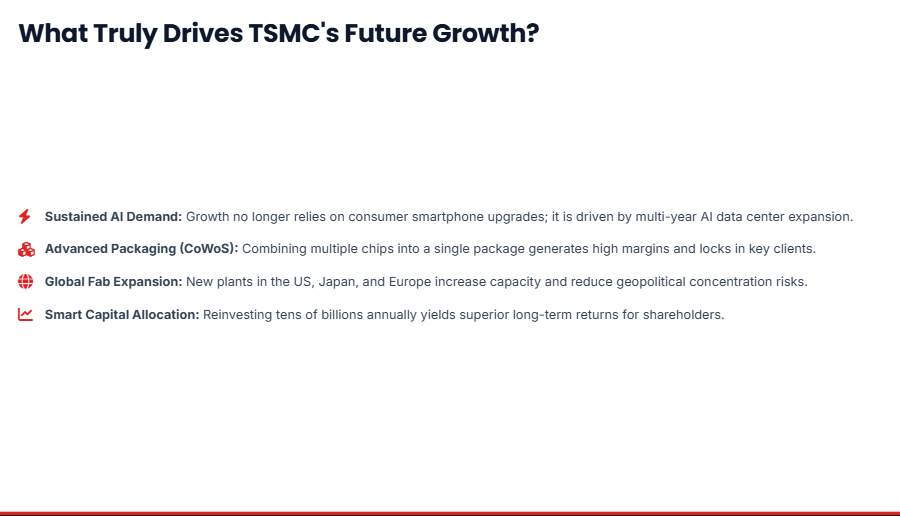
At the same time, the company faces challenges typical for an organization positioned at the center of a global technology race. The increasing scale of investments requires continued strong demand, while expanding production outside Taiwan increases operating complexity and costs. Another important factor is geopolitics and the risk associated with concentrating the world’s most advanced semiconductor manufacturing capacity on a single island.
For investors, however, the biggest question is not whether TSMC is an exceptional company. The fundamentals clearly suggest that it is. The key issue is whether the pace of artificial intelligence development, rising demand for computing power and continued adoption of advanced semiconductors will be strong enough to justify current market expectations.
The investment thesis behind TSMC is based on the belief that artificial intelligence is not a temporary trend, but a technological transformation comparable to previous digital revolutions. If this scenario unfolds, the Taiwanese company should remain one of the biggest beneficiaries of this structural change.
TSMC represents a business with exceptional characteristics: enormous barriers to entry, outstanding profitability and strategic importance for the entire technology ecosystem. However, this very strength also creates high expectations. In the coming years, investors will need to evaluate not only whether TSMC can continue growing faster than the broader market, but also whether the scale of future growth will be sufficient to justify the company’s current valuation.
TSMC is no longer simply a semiconductor manufacturer. It has become one of the most important infrastructure companies behind the artificial intelligence revolution. The future performance of the company will depend not only on technological leadership, but also on whether global demand for AI capabilities continues expanding at a pace capable of supporting today’s ambitious expectations.
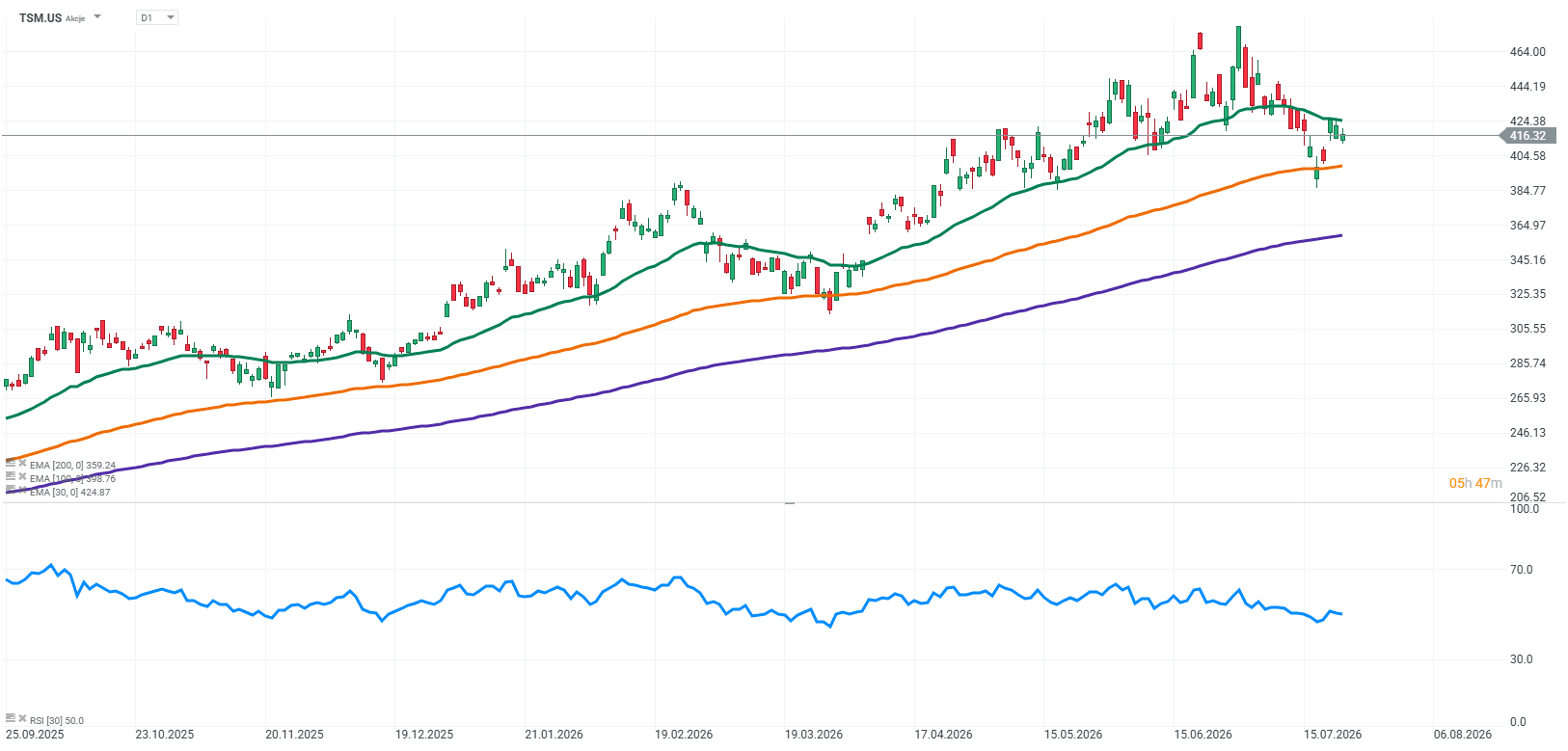
Source: xStation5



Daily Summary: Rising inflation weighs on markets, semiconductors suffer most (14.10.2026)


US Open: CPI reading weighs on American indices (14.10.2026)

POET: A “meme stock” in photonics, is there still hope?



Market Wrap: ASML lifts tech sentiment, EU yields pull back