



- July CPI rose 0.1% m/m and 3.4% y/y, in line with expectations, while core inflation came in at 0.2% m/m and 2.5% y/y, allowing markets to maintain the scenario of no rate hike in September.
- Fed funds futures are now pricing in roughly a 58% probability that the Fed will keep rates unchanged in the 3.50–3.75% range in September, up from just over 45% a week ago.
- Technology is once again emerging as the main driver of Wall Street: CoreWeave is up around 18%, Super Micro Computer 13% and Nebius more than 16%, while Micron, Dell and Cisco are also posting solid gains.
- Results from AI infrastructure companies suggest that despite questions surrounding the scale of capital spending by the largest technology firms, underlying demand for data centers and computing capacity remains strong, supporting the broader AI supply chain today.
- Oil remains the key risk factor, with WTI once again moving above $83 per barrel as hopes for a swift reopening of the Strait of Hormuz fade, potentially keeping pressure on energy prices and complicating the inflation outlook in the U.S.
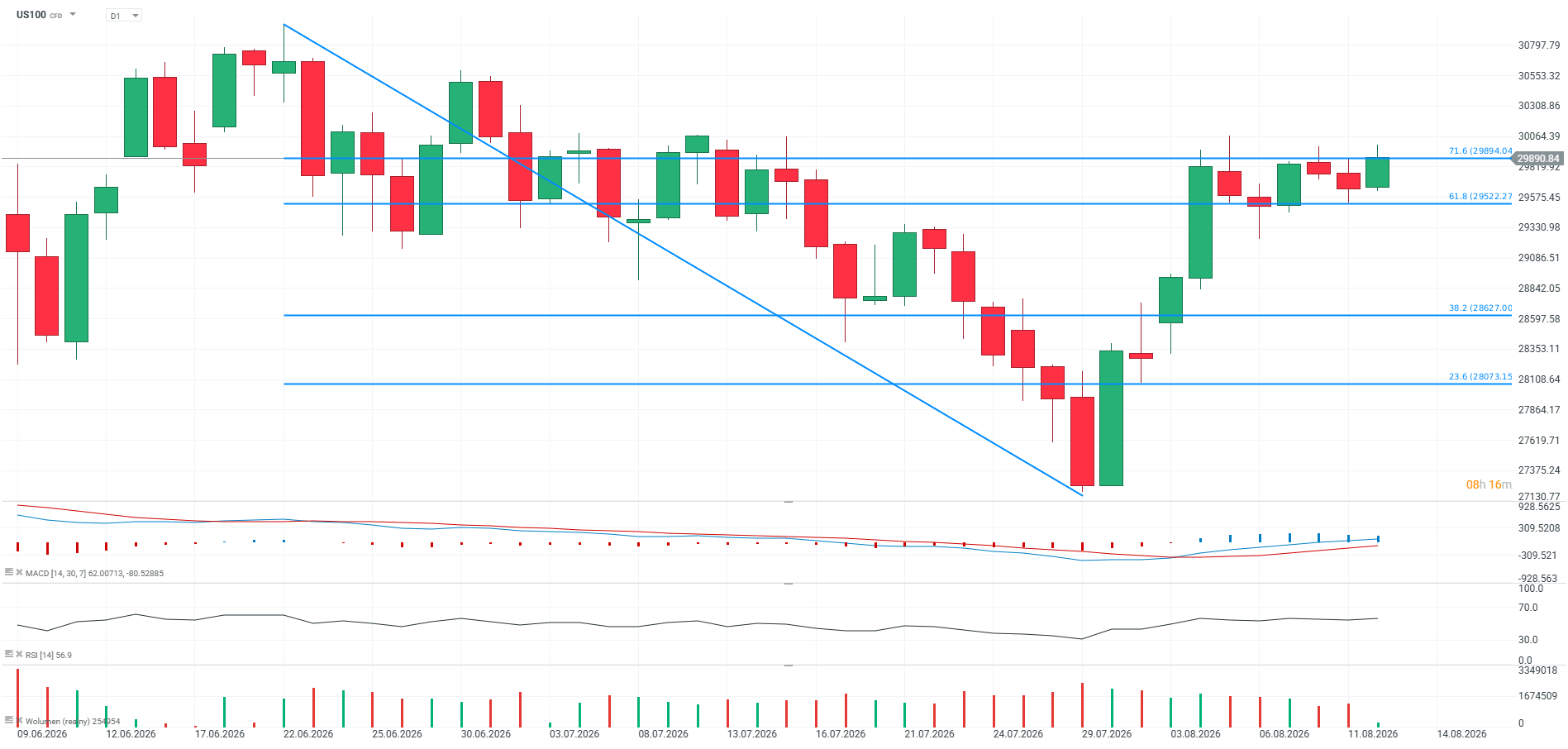
US100 (D1 interval)
The Nasdaq 100 futures contract has reached the 71.6% Fibonacci retracement of the latest downward impulse from the turn of June and July. A breakout above 30,000 points could trigger a stronger bullish impulse, potentially opening the way toward new all-time highs in the 30,800-point area.
Source: xStation5
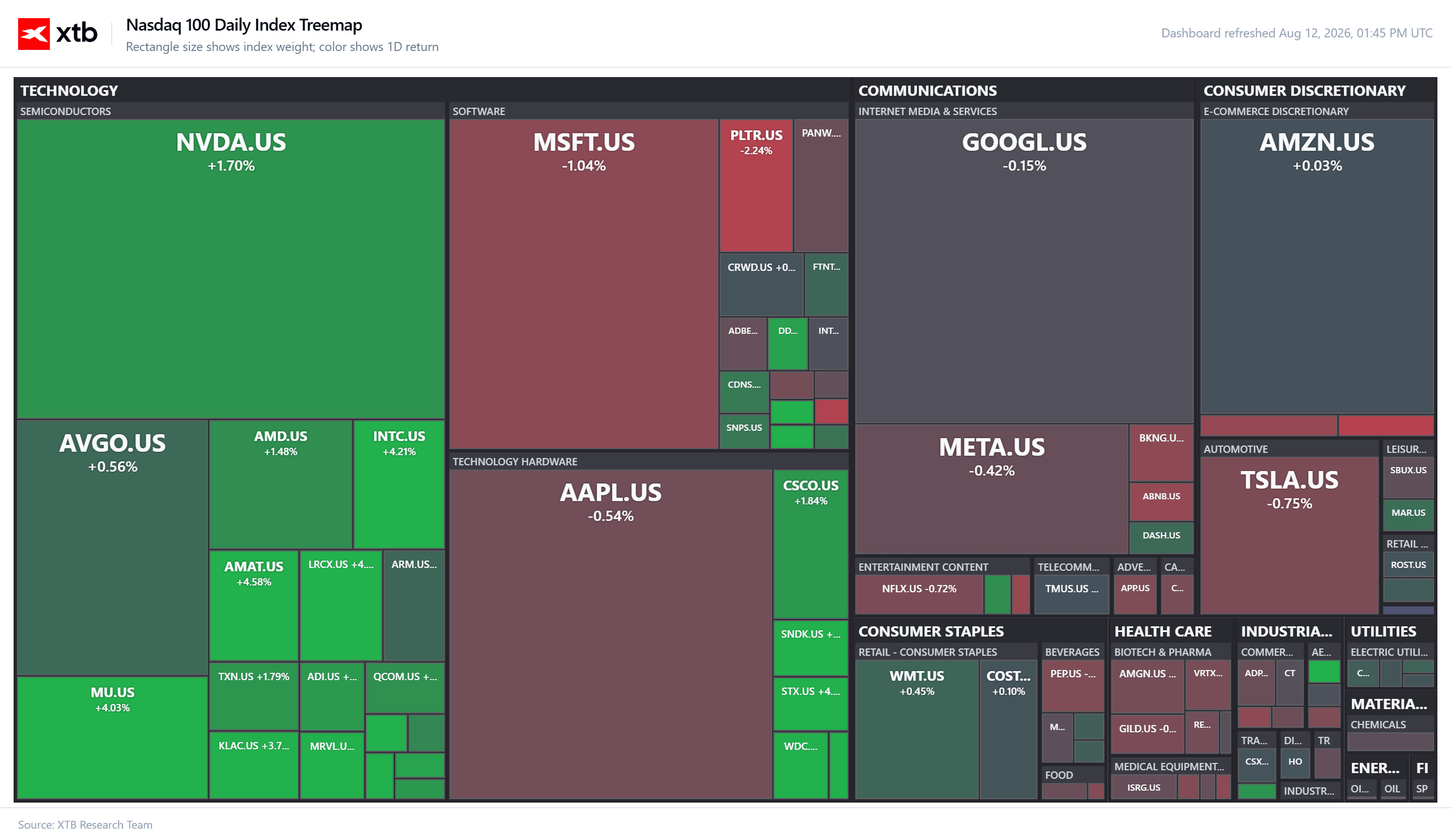
Nasdaq 100 – market heatmap
The Nasdaq 100 remains under slight pressure, but the underlying picture is considerably stronger than the headline index suggests, as semiconductor stocks are seeing broad buying interest. Nvidia is gaining around 1.7%, while Applied Materials, Intel, Micron and Lam Research are posting even stronger advances, pointing to continued demand for companies exposed to AI and computing infrastructure. The main drag comes from the largest software and internet names, with Microsoft down around 1%, Apple 0.5%, Meta 0.4%, while Alphabet remains slightly in negative territory. In practice, capital is not leaving technology as a whole but rotating toward semiconductors at the expense of some megacaps. Nvidia is particularly important given its large index weight, as its gains are helping offset weakness across several other major constituents. The session therefore remains highly selective: risk appetite has not disappeared, but investors are increasingly differentiating between individual companies even within the Nasdaq 100’s largest segments.
Source: XTB Research
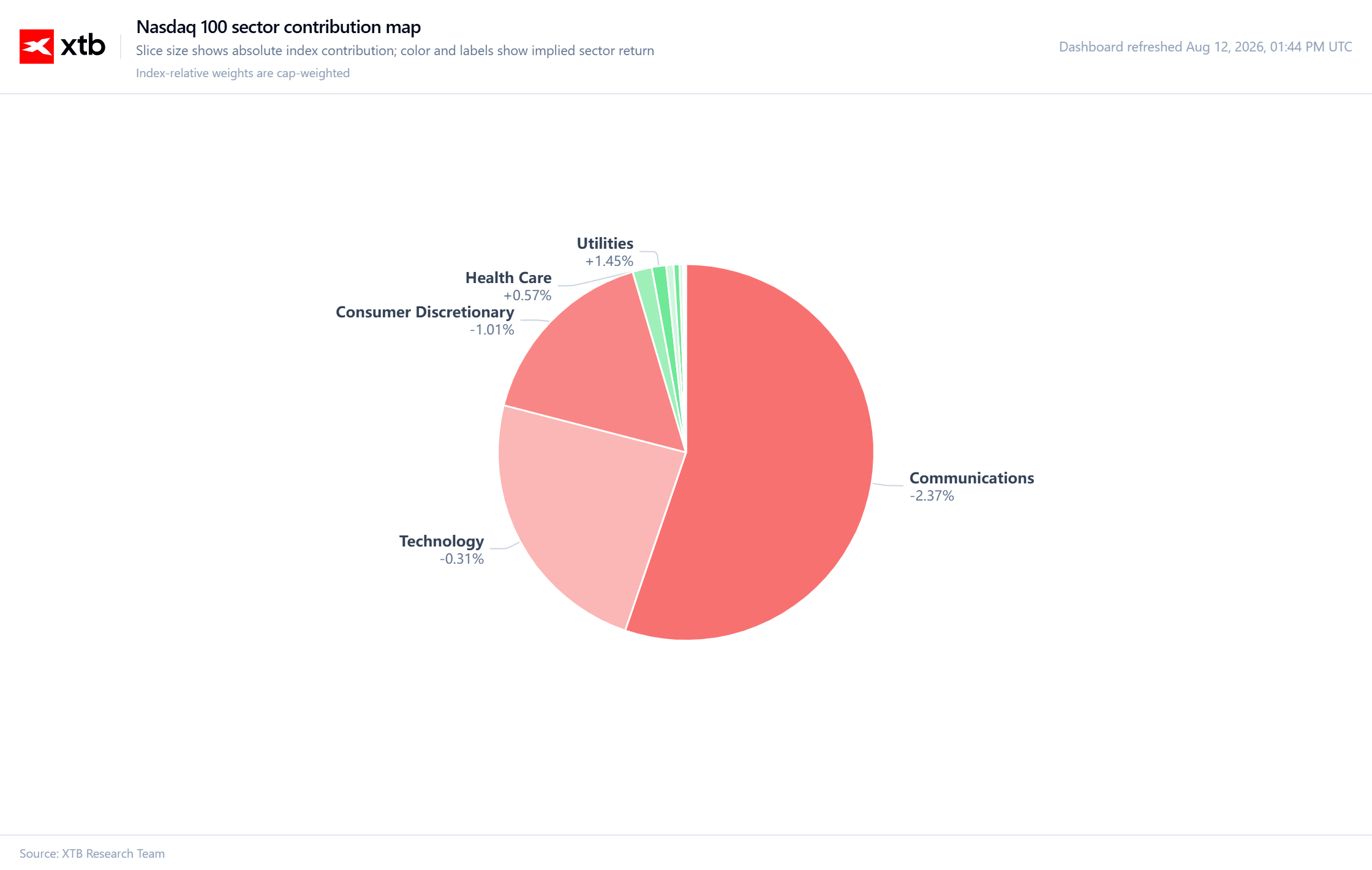
Nasdaq 100 – which sectors are driving the index lower?
Today’s weakness in the Nasdaq 100 is primarily a Communications story, with the sector down around 2.37% and accounting for by far the largest share of the index’s negative contribution. Technology, meanwhile, is down only around 0.31%, an important distinction showing that selling pressure is not evenly distributed across the broader growth complex. Consumer Discretionary is also weighing on the benchmark with a decline of roughly 1%, while Health Care and Utilities are trading in positive territory. This structure points more toward rotation within the index than a conventional broad-based selloff in risk assets. At the same time, the outsized contribution from Communications highlights an inherent feature of capitalization-weighted indices: moves in a handful of the largest companies can determine the direction of the entire benchmark even when the broader market remains relatively stable. For the remainder of the session, the key question will therefore be not so much how the average Nasdaq constituent performs, but whether the largest Communications names can begin to recover.
Source: XTB Research
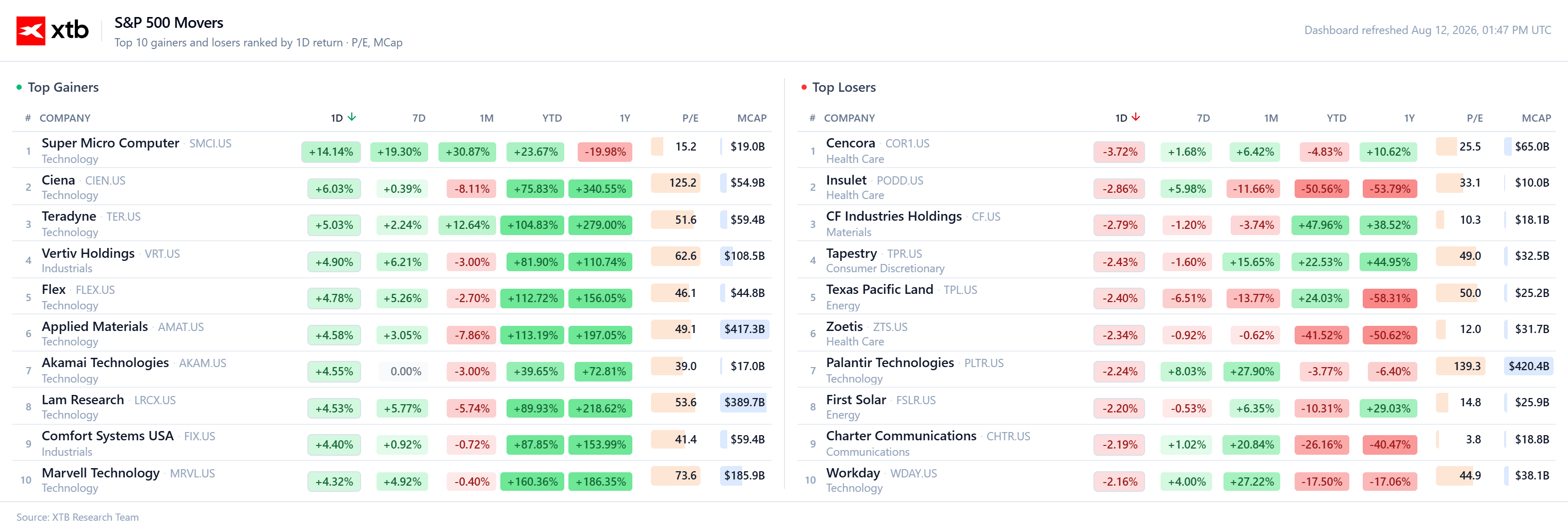
S&P 500 – top gainers and losers
Today’s S&P 500 leaderboard shows a clear preference for technology companies and beneficiaries of AI infrastructure spending, with Super Micro Computer (+14.14%) firmly leading the gains. Ciena (+6.03%), Teradyne (+5.03%), Applied Materials (+4.58%) and Lam Research (+4.53%) are also performing strongly, confirming that capital is once again flowing into hardware, semiconductor and data center infrastructure names. Valuations among some of these leaders remain demanding, however – Ciena trades at a P/E ratio above 125x, while Marvell is valued at around 74x, meaning the market continues to price in very strong future earnings growth. On the downside, there is no single dominant sector theme, with declines spanning health care names such as Cencora (-3.72%) and Insulet (-2.86%), as well as companies from energy, consumer and technology sectors. Palantir (-2.24%) is another notable case, with a P/E ratio of around 139x – at such a valuation, even modest deterioration in sentiment toward growth stocks can translate into above-average share price volatility. Overall, today’s session reflects not so much a broad increase in risk appetite as a highly selective return of capital to AI infrastructure and semiconductors, where investors remain willing to pay elevated multiples for expected growth.
Source: XTB Research
Nasdaq 100 – valuation, momentum and market breadth
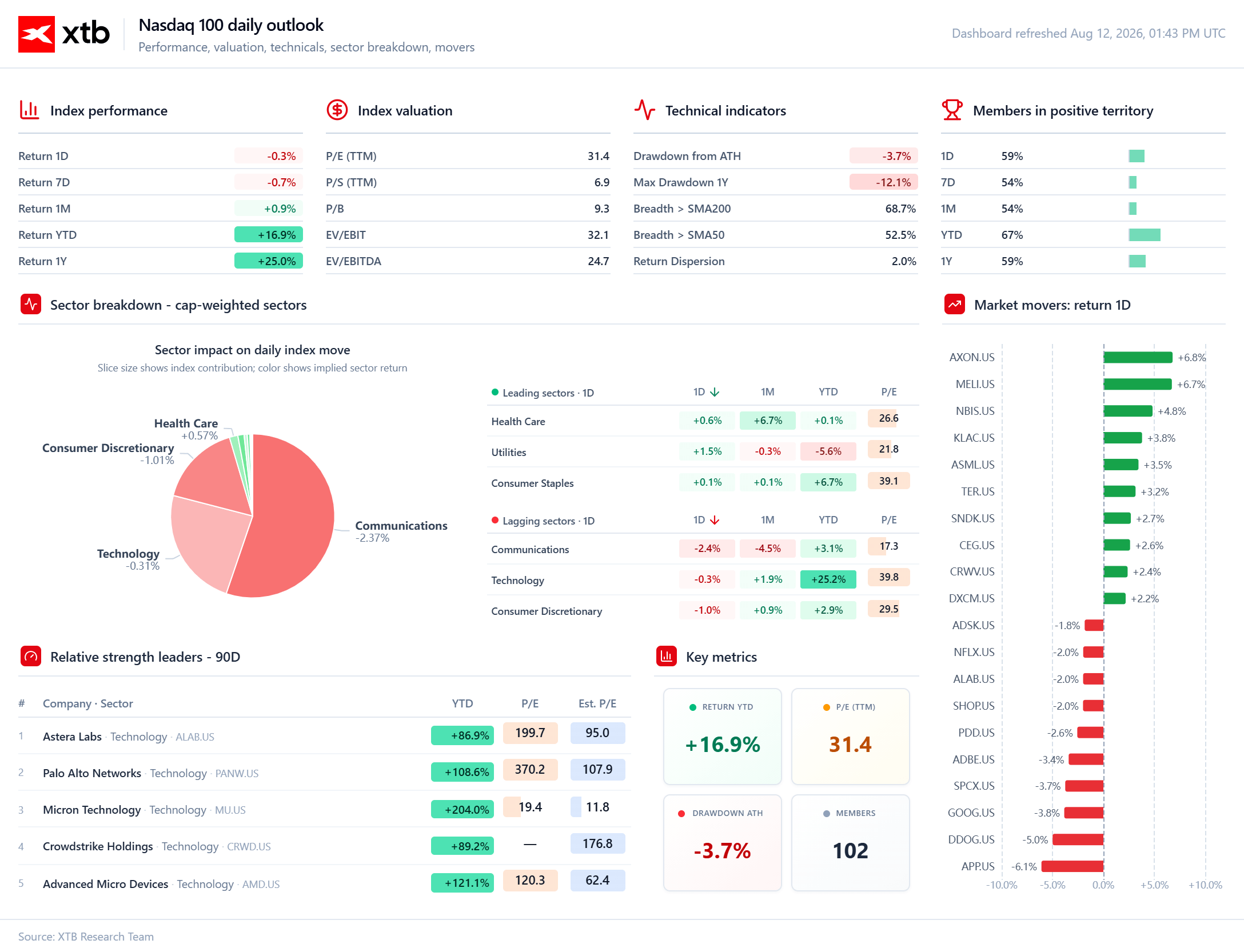
The Nasdaq 100 is down around 0.3%, but from a broader trend perspective there is little evidence so far of a meaningful deterioration in the market picture. The index is still up 16.9% YTD and 25% over the past year, while trading only 3.7% below its all-time high. Market breadth also remains relatively healthy: 68.7% of constituents are above their 200-day moving average and 52.5% are above their 50-day moving average, while as many as 59% of stocks are trading higher during today’s session. This divergence is significant because it shows that the index decline is being driven primarily by weakness in several heavyweight constituents rather than a broad-based market selloff. Valuation remains the main constraint – the Nasdaq 100 trades at a P/E ratio of around 31.4x and the technology sector at nearly 40x, leaving relatively little room for disappointment in upcoming earnings. Relative-strength leaders continue to include technology names such as Micron, AMD, Palo Alto Networks and CrowdStrike, confirming that investors are still seeking growth exposure, although increasingly on a selective basis. The current pullback therefore looks more like rotation beneath the surface of a strong trend than a breakdown of that trend, but at these valuation levels, sustaining the bull market will require continued underlying earnings growth rather than further multiple expansion alone.
Source: XTB Research
Company news: Nebius, Cava, Super Micro Computer and Intel
Nebius Group (NBIS) is gaining more than 12% after reporting results that exceeded market expectations on both revenue and EBITDA. Gross margin also came in ahead of forecasts, which is particularly important for a rapidly expanding AI infrastructure provider, as it suggests that scaling the business does not necessarily have to come entirely at the expense of profitability. The key issue for Nebius now is the pace of infrastructure expansion and utilization of newly added computing capacity, as these factors will determine whether the current revenue momentum can translate into a sustainable improvement in earnings.
Cava Group (CAVA) is up nearly 12% following its second-quarter results. The restaurant chain earned $0.19 per share versus expectations of $0.18, while revenue reached $368.4 million, ahead of the $361 million consensus estimate. The share-price reaction shows that the market continues to reward consumer companies capable of expanding their footprint while maintaining strong earnings momentum. As Cava grows, however, investors are likely to focus increasingly on the unit economics of new restaurants rather than simply the pace of new openings.
Intel (INTC), meanwhile, remains in focus after increasing its equity offering to $20 billion. The additional capital will dilute existing shareholders – Bank of America estimates the impact on earnings per share at around 5% – but analysts are also highlighting the other side of the transaction. The sizeable capital raise strengthens Intel’s balance sheet and provides greater financial flexibility to execute its capital-intensive foundry strategy, while Bank of America sees the move as a sign of growing confidence in future demand and the company’s ability to scale production. UBS also argues that the offering removes a previous source of uncertainty surrounding the financing of Intel’s strategy and could be interpreted as evidence of management’s greater confidence in its foundry roadmap. In the short term, investors therefore have to absorb the dilution, but over the longer term the more important question is whether the additional $20 billion can help Intel turn massive capital expenditure into new customers, higher fab utilization and improved profitability.
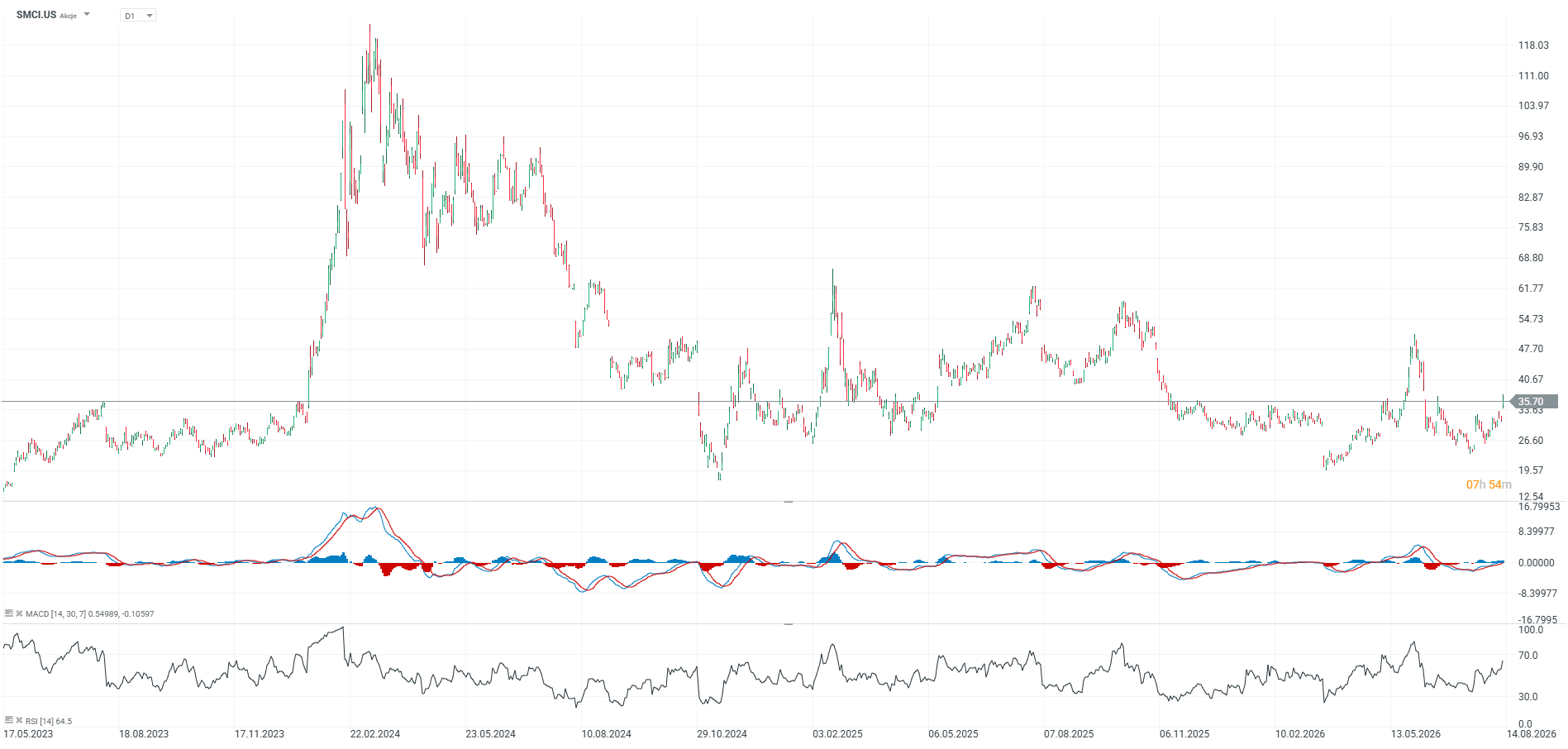
Super Micro Computer (SMCI.US, D1 interval)
Super Micro Computer (SMCI) is rallying following its results and particularly strong guidance for the next quarter. The company expects adjusted earnings per share of $1.01–$1.10, well above the consensus estimate of just $0.76, while its revenue guidance of $14.5–$15.5 billion also comfortably exceeds the $11.68 billion expected by the market. This is an important signal for the broader AI supply chain because Super Micro operates relatively close to end demand for servers and data center infrastructure. Such a wide gap between management’s guidance and the previous consensus suggests that demand for computing infrastructure remains stronger than many on Wall Street had anticipated.
 Source: xStation5



Morning Wrap: Oil cheaper despite attacks on Saudi Arabia, markets await CPI (12.10.2026)



Three Markets to Watch Next Week (09.10.2026)



Daily Summary: A Shallow Rebound Ahead of Earnings Season

Lumentum: Demand for AI infrastructure exceeds capacity