



Virgin Galactic (SPCE.US) shares are losing nearly 20% today as the company seeks additional capital to fund continued operations. While this seemed obvious looking at the rate at which the company is burning cash and the costs associated with scaling its sub-orbital travel business, investors did not welcome the prospect of further stock dilution. The company has completed a $300 million per-share offering but said it is planning another one for $400 million.
- The document filed with the SEC reads that the funds are to be used to develop the spacecraft fleet and infrastructure to scale the business, and for general corporate purposes, including working capital - general and administrative affairs.
- The company's stock has been gaining rapidly recently as the company will launch commercial services in June and send its first 'passengers' into space in August. Management made no secret of its recent excitement over this news as Michael Colglazier, during a phone call about the company's financial performance, simultaneously announced commercial flights that will take place in June.
- So far, the company is generating very little revenue ($392,000 in Q1 vs. $1.37 million forecast) but huge costs (nearly $800 million in 'burned' cash in Q1). Virgin Galactic's loss per share was $0.57, which was 10% higher than the estimated $0.52 loss.
- On the positive side, it appears that with all the regulatory approvals and upcoming commercial services, the company may have less trouble attracting investors.
The company's shares are trying to halt declines today, the key to further momentum may be closing the session above the SMA100 and SMA200 at $4.61 per share (red line).
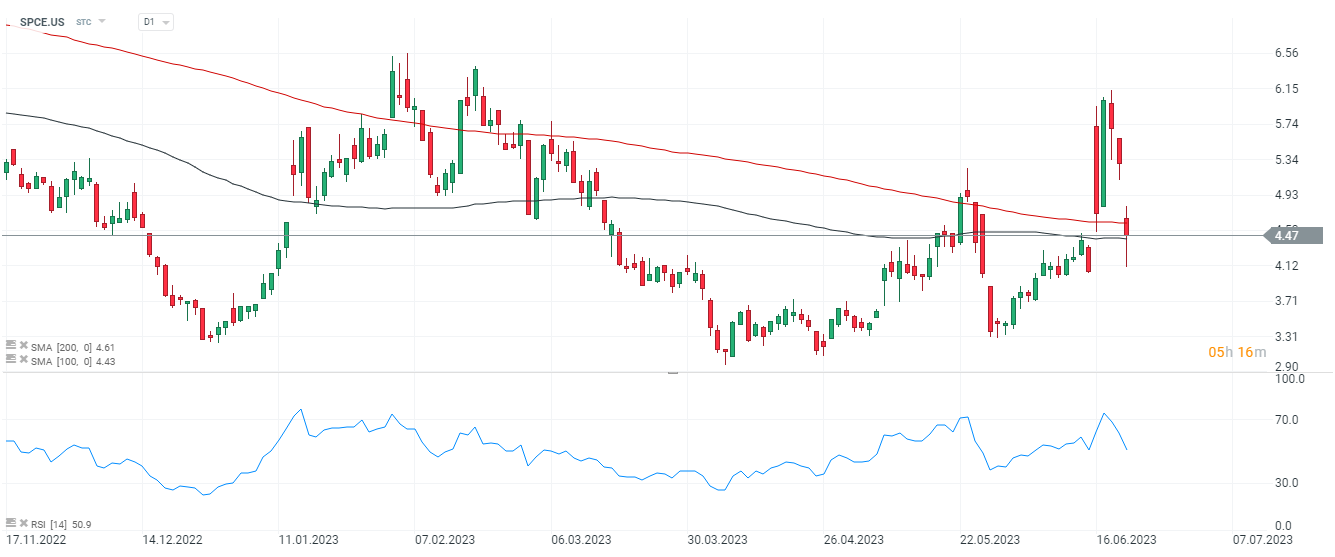 Virgin Galactic (SPCE.US) shares, D1 interval. Source: xStation5



Three markets to watch next week (23.10.2026)



Daily Summary: Oil at five-month highs, indices under pressure (23.10.2026)

US Open: Further declines on Wall Street, Brent above 111 USD, AI correction continues (14.10.2026)



Morning Wrap: AI profitability concerns spark market Sell-Off