


Can Belarus directly enter the war against Ukraine on Russia’s side?
This scenario is still not the base case, but it has also stopped being a fantasy. For markets, it would mean a rise in geopolitical risk, pressure on regional currencies, a potential strengthening of the US dollar, and a return of capital to the defence sector.
The return of the threat from the north?
The topic of Belarus fully joining the war against Ukraine on Russia’s side has regularly returned to the media since 2022. That was when the last Russian units were pushed out of northern Ukrainian territories after the failed offensive launched from the Belarusian direction.
Since then, Belarus has supported Russia in many ways. It has provided military infrastructure, barracks, hospitals, logistical facilities, and operational space. It has also taken part in activities supporting Russian strikes. Despite this, the regime in Minsk has tried to keep its involvement below the threshold of open war.
That is why further suggestions that Belarus may still enter the conflict can cause fatigue. In practice, however, the scenario of Minsk’s direct participation is no longer purely speculation. It has become an issue to analyse, monitor, and potentially price in.
The question of when escalation happens
The key question is: why would the Kremlin wait more than four years for Russia’s closest ally to enter the war only now?
Source: Bloomberg Finance
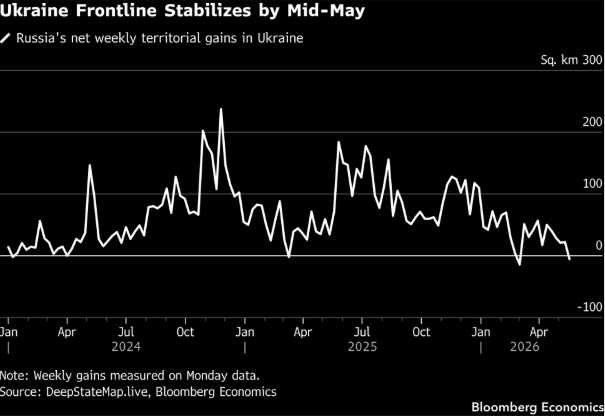
The answer may lie in Russia’s worsening situation on the front. More and more analytical centres indicate that the Russian war machine is losing momentum. In net terms, Russia is not losing territory, but available forces and resources are genuinely shrinking. The Kremlin may conclude that if Belarus does not enter the war in the near future, it may not join it at all.
Quiet mobilisation matters more than nuclear weapons
There are more and more indications of a slow but consistent shift in Belarus’s stance. Reports of gradual mobilisation of Belarusian forces appeared as early as the beginning of the year. Since then, they have been increasing in scale—though in a way that does not attract much media attention.
In the context of nuclear drills involving Belarus and Russia, a cool-headed assessment is needed. Nuclear weapons remain above all a tool of rhetorical pressure. Such exercises can, however, distract attention from more practical elements of escalation: reserve mobilisation and infrastructure expansion.
For NATO, more important than nuclear rhetoric itself is whether Minsk is genuinely increasing readiness for operations near the Ukrainian border. According to Ukrainian military officials, infrastructure expansion directed toward Ukraine is underway.
This is a more meaningful signal than propaganda statements alone.
The US and diplomatic pressure
Interest in Belarus is now being shown not only by Ukrainian military officials, but also by the United States. On 21 May, the President of Ukraine warned that any direct attempt by Belarus to engage on Russia’s side would meet with a devastating response.
Bloomberg reports also matter: according to them, the US allegedly asked Ukraine to ease sanctions on Belarusian fertiliser exports. The goal would be to reduce Minsk’s dependence on Russia. This shows that the issue is not limited to the battlefield—it equally involves the economy and trade.
It is often in moments like these that risk gets mispriced. The market assumes one conflict is partially fading because its attention shifts to another. Escalation involving Belarus would therefore be not only a military event, but also a narrative shock for investors.
Does Belarus have a real capacity to attack?
Despite rising risk, Belarus’s practical capabilities remain limited. The Belarusian armed forces are small and in a state of partial decay. Russia, in turn, no longer has the reserves that would allow it to easily man an additional several hundred kilometres of border.
The terrain between Belarus and Ukraine is very difficult. Dense forests, swamps, rivers, and a limited number of paved roads significantly hinder rapid manoeuvre. One of the key routes runs through the Chernobyl exclusion zone.
Over years of war, Ukraine has heavily fortified its northern border. An attempt to break through could end in disaster for Belarus and the Russians. Therefore, Belarus entering the war would not necessarily mean an effective offensive.
For Russia, however, escalation via Belarus could be an attempt to force political, diplomatic, and military concessions before it loses initiative or the ability to conduct controlled escalation.
What would this mean for the market?
For financial markets, Belarus directly entering the war would primarily be a signal of escalation in a conflict that some investors have already considered partially de-escalated or on a path toward ending.
The reaction could be quick, although its scale would depend on actual military actions.
The most likely effects are:
- A fall in bond prices in the region and an increase in the geopolitical risk premium,
- Pressure on Central and Eastern European currencies, including the Polish zloty.
- A strengthening of the US dollar as a “safe-haven” currency.
- A sell-off in stock indices, especially local ones.
- A return of capital to defence companies, especially those that have seen large declines in recent months.
Low probability, high risk
Belarus entering the war is still not the base-case scenario. The risk remains constrained by the weakness of the Belarusian army, difficult terrain, Ukrainian fortifications, and potentially very high political costs for the regime in Minsk.
That does not mean the topic can be ignored. Belarus would not have to win a single battle to change the geopolitical and market context.
Kamil Szczepański
Financial Markets Analyst at XTB



Morning Briefing: Warsh's silence on interest rates. AI debt fears cooled sentiment, but a rebound is visible


Daily Summary: Rising inflation weighs on markets, semiconductors suffer most (14.10.2026)


US Open: CPI reading weighs on American indices (14.10.2026)
US inflation concerns rise