



Growth disappoints, but the details are more nuanced
Australia’s economy slowed in the first quarter of 2026, with GDP rising just 0.3% q/q, below market expectations of around 0.5% and well down from 0.9% in Q4. On an annual basis, growth held at 2.5%, but the report points to a clear loss of economic momentum.
For investors, however, the data is not unequivocally negative. The weaker GDP reading was driven primarily by a significant drag from external trade, while private investment remained strong. This leaves the Reserve Bank of Australia (RBA) facing a more complicated picture: growth is slowing, but domestic demand has not collapsed.
Trade and weather disruptions weighed on growth
Net trade subtracted 0.8 percentage points from quarterly GDP growth. Exports fell 1.1%, marking the largest quarterly decline in two years. The sharpest drops came from coal exports (-6.8%) and mineral ores (-1.3%). Cyclone-related disruptions also weighed on mining and transport activity, with mining output declining 1.5%.
At the same time, imports increased 2.1%, partly due to stronger inflows of investment goods linked to data center development. This suggests that part of the GDP weakness reflected temporary disruptions and import-intensive investment activity rather than a broad deterioration in domestic economic conditions.
Data centers support investment, consumers remain cautious
The strongest component of the report was business investment, which rose 6.0% q/q. Spending on machinery and equipment surged 16.3%, the largest increase in three decades. A key driver was continued investment in data center infrastructure across New South Wales and Victoria.
Consumers, however, remain more cautious. Household spending increased 0.5%, but discretionary spending rose by just 0.1%, while essential spending increased 0.8%. The household saving ratio fell from 7.0% to 6.2%, suggesting consumers are increasingly feeling the impact of higher interest rates, elevated fuel costs, and the gradual expiry of energy subsidies.
What does the report mean for the RBA and markets?
The GDP release slightly weakens the case for another near-term RBA rate hike, as economic growth is clearly slowing and GDP per capita declined 0.1%.
However, the central bank is unlikely to view the report as a distinctly dovish signal. Inflation risks remain elevated, private demand is still relatively resilient, and energy prices continue to stay high.
Key market implications:
- Interest rates: Lower probability of an immediate rate hike, but still little justification for rate cuts.
- Bond market: Slower growth may limit further increases in yields, although inflation risks reduce the scope for a meaningful decline.
- Equities: Consumer-related sectors remain under pressure, while data center investment continues to support infrastructure, technology, utilities, and construction companies.
- AUD: The currency reaction was limited, suggesting the weaker GDP outcome was largely anticipated by the market.
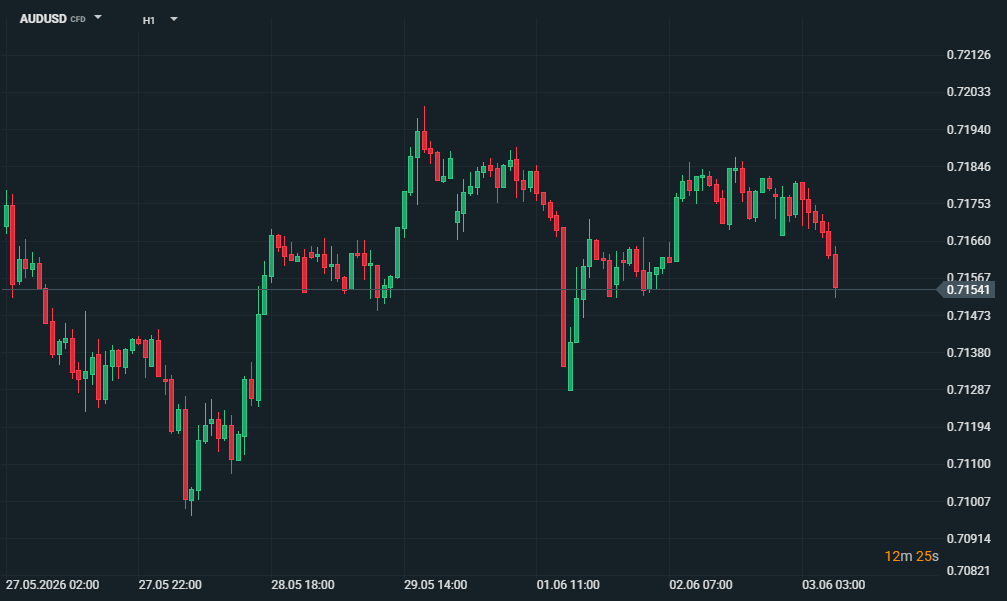
AUDUSD reaction
Following the release, AUDUSD edged slightly lower and is currently trading around 0.7150–0.7160. The muted reaction suggests investors viewed the report as weak, but not weak enough to materially alter expectations for RBA policy.
For now, AUDUSD is likely to be driven more by global risk sentiment, commodity prices, the direction of the US dollar, and upcoming inflation data than by the GDP report itself. The release is moderately negative for the Australian dollar, but it is not a major catalyst for a change in the longer-term trend.


Hot inflation data from the US🔥📈 PPI and retail sales are rising!

Nickel market panic 🚩 INSG revises forecast, surplus in 2027?


Market Wrap: Tech Sell-Off Hits Europe, Gold Shines Again

Gold sell-off over? 🔼 Central banks buy the most in nearly two years
This content has been created by XTB S.A. This service is provided by XTB S.A., with its registered office in Warsaw, at Prosta 67, 00-838 Warsaw, Poland, entered in the register of entrepreneurs of the National Court Register (Krajowy Rejestr Sądowy) conducted by District Court for the Capital City of Warsaw, XII Commercial Division of the National Court Register under KRS number 0000217580, REGON number 015803782 and Tax Identification Number (NIP) 527-24-43-955, with the fully paid up share capital in the amount of PLN 5.869.181,75. XTB S.A. conducts brokerage activities on the basis of the license granted by Polish Securities and Exchange Commission on 8th November 2005 No. DDM-M-4021-57-1/2005 and is supervised by Polish Supervision Authority.