


- Renewed Tensions and Price Spike: Brent crude surged by nearly 6%, surpassing $90 as the Strait of Hormuz was re-blocked and mutual attacks on commercial vessels occurred.
- Jeopardized Truce and Diplomacy: The likelihood of extending the ceasefire has dropped drastically after Iran accused the US of violations and rejected the planned round of talks in Islamabad.
- Supply Crisis and Speculation: An estimated 13 million barrels of daily production are cut off from markets, with the gap between physical and futures prices signaling extreme market strain.

- Renewed Tensions and Price Spike: Brent crude surged by nearly 6%, surpassing $90 as the Strait of Hormuz was re-blocked and mutual attacks on commercial vessels occurred.
- Jeopardized Truce and Diplomacy: The likelihood of extending the ceasefire has dropped drastically after Iran accused the US of violations and rejected the planned round of talks in Islamabad.
- Supply Crisis and Speculation: An estimated 13 million barrels of daily production are cut off from markets, with the gap between physical and futures prices signaling extreme market strain.
Following a period of brief optimism at the end of last week, the global crude oil market has once again entered a phase of extreme tension. The price of a Brent barrel rose by nearly 6% on Monday morning, surpassing the $90 level. This sharp move largely reverses the declines seen last Friday, which occurred after the Iranian Foreign Minister, Abbas Araghchi, declared the Strait of Hormuz open for shipping. Currently, the fundamental situation is exceptionally difficult: it is estimated that as much as 13 million barrels of daily production from the Persian Gulf remain cut off from the world, and any potential clearing of transportation bottlenecks could take many weeks, if not months. Although it might seem that the worst is behind us, the oil market remains extremely tight, as evidenced by a difference of a dozen or several dozen dollars between the price of oil on the futures market and physical oil.
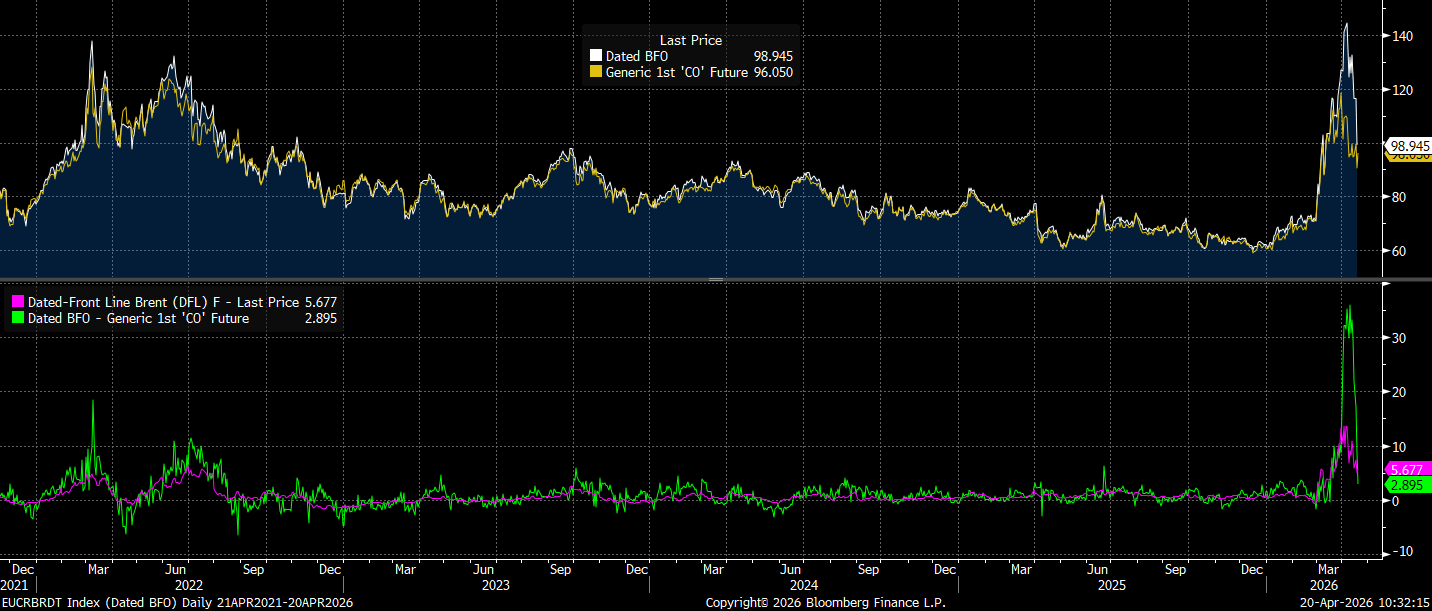 Dated Brent and front-month Brent on ICE. On the lower chart, the differences between Dated Brent and ICE, while the pink line represents the difference between Dated Brent and Bloomberg's Fair Value Brent. Source: Bloomberg Finance LP
Renewed Blockade of the Strait of Hormuz and Armed Incidents The key reason for the return to an upward trend is the renewed, almost immediate closure of the Strait of Hormuz by Iran, occurring just 24 hours after declarations of its opening. On one hand, there were Iranian attacks on vessels belonging to Western companies, and on the other, an attack and seizure of an Iranian vessel by the U.S. Navy. In response, Tehran officially halted vessel traffic, and Vice President Mohammad Reza Aref warned on the X platform that the world cannot expect free security for its exports while Iranian oil sales are being blocked. Iran emphasizes that fuel price stability depends on a permanent end to economic and military pressure against the country. An additional risk factor is the potential expansion of hostilities to regional energy infrastructure in Saudi Arabia and the United Arab Emirates.
Diplomatic Outlook and Ceasefire The probability of extending the two-week ceasefire, which expires this coming Tuesday, has significantly decreased and is currently assessed as low. Iranian Foreign Ministry spokesperson, Esmaeil Baqaei, officially accused the United States of a lack of sincerity in diplomatic efforts, describing the port blockades and vessel seizure as blatant violations of the truce. Furthermore, Tehran has rejected the Trump administration's proposal for a new round of peace talks in Islamabad scheduled for this week.
Nevertheless, communication channels have not been entirely closed. Iranian President Masoud Pezeshkian suggests that war is in no one's interest and that tensions should be reduced through diplomatic avenues. Some market analysts also believe that immense economic pressure on both sides will eventually force a return to negotiations, treating the current escalation as part of a brutal game for a better bargaining position. For the moment, however, the market remains in risk-off mode, reflected by falling valuations of stocks and bonds alongside rising energy commodity prices.
It is indicated that talks could theoretically begin today, but in reality, they will most likely take place tomorrow, just before the expiration of the official ceasefire, which, according to Iran, has been broken by the United States. Initially, U.S. Vice President JD Vance was expected to attend the negotiations, but recent reports indicate that due to security factors, it is uncertain whether his participation will occur. On the other hand, Iran has not officially indicated that it will send a delegation to Islamabad.
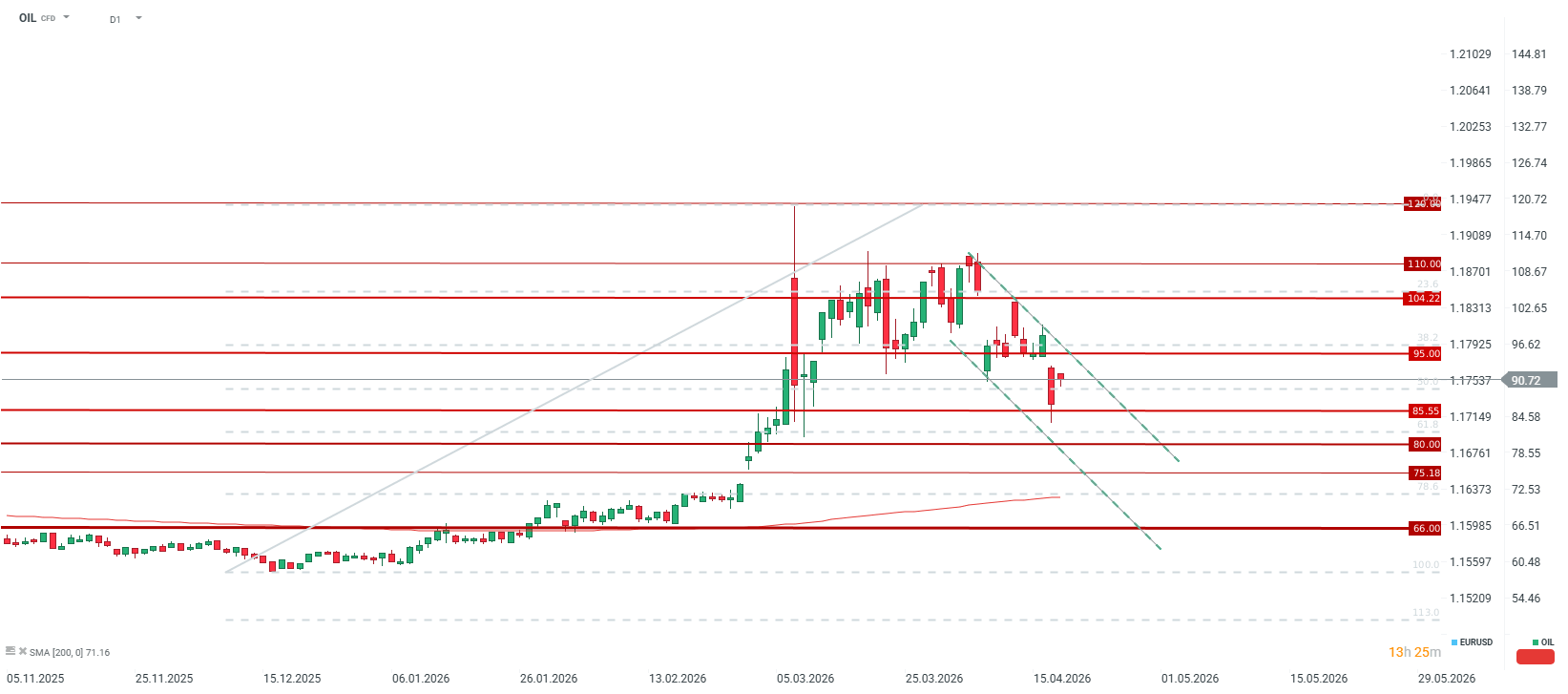
Brent Crude Remains in a Downward Trend
The price of Brent crude is opening higher, yet at the same time, it does not appear that the futures market is significantly concerned by the escalation of the situation. With the renewed closure of the Strait of Hormuz, prices should surpass the $100 per barrel level. Currently, the key resistance seems to be the area around $95 per barrel, at the 38.2% retracement and the upper limit of the downward trend channel. Conversely, the $80-$85 zone should be maintained with a slight increase in vessel flow, and a potential full opening of the Strait of Hormuz and the return of at least 50% of exports from the Persian Gulf could lead to prices returning toward $75-$80 per barrel, though this would be an extremely optimistic scenario.



Daily Summary: Oil at five-month highs, indices under pressure (23.10.2026)


BREAKING: France slows down, Germany holds on. Euro falls below 1.12



Daily Summary: Valuations Under Pressure, Capital Moves Away From Technology

Market Wrap: "Decent" results are not enough – tech stocks fall further; oil highest since May (22.10.2026)
This content has been created by XTB S.A. This service is provided by XTB S.A., with its registered office in Warsaw, at Prosta 67, 00-838 Warsaw, Poland, entered in the register of entrepreneurs of the National Court Register (Krajowy Rejestr Sądowy) conducted by District Court for the Capital City of Warsaw, XII Commercial Division of the National Court Register under KRS number 0000217580, REGON number 015803782 and Tax Identification Number (NIP) 527-24-43-955, with the fully paid up share capital in the amount of PLN 5.869.181,75. XTB S.A. conducts brokerage activities on the basis of the license granted by Polish Securities and Exchange Commission on 8th November 2005 No. DDM-M-4021-57-1/2005 and is supervised by Polish Supervision Authority.