


- Oil price surge could have far reaching consequences on Monday
- Will markets rebuild defensive positions?
- What’s next for the ceasefire and will market have patience for prolonged process?
- The China question and potential for further escalation of the conflict

- Oil price surge could have far reaching consequences on Monday
- Will markets rebuild defensive positions?
- What’s next for the ceasefire and will market have patience for prolonged process?
- The China question and potential for further escalation of the conflict
We start a new week with an escalating conflict In the Middle East. Peace talks ended with no resolution late on Saturday night, then on Sunday, President Trump said that the US will blockade the Strait of Hormuz, which is effectively already blockaded by Iran. The US has said that it will halt any ships trying to enter of leave the Strait, which has dashed hopes that a peace deal could have reopened the vital waterway. This will add further pressure to global oil markets at the start of the new week, and we expect this latest development to sap risk sentiment.
At this stage, the ceasefire is in limbo, however, Iran has responded to President Trump’s blockade threat by saying that any approach by US military vessels towards the Strait of Hormuz would be treated as a violation of the ceasefire agreement and would be met with force. The prospect of a resumption of fighting between the two sides could jolt financial markets at the start of the new week and push up oil prices even though Saudi Arabia said that it had restored output at one of its major pipelines hit by drone strikes last month. We expect that markets will ignore this news and focus on the blockade of the Strait of Hormuz, which could lift demand for the few safe havens that are out there, including energy and oil stocks, and defense firms.
Oil price surge could have far reaching consequences on Monday
The conflict is now moving into its 6th week, and we could start to see the economic damage more clearly as we wait for more Q1 corporate earnings, the IMF’s spring conference and the latest economic data. Another factor worth watching on Monday is interest rate expectations. The sharp decline in the oil price last week, Brent fell by 12%, restored confidence in the deflationary narrative and revived the prospect of Federal Reserve rate cuts later this year. Expectations for UK interest rates were also recalibrated last week. There was 1.5 cuts expected for the rest of this year at the end of last week, which is down from more than 3 hikes in the Middle of March. However, a surge in the oil price is likely to put further rate cut hopes to bed for now and is an interesting back drop for global central bankers who will be speaking at the IMF Spring conference.
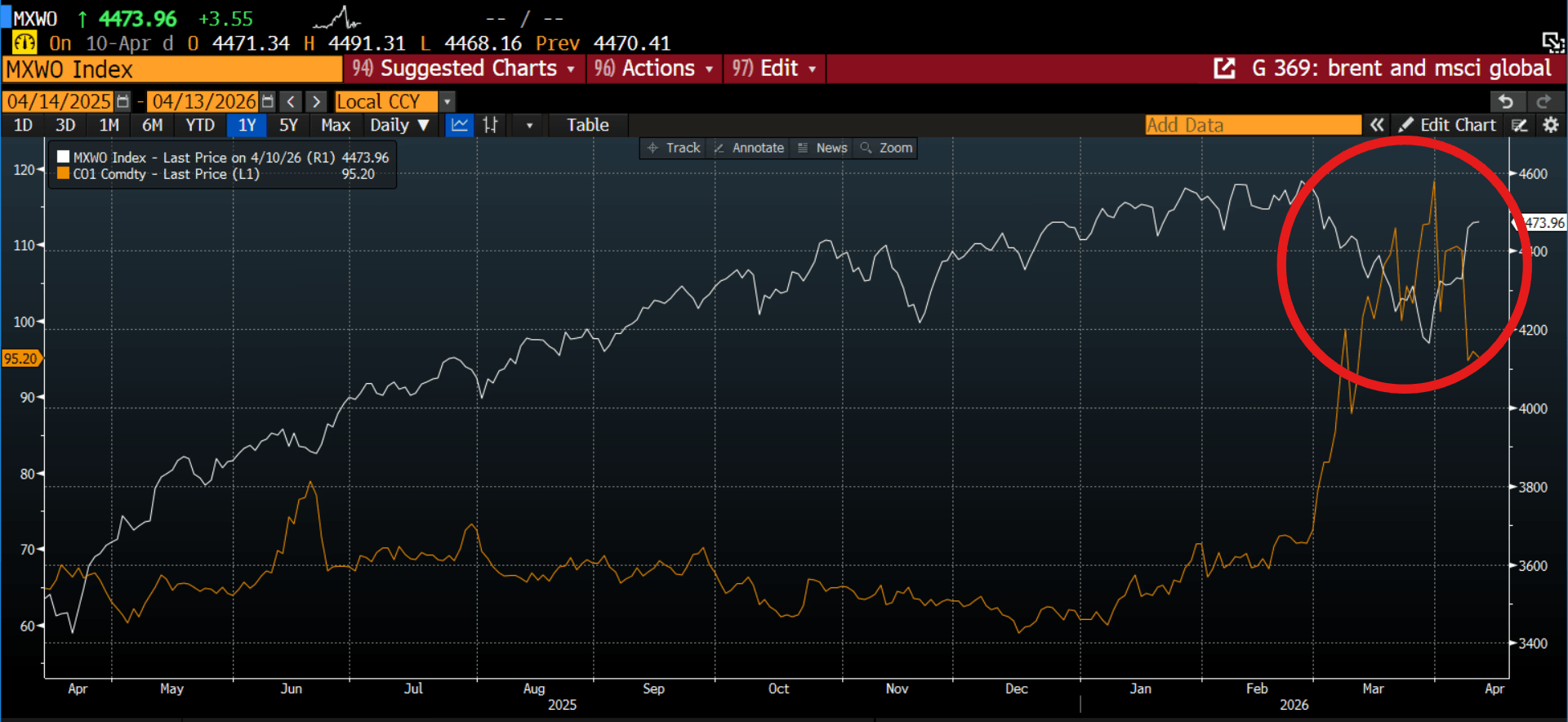
Failure to reach a deal means that the Strait of Hormuz is still closed and could become even more dangerous if Iran follows through with its threats. This is a dynamic that is likely to drive oil prices higher at the start of the week and trigger a risk off impulse across other financial markets. General market price action has taken its cue from oil prices since the outbreak of the conflict, as dwindling oil supplies raise the stakes for the global economy. A surge higher in the oil price on Monday could lead to a general risk off tone to markets, with stocks and bonds coming under pressure.
Chart 1: inverse correlation between the Brent crude oil price and the MSCI World index
Source: XTB and Bloomberg
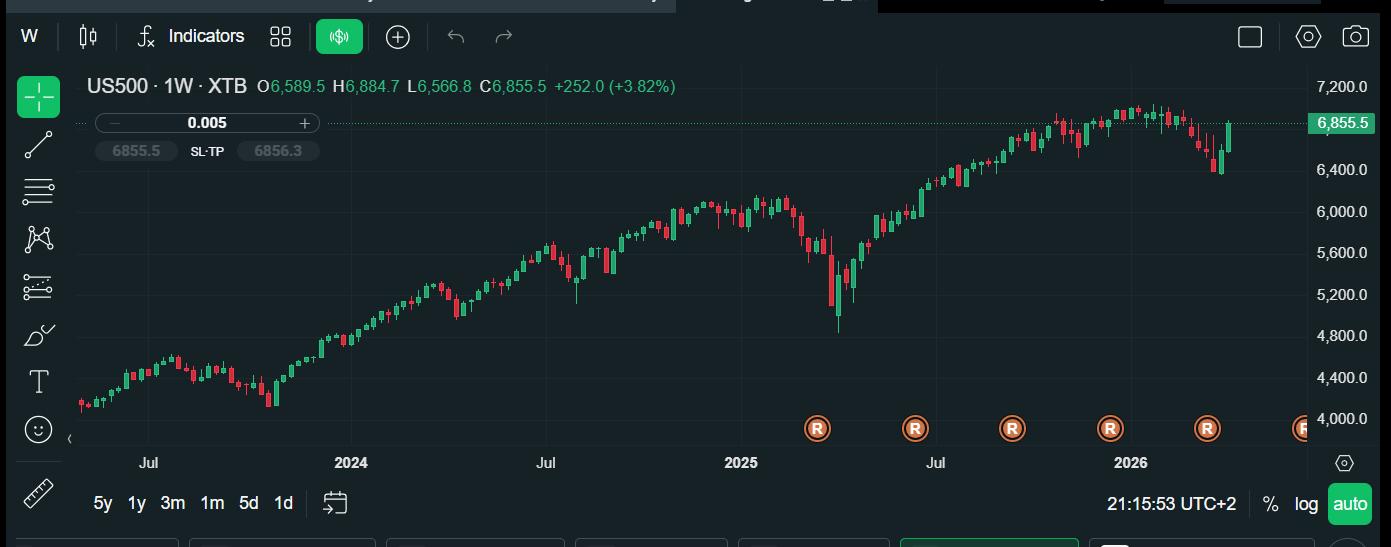
The question now is whether the oil price will return to its pre-ceasefire highs around $112 per barrel for Brent crude? Before this weekend’s developments, stocks had retraced most of their losses since the start of March, the S&P 500 is a mere 130 points away from its pre-war high. However, the path of least resistance for global stocks at the start of this week is for further losses, and we expect volatility to rise.
Chart 2: S&P 500
Source: XTB
Will markets rebuild defensive positions?
Markets are still reactionary to news flow around the conflict. Positioning helped the powerful reversal in markets last week, which sent the oil price tumbling and stocks and bond surging higher. Since the onset of the conflict, the market quickly built defensive positions, so it is natural that these would be unwound on the change in the circumstances. The question now is, how will markets react to this weekend’s developments and will positioning become defensive once more?
What’s next for the ceasefire?
Is there any hope left? The ceasefire has not yet officially been broken, we would need to see further bombing of Iran by the US, a standoff between the two sides in the Strait of Hormuz, and further attacks by Iran across the Gulf. There is a high chance that some or all of this will happen, however, Pakistan, who hosted the first round of peace talks, has urged both sides to respect the ceasefire, and pledged to continue with mediation. Other global leaders have also urged both sides to continue talking.
Markets need patience due to complex peace process
The reality is that any peace deal is going to take time to push through. A conclusive deal that reopened the Strait of Hormuz at the first round of talks was always going to be unlikely. However, will markets give both sides time to reach a deal? If there are plans for more talks, then any sell off at the start of this week could be scaled back. We also need to assess 2 things at the start of this week: how much will both sides escalate the situation, and 2, how flexible is the ceasefire. Only then will we know how far away a peace deal is, and what it means for the long-term direction of the oil price.
The China question and potential for further escalation of the conflict
There is another dimension to the President’s decision to blockade the Strait of Hormuz: China. China is a big buyer of Iranian oil; will the US stop a Chinese tanker that has paid a toll to Iran to pass through the Strait? If so, what would this do to US/ China relations? Could it put pressure on Iran to reach a deal with the US? Another impact to consider is the risk to the Red Sea, another important waterway for the world’s global commodity market. If Iran wants to punish the US for threatening the Strait of Hormuz, surely, they could encourage the Houthis of Yemen to target tankers in the Red Sea? If this happens then the price of oil could surge to fresh highs, as it would further restrict supplies of precious commodities.


Cocoa Falls 4% 📉 Are High Inventories Weighing on Prices?

Stock Market Commentary: Trump Signals a Major Drop in Oil Prices. Will U.S. Stocks Surge?



US Open: Nasdaq tries to recover loses 🗽 Fair Isaac shares in panic


🚩 Oil extends losses
This content has been created by XTB S.A. This service is provided by XTB S.A., with its registered office in Warsaw, at Prosta 67, 00-838 Warsaw, Poland, entered in the register of entrepreneurs of the National Court Register (Krajowy Rejestr Sądowy) conducted by District Court for the Capital City of Warsaw, XII Commercial Division of the National Court Register under KRS number 0000217580, REGON number 015803782 and Tax Identification Number (NIP) 527-24-43-955, with the fully paid up share capital in the amount of PLN 5.869.181,75. XTB S.A. conducts brokerage activities on the basis of the license granted by Polish Securities and Exchange Commission on 8th November 2005 No. DDM-M-4021-57-1/2005 and is supervised by Polish Supervision Authority.