



Meta will report its second quarter results today after the market closes. The company enters this earnings release with high market expectations, but also with growing pressure regarding the scale of its investments in artificial intelligence.
So far, investors have been willing to accept aggressive spending growth because AI has supported Meta’s most important business, advertising. Better recommendation systems, more effective targeting and automation of campaign creation can increase user engagement, advertising impressions and advertising value.
Today, however, the market expects more. Meta must demonstrate that massive investments in data centres, computing power and the development of its own AI models can create new sources of revenue in the future.
In recent weeks, particular attention has been drawn to reports regarding Meta’s potential development of its own AI infrastructure and the possibility of making computing capacity available to external entities. Such a move could open a new business opportunity similar to AI Cloud services and allow Meta to better utilise infrastructure currently being built for its own models and products.
There have also been reports regarding work on Meta’s own computing chips. In the long term, developing proprietary chips could reduce Meta’s dependence on external suppliers and improve the cost efficiency of AI infrastructure. At the current stage, however, the market will need specific information regarding the timeline, scale and practical applications of these solutions. Announcements alone will not be enough to change the economics of such large investments.
Today’s report will therefore be a test not only of advertising performance but also of the credibility of Meta’s long term AI strategy.
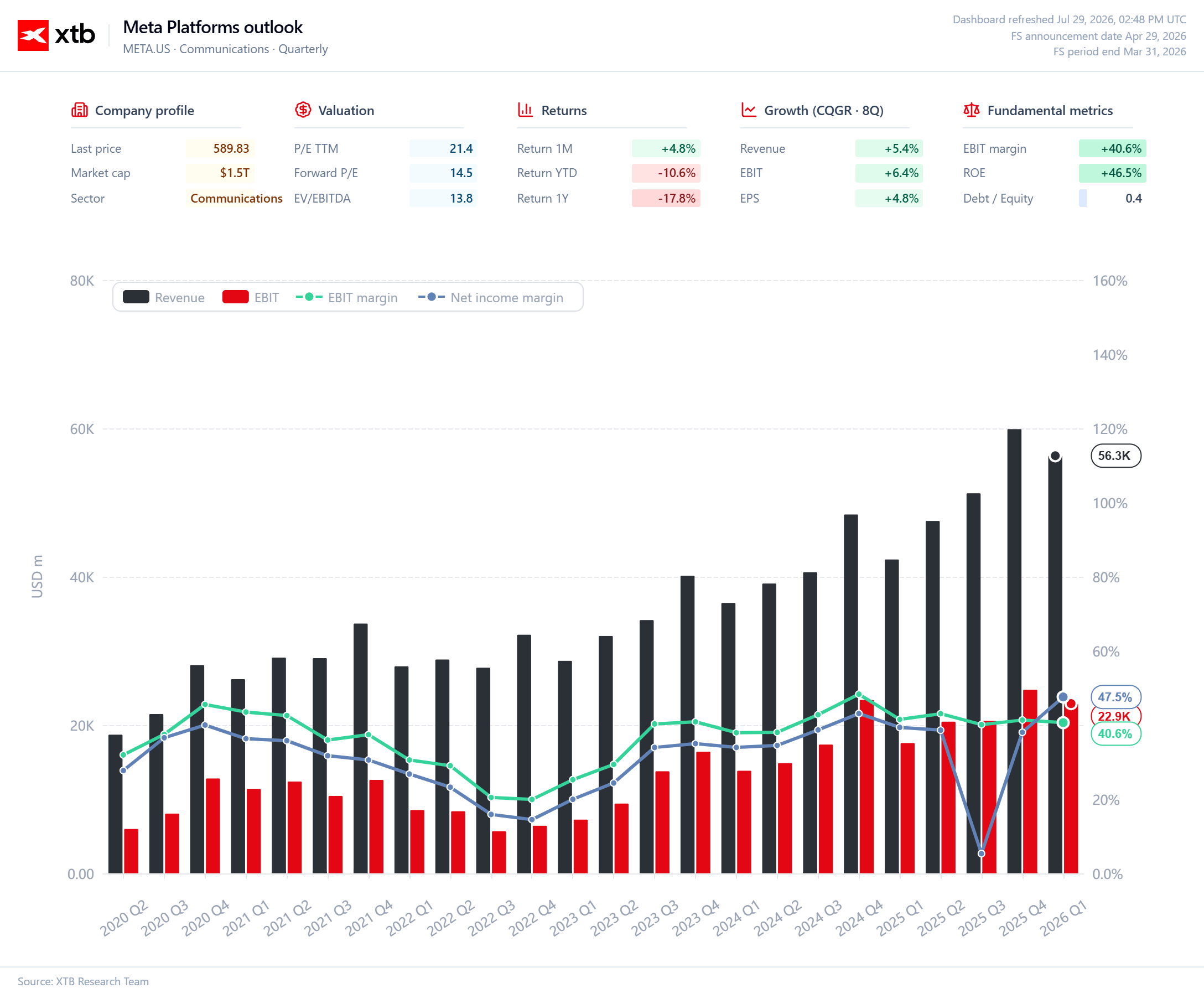
Key Financial Expectations
-
Revenue: $60.24 billion
-
Advertising revenue: $59.07 billion
-
Family of Apps segment revenue: $59.77 billion
-
Reality Labs revenue: $428.7 million
-
Other revenue: $863.3 million
-
-
Operating income: $21.50 billion
-
Family of Apps operating income: $26.11 billion
-
Reality Labs operating loss: $4.45 billion
-
Operating margin: 35.6%
-
EPS: $7.15
-
Growth in advertising impressions: approximately 14.6% year on year
-
Growth in average advertising price: approximately 11.7% year on year
Forecast for the Next Quarter
-
Expected third quarter revenue: $63.17 billion
-
Estimated third quarter CapEx: $38.88 billion
-
Estimated full year CapEx: $135.79 billion
-
Projected full year total costs: $163.02 billion
Consensus Points to a Very Strong Quarter
According to market consensus, Meta is expected to generate approximately $60.2 billion in second quarter revenue, with earnings per share expected at $7.15. The vast majority of sales will still come from advertising, with consensus estimates pointing to approximately $59.1 billion in advertising revenue. This shows that despite the growing importance of AI, the foundation of Meta’s business remains the scale of its social platforms and its ability to effectively monetise its massive user base.
The market also expects growth in advertising impressions and an increase in average advertising prices. The combination of higher advertising volume and higher prices could translate into very strong revenue growth.
However, such high expectations mean that simply meeting consensus may not be enough. Investors will be looking for a clear positive surprise, both in revenue and EPS, as well as in management’s commentary regarding future quarters. Meta must demonstrate that AI is not only supporting its current advertising model but also increasing the company’s long term growth potential.
Advertising Remains the Foundation, AI Must Increase Its Efficiency
Meta’s most important source of revenue remains the Family of Apps segment, which includes Facebook, Instagram, Messenger and WhatsApp.
The scale of this ecosystem is enormous. Consensus estimates suggest that the average daily number of users across Family of Apps services will reach approximately 3.61 billion. Such a large user base gives Meta a unique advantage in terms of data, distribution and the ability to deploy AI solutions.
Artificial intelligence can increase the value of Meta’s advertising business on several levels. AI models can improve content recommendations, increase time spent on platforms, help advertisers create campaigns and optimise advertising effectiveness.
Advertising results will therefore be the first test of AI’s economic value. If Meta shows both growth in advertising volume and an increase in average advertising prices, the market may conclude that investments in AI models and infrastructure are beginning to deliver measurable benefits in the company’s most important business segment.
At the same time, investors will analyse whether improving advertising performance is a lasting result of AI implementation or primarily the result of favourable conditions in the digital advertising market.
“AI Cloud” Could Create a New Revenue Stream
One of the most interesting elements of today’s earnings release could be Mark Zuckerberg’s comments regarding the possibility of making AI computing power and infrastructure available to external customers.
Meta is building massive infrastructure primarily for its own models, recommendation systems and AI based products. Making part of these resources available to external clients could allow the company to better utilise growing computing capacity and create an additional revenue stream.
A potential AI Cloud business would, however, represent a significant change to Meta’s operating model. The company would need not only sufficient infrastructure but also a competitive offering against the largest cloud providers.
The market will therefore expect specific information:
-
whether Meta is already in discussions with potential customers,
-
what form access to computing capacity could take,
-
whether Meta plans to offer access to its own AI models,
-
when the new business could begin generating revenue,
-
whether infrastructure built for Meta’s own needs can be effectively utilised by external customers.
It should be clearly emphasised that at this stage a potential AI Cloud business remains primarily a strategic opportunity. If management presents a concrete plan, the market may begin valuing Meta not only as a digital advertising leader but also as a future provider of AI infrastructure and services.
Proprietary Chips Could Change AI Economics, but Details Are Needed
Meta has recently attracted attention due to reports regarding the development of its own computing chips.
Strategically, such a direction makes sense. Proprietary chips could allow Meta to better tailor infrastructure to specific applications, reduce dependence on external suppliers and lower the cost of AI processing over the long term.
However, the potential benefits are still distant. Designing and deploying proprietary chips requires years of investment, access to advanced manufacturing technologies and an appropriate software ecosystem. Therefore, investors should treat current information as part of a long term strategy rather than a factor that will significantly change financial results in the near term.
Today’s report may nevertheless provide important insights into the timeline for chip development, their applications and their potential impact on future capital expenditure.
CapEx Will Test Market Tolerance
Without major surprises, the biggest risk remains the scale of investment spending. Meta previously raised its full year CapEx forecast to levels approaching $145 billion. Such significant investment demonstrates that Meta is aggressively expanding data centres and infrastructure required for AI development.
Similar to Microsoft, the market may accept higher CapEx if investments lead to clear growth in advertising revenue, improved operational efficiency and the creation of new monetisation opportunities.
However, if spending continues to increase without equally clear evidence of returns on investment, investors may begin questioning the pace of infrastructure expansion. The relationship between CapEx and future revenue growth will therefore be one of the most important topics during today’s earnings call.
High spending does not necessarily have to be a problem if Meta demonstrates that it is building infrastructure in response to real demand and has a concrete plan for commercial utilisation.
Reality Labs Continues to Pressure Results
Another area requiring attention remains Reality Labs.
Consensus estimates point to approximately $428.7 million in revenue and an operating loss of around $4.45 billion. The segment continues to generate significant costs and remains a burden on Meta’s overall profitability.
However, Meta can continue financing these investments thanks to the high profitability of Family of Apps. Consensus estimates suggest that operating income from this segment will reach approximately $26.1 billion.
The long term vision connected with Reality Labs remains an important part of Meta’s strategy. In the short term, however, investors will primarily assess whether cost growth remains justified and whether new monetisation opportunities are emerging.
Meta Must Show More Than a Strong Quarter
Today’s results could create three main scenarios.
The positive scenario assumes a clear beat of consensus expectations, strong advertising performance, growth in advertising impressions and average advertising prices, as well as positive guidance for the next quarter. An additional catalyst could be a concrete AI Cloud development plan and convincing information regarding the monetisation of infrastructure and models. In this case, even further CapEx growth could be viewed positively. The market would conclude that Meta is investing in response to rising demand and has real opportunities to transform AI infrastructure into a new source of revenue.
The neutral scenario assumes results in line with consensus, stable advertising momentum and no new information regarding AI commercialisation. Such a report may prove insufficient, particularly if management again raises spending forecasts.
The negative scenario includes weaker advertising results, pressure on margins and continued CapEx growth without a clear plan for monetising AI infrastructure. Such a combination could increase concerns that AI development costs are rising faster than the economic benefits.
Will We See a Return on Investment?
Meta remains one of the companies best positioned to benefit from artificial intelligence.
The company has a massive user base, one of the most profitable advertising businesses in the world and the ability to quickly deploy AI across products used by billions of people.
At the same time, the scale of investment is rising to levels that require increasingly concrete evidence of future returns.
Today’s report will answer several key questions:
-
Does AI continue to improve the efficiency of Meta’s advertising business?
-
Are growth in advertising impressions and prices strong enough?
-
How does Meta plan to monetise its growing computing capacity?
-
Can an AI Cloud business become a new source of revenue?
-
What are the real plans regarding proprietary chips?
-
Will further CapEx growth be justified by rising revenue?
Meta may deliver very strong results today. However, to trigger a decisively positive market reaction, the company will likely need to provide something more: a strong beat of consensus expectations, clear confirmation of AI’s effectiveness in advertising and specific information regarding the future monetisation of its infrastructure.
Source: xStation5



Three markets to watch next week (23.10.2026)



Daily Summary: Oil at five-month highs, indices under pressure (23.10.2026)

US Open: Further declines on Wall Street, Brent above 111 USD, AI correction continues (14.10.2026)



Morning Wrap: AI profitability concerns spark market Sell-Off
This content has been created by XTB S.A. This service is provided by XTB S.A., with its registered office in Warsaw, at Prosta 67, 00-838 Warsaw, Poland, entered in the register of entrepreneurs of the National Court Register (Krajowy Rejestr Sądowy) conducted by District Court for the Capital City of Warsaw, XII Commercial Division of the National Court Register under KRS number 0000217580, REGON number 015803782 and Tax Identification Number (NIP) 527-24-43-955, with the fully paid up share capital in the amount of PLN 5.869.181,75. XTB S.A. conducts brokerage activities on the basis of the license granted by Polish Securities and Exchange Commission on 8th November 2005 No. DDM-M-4021-57-1/2005 and is supervised by Polish Supervision Authority.