


- Weak growth expected
- Fiscal headroom boost could come in handy if energy rescue package is needed
- Why a grind lower in stocks could have fiscal repercussions for UK
- Rate cut bets get squashed as energy prices spike

- Weak growth expected
- Fiscal headroom boost could come in handy if energy rescue package is needed
- Why a grind lower in stocks could have fiscal repercussions for UK
- Rate cut bets get squashed as energy prices spike
Unsurprisingly, the events of recent days have overshadowed the Chancellor’s Spring Statement. The Chancellor wanted a low key event and she got one. The Middle East conflict was a negative backdrop for this statement, and as it was delivered UK stocks slipped deeper into the red and bond yields continued to rise.
Weak growth expected
The main takeaway from the statement is that growth has been revised down for this year. The OBR now sees GDP for 2026 at 1.1%, down from 1.4% in November. Even the downwardly revised forecast is at risk if the Middle East conflict drags on, as a sustained rise in energy prices would be damaging to the UK’s already slowing economy.
The OBR’s inflation forecasts are essentially obsolete until we know how long energy prices will remain elevated for. However, without factoring in a prolonged energy price spike, the OBR revised down CPI expectations for this year to 2.3% and expects inflation to reach the 2% target next year.
Fiscal headroom boost could come in handy if energy rescue package is needed
One piece of good news in the current environment, the OBR also revised up the Chancellor’s fiscal headroom to £23.6bn, up from £21.7bn in November. This means that the UK’s economic war chest has received a boost just when we need it. If the conflict between the US and Israel and Iran drags on, then the Chancellor will have multiple requests for support, for example on household energy bills and urgent defense spending, and that fiscal headroom could get whittled down very quickly. However, it does suggest that building up the war chest last November was a sensible economic plan from Rachel Reeves.
There was other good fiscal news, the OBR has reduced net borrowing over the next 5 years by £12.1bn, and the budget surplus has been revised up by £1.9bn for 2029-30. However, the bond market has ignored this news on borrowing as inflation concerns dominate.
Tough jobs market expected
The OBR, unsurprisingly, revised higher the UK’s unemployment rate to 5.3% for this year, from 4.9% in November. The risk is to the upside however, as the unemployment rate is already at 5.2%. Unemployment is not expected to fall back to 4.1% until 2030, so it could be a tough few years for the jobs market.
Why a grind lower in stocks could have fiscal repercussions for UK
The messages contained in the Spring Statement might seem contradictory, if growth is revised down and the unemployment rate is higher, how can borrowing be lower? Rachel Reeves blames lower net migration for weaker growth, while the rally in the FTSE 100 in recent months to a record high accounts for two thirds of the increase in the UK’s forecast tax receipts out to 2029-30. The Treasury will be hoping that the selloff in equities is contained, otherwise a grind lower in global stocks could have fiscal repercussions for the UK.
Rate cut bets get squashed as energy prices spike
The other risk is that the crisis disrupts the Bank of England’s planned path for monetary policy easing. Already this week, the market has priced out the chance of a rate cut at this month’s meeting, and there are no rate cuts currently expected by the BOE this year.
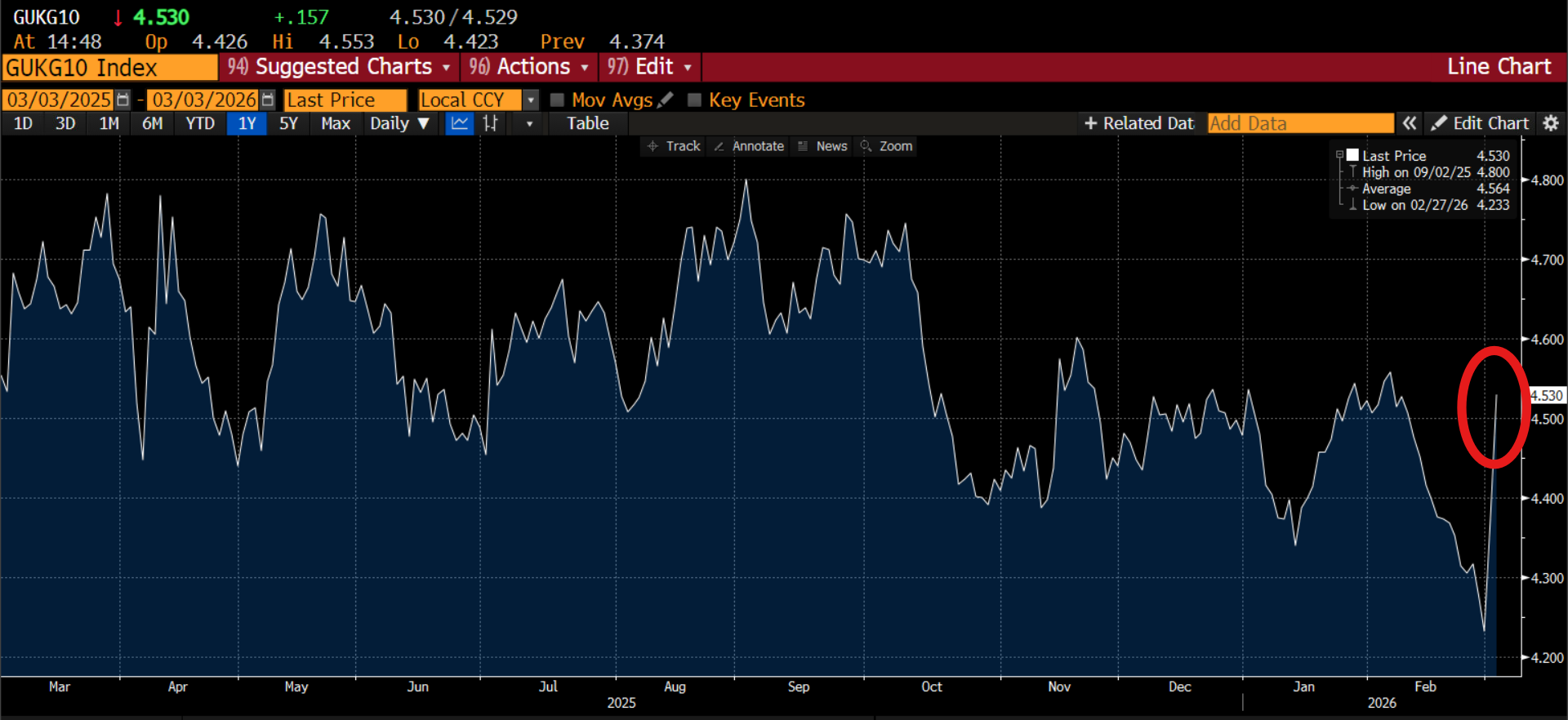
The Chancellor announced no new fiscal policies in the Spring Statement, which is a sign that the government plans to stick to one fiscal event per year. There is no denying that the Spring Statement was unfortunately timed, UK bond yields are soaring on Tuesday, and this time it is not Rachel Reeves’ fault. UK 2- and 10-year Gilt yields are higher by 16 bps each today as the bond market prices in the worst case scenario of a prolonged war in the Middle East and an energy price inflation shock. UK 10-year Gilt yields are reversing all of the progress made on reducing borrowing costs since February. Stocks are falling globally, and the pound remains weak, although GBP/USD has picked up from today’s low of $1.3263. So far this week, GBP is down 1.3% vs. the USD, but it is one of the more resilient currencies vs, the greenback, as higher yields and a reduction in BOE rate cut expectations for this year bolster the pound.
Chart 1: UK 10-year Gilt yield
Source: XTB and Bloomberg



Daily Summary: Rising inflation weighs on markets, semiconductors suffer most (14.10.2026)


US Open: CPI reading weighs on American indices (14.10.2026)



Inflation data causes market havoc
US inflation concerns rise
This content has been created by XTB S.A. This service is provided by XTB S.A., with its registered office in Warsaw, at Prosta 67, 00-838 Warsaw, Poland, entered in the register of entrepreneurs of the National Court Register (Krajowy Rejestr Sądowy) conducted by District Court for the Capital City of Warsaw, XII Commercial Division of the National Court Register under KRS number 0000217580, REGON number 015803782 and Tax Identification Number (NIP) 527-24-43-955, with the fully paid up share capital in the amount of PLN 5.869.181,75. XTB S.A. conducts brokerage activities on the basis of the license granted by Polish Securities and Exchange Commission on 8th November 2005 No. DDM-M-4021-57-1/2005 and is supervised by Polish Supervision Authority.