


Micron Technology is once again featured in our “Stock of the Week” series. The reason is straightforward. The latest results from the US memory chip manufacturer showed that the boom in AI infrastructure is still gathering pace. The scale of business growth, the level of margins and the outlook for the coming months have made Micron’s earnings one of the most important readouts for the broader technology sector.
The results released yesterday after the market close once again exceeded market expectations. Revenue reached a record level, earnings rose to levels that seemed unattainable just a year ago, and guidance for the next quarter points to further improvement. The market therefore received another confirmation that demand for advanced memory used in data centers remains extremely strong.
Micron is particularly interesting because it operates in one of the most cyclical parts of the semiconductor industry. For decades, the memory market followed a familiar pattern. Rising demand pushed prices and margins higher, encouraging manufacturers to increase capital spending. A few years later, new production capacity reached the market, oversupply emerged, prices fell and manufacturers’ earnings deteriorated. The next cycle would only begin after a painful period of production and investment cuts.
Artificial intelligence has changed the dynamics of this market. Demand for memory is rising alongside the expansion of computing infrastructure, while each new generation of accelerators requires greater bandwidth and larger amounts of memory. AI data centers need HBM, advanced DRAM and high-performance storage. The scale of these investments has become so large that memory availability is now one of the key constraints on further expansion of AI infrastructure.
Micron’s latest report therefore allows us to revisit the question that matters most for the entire sector. Is the current boom simply another iteration of the classic memory cycle, followed by oversupply, or has the development of artificial intelligence created the conditions for a much longer period of structural demand growth?
The fourth-quarter fiscal 2026 results provide several important answers.
The Memory Cycle Is Playing Out Differently This Time
The memory market has been cyclical for decades. Rising prices encouraged manufacturers to increase investment, and when new production capacity eventually reached the market, oversupply emerged and margins fell sharply. Supply always responded with a delay, but once new capacity came online, it could completely reverse market conditions.
The current cycle has a different center of gravity. AI is increasing demand for DRAM, HBM and storage much faster than the industry can expand production. For Micron, this means that limited supply is not holding back growth. Instead, it is strengthening pricing power. Demand is strong enough to absorb additional supply, while data center customers are competing for limited availability of the most advanced memory products.
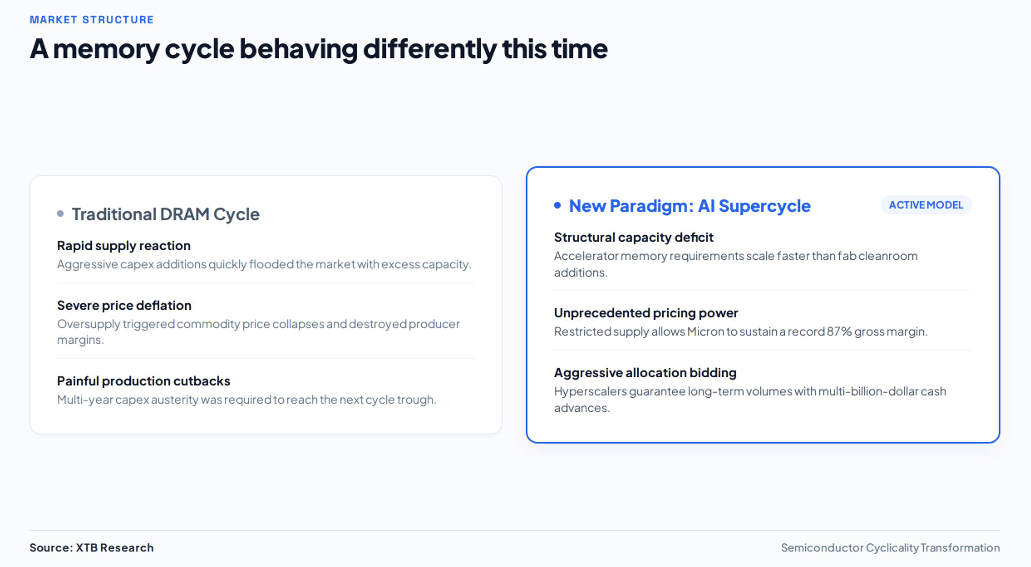
This shortage is now the most important feature of the cycle. The problem is not simply that manufacturers need more factories. Expanding production capacity takes years, requires enormous investment and cannot be accelerated quickly. At the same time, demand for memory continues to rise with every new stage of AI infrastructure expansion. The result is a gap between demand, which is growing today, and supply, which can only respond over the coming years.
AI is also changing the structure of demand. The most advanced systems require not only more memory, but also significantly higher bandwidth and more sophisticated memory architectures. HBM consumes substantially more manufacturing resources than conventional DRAM. As a result, shifting production capacity toward AI applications also reduces the amount of memory available to other segments of the market.
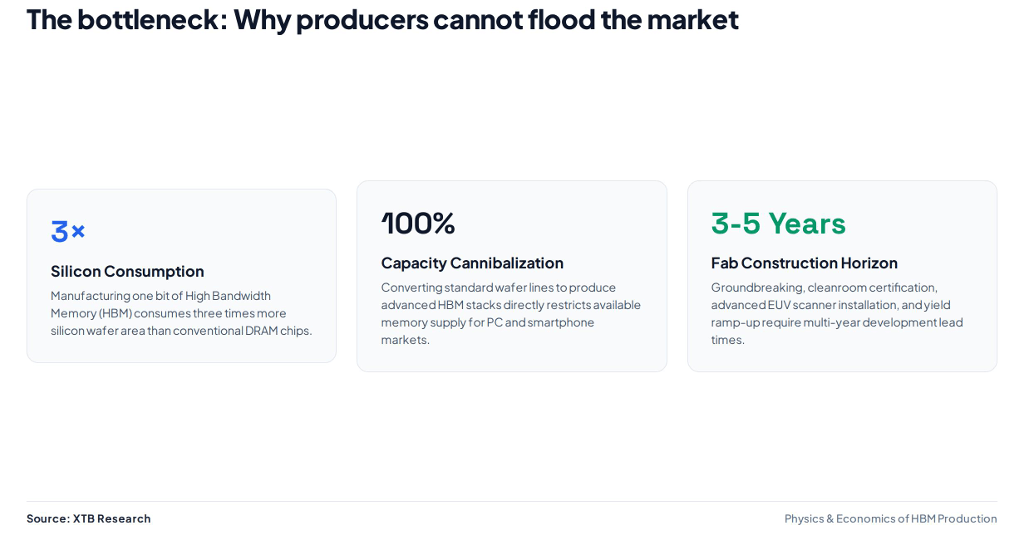
This creates an unusual situation for Micron. The company is not simply benefiting from higher demand for a single product. The entire memory market is shifting toward segments where supply is most constrained. The faster AI infrastructure expands, the greater the pressure on memory availability and the longer elevated profitability can potentially persist.
This does not mean that cyclicality has disappeared. There is still a risk that manufacturers will invest too aggressively and create oversupply in the coming years. The difference is timing. Given the current scale of demand, the market needs a much larger increase in capacity to reverse the balance between supply and demand. Until that happens, Micron is operating in an environment defined by shortage rather than a struggle to keep its factories utilized.
Record After Record
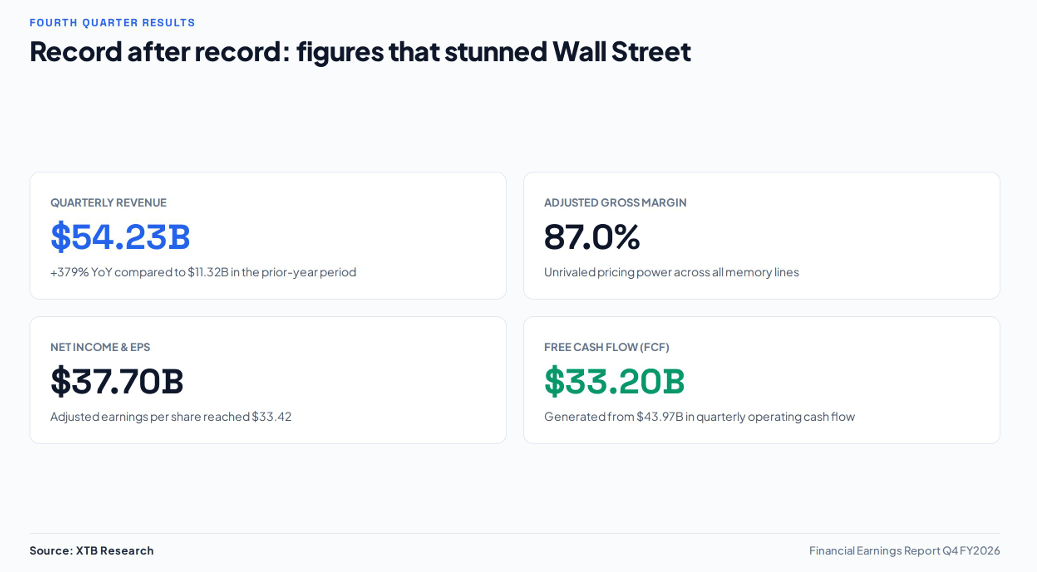
Micron’s fourth-quarter fiscal 2026 results show how dramatically the scale of the business has changed in just one year. The company delivered another quarter of records, and the improvement was not limited to revenue. Earnings, cash flow and profitability all surged.
Key Q4 FY2026 results:
-
Revenue: $54.23 billion, versus $11.32 billion a year earlier
-
Adjusted EPS: $33.42
-
Adjusted gross margin: 87%
-
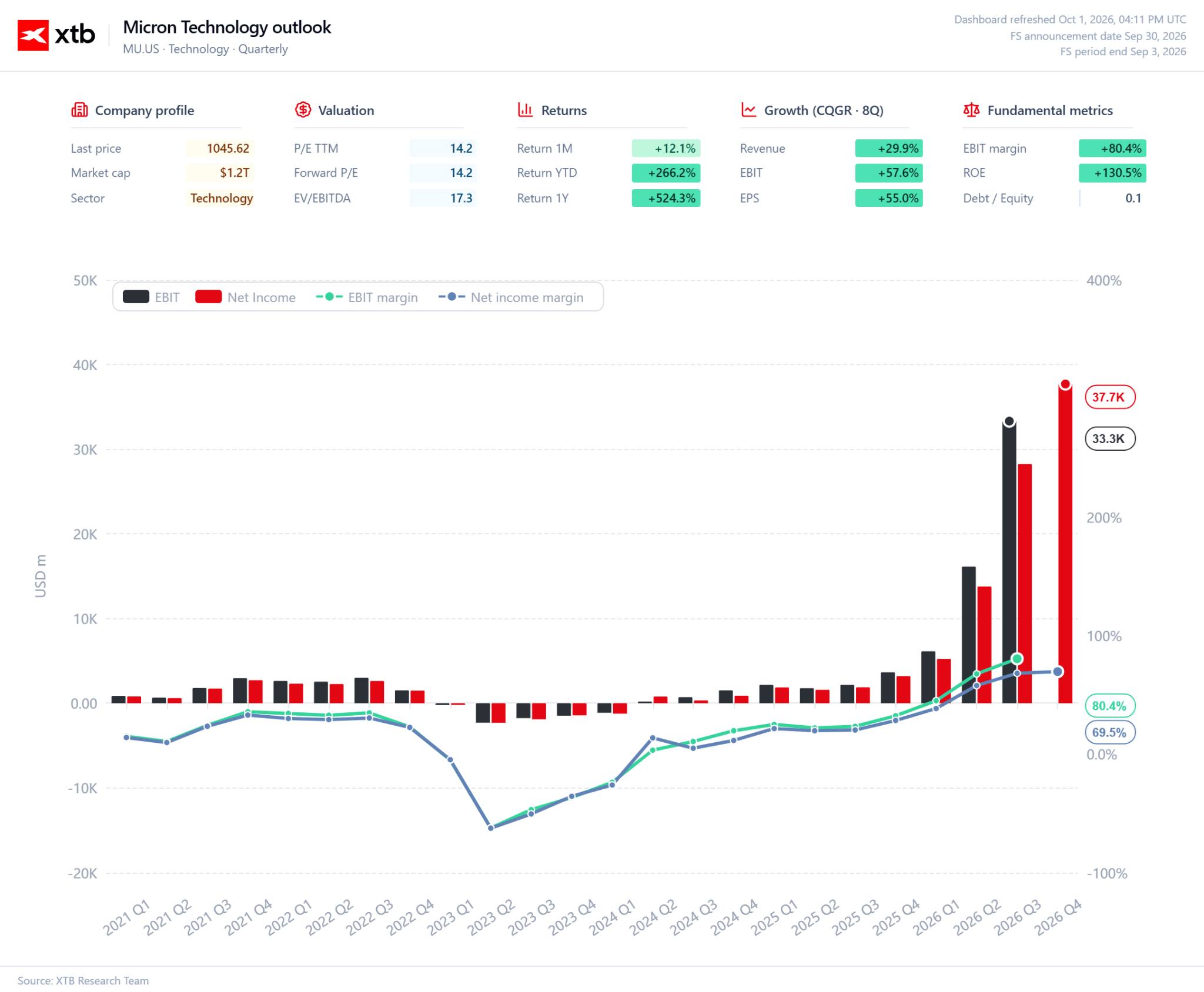
Net income: $37.70 billion
-
Operating cash flow: $43.97 billion
-
Adjusted free cash flow: $33.20 billion
-
Q1 FY2027 revenue guidance: $61.5 billion
The most important factor is the pace of growth. Revenue increased nearly fivefold year over year, while Micron reached profitability levels that would have been difficult to imagine for such a cyclical business only recently. Crucially, the growth is not coming solely from higher volumes. With memory supply constrained, the company is benefiting from both higher prices and stronger demand.
This is particularly visible in the data center business. The Core Data Center segment generated $18 billion in revenue, with a gross margin of 90%. Cloud Memory added another $16.3 billion of revenue at an 83% gross margin. These two segments illustrate where the center of gravity of Micron’s business now lies.
Even more important than Q4 itself is the outlook for the next quarter. Management expects revenue of $61.5 billion, representing further growth from an already record level. In a typical memory cycle, such a rapid acceleration in results would quickly lead to higher supply and increasing price pressure. This time, Micron is entering the next quarter with demand still rising while memory availability remains constrained.
The report therefore shows more than another record quarter. It shows that the current cycle is still accelerating, while the memory shortage allows Micron to convert stronger demand into exceptionally high profitability.
Financial Analysis
Micron’s results demonstrate not only the scale of the current memory boom, but also its impact on the economics of the business. Revenue growth has been accompanied by a dramatic improvement in profitability, meaning that each additional dollar of sales is currently translating into an unusually high level of earnings and cash generation.
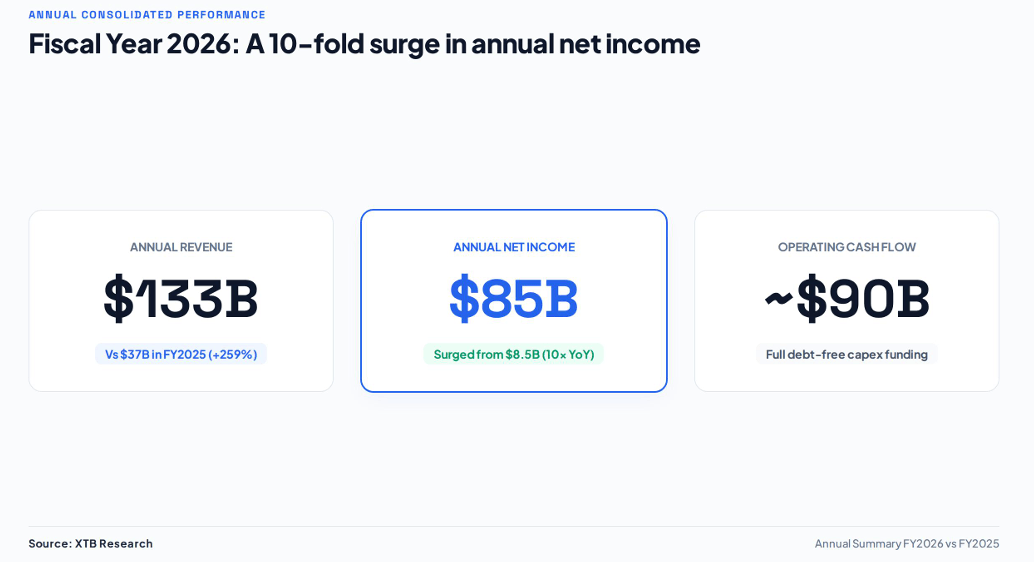
For fiscal 2026 as a whole, Micron generated more than $133 billion in revenue, compared with $37 billion a year earlier. Net income increased from $8.5 billion to $85.0 billion, while operating cash flow reached nearly $90 billion. This shows that the current cycle is not driven merely by accounting-driven margin expansion. The company is converting its high profitability directly into cash.
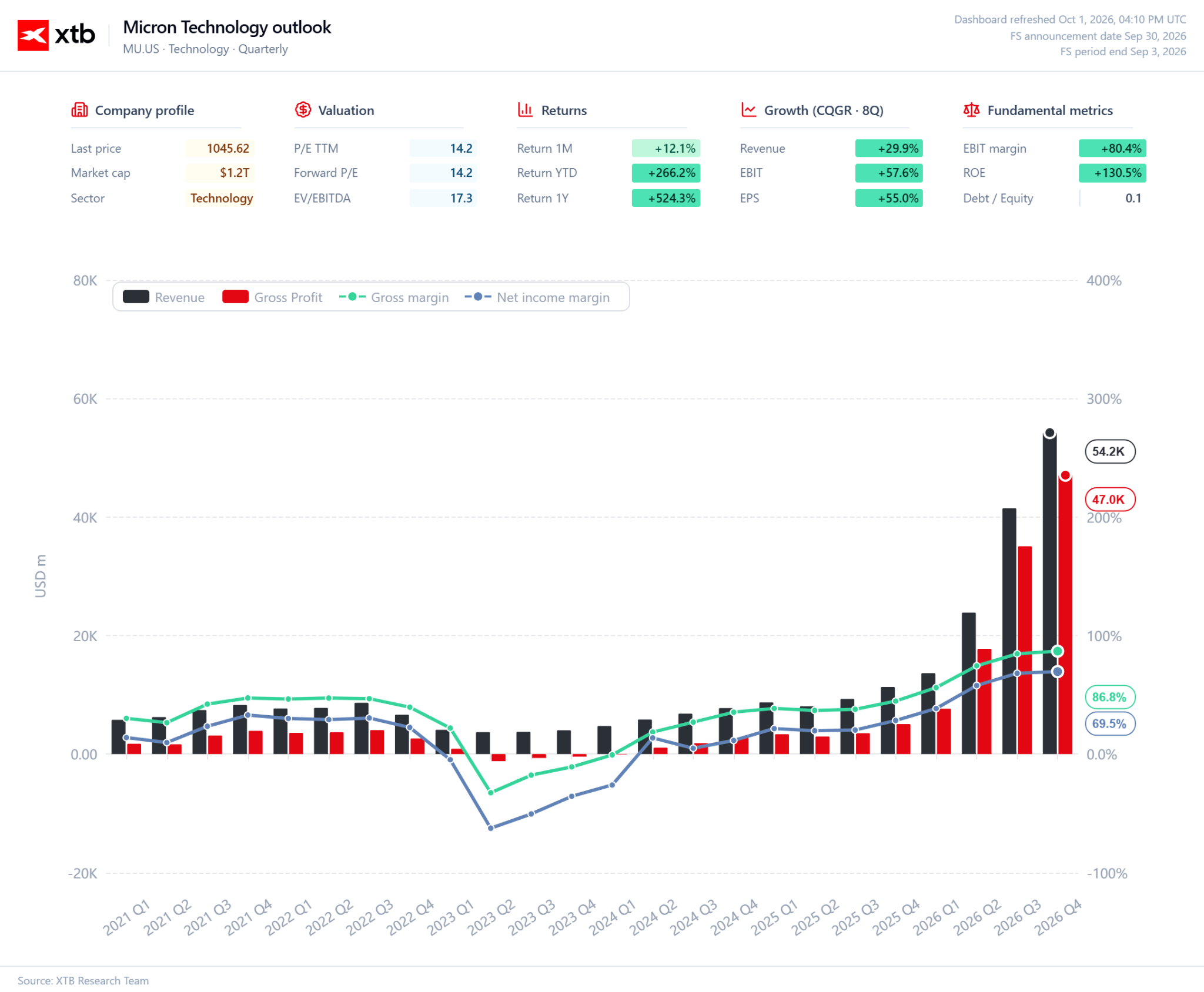
The biggest change is visible at the gross margin level. Despite the enormous increase in revenue, Micron achieved an adjusted gross margin of around 87% in Q4. For a memory manufacturer, that is an extraordinary level and reflects the pricing power created by the current shortage. When supply remains constrained, higher sales do not require aggressive price competition, allowing a much larger share of incremental revenue to flow through to operating and net income.
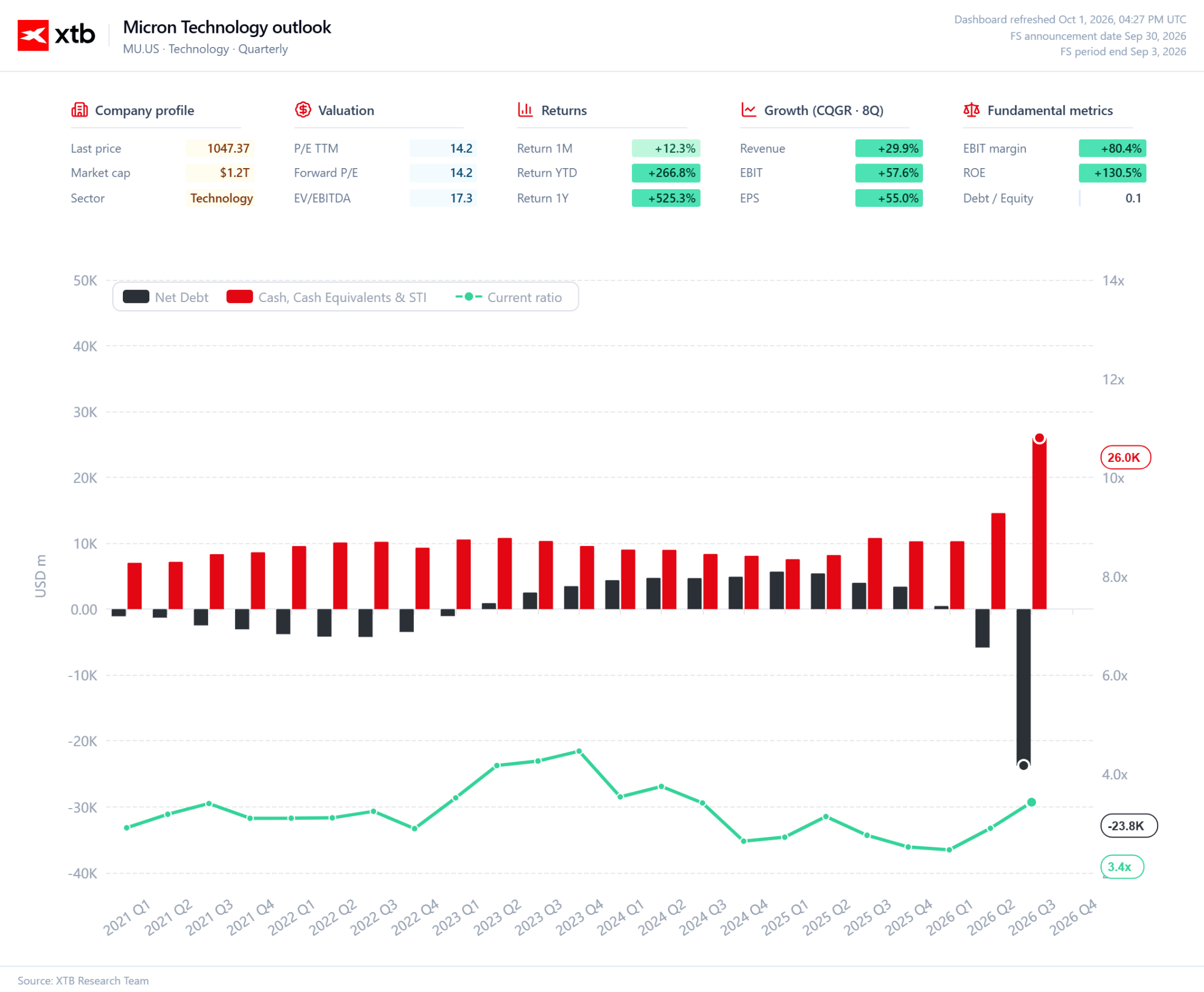
At the same time, Micron remains highly capital intensive. Expanding production capacity requires tens of billions of dollars in investment, meaning a significant portion of current cash generation must be directed toward capital expenditure. This creates an important advantage, however: the current cycle is providing Micron with the financial resources needed to fund the next phase of expansion without excessive reliance on additional debt.
This is why Micron should not be viewed purely through the lens of revenue growth or short-term EPS. The more important question is whether the current margins translate into sustained cash generation and the ability to finance another wave of capacity expansion. If demand for AI memory remains strong for years, Micron can use the current phase of the cycle to expand production, strengthen its technological position and build a larger revenue base for the future.
What Comes Next for Micron?
After such a strong report, the key question is no longer whether demand for memory is strong. That has been established. The real question is how long manufacturers can keep supply below demand. Micron is continuing to increase investment, but new production capacity will not appear overnight. The company is spending heavily today to meet AI-driven demand in the years ahead.
This is where the current cycle has its most important advantage. Micron can increase production, but the entire industry needs to expand supply fast enough to satisfy growing demand for DRAM, HBM and data center memory. If industry investment grows more slowly than demand, the shortage will persist and pricing power will remain elevated.
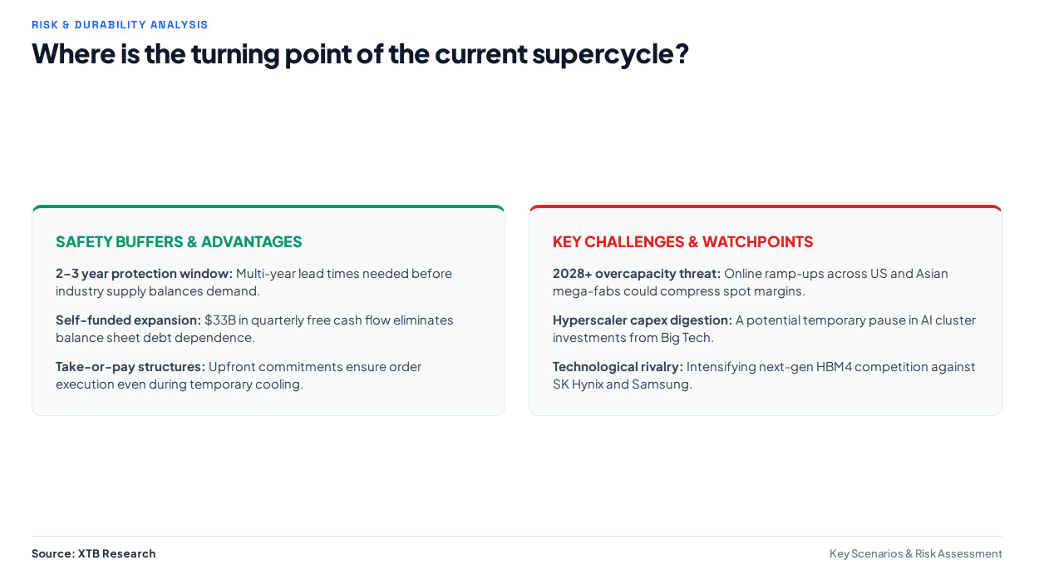
Micron is also securing an increasing portion of future demand through long-term agreements with customers. This is an important shift from the traditional memory market model, in which manufacturers were far more exposed to prevailing spot prices and short-term market conditions. According to recent information, customer commitments under these agreements have risen to around $32 billion, while remaining performance obligations have reached roughly $150 billion.
This does not mean that the traditional memory cycle has disappeared. The biggest risk remains the point at which new factories operated by Micron and its competitors begin supplying enough memory to eliminate the shortage. When that happens, pricing pressure could return quickly and today's exceptional margins would become difficult to sustain. The more aggressively the industry invests, the more important it becomes to determine whether AI demand can continue growing faster than supply.
For now, the data suggest that this point has not yet arrived. Micron is ending fiscal 2026 with enormous cash generation that can be directed toward expanding production capacity and developing the next generations of memory. At the same time, the company is increasing investment while customers are securing future supply. This creates a powerful mechanism in which today's shortage generates the cash needed to build the supply required to serve the next wave of demand.
The most important test for Micron, therefore, is not the absolute level of earnings in the next quarter, but the durability of the relationship between supply and demand. As long as AI infrastructure expands faster than the industry's production capacity, Micron can maintain high prices, margins and cash generation. The real turning point will come when supply begins to catch up with demand.
Harvest Time in the Memory Market
Micron is ending 2026 at a point when the memory industry still cannot keep up with AI-driven demand. New production capacity is coming, but bringing it online will take years, while data center demand is growing today. This gives Micron a rare window in which it can increase sales, maintain high pricing and finance expansion from record cash generation.
The current cycle does not yet look like the final stage of a traditional memory boom. Its end will be determined by the moment when new production capacity starts growing faster than demand. Until that happens, Micron remains one of the primary beneficiaries of the structural memory shortage.
That is the core of the current investment thesis. This is no longer simply a recovery from the bottom of a memory cycle. The question is whether AI can keep the market undersupplied for long enough for Micron to turn today's supply constraints into sustained growth in the scale of its business. The latest results suggest that this process is still gaining momentum.
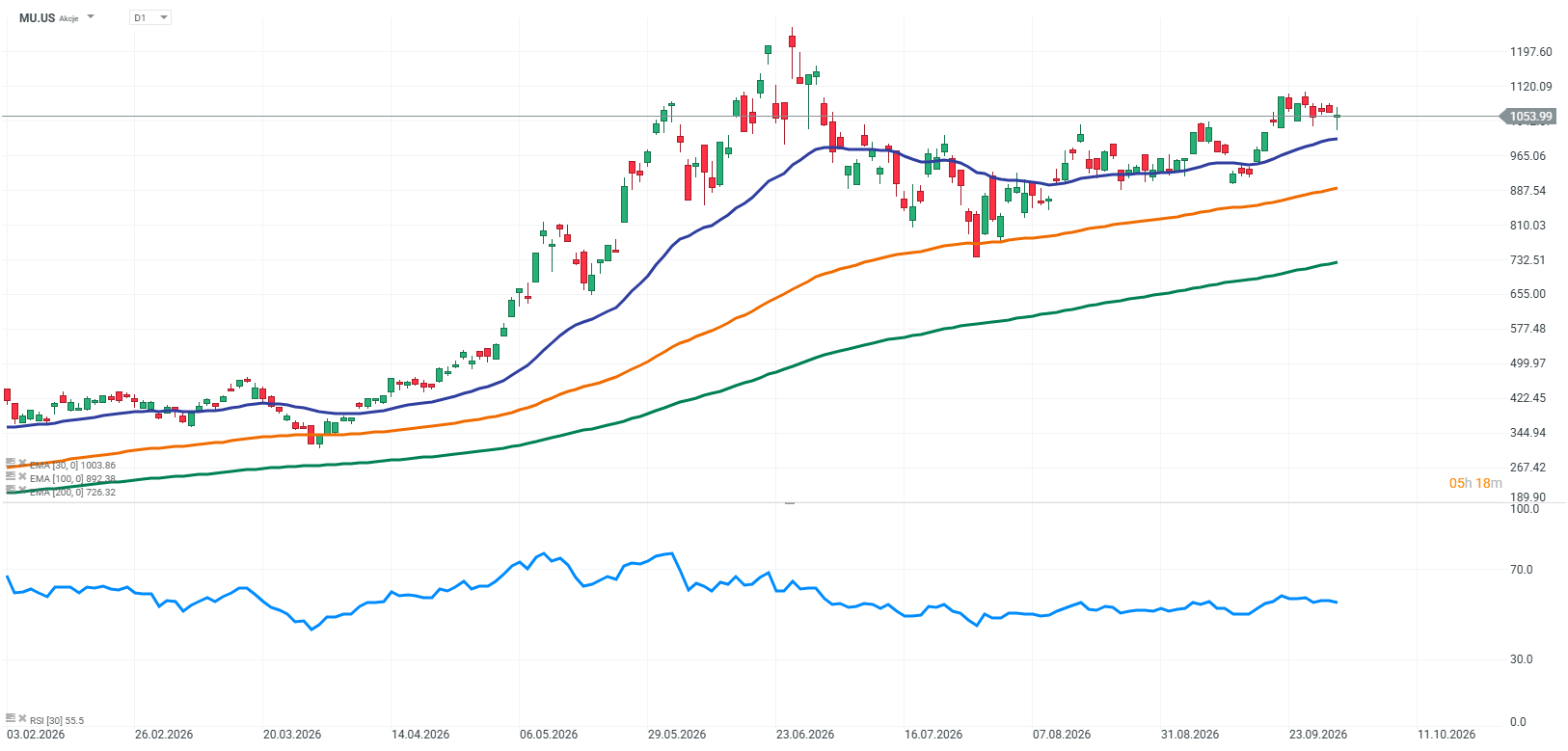
Source: XTB Reserach


Tesla was supposed to burn $5 billion, but posted a positive result. Will Tesla still be a car company in a year?


Record-breaking Meta, though with a cash loss. Investors (for now) are buying Zuckerberg's plan anyway


US OPEN: Preparations for Tesla's mega-merger with SpaceX. Diplomatic stalemate with Iran cools Wall Street's enthusiasm
Meta Preview: Billions in AI spending, but when will the investments start paying off?
This content has been created by XTB S.A. This service is provided by XTB S.A., with its registered office in Warsaw, at Prosta 67, 00-838 Warsaw, Poland, entered in the register of entrepreneurs of the National Court Register (Krajowy Rejestr Sądowy) conducted by District Court for the Capital City of Warsaw, XII Commercial Division of the National Court Register under KRS number 0000217580, REGON number 015803782 and Tax Identification Number (NIP) 527-24-43-955, with the fully paid up share capital in the amount of PLN 5.869.181,75. XTB S.A. conducts brokerage activities on the basis of the license granted by Polish Securities and Exchange Commission on 8th November 2005 No. DDM-M-4021-57-1/2005 and is supervised by Polish Supervision Authority.