


- Oil prices remain calm as tensions flare in the Middle East
- Middle East oil supply gets a boost
- AI trade comes under more scrutiny
- Why rising Treasury yields weighs on AI
- Will the wobble in stocks impact SpaceX IPO?
- Could CPI come in weaker than expected?

- Oil prices remain calm as tensions flare in the Middle East
- Middle East oil supply gets a boost
- AI trade comes under more scrutiny
- Why rising Treasury yields weighs on AI
- Will the wobble in stocks impact SpaceX IPO?
- Could CPI come in weaker than expected?
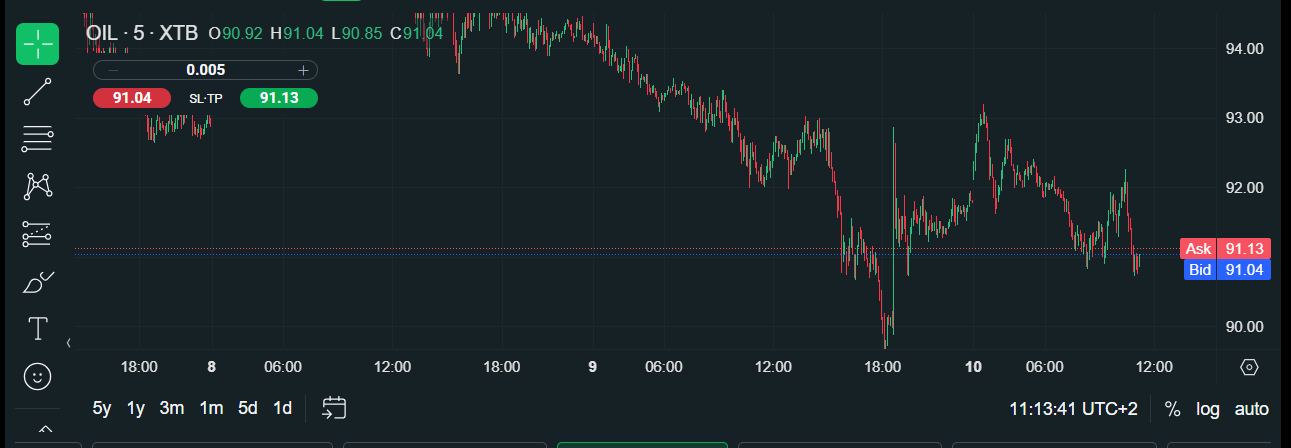
Markets are directionless as we move through Wednesday. A flare up in tensions between Iran and the US, with both sides striking each other has not translated into an oil price spike, and the price of Brent crude remains below $92 per barrel. There is a lack of anxiety in the oil market right now, even though a peace deal is unlikely in the current scenario.
The oil market is trading on hope that a resolution can be found, and on a loosening of oil supply. Although Iran continues to block most tankers from passing through the Strait of Hormuz, there is a significant amount of Middle Eastern oil leaving the Persian Gulf by tanker through the Strait and through other routes. It is difficult to tell exactly how many ships are passing through the Strait, but anecdotally it is more than officially reported, as ships turn off their radars when traversing the Strait. The decline in onshore Middle Eastern oil inventories is also telling us that Middle Eastern oil supply is managing to loosen up, even if it is nowhere near pre-war levels. For example, UAE oil company ADNOC is selling 14mn barrels of oil this week and is planning a second tender in the coming days.
This supply boost explains why the oil price is not surging on the latest outbreak of fighting in the Gulf, and how the oil industry can operate when there is no peace deal.
Elsewhere, tech is obviously in focus. There was another sell off in tech stocks on Tuesday, with Marvell, the chip maker much lauded by Nvidia CEO Jensen Huang, leading the sell off along with Bitcoin Treasury company Strategy. Both fell 8% on the day. Other large decliners included Qualcomm, Arm, and Apple. This suggests that the shake out in AI stocks is not over yet.
Apple failed to impress investors with its latest version of Siri AI. The verdict on the new Siri is that it is basic, but it works. It won’t change your life, but it could make your workflow or day-to-day task management easier. It can answer questions and reference details in your email and calendar to make recommendations. It can even add a list of events to your calendar from your email. This latest voice activated AI assistant is a big step for Apple, since it has been lagging in the AI race, however, Apple is entering a competitive space. OpenAI has just announced that its next phase of growth will include consumer products infused with AI capabilities. The market was not in the mood for more AI capabilities on Tuesday, and Apple’s share price tanked by 3%.
The proof will be in Apple’s future earnings reports. With the market wobbling on the AI trade this week due to valuation concerns, there will be even more focus on earnings season, which will start around August. For now, futures are pointing to further declines in US indices, Nasdaq futures are currently lower by 0.8% and S&P 500 futrues are down 0.5%.
The smaller tech sector is helping to protect Europe. Interestingly, the AI enabler trade touches 50% of the S&P 500, this includes companies that are indirectly linked to the build out for AI technology, including utilities and other firms. In Europe, the AI-enabler trade is much smaller at 15%, thus, in this period of AI trade volatility, we should see some European stock market outperformance vs. the US.
The issue for the AI trade right now is not only stretched valuations, it is also rising bond yields. Firstly, capex spending could become more expensive if bond yields continue to rise and if the Fed decides to hike interest rates later this year. The last time the Nasdaq recorded an annual decline was in 2022, when global central banks started to raise interest rates. Added to this, even immensely successful AI stocks, like Nvidia, have an earnings yield that is now below the 10-year Treasury yield. The most recent quarterly results from Nvidia show a forward earnings yield of 3.6%, which is below that of the 10-year Treasury yield, which is 4.57%. This means that Nvidia offers a significantly lower earnings yield than risk-free bonds. The market is ruthless, if it can get a higher and lower risk return elsewhere, then it will ditch the AI trade.
Ahead today, the focus will be on whether the AI trade stabilizes ahead of tomorrow’s much-hyped SpaceX IPO. The valuation is set at more than $1.7 trillion, and reports suggest that the IPO, which is offering $80bn of shares, is oversubscribed. We expect the IPO to be successful on Thursday, and trading could be strong on Friday, as the cult of Elon Musk helps to prop up the stock.
However, this IPO might be historic for its size, yet that is not the most interesting event, in our view. The more interesting event for us will be SpaceX’s first earnings report. The media frenzy is intense ahead of the SpaceX IPO, because of its sheer size. But the majority of SpaceX’s future revenues are based on estimates of XAI sales. XAI is currently a small business within SpaceX that is loss making. Thus, investors are being asked to buy an idea or a vision of what the XAI future could look like in 2 years, when analysts suggest that it could see $300bn + in revenue. This is highly unusual. In a typical IPO investors know what they are buying, SpaceX’s IPO does not have a complete business, instead investors are buying an idea of a business. We shall have to see if this is enough to sustain the share price, or if it comes crashing below the IPO price of $135 per share in the coming weeks.
The key economic event today is US CPI, which will be released at 1330 BST. The market is expecting a reading of 4.2% from 3.8% last month. The market is going to be extremely sensitive this reading. A CPI miss could see a rebound in the tech trade and a decline in Treasury yields. A stronger than expected reading could see a continuation of the sell-off in stocks and bonds.
Treasury yields have been rising into this report, and the 2-year Treasury yield is higher by 6bps in the past week, and 25 bps in the past month. The 10-year yield is also higher. Thus, the bigger move could be if we get a weaker CPI reading than expected. While the annual rate is likely to see a large increase, it is worth watching the month-on-month rate, since average gasoline prices have fallen nearly 10% since late May. While this may show up more clearly in the June CPI report, a weaker than expected MoM reading for CPI could dampen expectations for a Fed rate hike later this year.
Chart 1: The oil price remains stable
Source: XTB


Daily summary: Wall Street sentiment weakens amid hawkish Fed remarks 🚩 USDIDX at its highest level since July 24


Cocoa Falls 4% 📉 Are High Inventories Weighing on Prices?
Stock Market Commentary: Trump Signals a Major Drop in Oil Prices. Will U.S. Stocks Surge?

US Open: Nasdaq tries to recover loses 🗽 Fair Isaac shares in panic
This content has been created by XTB S.A. This service is provided by XTB S.A., with its registered office in Warsaw, at Prosta 67, 00-838 Warsaw, Poland, entered in the register of entrepreneurs of the National Court Register (Krajowy Rejestr Sądowy) conducted by District Court for the Capital City of Warsaw, XII Commercial Division of the National Court Register under KRS number 0000217580, REGON number 015803782 and Tax Identification Number (NIP) 527-24-43-955, with the fully paid up share capital in the amount of PLN 5.869.181,75. XTB S.A. conducts brokerage activities on the basis of the license granted by Polish Securities and Exchange Commission on 8th November 2005 No. DDM-M-4021-57-1/2005 and is supervised by Polish Supervision Authority.