


- Strong weekly performance transformed stock market performance in November
- However, risk plummets as we start December
- Bitcoin drops 5%
- After strong end to November, hopes were high for a bullish end to the year
- Europe sizes up to US, and hopes are high for 2026
- Black Friday and PMI reports could suggest a resurgent US economy
- European CPI could boost EUR/USD towards $1.20

- Strong weekly performance transformed stock market performance in November
- However, risk plummets as we start December
- Bitcoin drops 5%
- After strong end to November, hopes were high for a bullish end to the year
- Europe sizes up to US, and hopes are high for 2026
- Black Friday and PMI reports could suggest a resurgent US economy
- European CPI could boost EUR/USD towards $1.20
The narrative has abruptly shifted on Monday. After a powerful rally that helped US and European stocks reverse earlier losses and close November with small gains, equity futures are now in the red across the US and Europe, after sentiment took a knock following a sharp decline across crypto markets.
Bitcoin is lower by more than 5% on Monday and is back below $90,000. There was no news or obvious driver for the slide, which gathered pace during the Asian session. Eurostoxx futures are now pointing to a 0.3% decline later this morning, and US futures are currently nursing larger losses.
There is no obvious driver, however, the sharp decline in volatility last week, the Vix fell back below the average for the last 12 months, may have unnerved some investors who remain concerned about an uncertain outlook into year end. Bitcoin tends to be a leading indicator for overall risk sentiment right now, and its slide does not bode well for stocks at the start of this month.
No demand upswing in demand for safe havens, so can sell off last?
However, there has been no concurrent rise in demand for safe havens. Gold is lower by $2 so far this morning, and although the yen is the best performing currency in the G10 FX space today, it is higher by only 0.3% vs. the USD. Without a clear driver for the abrupt shift in market sentiment, the question is, can it last? There is an 80% chance of a Fed rate cut next week, unless that is significantly reduced, potentially on the back of strong US economic data and further signs that this year’s Black Friday was so strong it now threatens the prospect of a December rate cut, the sell off could be short lived.
Monday’s reversal comes after sentiment picked up across a broad range of assets and sectors last week, . Gold is back above $4,200, and the AI trade was back on, the American exceptionalism trade came roaring back, and markets appeared sanguine about the economic prospects for the UK after a deeply unpopular budget. If the sell off in risk persists, then we will be watching the bond market, to see if UK Gilts give back some of last week’s gains. In the commodity space, oil is higher by nearly 2%, after Opec+ confirmed that production hikes will be paused from next year.
Strong weekly performance saved November
The rally across global markets was powerful at the end of November, the S&P 500 rose by 4.75%, and the Nasdaq rose by more than 5%; the FTSE 100 was higher by nearly 2% even though the Office for Budget Responsibility revised down the UK’s growth forecast. US stocks posted a 5-day consecutive gain, and nearly 80% of companies registered gains on the S&P 500 on Friday. Liquidity, momentum and growth were the top three factors that powered stocks last week.
The AI trade is back, just in a different form
The top performers at the end of last week, included Intel, it rose by 10% on Friday, as an analyst noted that Intel will become an important supplier to Apple, providing the iPhone marker with advanced nodes. While Intel is not part of the Magnificent 7, it is still worth $197bn, and is considered a growth stock. Google had a tremendous November, the company is now valued at over $3.8trn, after seeing its market cap rise by $1.3 trillion since the start of September. Google’s star is rising, and it is now a major force in the AI space. Its share price was higher by 7% last week, compared with a 2.3% loss for Nvidia. This reshuffling at the top of the AI trade is positive for the entire market, as it revitalizes the AI trade, this was exemplified by the Philly semiconductor index, which rose by 10% last week. Now that sentiment has dipped at the start of December, we could see Google and other AI -related stocks give back some gains later today.
A bullish narrative forms as we enter final month of year
Thus, although sentiment has slipped at the start of December, a bullish market narrative is taking shape. Fears about an AI bubble have been put to bed. Not even a CME outage that saw multiple exchanges closed for hours at the end of last week could dent the market mood. And the ‘hurrah’ may continue, as long as Monday’s sell off does not persist. We are expected to get a Fed and Bank of England rate cut in the next few weeks, which is bolstering the market mood, and boosting market liquidity. Even earnings revisions are helping market sentiment, as they have been revised higher in recent days. The commodity space also had a strong performance last week, with gains for gold, silver, copper and oil, even if the monthly performance was uneven.
Europe regains its stature in 2025, and hopes are high for 2026
2025 may end the year with a resurgence in the AI trade, however, the performance of European stocks suggests that this is not the only theme that is driving markets. Many European indices are outperforming their US counterparts. For example, Spain’s Ibex is higher by more than 40%, and the FTSE MIB in Italy is higher by mor than 26%. On a currency adjusted basis, the FTSE 100, the Dax, the Cac 40 and the Eurostoxx 50 index are all outperforming the Nasdaq 100 and the S&P 500.
European stocks have been driven by banking, defense and renewables, and whenever there have been doubts about the sustainability of the US equity market rally, this has benefitted the European markets since they are not full of tech. While the AI theme is far from over, we continue to think that investors will want a good alternative to the US for the foreseeable, and any end of year rally could see European stocks and US stocks rise side by side.
As we start a new week, the focus is on some key economic data as we enter the blackout period for the Fed, before they are expected to cut rates on the 12th December. Below we look at 3 events that could drive financial markets in the coming days.
1, Global PMI surveys
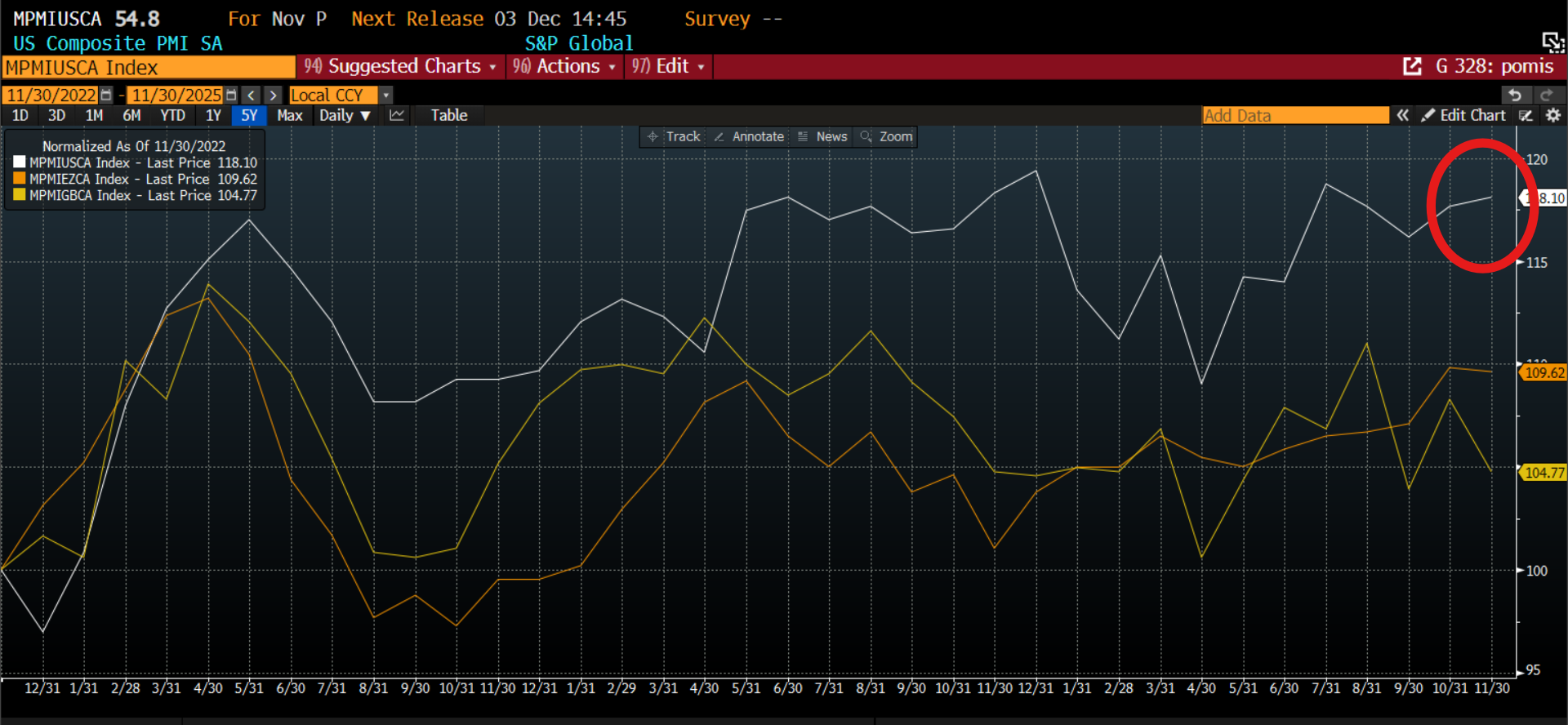
Worldwide PMI surveys for November will be released this week. Economists are expecting continuing US economic outperformance for both manufacturing and service sector surveys. Eurozone business growth continues to improve and is at one of the strongest rates of growth in 2.5 years, likewise Japan’s private sector sentiment survey reading was at one of its strongest levels for the year. This makes the UK an outlier, as the flash reading of its PMI for November suggested that the economy stalled last month as Budget uncertainty weighed heavily on the private sector.
Now that the Budget is out of the way, will the UK PMI survey pick up? We think that it is too early for the November reading to show this, and instead we will need to watch the December report. However, the PMI reports survey the private sector, which was the big loser in the Budget. Income tax rates are rising, and the OBR do not think that the measures in this Budget, including a large increase in welfare spending, will boost growth. Thus, the negative sentiment around the UK and its economic management continues, which could weigh on PMI survey results for some time.
So far, the markets have been sanguine about the UK’s budget, UK bond yields fell by 10 bps last week, and the pound was the fifth best performing currency in the G10 FX space. However, if the economic data starts to show that the UK economy is under strain, then we could see volatility in the bond market, which may weigh on the pound.
Another strong reading for the US PMI surveys could reinforce the American exceptionalism narrative, which fueled strong gains in US stocks last month. The prospect of a Fed rate cut is also likely to boost sentiment.
Chart 1: US, Eurozone and UK PMI readings, the UK is a clear outlier as the economy stalls.
Source: XTB and Bloomberg
2, US consumer data and PCE update
The focus on Monday is likely to be on the 4.1% uplift to Black Friday sales in the US compared to a year ago. Although this flash figure does not adjust for inflation, it is still higher than the 3.4% increase in 2024. This suggests that the US consumer remains resilient and is ending 2025 with significant purchasing power. This may ease fears about the strength of the US economy as we end the year.
Early signs suggest that younger people were a key driving force for sales this year, as households and families cope with rising costs. We will need to wait until early next year to get the full update from the retailers themselves, but signs that sales were strong last weekend could lead to a wave of analyst upgrades for Q4 earnings, which may help boost sentiment towards the stock market in the coming weeks.
The other main data point to watch this week is the delayed release of the September PCE reading. The Core PCE is the Fed’s preferred inflation measure, and it will be one of the last major economic data releases before the Fed meeting next week. The market expects the PCE reading to be moderate, with core PCE expected to come in at 2.8% for September. While this is old data, it still has significance. Combined with the University of Michigan inflation expectations readings, this data could give the Fed a more complete picture of US inflation ahead of their meeting on 12th December. It could also help the market determine if a rate cut is likely. Signs that inflation is moderating would essentially give a green light to another rate cut next in the US. However, there is already an 83% chance of a rate cut from the Fed priced in by the Fed Fund Futures market. Thus, the bigger risk could be if inflation pressures remain elevated, or are building. This could lead to a rapid recalibration of rate cut expectations, and it may dent sentiment towards stocks and other risky assets.
3, Eurozone CPI
The initial reading of November’s CPI is due for release this Tuesday. The market expects headline and core annual CPI to remain steady at 2.1% and 2.4%, respectively. However, a hefty 0.3% monthly decline is also expected.
Overall, we do not expect this data to shift the dial for the ECB, and we expect them to remain on hold when they meet later this month. The euro will be in focus this week, EUR/USD closed last week just above $1.16. This pair is well above the 200-day sma, and the next key resistance level is $1.1645, the 100-day sma. A close above here could be a bullish development for this pair, and it may lead to some anticipation that the single currency could reach $1.20 by year end, especially if the Fed cuts rates but the ECB holds firm in the face of a reduced disinflationary impulse and a stronger growth outlook for 2026. The euro is the fourth best performer in the G10 FX space so far this year, and it has registered gains of more than 10% vs. the USD and the yen and is up 5.5% vs. the pound. The euro is the top performing major currency in 2025, and there could be more to come. Combined with strong stock market gains and an improved growth outlook, European assets could start 2026 in a strong position.
The OCED growth forecasts are released on 2nd December, so investors will be looking to see how the Eurozone is expected to fare in 2026 and beyond, and whether it can narrow the growth gap with the US.



US Open: Further declines on Wall Street, Brent above 111 USD, AI correction continues (14.10.2026)


BREAKING: France slows down, Germany holds on. Euro falls below 1.12


Chart of the Day: Is USDJPY running out of road? Inflation forces the BoJ to act, but the Fed could spoil the Yen’s rally


Macro Calendar: Preliminary PMI Readings and Earnings Ahead
This content has been created by XTB S.A. This service is provided by XTB S.A., with its registered office in Warsaw, at Prosta 67, 00-838 Warsaw, Poland, entered in the register of entrepreneurs of the National Court Register (Krajowy Rejestr Sądowy) conducted by District Court for the Capital City of Warsaw, XII Commercial Division of the National Court Register under KRS number 0000217580, REGON number 015803782 and Tax Identification Number (NIP) 527-24-43-955, with the fully paid up share capital in the amount of PLN 5.869.181,75. XTB S.A. conducts brokerage activities on the basis of the license granted by Polish Securities and Exchange Commission on 8th November 2005 No. DDM-M-4021-57-1/2005 and is supervised by Polish Supervision Authority.