



A potential agreement between the US and the Houthis drastically reshuffles the balance of power in the Middle East once again. Securing international shipping in the Bab al-Mandab Strait came at the cost of excluding Saudi Arabia, whose vessels are key to keeping the global oil balance in check, from this protection. Washington's rejection of requests for military support, combined with the Houthis gaining control over the Yemeni coast and Perim Island, gave the rebels a free hand to continue targeting Saudi infrastructure.
Recent attacks on Saudi Aramco installations in the Red Sea port city of Yanbu and on the base in Khamis Mushait show that Saudi oil exports are called into question. The sea route along the west coast is becoming highly risky, forcing Riyadh to reroute logistics and transport to Persian Gulf ports (e.g., Ras Tanura). Changing routes lengthens delivery times, increases freight costs, and raises insurance rates, imposing a permanent geopolitical premium on crude prices.
Aramco's quick response cools price fever
Despite the real geopolitical threat, the oil market ignored further attacks and reacted with a drop in prices. Saudi Aramco's swift response turned out to be the key fundamental factor. The company undertook intensive work to build a bypass for the main long-distance pipeline damaged in last week's attack.
Aramco plans to restore about half of the main line's capacity in just a few days, and regain full transmission capacity in about six weeks. This information removed the threat of a sudden, complete paralysis of East-to-West supplies from the market and gave investors an excuse to take profits following previous dynamic gains.
Brent Crude Technical Analysis (D1)
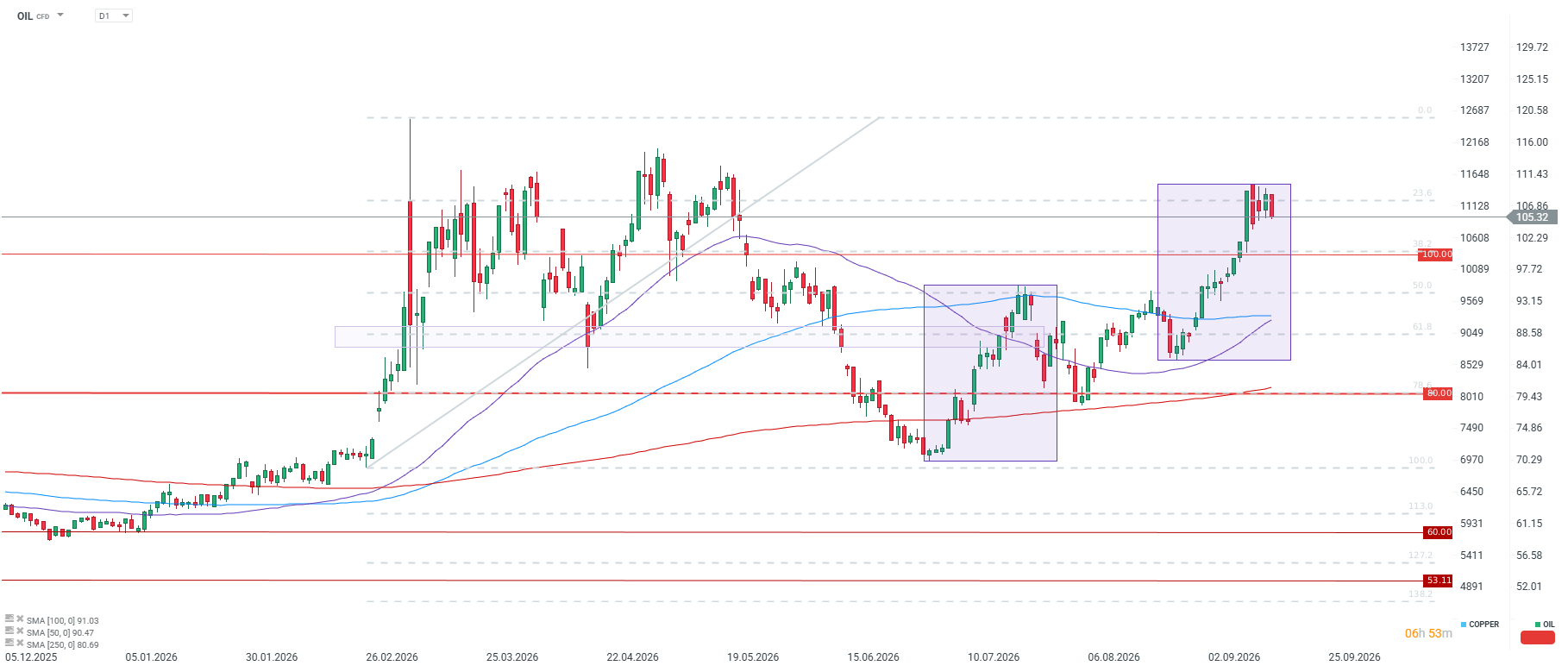
The sharp drop in WTI oil during today's session was partly a technical effect resulting from contract rolling. Nevertheless, we are observing a clear pullback in prices on both key benchmarks today. The latest upward wave in Brent crude reached a model 1:1 geometry target relative to the previous impulse, and after reaching a local peak, the price is currently oscillating around $105.
The market is facing a key resistance zone between $106.86 and the recent high near $110, reinforced by the 23.6% Fibonacci retracement. A sustained break above the $110 level will open the way for bulls toward $120.
The first and most important support barrier for demand is the psychological level of $100.00 (38.2% Fibo). Should a deeper correction occur, another strong buffer is formed by the 50-day and 100-day moving averages (SMA 50 and SMA 100) in the $90.47–$91.03 area (along with the 61.8% Fibo level at $88.58). The main defensive level for the entire trend remains the $80.00 region, where the 250-period moving average runs. The current pullback is a local correction within a strong uptrend. As long as the price stays above $100 per barrel, buyers retain full control.



Market Wrap: Oil rises again, French fiscal concerns weigh on euro (07.10.2026)



Oil falls below $100🚨
💶Chart of the Day: EURUSD at Lowest Since May 2025 Amid French Fiscal Crisis

Morning Briefing: Dollar gains, oil falls. EURUSD at multi-month lows
This content has been created by XTB S.A. This service is provided by XTB S.A., with its registered office in Warsaw, at Prosta 67, 00-838 Warsaw, Poland, entered in the register of entrepreneurs of the National Court Register (Krajowy Rejestr Sądowy) conducted by District Court for the Capital City of Warsaw, XII Commercial Division of the National Court Register under KRS number 0000217580, REGON number 015803782 and Tax Identification Number (NIP) 527-24-43-955, with the fully paid up share capital in the amount of PLN 5.869.181,75. XTB S.A. conducts brokerage activities on the basis of the license granted by Polish Securities and Exchange Commission on 8th November 2005 No. DDM-M-4021-57-1/2005 and is supervised by Polish Supervision Authority.