
This study explains the components of a balance sheet and how investors can use it to evaluate a company’s financial health, identify risks, and make informed investment decisions.
This study explains the components of a balance sheet and how investors can use it to evaluate a company’s financial health, identify risks, and make informed investment decisions.


What are the main components of a balance sheet?
A balance sheet contains three main components: assets, liabilities, and shareholders' equity. These sections group individual accounts to clearly separate corporate resources from external debts and internal owner funding.
Investors read a balance sheet to see exactly what a company owns versus what it owes on a specific date. It is a fundamental financial statement showing assets, liabilities, and shareholders' equity, built on the core accounting equation Assets = Liabilities + Equity.
Key takeaways
-
Snapshot in time: The balance sheet captures a company's financial position on one specific day, unlike other reports that cover entire periods.
- Three main elements: Every balance sheet categorises financial data into assets, liabilities, and shareholders' equity.
- Accounting equation: The entire document functions on the formula where total assets must exactly equal the sum of total liabilities and shareholders' equity.
- Investor utility: Analysing the balance sheet helps you determine a company's working capital, debt load, and intrinsic book value prior to investing.
What is a balance sheet and what is it used for?
A balance sheet is a financial statement that details a company's assets, liabilities, and shareholders' equity at a specific reporting date. This document provides a "snapshot in time" of a company's financial standing, contrasting sharply with an income statement that measures performance over an extended period.
You use the balance sheet to evaluate a company's solvency, liquidity, and overall capital structure. Market participants rely on this financial statement to see exactly what a corporation owns versus what it owes to creditors, ultimately revealing the net value left for the owners.
Under International Financial Reporting Standards (IFRS), the balance sheet is formally called the statement of financial position (IAS 1), while U.S. companies prepare it under US GAAP. For public companies, the balance sheet appears in regulatory filings - in the U.S. through SEC EDGAR (10-K annual and 10-Q quarterly reports).
What is the main purpose of a balance sheet?
The main purpose of a balance sheet is to provide a standardised summary of financial health for external and internal stakeholders. Stock investors, creditors, corporate management, and regulators examine this financial statement to assess risk levels before allocating capital. By reviewing the document, you can determine if a company possesses enough resources to fund its operations without taking on excessive debt.
What are the main components of a balance sheet?
A balance sheet contains three main components: assets, liabilities, and shareholders' equity. These sections group individual accounts to clearly separate corporate resources from external debts and internal owner funding.
What is in a balance sheet and what are its 5 elements?
A standard balance sheet breaks the main components down into five distinct elements to provide granularity. This classification helps you assess how quickly resources can be converted into cash and when debts must be repaid.
- Current assets: These are short-term resources expected to be converted into cash within one year, including cash equivalents, accounts receivable, and inventory.
- Non-current / fixed assets: These represent long-term investments not easily liquidated, such as property, plant, equipment, and intangible assets like patents.
- Current liabilities: These are short-term financial obligations that the company must settle within one year, such as accounts payable and short-term debt.
- Long-term liabilities: These represent obligations due after more than one year, including corporate bonds, long-term lease obligations, and extended loan facilities.
- Shareholders' equity: This is the residual interest in the company's assets after deducting all liabilities, consisting primarily of share capital and retained earnings.
What is the balance sheet formula (accounting equation)?
The fundamental balance sheet formula is Assets = Liabilities + Shareholders' Equity, and both sides must always be equal. This accounting equation forms the mathematical foundation of the double-entry accounting system utilised by public companies globally.
Every corporate transaction affects at least two accounts to keep the accounting equation in perfect balance. For example, if a publicly traded company borrows cash from a bank, its total assets increase, but its total liabilities simultaneously increase by the exact same amount to maintain the equilibrium.
You can rearrange this accounting equation to isolate the owner's claim on the business by subtracting liabilities from assets. This modified formula, Shareholders' Equity = Assets - Liabilities, calculates the net worth or book value of the company. The progression of this value over time is further detailed in the statement of changes in equity.
Balance sheet format and example: what does it look like?
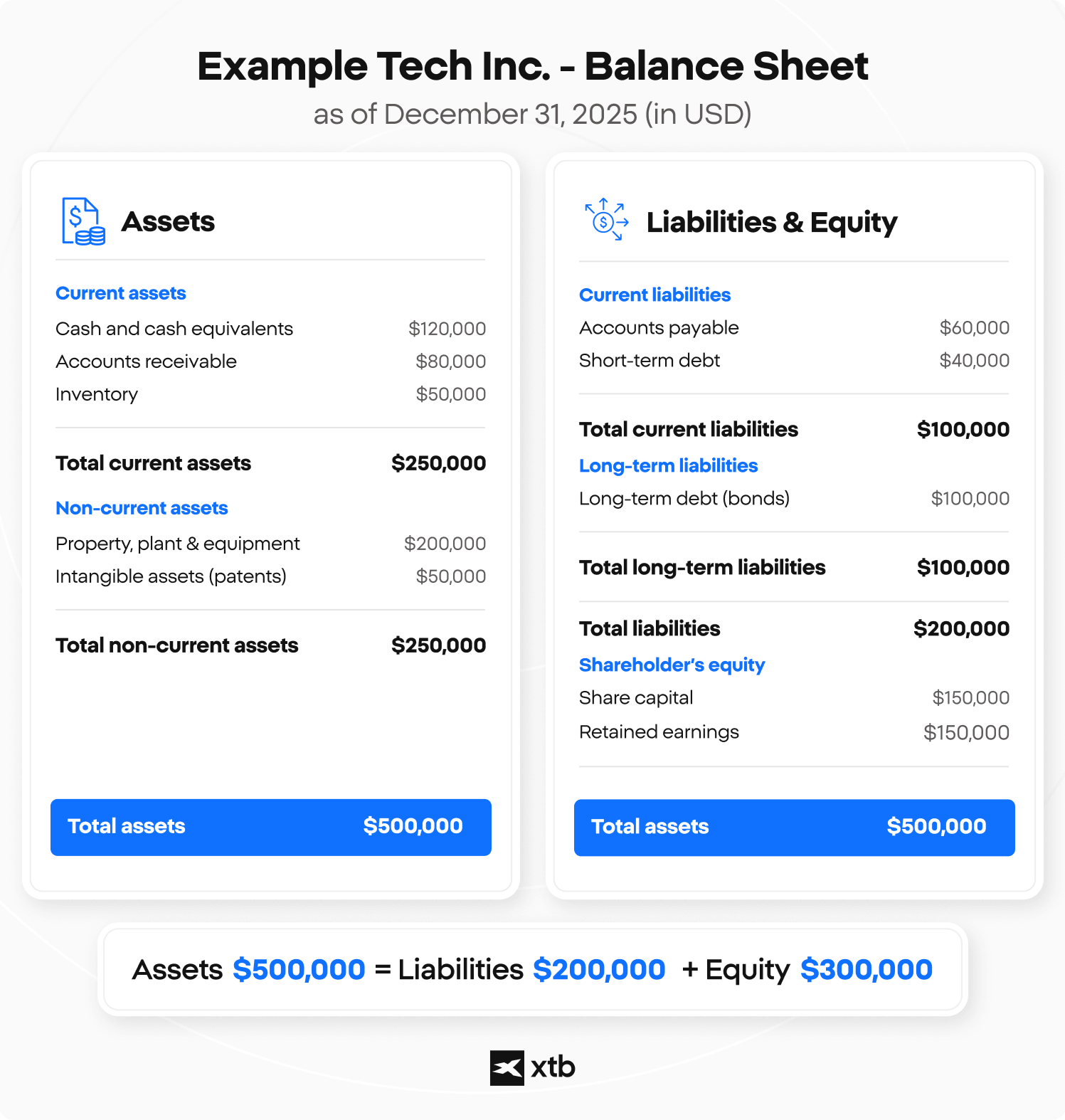
A balance sheet is formatted in two sections - assets on one side, and liabilities plus shareholders' equity on the other, always dated for a specific day. This balance sheet format organises line items in order of liquidity, starting with the most easily accessible cash at the top of the list.
A typical balance sheet example from a public company lists assets first, followed immediately by liabilities and equity to clearly demonstrate the balancing equation.
What are the main types of a balance sheet?
Balance sheets come in a few standard formats. A classified balance sheet groups items into current and non-current categories (the version most public companies use). A comparative balance sheet places two or more reporting dates side by side so you can spot trends. A common-size balance sheet expresses every line as a percentage of total assets, making it easy to compare companies of different sizes. The layout is usually vertical (report form), with assets on top and liabilities plus equity below.
How is a balance sheet prepared, and why does it matter to investors?
A balance sheet is built from all transactions recorded by a company during the reporting period under the double-entry accounting system. Because each transaction affects at least two accounts, the accounting equation must always remain balanced. Before the report is published, accountants review the records and make adjustments for items such as depreciation, accrued expenses, inventory changes, and provisions.
Public companies usually publish unaudited balance sheets in quarterly reports and audited balance sheets in annual reports. Investors should therefore read the balance sheet together with the income statement, cash flow statement, and accompanying notes to assess whether changes in financial position reflect genuine business improvement or accounting adjustments.
The preparation process generally includes:
- recording business transactions,
- adjusting balances for depreciation, accruals, provisions, and other accounting items,
- calculating final asset, liability, and equity balances,
- reconciling the balance sheet with the income statement and cash flow statement,
- reviewing the accompanying notes and auditor’s opinion.
What should investors look for first on a balance sheet?
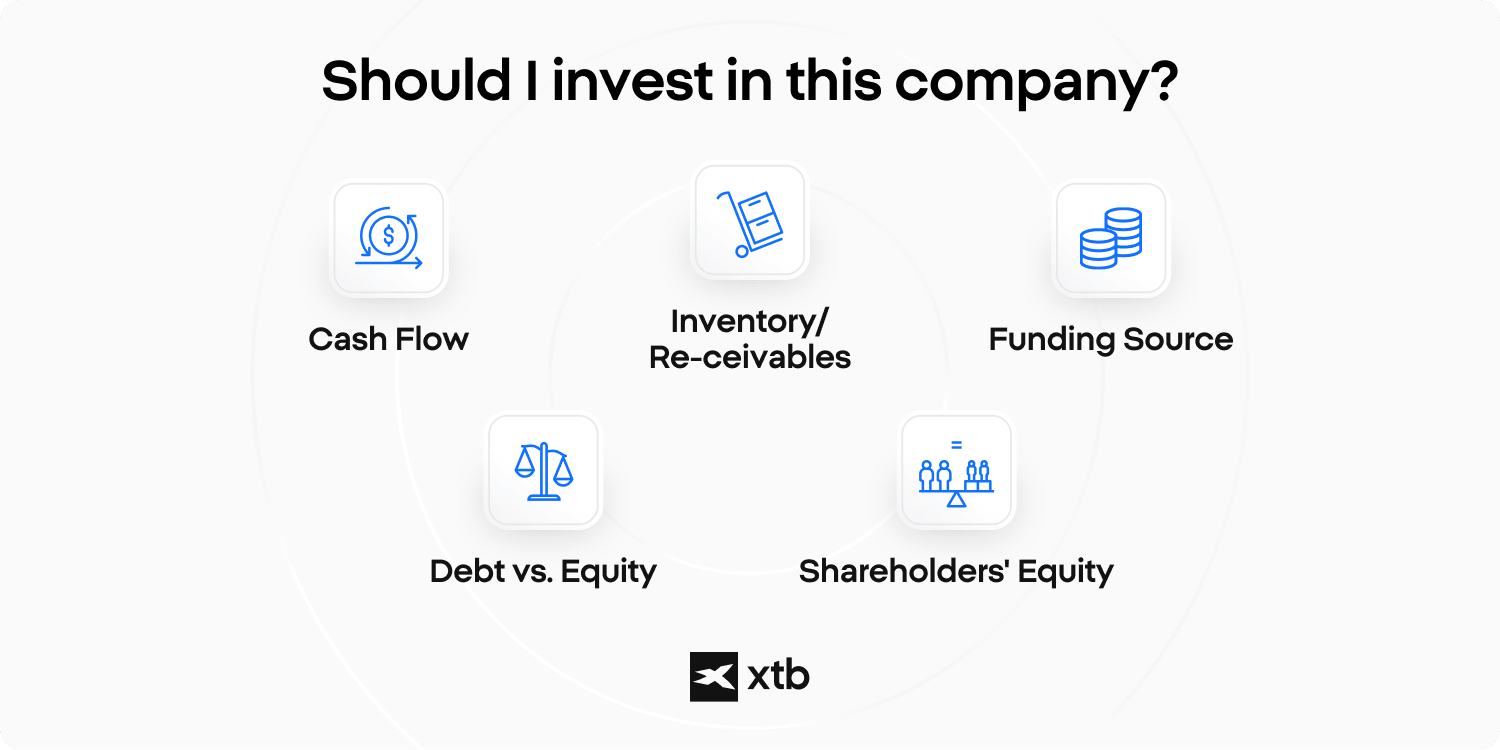
Investors first scan the balance sheet to determine whether the company's financial position is strengthening or weakening over time, before calculating complex financial ratios.
The first questions investors typically ask include:
- Is cash increasing over time?
- Is debt growing faster than shareholders' equity?
- Are inventories or accounts receivable rising unusually quickly?
- Is shareholders' equity consistently increasing?
- Is the company funding growth through retained earnings or additional borrowing?
This initial review helps investors identify potential strengths or warning signs before moving on to a more detailed financial analysis. Rather than relying on a single reporting date, experienced investors usually compare several years of balance sheets to identify long-term trends in financial health.
How to read a balance sheet and analyse it?
Investors evaluate a balance sheet's liquidity through the current ratio, leverage using the debt-to-equity ratio, working capital, and the company's book value. Calculating these key financial ratios is the next step after assessing the overall financial position.
You calculate working capital by subtracting current liabilities from current assets to assess short-term financial flexibility. Healthy companies often maintain a current ratio above 1.5, indicating they have sufficient short-term assets to cover immediate obligations, while heavily leveraged businesses may show debt-to-equity ratios exceeding 2.0. However, these benchmarks vary considerably across industries, so comparing a company with its direct competitors is generally more meaningful than relying on universal thresholds.
While the balance sheet provides crucial insight into a company's capital structure, it also has important limitations. Many assets are recorded at historical cost rather than current market value, and the document represents only a single reporting date. For a complete investment analysis, investors should combine the balance sheet with the income statement, cash flow statement, and valuation metrics such as the P/E ratio to gain a broader understanding of a company's financial health and market valuation.
Balance sheet vs income statement: what is the difference?
A balance sheet shows a company's financial position at a single point in time, while an income statement shows revenues, expenses, and profits over an extended period. Understanding the difference between a balance sheet and an income statement helps you distinguish a company's accumulated wealth from its ongoing profitability.
The table below compares the core characteristics of these two primary financial statements. You must analyse both documents, alongside the third major report, the cash flow statement, out of the three primary financial statements, to form a complete picture of corporate health.
|
|
|
|
|
|
|
|
|
|
|
|
|
|
|
|
|
|
|
|
FAQ
A balance sheet shows what a company owns (assets), what it owes (liabilities), and the value remaining for shareholders (equity) at a specific date. Investors use it to evaluate financial stability, debt levels, liquidity, and the company's ability to withstand economic downturns. It is one of the three primary financial statements used in fundamental analysis.
Yes. Under International Financial Reporting Standards (IFRS), many companies use the term statement of financial position instead of balance sheet. Both documents contain the same core information about assets, liabilities, and shareholders' equity.
A balance sheet always balances because it follows the accounting equation:
Assets = Liabilities + Shareholders' Equity
Every business transaction affects at least two accounts under the double-entry accounting system. If a company purchases equipment with a bank loan, for example, both assets and liabilities increase by the same amount.
There is no universal definition because financial strength depends on the industry and business model. However, investors generally look for:
- Strong liquidity and positive working capital
- Manageable debt relative to equity
- Consistent growth in shareholders' equity
- Stable or improving cash balances
- Sufficient assets to cover liabilities
Capital-intensive industries often operate with higher debt levels than software or service companies.
Professional investors often begin with several key ratios:
- Current ratio (short-term liquidity)
- Quick ratio (liquidity excluding inventory)
- Debt-to-equity ratio (financial leverage)
- Working capital
- Book value per share
- Return on equity (ROE), when combined with the income statement
No single ratio should be interpreted in isolation.
Yes. A business may report strong profits while carrying excessive debt, facing liquidity problems, or generating insufficient cash.
For example, a company can report positive net income but still struggle to repay short-term obligations if most of its assets are tied up in inventory or unpaid customer invoices. This is why experienced investors always analyse the balance sheet together with the income statement and cash flow statement.
Although it is an essential financial statement, a balance sheet has several limitations:
- It reflects only one reporting date rather than ongoing performance.
- Many assets are recorded at historical cost instead of current market value.
- Internally developed brands, intellectual property, and human capital are often not fully reflected.
- It cannot explain why assets or liabilities changed without reviewing other financial statements.
Because of these limitations, investors typically combine it with the income statement, cash flow statement, and management commentary.
Public companies publish balance sheets in their quarterly and annual financial reports. For U.S. companies, investors can access them through The company's Investor Relations website and SEC EDGAR filings (10-K and 10-Q)
For European companies, they are typically available through the company's Investor Relations website, annual Reports and Interim (Half-Year or Quarterly) Reports, or national stock exchange filing systems or financial market regulators, depending on the country.
Most publicly traded companies publish updated balance sheets every quarter and every fiscal year. Quarterly reports provide an updated financial snapshot during the year. Annual reports include audited financial statements and more detailed disclosures. Investors often compare multiple reporting periods to identify long-term trends rather than relying on a single balance sheet.
No. The balance sheet is only one part of a complete investment analysis.
- Professional investors typically combine it with:
- the income statement to assess profitability,
- the cash flow statement to evaluate cash generation, valuation metrics such as the P/E ratio or EV/EBITDA, and qualitative factors, including competitive advantages, management quality, industry conditions, and future growth opportunities.
Looking at all these elements together provides a much more reliable picture of a company's financial health and investment potential than any single financial statement alone.