
The reader knows roughly what an ETF is and wants the concrete steps to invest in one; they leave knowing how to open a suitable account, choose an ETF by clear criteria, place a buy order, decide how much and how often to invest, and avoid common mistakes.
The reader knows roughly what an ETF is and wants the concrete steps to invest in one; they leave knowing how to open a suitable account, choose an ETF by clear criteria, place a buy order, decide how much and how often to invest, and avoid common mistakes.
This article focuses on how to invest in ETFs in practice. If you are not yet fully comfortable with what an ETF actually is, it is worth reading our "What is an ETF" article first. Investing in an ETF requires opening a brokerage account that provides market access, selecting a fund based on strict criteria like cost and index tracking, and placing a buy order. You can typically start with as little as 10 EUR, depending on the platform's fractional share policies. Whether you plan to invest a lump sum or contribute monthly, understanding the mechanics of these funds ensures you build a portfolio aligned with your long-term financial goals.
Key takeaways
-
Process overview: The process of ETF investing involves four clear steps: opening a brokerage account, funding it with capital, choosing a specific asset, and executing a trade on the market.
- Execution method: You buy ETF shares directly on a stock exchange during standard market hours, functioning exactly like individual corporate stocks.
- Selection criteria: Fund selection should rely on concrete metrics such as the expense ratio, liquidity, and index tracking accuracy, rather than chasing market hype or social media trends.
- Inherent volatility: Market risk is inherent to all investments, meaning the value of your portfolio can fluctuate based on broader macroeconomic conditions and geopolitical events.
How do you start investing in ETFs?
Starting your journey into ETF investing requires opening a brokerage account that grants access to financial markets, allowing you to buy and sell fund shares seamlessly. The exact account type you choose may depend on your tax strategy. Once you open a standard taxable investment account, you may also opt for a special tax-advantaged retirement account, depending on your jurisdiction's tax code.
Once your investment account is active, you must fund it using a bank transfer, debit card or another enabled option before you can execute any trades. Beginners often ask how to navigate the platform, but the fundamental process remains universal across modern interfaces: fund the account, search for the fund's specific ticker symbol, and enter your order details.
How do you choose the right ETF?
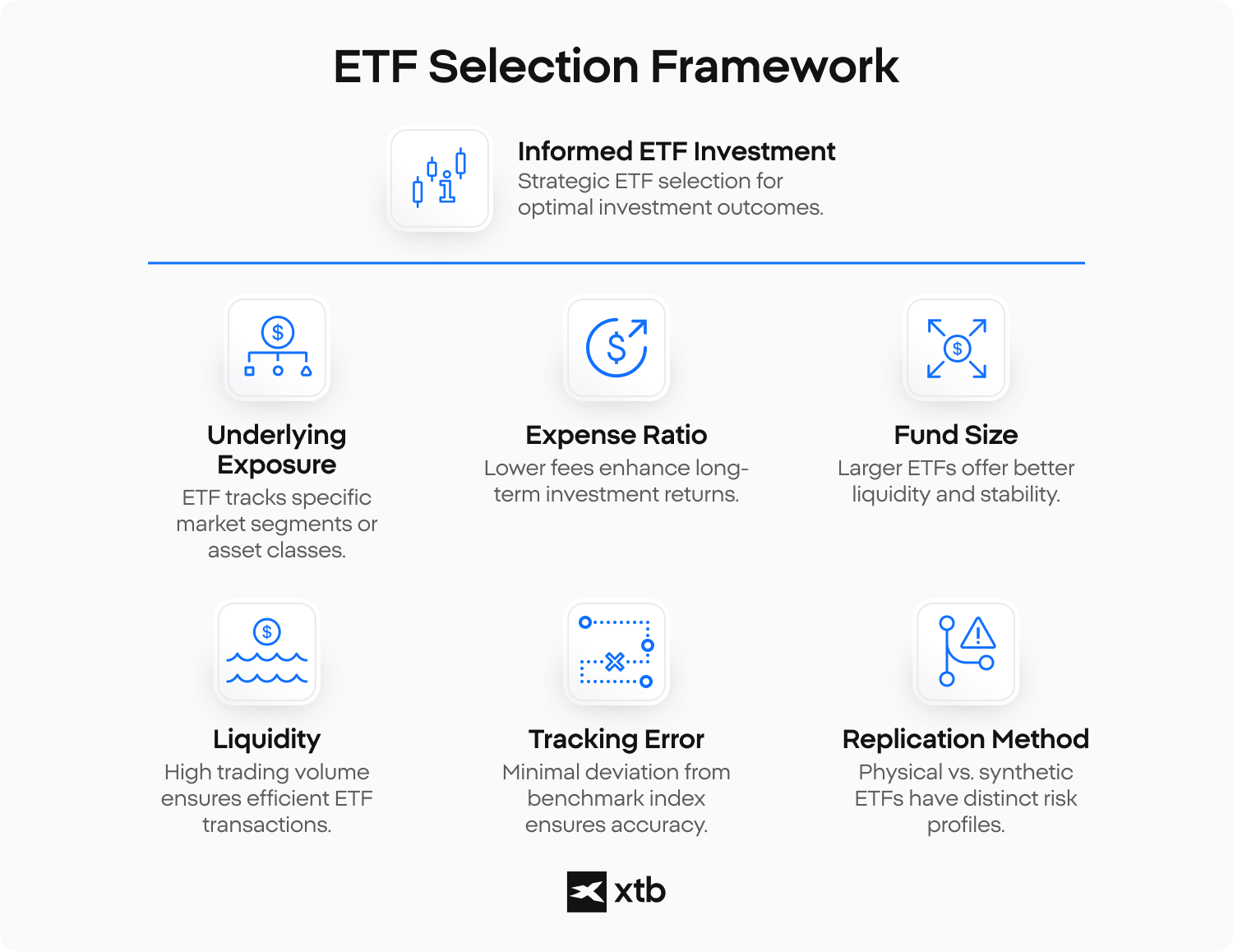
Choosing the right ETF depends on evaluating specific criteria: the underlying index or asset class exposure, the total expense ratio (TER), the fund's size and liquidity, its tracking error, and how it handles dividends (accumulating or distributing). When you want to invest in ETFs, you should not rely on hot tips or short-term trends; instead, build a strict analytical checklist. First, identify the asset class, whether you are targeting a broad market index, specific geographical sectors, or fixed-income securities.
Second, evaluate the operational cost; index-tracking funds typically have an expense ratio / TER between 0.05% and 0.5%, which directly impacts your long-term compounding returns. Third, look at liquidity and fund size, as larger funds generally offer tighter bid-ask spreads. You must also decide how you want to manage income. Distributing funds pays out cash to your account, requiring you to understand what a dividend is, while accumulating funds automatically reinvest those payouts to accelerate growth.
Finally, understanding the fundamental differences between asset vehicles—such as how an ETF vs CFD or an ETF vs a mutual fund operates—ensures you select the instrument that actually matches your legal ownership and duration goals. Remember that less popular ETFs enabling thematic investing are usually more expensive than the most popular ones, such as MSCI World or S&P 500-based products.
ETFs selection criteria
-
Underlying exposure: Check what the ETF actually tracks: a broad index, a country, a sector, bonds, commodities, or a specific theme.
- Expense ratio / TER: Lower costs usually matter more over long periods, because fees reduce compounding returns year after year.
- Fund size: Larger ETFs are often more liquid, more established, and less likely to be closed by the provider.
- Liquidity and bid-ask spread: High trading volume and narrow spreads make buying and selling more efficient.
- Tracking error: A good ETF should closely follow its benchmark index, with limited performance deviation over time.
- Replication method: Physical ETFs hold the underlying securities, while synthetic ETFs use swaps. Both can work, but they carry different risks.
- Dividend policy: Accumulating ETFs reinvest dividends automatically, while distributing ETFs pay income directly to investors.
- Currency exposure: Check the ETF’s trading currency and the currency of its underlying assets, as FX movements can affect returns.
- Domicile and tax treatment: The country where the ETF is registered may influence withholding tax, reporting rules, and net returns.
- Portfolio role: The ETF should fit your overall strategy, not duplicate existing exposure or add unnecessary concentration risk.
How do you buy ETFs?
You buy ETF shares by submitting an order on a stock exchange through your trading platform, typically choosing between a market order executed at the current available price or a limit order capped at a strict maximum price. Executing a trade involves balancing execution speed with precise price control. A market order prioritises immediate fulfilment, filling your request as quickly as possible based on current market liquidity.
Conversely, a limit order allows you to specify the exact maximum price you are willing to pay, protecting you from sudden intraday price spikes. The total cost of this transaction is not just the fund's listed price; it includes the expense ratio / TER (deducted internally by the fund manager), the bid-ask spread, and any direct execution commission charged. Once the order is filled, the shares immediately appear in your portfolio.
Remember to search for brokers with the most competitive offers to optimise long-term returns from ETF investing. Search for regulated brokers which enable ETF investing with zero commission.
How much should you invest and how often?
You can invest in ETFs using a one-time lump sum or by making regular, fixed contributions through dollar-cost averaging, with the ideal amount depending entirely on your financial goals, time horizon, and personal risk tolerance. Deciding how to deploy your capital is a central pillar of ETF investing. A lump-sum strategy involves investing a large amount of capital all at once, which historical data suggests can maximise time in the market if deployed early.
Alternatively, dollar-cost averaging (DCA) means investing a fixed, recurring amount—such as 100 EUR per month, regardless of current market conditions. This systematic approach smooths out the average purchase price over time and removes the emotional stress of trying to time the market perfectly. Your contribution frequency and size should align closely with broader asset allocation models.
Even if you are starting small, understanding how to invest with little money usually points toward regular, disciplined contributions using fractional shares if your brokerage account permits it. Nothing is guaranteed in the investing world, but the nominal annualised return from the S&P 500 is about 10%, with an inflation-adjusted return of roughly 6.5% since the adoption of 500 stocks in the index in 1957, according to Fidelity Investments Data.
During the last 15-year period from 2010 to 2025, the S&P 500 delivered a much higher annualised total return of roughly 14.5%. Investors who choose equity ETFs generally do so with the expectation that stock markets appreciate over the long term. History largely supports that view: despite major crashes such as 1987, the Great Depression, the stagflation era of the 1970s, the dot-com bust, and the Global Financial Crisis, U.S. equities have generated positive long-term returns over the past century.
What are the risks and common mistakes when investing in ETFs?
Investing in ETFs inherently involves market risk, meaning the value of your shares can fall significantly, and beginners often compound this by ignoring total operational costs, buying niche thematic funds they don't understand, or failing to maintain a diversified plan. The most fundamental risk is market risk; because a fund tracks a specific basket of assets, if the underlying index declines due to economic pressure, the fund's value will decline alongside it. Loss of capital is a real possibility that every investor must accept.
While broad market funds inherently offer diversification across many companies, diversification itself does not eliminate the possibility of negative returns during severe macroeconomic downturns. Common mistakes often stem from a lack of strategic discipline. Beginners frequently chase past performance by piling into trendy, narrow-sector funds rather than sticking to a diversified, low-cost core strategy. Additionally, ignoring the cumulative drag of high expense ratios and wide bid-ask spreads can severely erode long-term portfolio gains.

FAQ
FAQ
Yes, but knowledge and caution are needed because investing in ETFs is risky. ETFs are considered one of the most beginner-friendly investment products because they provide instant diversification through a single purchase. Many brokers allow investors to start with a small amount of capital, and some platforms support fractional ETF investing, making it possible to invest even if you cannot afford one full share. Before investing, make sure you understand what the ETF holds, its costs, and your own investment horizon.
Both approaches can be appropriate depending on your financial situation. Investing a lump sum gives your money more time in the market, which has historically produced higher expected returns over long periods. Monthly investing through dollar-cost averaging (DCA), however, reduces the emotional pressure of trying to find the "perfect" entry point and spreads purchases across different market conditions. Many long-term investors prefer regular monthly contributions because they build discipline and consistency.
Yes. ETFs are investments, not savings products, and their value can fall as well as rise. Even broad market index ETFs can experience significant declines during recessions, financial crises, or periods of elevated interest rates. Diversification reduces company-specific risk but cannot eliminate overall market risk. Investors should only commit money they will not need in the short term.
An accumulating ETF automatically reinvests dividends received from the underlying companies back into the fund, allowing returns to compound without paying cash to investors. A distributing ETF pays dividends directly into your brokerage account, providing regular income. The better choice depends on your investment objective, tax situation, and whether you prioritise long-term growth or current income.
Even seemingly small annual fees can have a meaningful impact over decades because costs compound just like investment returns. For example, an ETF charging 0.10% annually will generally leave investors with more wealth over the long run than a comparable fund charging 0.80%, assuming similar performance before fees. Besides the expense ratio (TER), investors should also consider trading commissions, bid-ask spreads, and tracking error when comparing funds.
No ETF is completely risk-free, but broadly diversified index ETFs tracking markets such as the MSCI World, FTSE All-World, or S&P 500 are generally considered less risky than narrowly focused thematic or sector funds. They spread investments across hundreds or even thousands of companies, reducing exposure to the failure of any single business. However, they remain exposed to overall stock market movements and can still decline during broad market downturns.
Many ETFs receive dividends from the companies they hold. Whether you receive those payments depends on the fund's structure. Distributing ETFs transfer dividends directly to investors, while accumulating ETFs automatically reinvest them into the portfolio. Both structures participate in the same underlying dividend stream, but they handle the cash differently.
An ETF that tracks a market index is designed to match that index's performance, not outperform it. Actively managed ETFs aim to exceed benchmark returns, but they typically charge higher fees and there is no guarantee they will outperform over time. For many long-term investors, consistently matching the market at a low cost has historically proven to be an effective investment strategy.
There is no universal holding period, but broad equity ETFs are generally designed for long-term investing measured in years rather than months. Short-term price fluctuations are normal, while historically the probability of positive returns has increased over longer investment horizons. Your ideal holding period should match your financial goals, risk tolerance, and when you expect to need the invested money.
Before investing, review the ETF's objective, the index it tracks, its expense ratio (TER), fund size, trading liquidity, historical tracking error, and dividend policy. You should also verify whether the ETF is physically or synthetically replicated, understand the risks of the underlying assets, and confirm that the investment fits your overall portfolio rather than buying it simply because it has recently performed well.