This article explains what drives crude oil prices, reviews credible 2026 forecasts as scenarios, and examines key market risks. It also provides a practical framework for beginner and intermediate investors considering oil as part of a diversified portfolio, without covering short-term trading strategies.
This article explains what drives crude oil prices, reviews credible 2026 forecasts as scenarios, and examines key market risks. It also provides a practical framework for beginner and intermediate investors considering oil as part of a diversified portfolio, without covering short-term trading strategies.


Most institutional forecasts suggest oil prices could remain volatile in 2026, but crude oil could fall below $80 per barrel this year, to the lowest level since the start of the Middle East conflict - if the Strait of Hormuz remains open without major disruptions after the US–Iran peace deal. However, oil is one of the most geopolitically sensitive commodities in the world.
Even a single supply shock or geopolitical tensions can quickly change the outlook. That is why analysts focus less on predicting an exact price and more on assessing a range of possible scenarios. In this article, we examine what major institutions expect for oil prices in 2026, the key factors driving those forecasts, and the risks that could push prices significantly higher or lower.
Key takeaways
-
Goldman Sachs, Morgan Stanley and Citi have cut their Brent forecasts, with Q4 2026 estimates now ranging from $70 to $80 per barrel.
- Most forecasts point to a moderate oil price environment, with downside pressure increasing if the Middle East supply risks ease.
- A sustained reopening of the Strait of Hormuz could push Brent crude below $70 per barrel by improving global supply expectations - but in 2027
- Oil forecasts should be viewed as scenarios, not certainties, as geopolitics, OPEC+ policy and Chinese demand can quickly change the outlook.
What Factors Determine the Price of Crude Oil in 2026?
Oil prices are primarily determined by the balance between global supply and demand. When the global economy grows, demand for crude oil usually rises through transport, industry and trade; when growth slows, demand can weaken, and prices often come under pressure. On the supply side, OPEC+ production decisions, US shale output, inventories and disruptions in major producing regions all influence how much oil reaches the market.
Geopolitics can change this balance very quickly. Tensions in the Middle East, sanctions, attacks on infrastructure or risks around key shipping routes such as the Strait of Hormuz can push prices higher even before physical supply is affected. If those risks ease and supply flows remain stable, the market may shift its focus back to demand, inventories and production levels.
Key drivers of crude oil prices in 2026 include:
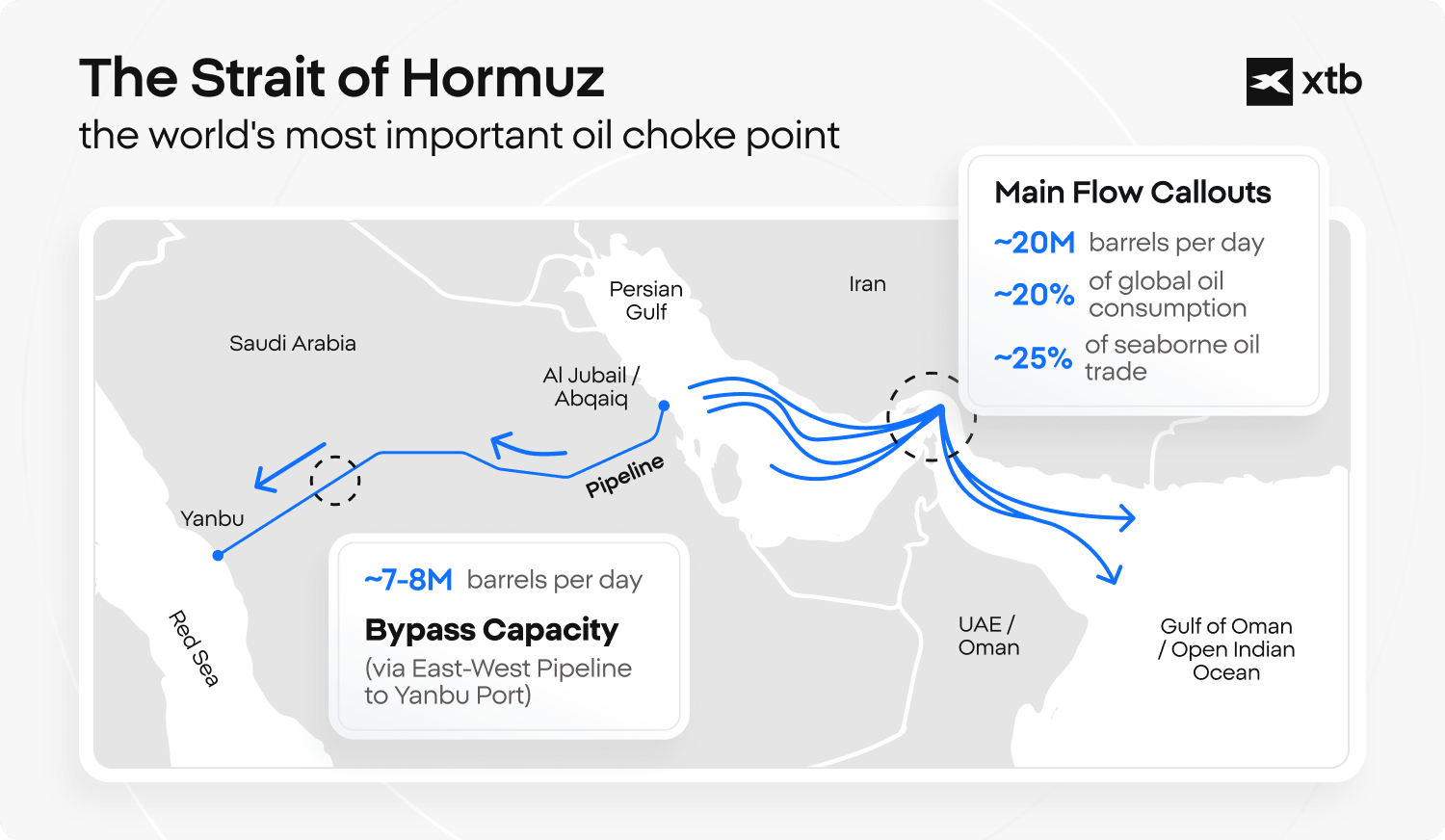
- the situation in the Middle East and oil flows through the Strait of Hormuz, which normally handles around 20 million barrels per day - roughly 20% of global oil consumption and about 25% of seaborne oil trade
- global economic growth and oil demand, with major forecasters expecting demand to change by roughly 0.9 - 1.4 million barrels per day in 2026, depending on the scenario
- OPEC+ production policy and compliance with output targets
- US shale oil production and supply growth from non-OPEC producers
- geopolitical disruptions, sanctions and supply outages
- commercial inventories and strategic petroleum reserves
- the strength of the US dollar, which influences the affordability of oil for importing countries
Crude Oil Price Today: Recent Developments and Market Context
Current oil prices reflect a market balancing concerns about solid global demand against persistent geopolitical risks. While fears of supply disruptions in the Middle East have periodically supported prices, expectations of ample supply and slower economic growth have limited stronger gains. Over the past two years, the oil market has been shaped by several competing forces.
OPEC+ has continued to manage production levels in an effort to support market stability, while rising output from producers outside the group has helped prevent a significant supply shortage - the US oil production is rising. At the same time, investors have closely monitored economic activity in China, inflation trends and geopolitical tensions in the Middle East and Russia, all of which influence expectations for future oil demand.
Recent market developments include:
- Geopolitical tensions in the Middle East and the rise of inflation
- The Hormuz Strait blockade, which led to the risk of real shortages
- Depleting global oil inventories and the United Arab Emirates (UAE) exiting OPEC
- Ukrainian retaliatory strikes on Russian oil refineries
- The Memorandum of Understanding was signed between the US and Iran after 3.5 months of conflict
- Solid global economic growth and China's inventory build-up
- Supply growth from the United States and other non-OPEC producers
EIA STEO: Will OPEC+ production fall in 2026?
The updated June EIA STEO outlook points to tighter U.S. gas and oil balances, lower-than-expected OPEC+ production in 2026, and a significantly weaker near-term outlook for global oil demand growth.
- Henry Hub natural gas price forecast revised higher
- 2026 forecast raised to $3.60/MMBtu from $3.50/MMBtu (+2.8%)
- 2027 forecast raised to $3.46/MMBtu from $3.18/MMBtu (+9.0%)
- OPEC+ oil production forecast revised lower for 2026
- 2026 output forecast cut to 34.0 mbpd from 35.6 mbpd (-4.5%)
- 2027 forecast unchanged at 39.8 mbpd
- Global liquid fuels demand outlook weakened
- 2026 demand growth forecast revised to -1.1 mbpd from +0.2 mbpd (-1.3 mbpd revision)
- 2027 demand growth forecast increased to 2.5 mbpd from 1.5 mbpd (+1.0 mbpd revision)
- U.S. crude oil inventory forecasts lowered
- 2026 inventories expected at 419 million barrels vs 431 million barrels previously (-2.8%)
- 2027 inventories expected at 422 million barrels vs 434 million barrels previously (-2.6%)
Such forecasts are not a reliable indicator of future performance
Oil Price Forecasts for 2026: What Major Banks and Institutions Expect
Major Wall Street banks now expect Brent Crude prices to move lower by the end of 2026, after the U.S. and Iran reached an interim agreement aimed at reopening the Strait of Hormuz and restoring Persian Gulf oil flows. The revisions suggest that analysts see less risk of a prolonged supply shock, although forecasts still vary depending on how quickly tanker traffic normalizes and whether the de-escalation holds. The latest forecasts point to a broad but lower range for Brent Crude.
- Goldman Sachs now expects Brent to average around $80 per barrel in Q4 2026, down from its previous estimate of $90.
- Morgan Stanley also sees Brent at $90 in Q3 2026 and $80 per barrel in Q4, while Citi is more bearish, forecasting Brent at around $75 per barrel in the Q3 2026 and $70 by the year-end of 2026.
- For 2027, the forecasts fall further, with Goldman Sachs expecting $75 per barrel and Citi projecting $65 per barrel.
- The World Bank still expected crude oil prices at $94 on average in 2026
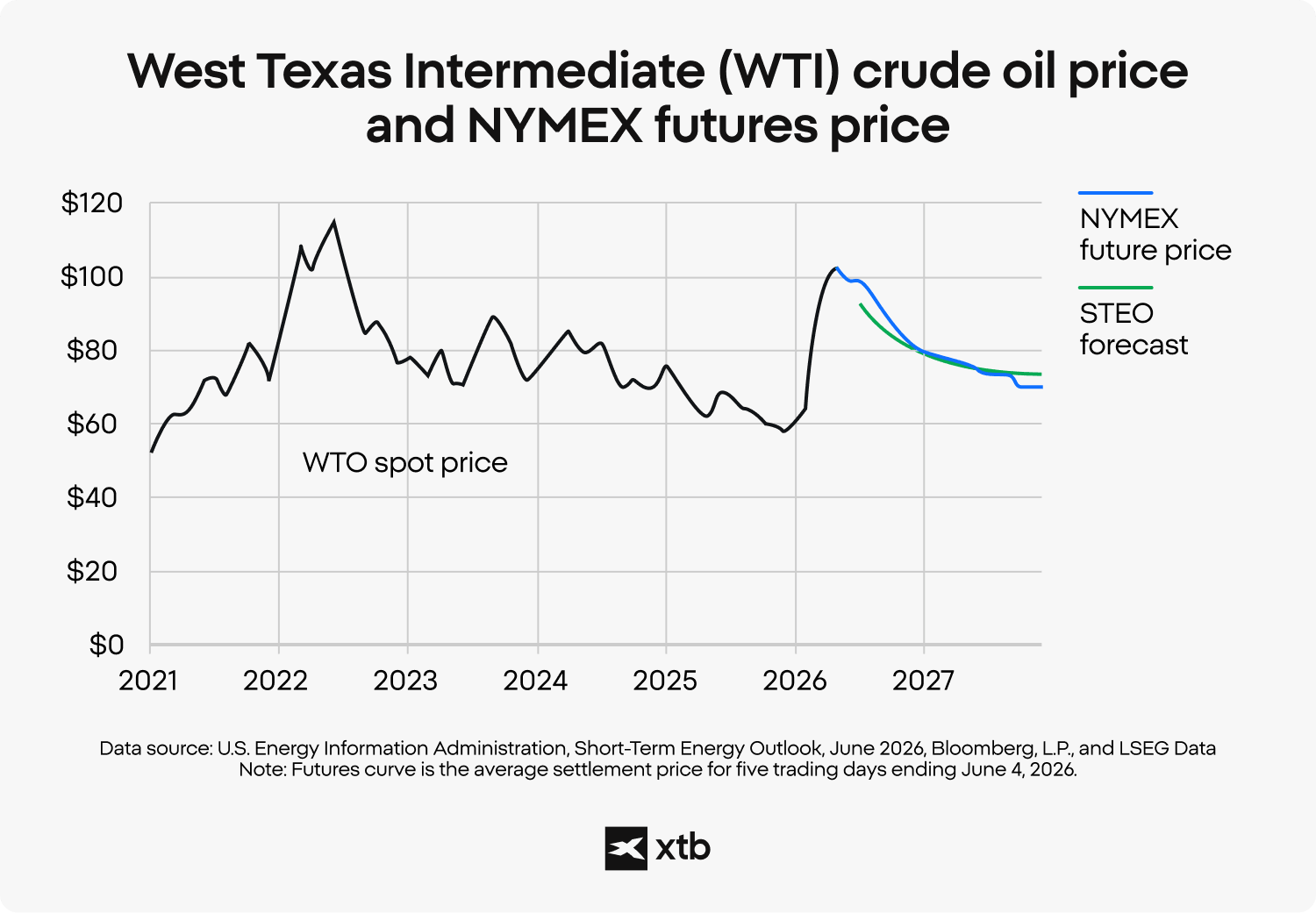
- US Energy Information Administration (EIA) expects $79 per barrel at the end of the year 2026
These forecasts should not be read as certainties. They rely on one key assumption: that the Strait of Hormuz remains open and oil exports from the Persian Gulf recover quickly.
|
|
What Could Push Oil Prices Lower in 2026?
Oil prices could fall below current forecasts if geopolitical risks ease while global supply rises and demand weakens. A stable flow of oil through the Strait of Hormuz would reduce the risk premium built into crude prices, especially if the U.S.–Iran de-escalation continues and the market starts to price in fewer supply disruptions.
At the same time, a de-escalation between Russia and Ukraine, rising OPEC+ production, stronger non-OPEC supply and a slowdown in China could all add downward pressure. In that scenario, the market would shift from concerns about shortages toward oversupply and weaker demand. Key downside risks for oil prices in 2026 include:
- the US–Iran relations improvement, easing sanctions and nuclear deal
- stable oil flows through the Strait of Hormuz
- de-escalation between Russia and Ukraine
- rising OPEC+ production
- weaker Chinese economic growth
- lower global oil demand
- stronger supply from the US and other non-OPEC producers
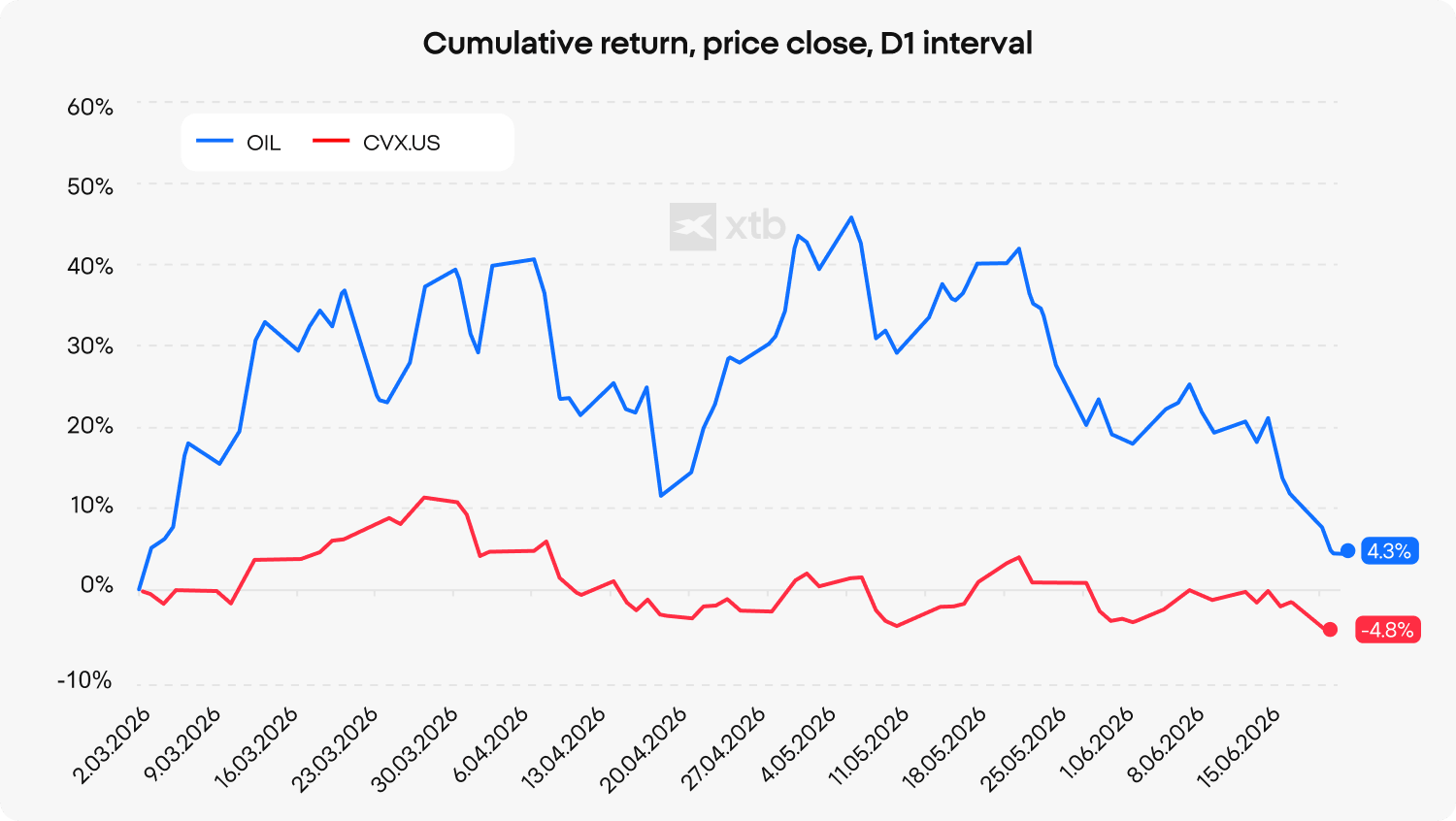
Source: XTB, Bloomberg Finance L.P.
Past performance is not a reliable indicator of future results.
Since the outbreak of the US–Israel conflict with Iran in 2026, oil stocks such as Chevron have underperformed crude oil itself. Following the signing of a Memorandum of Understanding between the United States and Iran on 16 June 2026, oil prices fell sharply as investors priced in easing geopolitical tensions and the anticipated reopening of the Strait of Hormuz. At the peak of the crisis, crude oil prices were up by nearly 45%, but those gains were largely erased as the perceived risk of major supply disruptions declined. The episode highlights how sensitive oil markets are to geopolitical developments and how quickly sentiment can shift when expectations around supply and global trade routes change.
The difference between Brent and WTI narrowed significantly in 2026, with WTI briefly trading above Brent in an unusual market anomaly. If market conditions normalise, the difference between Brent and WTI is likely to widen again, with WTI moving back below Brent and restoring the more typical Brent premium.
Upside Oil Price Risks: Why Some Forecasts Remain Bullish
Some forecasts signal that oil prices will be above the market consensus because they assume supply disruptions could last much longer than expected. While many recent forecasts have been revised lower following diplomatic progress between the United States and Iran, not all institutions believe that oil flows will return to normal quickly.
One example comes from the US Energy Information Administration (EIA), which recently projected that Brent crude could average around $105 per barrel during June and July 2026 before gradually falling below $80 later in the year. The agency's outlook was based on a scenario in which disruptions around the Strait of Hormuz persist for longer and global oil supplies remain constrained.
According to the EIA, several factors could continue to support higher oil prices despite still solid production levels from the largest oil producers:
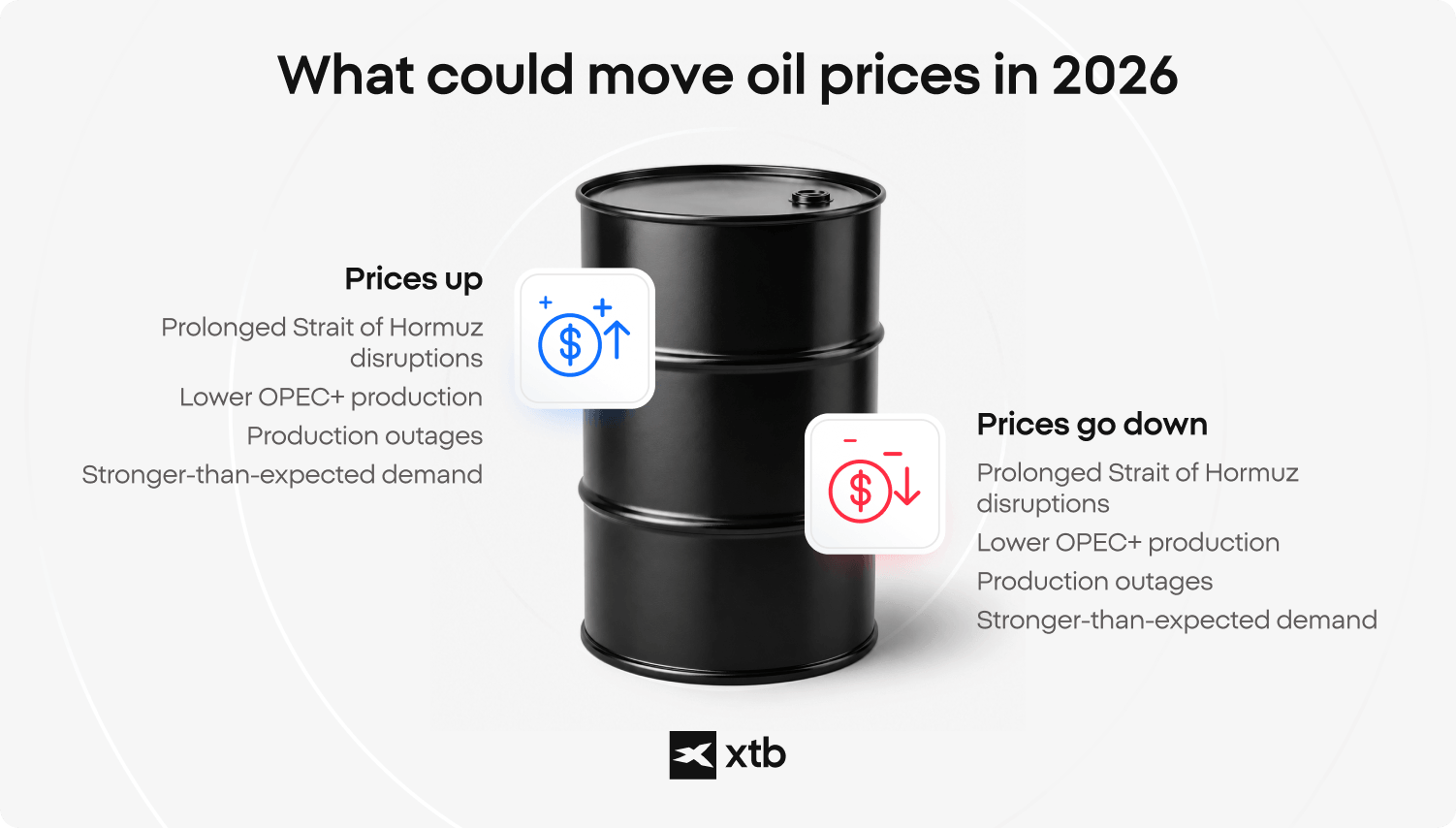
- prolonged disruptions to shipping through the Strait of Hormuz
- lower-than-expected oil production from OPEC+
- production outages in key exporting countries
- stronger global demand than currently anticipated
- slower growth in supply from the United States and other non-OPEC producers
The key takeaway is that oil forecasts depend heavily on assumptions. If Middle East tensions continue to ease and Gulf exports return to pre-crisis levels, prices may move closer to the lower end of current forecasts. However, if supply disruptions persist for months rather than weeks, the market could remain significantly tighter than many investors currently expect.
|
|
How Do Oil Price Movements Affect Investors Who Don’t Hold Physical Crude?
Oil price movements can affect investors even if they never buy, sell or hold physical crude oil. As one of the world's most important commodities, oil influences inflation, interest rates, corporate profitability and economic growth, which means its impact often extends far beyond the energy sector itself.
The most important transmission channel is inflation. When oil prices rise, fuel, transportation and production costs often increase across the economy, potentially putting upward pressure on consumer prices. This can influence how central banks approach interest rates, which in turn affects borrowing costs, stock valuations and broader market sentiment. For this reason, investors frequently monitor oil prices as an indicator of future inflationary pressures and economic conditions. Oil prices can also influence specific asset classes directly.
Energy producers often benefit from higher crude prices, while sectors such as airlines, logistics and manufacturing may face rising costs. In addition, investors can gain exposure to oil through instruments such as CFDs, futures-based ETFs and other commodity-linked products. However, unlike gold, which is often viewed as a defensive asset during periods of uncertainty, oil is primarily a cyclical industrial commodity whose performance tends to depend on global supply, demand and economic activity. Investors interested in exploring these differences may explore the topic of how to invest in oil.
Is Oil a Good Investment in 2026? What Investors Should Know
After a significant decline from the April 2026 high at $120 to $80 in mid-June 2026, oil may be worth analysing in 2026, as it offers a range of contrarian and hedging opportunities. For investors, the more important question is whether exposure to oil fits their investment horizon, risk tolerance and overall portfolio structure. If tensions between the US and Iran rise ahead of the so-called nuclear deal, the Middle East may be the source of fear again. Oil is a cyclical and geopolitically sensitive commodity, which means its price can move sharply when supply risks, OPEC+ policy or global demand expectations change.
This can create opportunities, but it also increases volatility and makes short-term forecasts uncertain. According to OPEC’s June report, global oil demand is still expected to rise by 970,000 barrels per day in 2026, which points to broadly resilient market fundamentals. However, the direction of revisions is clearly negative. OPEC’s May report had projected demand growth of 1.7 million barrels per day, while the IEA now sees 2026 global oil demand roughly 1.3 million barrels per day below its pre-war forecast.
Investors should learn how to start investing in oil and watch not only year-over-year dynamics, but also specific short-term trends and projections revisions. Before considering any exposure to oil, investors should ask whether they understand how the instrument works, how much volatility they can accept, and whether oil would improve diversification or simply add another concentrated risk.
|
|
FAQ
FAQ
There is no single “most realistic” oil price forecast for 2026, because the outlook depends heavily on geopolitical and supply assumptions. After the U.S.–Iran memorandum and the expected reopening of the Strait of Hormuz, several major banks lowered their Brent forecasts, with Goldman Sachs and Morgan Stanley seeing Brent near $80 per barrel in Q4 2026, while Citi expects around $70.
That makes the $70–80 range a reasonable market baseline if Middle East tensions continue to ease and oil flows remain stable. However, higher forecasts from institutions such as the World Bank and EIA show that supply risks have not disappeared. The key point is that oil forecasts are scenarios, not fixed targets.
Oil price predictions differ because analysts use different assumptions about demand, supply and geopolitical risk. One forecast may assume stable flows through the Strait of Hormuz and rising OPEC+ production, while another may allow for renewed disruption, lower inventories or stronger global demand.
Even small changes in assumptions can lead to very different price targets. For example, a faster recovery in Gulf exports could push prices lower, while renewed tension in the Middle East could quickly rebuild the geopolitical risk premium.
Yes. Oil prices often react not only to actual supply disruptions, but also to the risk that disruptions may happen. This is why events around the Strait of Hormuz, Iran, Russia and Ukraine can move prices quickly, even before physical supply changes are fully visible.
The 2026 market reaction shows this clearly. Crude oil rose sharply during the peak of geopolitical stress, but then gave back much of that gain after signs of de-escalation and improving expectations for global oil flows.
Oil is generally not considered a stable asset. It is a cyclical industrial commodity, which means its price is closely linked to economic growth, demand expectations, production policy and geopolitical risk.
This makes oil different from assets such as gold, which is often viewed as a defensive store of value. For beginner investors, the main takeaway is that oil exposure should be analysed through scenarios, risk tolerance and portfolio diversification, not through a single price forecast.