This article is written for readers who are exploring silver as a potential investment
and want to understand whether it makes sense for them. It is not intended for
readers already committed to investing in silver or looking for practical
instructions/strategies.
This article is written for readers who are exploring silver as a potential investment
and want to understand whether it makes sense for them. It is not intended for
readers already committed to investing in silver or looking for practical
instructions/strategies.


Silver is often seen as gold’s quieter cousin, but from an investor’s perspective it plays a very different role. This article explains what silver represents as an investment asset, why it attracts investor attention, and what drives its price over time. You’ll learn how silver is commonly viewed in portfolios, what risks are involved, and what beginners should understand before deciding whether silver is right for them.
Key takeaways
- Silver is a physical asset with a long monetary history, but it is also an industrial metal tied to real economic activity.
- Investor interest in silver often increases during periods of economic uncertainty, inflation concerns, or currency instability, though this does not guarantee consistent protection.
- Because of its dual investment and industrial role, silver can behave differently from purely financial assets and may show higher price sensitivity.
- Silver is typically considered as a diversification element rather than a core investment holding.
What is silver from an investor’s perspective?
From an investor’s perspective, silver is not just an industrial material used in electronics or jewelry. It is a physical asset that exists outside the financial system and does not depend on a promise from a bank, company, or government. This tangiblenature is a key reason silver is often considered alongside other real assets. Silver is also a finite resource. The total amount available is limited, and much of the global silver supply comes as a by-product of mining other metals, such as copper or lead. As a result, supply is relatively inflexible and cannot quickly adjust to changes in demand. Historically, silver has played a role as money, which is why some investors still view it as a store of value. Unlike gold, however, silver’s value has not always been stable over shorter time frames.
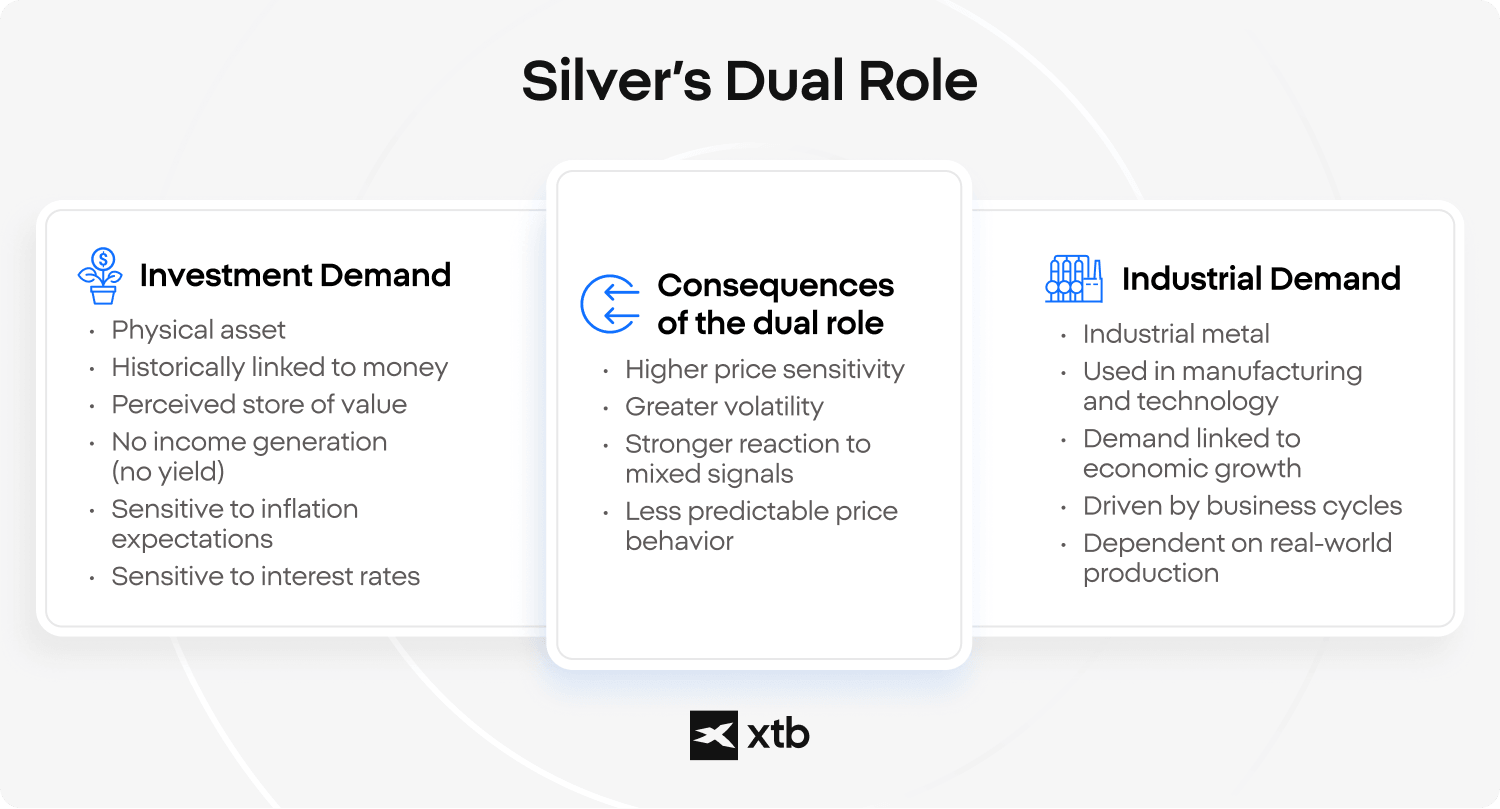
In simple terms, silver sits between finance and industry. It is neither a purely defensive asset nor a purely speculative one, which makes understanding its characteristics essential before considering it as part of an investment portfolio. Investors can gain exposure to silver in different ways, including physical silver, exchange-traded products, futures, and CFDs - though the latter two involve higher risk and are better suited to more experienced investors. A detailed overview of these approaches is covered in <How to invest in silver article title>
Why do investors pay attention to silver at all?
Investors tend to pay attention to silver because it occupies a unique position within the broader commodities space. Its appeal usually spikes during periods of economic uncertainty, inflation concerns, or currency instability. When doubts arise about the purchasing power of money or the stability of financial systems, silver enters the discussion as a tangible asset that cannot be '' printed'' This does not mean it consistently protects against inflation, but it explains why attention to the metal increases during such times. Another reason silver attracts interest is its link to real-world economic activity. Its industrial relevance in technology and renewable energy connects the metal to long-term structural trends in the global economy. This combination of monetary history and industrial necessity makes silver worth understanding, even for those who ultimately decide it does not fit their personal goals.
Furthermore, investors are often drawn to silver's distinct price dynamics. Because of the dual nature mentioned earlier, silver prices respond not only to investor sentiment but also to broader industrial conditions. This often results in much larger price swings when comparing silver to gold. For some, this higher volatility is a risk; for others, it is the very reason they pay attention to the metal, as it creates a different type of market behavior that can react to mixed economic signals in ways other assets do not.
Is silver a good investment and is it worth investing?
Whether silver is a good investment depends largely on an investor’s goals, time horizon, and tolerance for risk. Silver does not generate income in the form of interest or dividends, and its price can fluctuate significantly over time. For this reason, it is commonly viewed as a complementary asset rather than a standalone investment solution.
When silver may make sense:
- As a diversification tool within a broader portfolio.
- For investors who understand and accept higher price volatility.
- With a longer-term perspective, where short-term price swings are less critical.
- When the goal is exposure to both investment demand and industrial trends, rather than steady returns.
When silver may not be suitable:
- For investors seeking stable or predictable performance.
- For those who rely on regular income from their investments.
- With a short investment horizon or low tolerance for drawdowns.
- When decisions are driven mainly by market headlines or fear of missing out.
It is also important to avoid common assumptions. Silver is not guaranteed to protect capital in every market environment, nor is it simply a cheaper alternative to gold with the same characteristics. Its performance can differ markedly depending on economic conditions. In short, whether silver is worth investing in depends less on price forecasts and more on how well it aligns with an investor’s objectives, expectations, and ability to handle risk.
What factors influence silver prices the most?
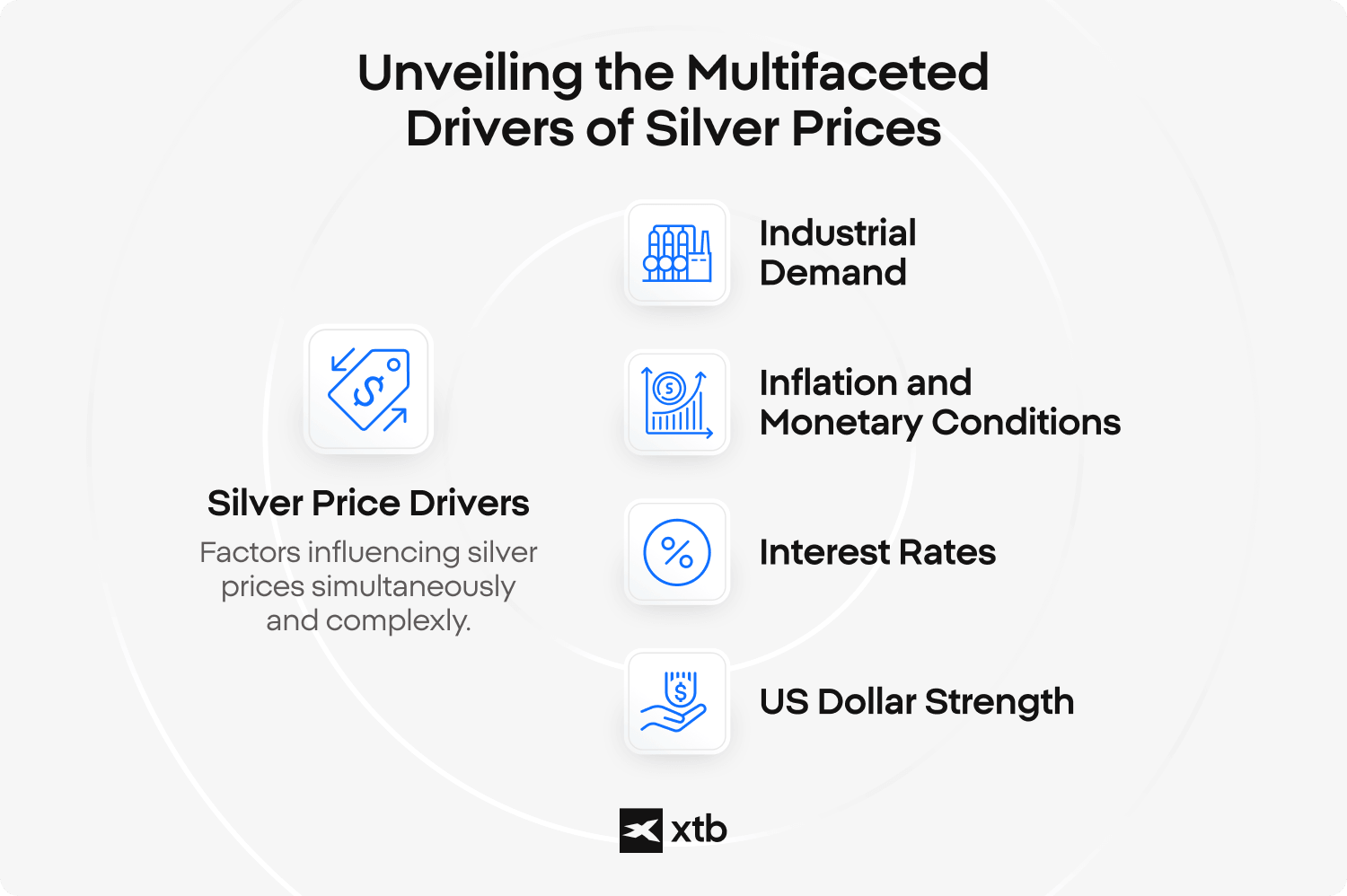
Silver prices are shaped by several forces acting at the same time, which helps explain why the metal can be highly volatile. Unlike assets driven mainly by a single factor, silver reacts both to financial conditions and to changes in the real economy.
- Industrial demand plays a major role. Silver is widely used in technology, manufacturing, and renewable energy, so demand often rises when economic activity is strong and falls during slowdowns. This link to industry makes silver more sensitive to economic cycles than many other precious metals.
- Inflation and monetary conditions are another key driver. Silver is sometimes viewed as a hedge against rising prices, especially when inflation expectations increase. However, this effect is not constant and often depends on how central banks respond to inflation pressures.
- Interest rates influence silver through opportunity cost. When interest rates are low, holding a non-yielding asset like silver can appear more attractive. When rates rise, investors may favor assets that generate income, which can weigh on silver prices.
- The strength of the US dollar also matters. Because silver is priced globally in US dollars, a stronger dollar can make it more expensive for non‑US buyers, potentially reducing demand. Conversely, a weaker dollar can provide support to prices.
Taken together, these factors show that silver prices rarely move for a single reason. Instead, they reflect the interaction between industrial demand, monetary policy, interest rates, and currency dynamics—often pulling prices in different directions at the same time.
What are the main risks of investing in silver?
One of the most important risks of investing in silver is high price volatility. Silver prices can move sharply both upward and downward over relatively short periods of time. While this volatility can attract attention during strong rallies, it can also lead to sudden and significant drawdowns that are difficult for many investors to tolerate. Another key risk lies in long and uneven market cycles. Silver has historically experienced extended periods of sideways or declining prices, sometimes lasting for years. For investors, this means that patience is often required, and returns may not materialize within a predictable timeframe. Silver is also exposed to economic and industrial cycles. Because a substantial portion of demand comes from industrial uses, economic slowdowns can reduce consumption and put pressure on prices. This makes silver less reliable as a defensive asset during all types of market stress.
Finally, emotional and narrative-driven investing poses a significant risk. Silver frequently appears in strong market narratives related to inflation, currency debasement, or financial crises. Acting on headlines or fear rather than a clear understanding of the asset can lead to poorly timed decisions. Taken together, these risks highlight that silver can experience both sharp gains and meaningful losses. Understanding these characteristics is essential before considering silver as part of an investment strategy.
Taken together, these risks highlight that silver can experience both sharp gains and meaningful losses. Understanding these characteristics is essential before considering silver as part of an investment strategy.
What should a beginner understand before considering silver as an investment?
Before considering silver as an investment, a beginner should first be clear about expectations and objectives. Silver is not designed to deliver steady returns or predictable income, and it should not be approached as a short-term solution to market uncertainty. Understanding what silver can and cannot offer is more important than trying to anticipate price movements. It is also essential to recognize the role of time horizon and patience. Silver’s price history shows that periods of strong performance can be followed by long phases of stagnation or decline. For inexperienced investors, this can be psychologically challenging and may lead to impulsive decisions if expectations are not properly set from the start. Another key consideration is risk tolerance. Silver’s volatility means that price swings are a normal part of its behavior, not an exception. Beginners should ask themselves whether they are comfortable seeing significant fluctuations in value without reacting emotionally. Finally, silver should be viewed as an asset to understand before using, not as an automatic hedge or a guaranteed store of value. Taking the time to learn how silver behaves, why its price changes, and where it fits within a broader investment framework helps ensure that any future decision is informed rather than reactive.
FAQ
No. While many people buy coins or bars, you can gain exposure through ETFs, silver mining stocks, or CFDs. These allow you to benefit from price movements without the need for secure storage or insurance.
Silver has a dual role as both an investment asset and an industrial metal. Because it reacts to both financial market shifts and changes in manufacturing demand (like solar panels or electronics), its price swings tend to be much sharper.
Not necessarily. Although it is a finite resource, silver is not a guaranteed hedge. Its price can fall even during high inflation if industrial demand weakens or if central banks raise interest rates significantly.
Silver does not pay interest or dividends. When interest rates rise, investors often move their money into assets that offer a yield (like bonds), which can put downward pressure on silver prices.
It depends. While it is a "real asset," its heavy use in industry means a recession can lower demand from factories. Silver is often less reliable as a defensive asset than gold during a broad economic slowdown.
Most experts view silver as a diversification tool rather than a core holding. Because of its high volatility, beginners often limit it to a small percentage of their total portfolio to avoid outsized risks.