
The reader wants to understand the fundamental differences between Brent and WTI crude oil — what each benchmark represents, why their prices diverge, and which one is relevant to global vs. North American markets. The article satisfies an
informational intent with a secondary decision-making layer: helping traders and investors recognise how these benchmarks function as tradeable instruments. It targets readers with little-to-no prior knowledge of oil markets who have encountered
both names in financial news and need a clear, trustworthy explanation.
The reader wants to understand the fundamental differences between Brent and WTI crude oil — what each benchmark represents, why their prices diverge, and which one is relevant to global vs. North American markets. The article satisfies an
informational intent with a secondary decision-making layer: helping traders and investors recognise how these benchmarks function as tradeable instruments. It targets readers with little-to-no prior knowledge of oil markets who have encountered
both names in financial news and need a clear, trustworthy explanation.


Brent and WTI are the two main crude oil benchmarks, and the divide between them helps explain how global and North American oil prices are formed, why they sometimes
differ, and why both matter for energy markets. While both represent light crude oil, Brent reflects globally traded seaborne supply, whereas WTI is tied more closely to North American production and infrastructure. This distinction explains why their prices do not always move in the same way, even when broader oil market conditions are similar. Understanding how they function provides a foundation for interpreting energy markets and the instruments linked to them.
Key Takeaways
- Brent crude is the global benchmark used to price around 70–80% of internationally traded oil, while WTI primarily reflects North American market conditions.
- The price difference between Brent and WTI is driven by a mix of global supply–demand forces and regional factors such as infrastructure, storage, and export capacity.
- Although Brent and WTI are strongly correlated and usually move in the same direction, their spread can change over time and does not follow a fixed pattern.
What is Brent crude oil and what is WTI and why do both matter?
Brent crude oil and WTI are the two main global oil benchmarks used to price crude oil across different regions and markets. They exist because crude oil varies in quality and
location, which makes a single universal oil price impractical and unrealistic measure. Benchmarks solve this by providing standardized reference points that can be used in physical
trade, contracts, and financial instruments.
Brent comes from the North Sea and reflects oil that can be transported by sea, while WTI originates in the United States and is priced at the inland hub in Cushing, Oklahoma. This is why discussions such as WTI vs Brent or brent vs WTI appear frequently in market analysis. Each benchmark represents a different part of the global oil system rather than competing versions of the same price.
These benchmarks matter because they influence everything from refinery costs to fuel prices and financial markets. Their pricing ultimately reflects global supply and demand conditions, which means changes in production by the largest oil producers, economic activity, or geopolitical risk can affect both benchmarks - though not always in the same way.
What are the main differences between Brent and WTI crude oil?
The difference between Brent and WTI comes down to quality, location, and how each benchmark is priced and delivered. While both are classified as light and sweet crude, their structural differences can lead to distinct pricing behavior and influence broader market expectations, including an oil-price-forecast.
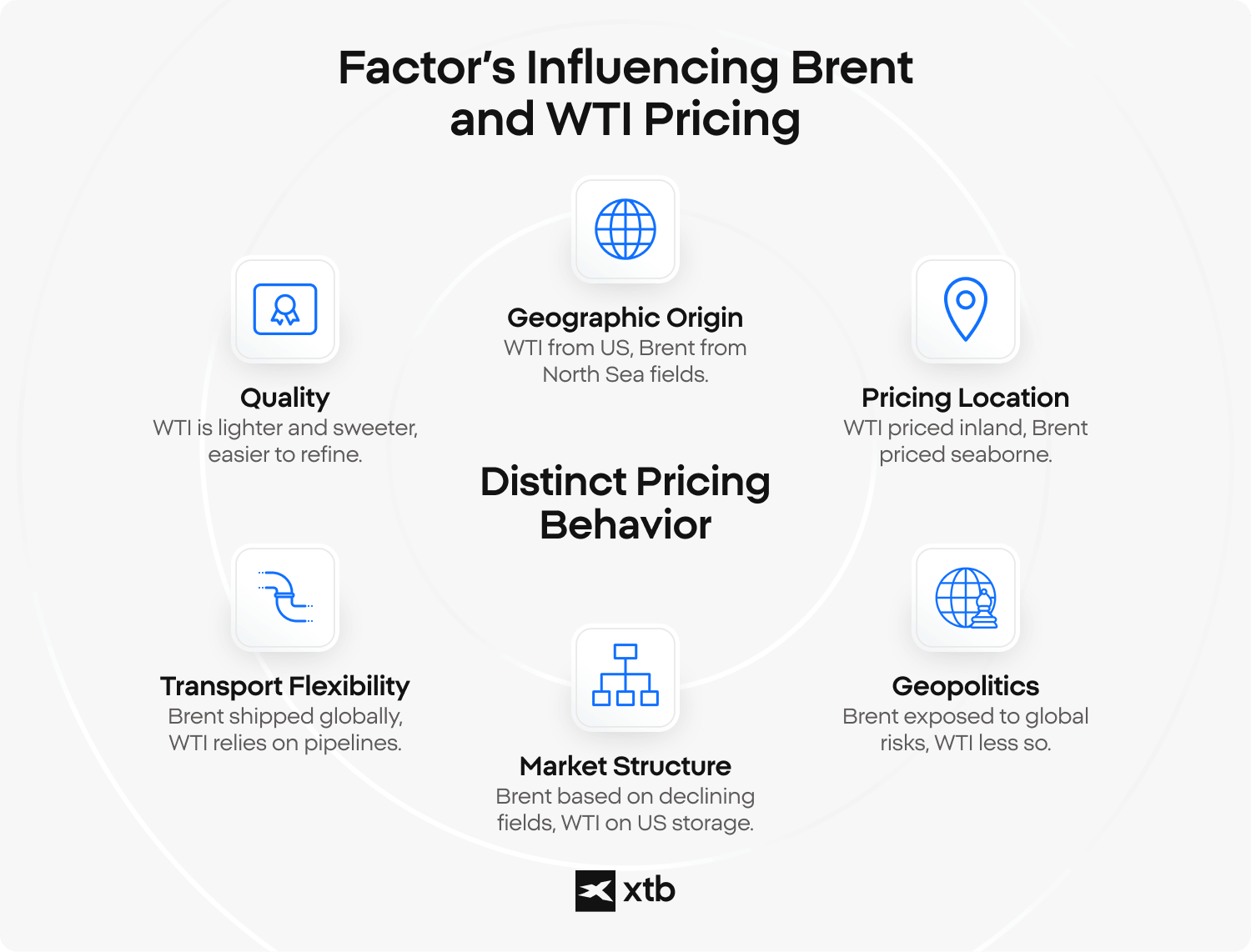
The most important differences include:
- Quality (API gravity and sulfur content): WTI is slightly lighter and sweeter than Brent, meaning it contains less sulfur and is easier to refine into products like gasoline
- Geographic origin: WTI is produced in the United States, while Brent comes from multiple oil fields in the North Sea
- Pricing location: WTI is priced inland at Cushing, Oklahoma, whereas Brent reflects seaborne oil traded internationally
- Transport flexibility: Brent can be shipped globally, while WTI depends more heavily on pipelines and domestic infrastructure
- Market structure: Brent is based on a basket of declining North Sea fields, while WTI is tied to U.S. storage and logistics conditions
- Geopolitics: Brent is generally more exposed to global geopolitical risks because it reflects seaborne oil traded across international routes, including regions such as the Middle East, while WTI may be less immediately impacted due to its stronger link to U.S. domestic production and infrastructure.
These differences explain why comparisons such as brent crude vs WTI are not just technical They reflect two distinct pricing systems. Neither benchmark represents the entire oil market on
its own, but together they provide a useful view of both regional and global dynamics.
Why do Brent and WTI prices differ - which one is usually higher?
Brent and WTI prices differ because global oil market forces interact with regional constraints in different ways. In most recent years, Brent has traded at a premium to WTI, but
this relationship has changed over time. Before the U.S. shale boom, WTI was often more expensive due to its higher quality. However, rapid growth in U.S. production created local oversupply and infrastructure bottlenecks, which pushed WTI prices below Brent. This shift highlights that the difference between Brent and WTI is not fixed but evolves with market conditions.
To understand the spread, it helps to separate global and regional drivers:
- Global supply and demand (OPEC decisions, economic growth, disruptions) influence both benchmarks simultaneously
- Regional bottlenecks (pipeline capacity, storage limits) can weaken WTI relative to Brent
- Geopolitical risk tends to impact Brent more strongly, as it reflects internationally traded oil
- Export flexibility allows Brent-linked crude to respond faster to global demand shifts
Source: xStation5
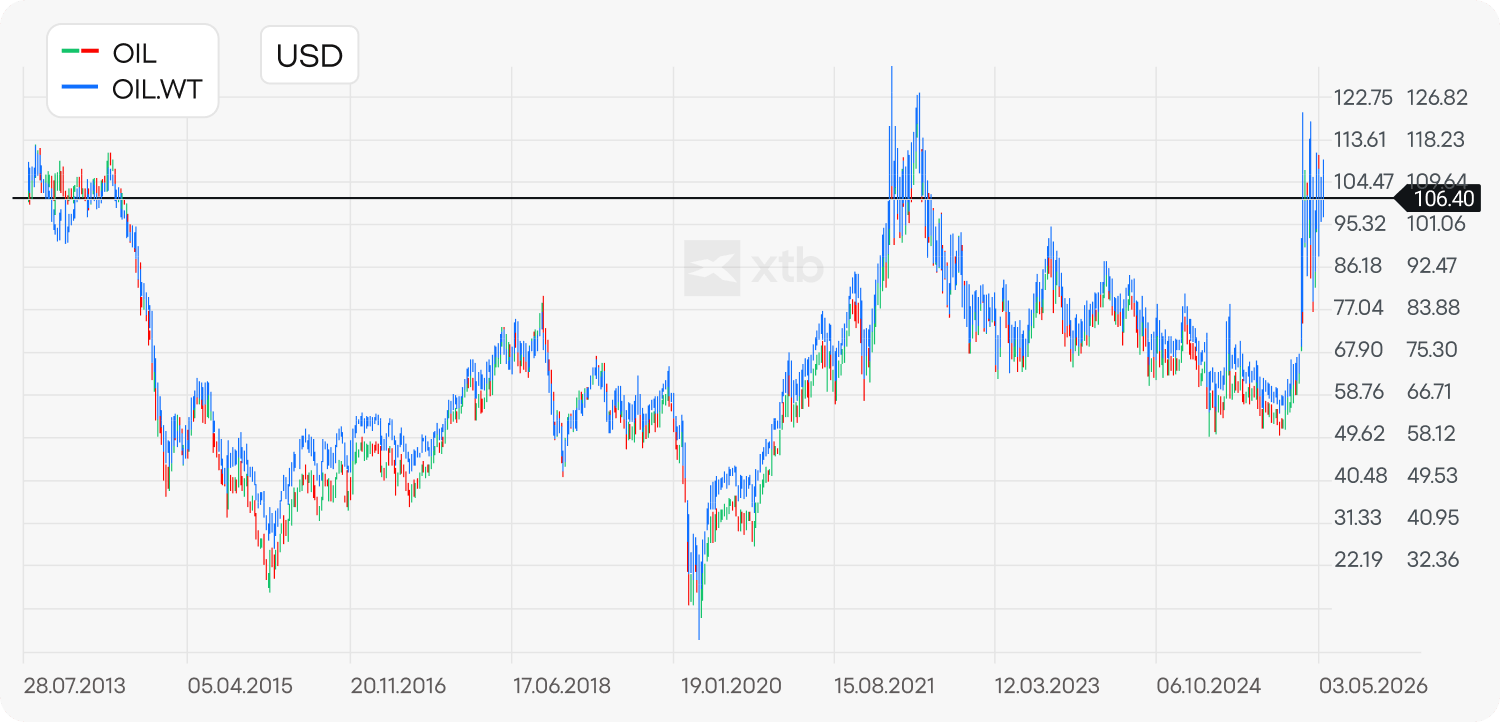
As we can see on the chart above which compares ICE Brent crude futures (OIL) vs WTI (OIL.WTI) over the long term both Brent and WTI are correlated. The spread may fluctuate largely but usually over the very short period of time. Usually both oil benchmarks are moving in the same direction. Remember - past performance does not indicate future results.
Which benchmark is used where and why does it matter for oil markets?
Brent is used as the main global oil benchmark, while WTI is primarily used in North America. Brent prices influence around 70 to 80% of internationally traded crude, including markets
in Europe, Africa, and the Middle East, whereas WTI reflects U.S. supply and demand conditions more directly.
This distinction matters because oil prices feed into the broader economy. When benchmark prices rise, fuel costs tend to increase, which can affect transportation, production, and inflation. Oil-importing economies may face higher costs, while exporting countries may see increased revenues, creating uneven economic effects across regions.
The influence of oil benchmarks extends into financial markets as well. Energy stocks, currencies linked to commodity exports, and broader market sentiment can all react to changes in oil prices. Investors who follow these movements sometimes use instruments such as ETFs or oil CFDs to track price changes, although these instruments still depend on the underlying benchmark dynamics. However, CFDs are much more risky, speculative instruments.
How can traders and investors use WTI and Brent in their strategy?
Traders and investors can use WTI and Brent to analyze oil price trends, compare regional and global market conditions, and track energy-related risks. Exposure to these
benchmarks is commonly available through instruments such as ETFs and CFDs. ETFs generally provide a more straightforward way to access oil-related markets, while CFDs
are more complex instruments that can involve a higher level of risk. Understanding these markets is often one of the first steps when learning how to start investing in oil.
One commonly analyzed indicator is the spread between the two benchmarks. Changes in the spread can reflect regional imbalances, logistical constraints, or shifts in global demand. For
example, a widening gap between WTI vs Brent prices may suggest bottlenecks in U.S. infrastructure, while a narrowing spread may indicate a closer balance between regional and
global oil markets.
For beginners, understanding these benchmarks helps connect everyday price changes with broader market dynamics. Fuel prices, inflation trends, and market sentiment are often linked to oil price movements, which means Brent and WTI can be useful reference points even for readers who do not trade oil directly.
FAQ
The main difference between Brent and WTI oil prices comes from location, transport access, and market exposure. Brent reflects seaborne oil that can move freely between regions, while WTI is priced inland in the U.S. and depends more on pipeline and storage infrastructure.The main difference between Brent and WTI oil prices comes from location, transport access, and market exposure. Brent reflects seaborne oil that can move freely between regions, while WTI is priced inland in the U.S. and depends more on pipeline and storage infrastructure.
Brent is usually more expensive than WTI because it reflects globally traded oil, which includes geopolitical risk and transport flexibility. Since Brent-linked crude can be shipped worldwide, it tends to incorporate a broader range of risks, especially those related to supply disruptions. In contrast, WTI prices can be temporarily discounted due to infrastructure constraints in the U.S., particularly around storage and pipeline capacity. However, this relationship is not permanent. Historical data shows that brent vs WTI pricing has reversed in the past, especially before the shale oil expansion.
Brent is generally more important for the global economy because it prices the majority of internationally traded crude oil. It serves as the reference for approximately ¾ of global oil transactions, influencing fuel prices across Europe, Asia, and emerging markets. WTI remains highly relevant, particularly for understanding U.S. market conditions. However, when analyzing global inflation trends or energy costs, Brent is often the primary reference used in reports by institutions such as the IEA and IMF.
Yes, the price difference between Brent and WTI can narrow significantly or even temporarily disappear under certain market conditions. This typically happens when U.S. infrastructure constraints ease or when global supply disruptions affect both benchmarks similarly. For example, increased U.S. export capacity has historically reduced the gap between WTI crude vs brent crude. However, structural differences between the benchmarks mean that some level of divergence is likely to persist over time.
Brent and WTI prices influence fuel prices by affecting the cost of crude oil used in refining. When benchmark prices rise, the cost of producing gasoline, diesel, and other fuels tends to increase, although the exact impact depends on local taxes, refining capacity, and distribution systems. In many regions outside North America, fuel prices are more closely linked to Brent. In the U.S., WTI plays a larger role. According to IEA energy market reports, oil price changes are one of the key contributors to short-term inflation fluctuations in many economies.
The Brent–WTI spread provides insight into regional imbalances and global market conditions. A widening spread can indicate logistical issues in the U.S. or increased geopolitical risk affecting global supply, while a narrowing spread may suggest improved infrastructure or more balanced demand. For those analyzing the difference between Brent and WTI, the spread is often used as a diagnostic tool rather than a predictive signal. It reflects underlying market conditions rather than offering clear directional guidance.
Neither WTI nor Brent is inherently “better, they serve different analytical purposes. WTI is often used to assess U.S. supply, shale production, and domestic demand trends, while Brent provides a broader view of global oil market conditions. Many market participants monitor both benchmarks simultaneously, especially when evaluating brent crude vs WTI dynamics. This dual perspective helps avoid relying on a single regional indicator when interpreting global energy trends.
Analysts track both Brent and WTI because together they provide a more complete picture of the oil market. Each benchmark reflects different supply chains, pricing mechanisms, and risk exposures. Relying on only one benchmark can lead to incomplete conclusions, especially during periods of market stress or regional disruption. As highlighted in IEA market analysis frameworks, combining multiple benchmarks improves the accuracy of interpreting global oil dynamics.
Brent and WTI are widely used indicators, but they do not represent the entire oil market perfectly. Each benchmark is based on specific crude types and regions, which means they capture only part of a highly complex global system. While they remain the most important reference points, analysts often supplement them with additional data, such as regional price differentials, refinery margins, and inventory levels, to gain a more complete understanding of oil market behavior.