
Most investors get Amazon's ownership wrong. See who controls the company, from Bezos to Vanguard, BlackRock and more.
Most investors get Amazon's ownership wrong. See who controls the company, from Bezos to Vanguard, BlackRock and more.


Amazon operates as a publicly traded company without a single proprietor, meaning that while Jeff Bezos is the largest individual shareholder, institutional investors collectively own the absolute majority. Jeff Bezos holds an approximate 9% stake, whereas institutions control over 65% of the corporation. The company is listed on the NASDAQ exchange under the ticker AMZN, with its total ownership distributed among thousands of entities and individuals worldwide.
Key Takeaways
-
No single entity possesses a majority stake in Amazon, as its ownership structure is fundamentally tied to its status as a public corporation.
- Jeff Bezos remains the founder and the largest individual shareholder, though his equity is limited to a single-digit percentage of almost 9% as of 3 June 2026.
- Major institutional investors, led by passive funds like Vanguard, BlackRock, and State Street but also active managers collectively hold more than half of the company's outstanding equity.
- Andy Jassy currently serves as the CEO of Amazon, directing the organization's operations without holding a controlling or a significant stake.
Who owns Amazon? The short answer
Amazon does not have a single owner but functions as a public company where Jeff Bezos is the largest individual shareholder, yet institutional investors collectively possess the majority of the equity. The company boasts a massive market capitalization of roughly $2.7 trillion, distributed across millions of shares. The division of ownership demonstrates a clear split between individual insiders and massive financial institutions. Investors should be aware that the shareholder structure is changing constantly - one institution sells, while another buys AMZN shares at scale. The following table outlines the general breakdown of Amazon’s largest shareholders as of 2026.
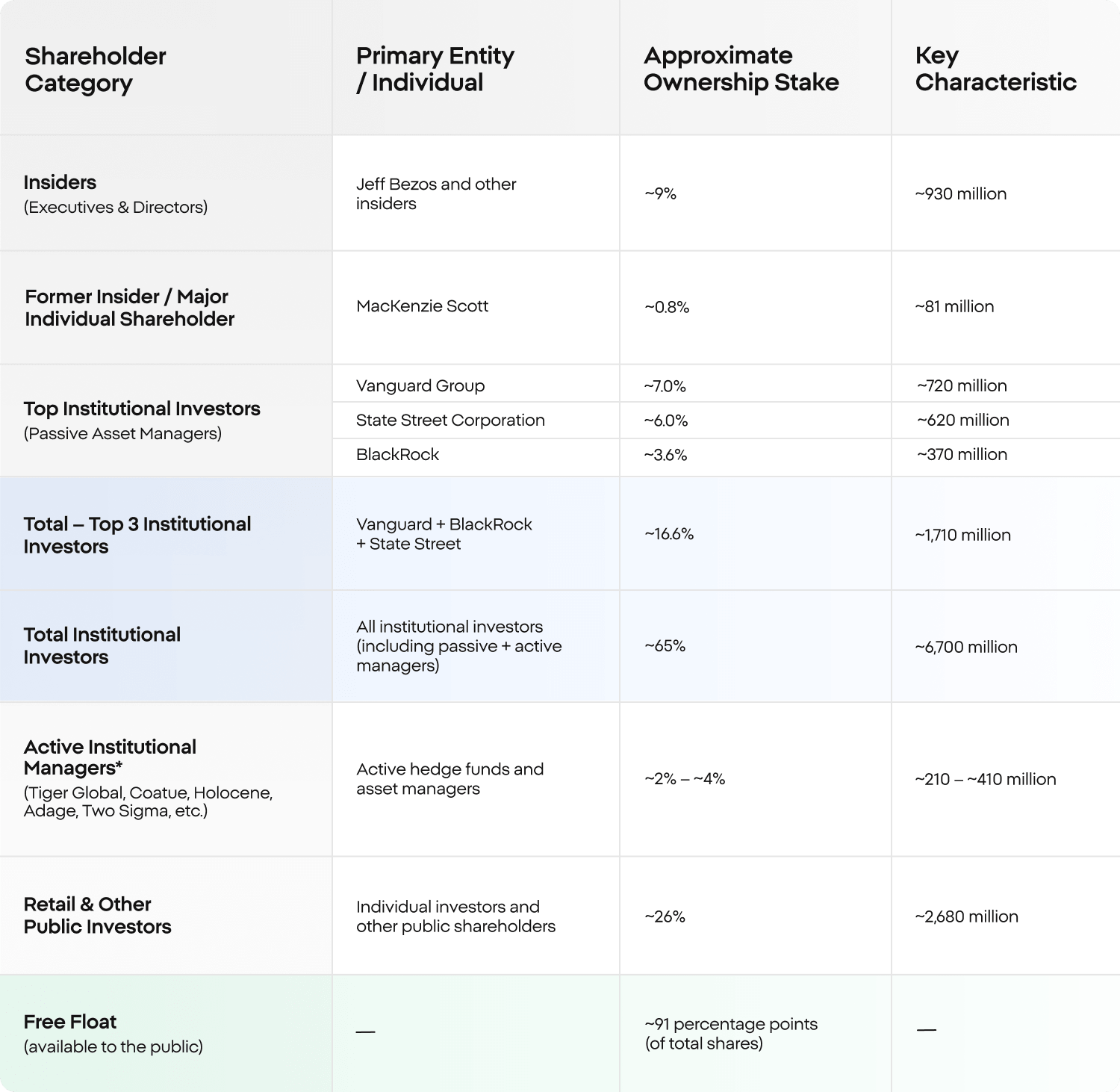
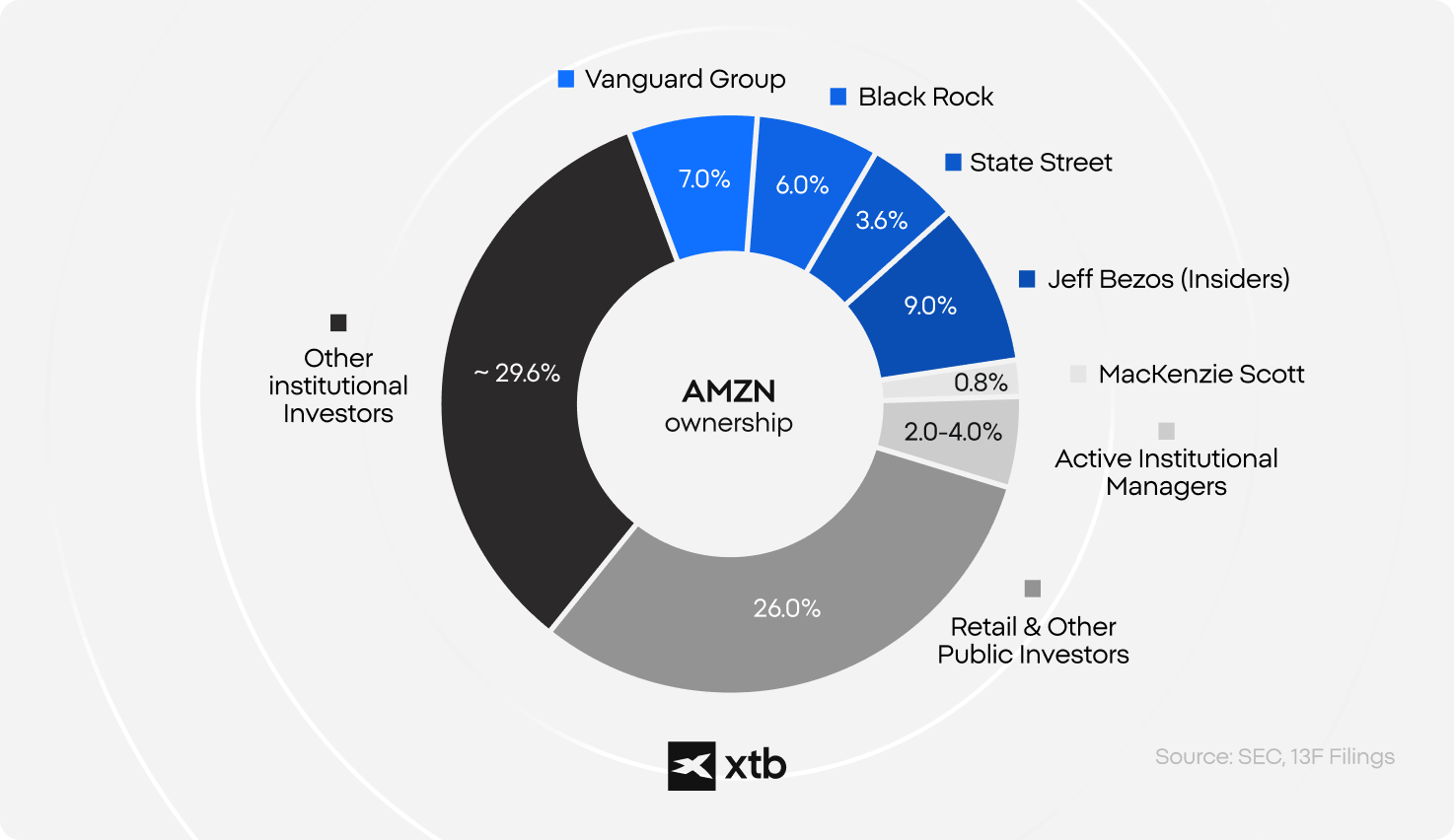
A persistent misconception is that Jeff Bezos unilaterally owns Amazon today. While he founded the company, maintains a highly influential position, and remains its largest individual shareholder, he does not own the corporation outright. The combined voting power and ownership structure are heavily influenced by institutional investors that control the majority of the public float. The largest holders are passive asset managers, which primarily own shares through ETFs and index funds. Insiders, led by founder Jeff Bezos, own approximately 9% of the company, while MacKenzie Scott owns roughly 0.8%.
Scott received a substantial Amazon stake as part of her 2019 divorce settlement with Bezos, one of the largest divorce settlements in history. At the time, she acquired approximately 4% of Amazon's outstanding shares, instantly becoming one of the company's largest shareholders. Since then, she has steadily reduced her position through a combination of stock sales and charitable donations, using Amazon shares to fund one of the largest philanthropic efforts in modern history. Despite donating tens of billions of dollars and distributing millions of shares to charitable organizations, Scott remains a significant shareholder, with an estimated stake of around 0.8% of Amazon as of 2026.
Jeff Bezos: founder and largest individual shareholder
Jeff Bezos remains the largest individual shareholder of Amazon, retaining an approximate 9% ownership stake comprising roughly 949 million shares even after stepping down as CEO. The value of this equity position fluctuates with the market, representing a net worth component valued at nearly $256 billion. This solidifies his status not just as the visionary behind the company, but as its most heavily invested private individual.
Bezos transitioned from his role as the operational CEO to the Executive Chairman of the Board in July 2021. This strategic shift allowed him to step away from daily management while maintaining significant influence over the company's long-term trajectory. His current role reflects his ongoing commitment to the corporation he launched in a Bellevue garage in 1994 before taking it public on May 15, 1997 on the Nasdaq under the ticker symbol AMZN.
|
❓ Did you know? Despite founding Amazon and building it into a global powerhouse, Jeff Bezos currently owns a 9% of his own company. As Amazon grew and required capital, issuing new shares diluted the founder's initial equity. |
The institutional investors who really own the majority
Institutional investors hold over 65% of Amazon stock while BlackRock, Vanguard and State Street control approx. 16.5% shares - a significantly larger portion of the company than any individual founder or executive. These financial conglomerates dominate the shareholder registry due to the sheer volume of capital they manage. Their dominance is a standard characteristic of modern, mega-cap publicly traded companies.
- The Vanguard Group leads this institutional pack with a roughly 7% stake, acquiring these shares predominantly to populate their massive ETF offerings.
- BlackRock follows closely, holding approximately 6% primarily through its popular iShares products.
- State Street Corporation, known for its SPDR ETFs, controls another 3.6% of the equity.
Crucially, these financial institutions do not hold Amazon shares solely for their own corporate treasuries; they hold them on behalf of their clients. When everyday investors purchase a broad market index fund, the asset manager allocates a portion of that capital to buy Amazon stock. Therefore, millions of retail investors indirectly own a fraction of Amazon through their retirement and investment portfolios.
Andy Jassy and Amazon's leadership
Andy Jassy has served as the current CEO of Amazon since July 5, 2021, directing the company as an executive manager with an ownership stake that is negligible compared to the founder's. Before assuming the top position, Jassy led Amazon Web Services (AWS), driving the division to become the company's most profitable segment. His elevation to CEO answered the common question of who leads Amazon today, effectively separating the company's operational leadership from its majority ownership.
Managing a publicly traded corporation does not equate to owning it. The Chief Executive Officer reports to the Board of Directors, which is elected by the shareholders to represent their financial interests. While executives like Jassy are often compensated with stock options to align their incentives with company performance, the aggregate equity held by the current management team remains a tiny fraction of the total outstanding shares.
Hedge funds and other notable shareholders
Beyond passive index providers, Amazon stock is actively held by various hedge funds and active asset managers who frequently position AMZN as one of the largest holdings in their portfolios.
Beyond the largest passive holders such as Vanguard, BlackRock, and State Street, prominent hedge funds and active managers including Tiger Global, Coatue Management, Adage Capital, Two Sigma, and Holocene Advisors have historically maintained significant positions in Amazon. These active managers buy and sell shares based on their strategic outlook for the e-commerce and cloud computing sectors.
Tracking the activity of these hedge funds provides retail investors with insights into the "conviction" levels of large, sophisticated market participants. When top-tier active managers increase their positions in Amazon, it signals a bullish institutional sentiment regarding the company's future cash flows and market dominance. Conversely, widespread selling by these funds can indicate broader concerns about the technology sector's valuation.
What does it actually mean to "own" Amazon?
Owning a portion of Amazon requires holding its shares, where each single share represents a mathematically precise fraction of the company's total equity, and an investor's ownership is calculated as a percentage of all outstanding shares.
- One Amazon share represents a fraction of the company's total equity, with ownership calculated as a percentage of all outstanding shares.
- Because Amazon has billions of shares outstanding, even large investments represent only a tiny ownership stake.
- No single shareholder owns a majority of Amazon, making it a widely held public company.
Investors and analysts determine exactly who owns Amazon by examining mandatory regulatory disclosures, specifically 13F filings submitted to the Securities and Exchange Commission (SEC). These quarterly reports compel large institutional investors to publicly declare their equity holdings, creating transparency regarding the largest shareholders.
Retail investors can access these public records to see exactly which funds are buying or selling AMZN. Amazon is one of the Magnificent Seven stocks and among the largest companies in the world, employing more than 1.5 million people globally. Given its market capitalization of roughly $2.7 trillion, even a 0.01% ownership stake would be worth a fortune.
|
📌 Example If a public company has 10 billion outstanding shares, and you buy 100 shares, your ownership stake is 0.000001%. To achieve a 9% stake similar to Jeff Bezos, an investor would need to acquire more than 900 million individual shares. |
How can you become an Amazon shareholder?
Any individual can become a direct part-owner of Amazon by securing an investment account and purchasing the company's equity on the open market. Investors may even use fractional rights to gain exposure without paying the full share price. However, fractional rights provide beneficial ownership - not direct legal ownership of the shares.
The current price of a single AMZN share fluctuates, recently trading between $200 and $278. Fractional investing democratizes market access, allowing individuals to gain economic exposure to high-priced stocks through beneficial ownership rather than direct legal ownership of the underlying shares.
To initiate buying the Amazon stock, an investor must open an investment account through a dedicated platform. Once the brokerage account is open, verified and funded, the investor can execute a trade to buy whole or fractional rights of Amazon stock directly. This process transforms a consumer into a shareholder or fractional rights holder, aligning their financial outcomes with not only the operational but also stock market success of the company.
|
⚠️ Caution Investing in individual equities like Amazon stock carries inherent market risk. The value of your investment account can fluctuate based on corporate earnings, broader economic conditions, and market sentiment, meaning your capital is never guaranteed to generate a positive return. |
Which country owns Amazon?
Amazon is an American public company headquartered in Seattle, Washington, meaning it is not owned by any single country but is instead the collective property of a global network of international shareholders. The corporation was founded in the United States and trades its equity on the NASDAQ stock exchange, subjecting it to U.S. financial regulations and corporate laws. Despite its American origins, its equity is accessible to investors worldwide.
Because the massive institutional investors controlling the majority of Amazon's stock manage capital for clients across the globe, the ultimate economic beneficiaries of Amazon's profits reside in numerous countries. Furthermore, subsidiaries and services like Amazon Prime are fully integrated operational segments of the parent corporation, not separate entities owned by foreign states. Consequently, Amazon's ownership transcends borders, reflecting the highly globalized nature of modern financial markets.
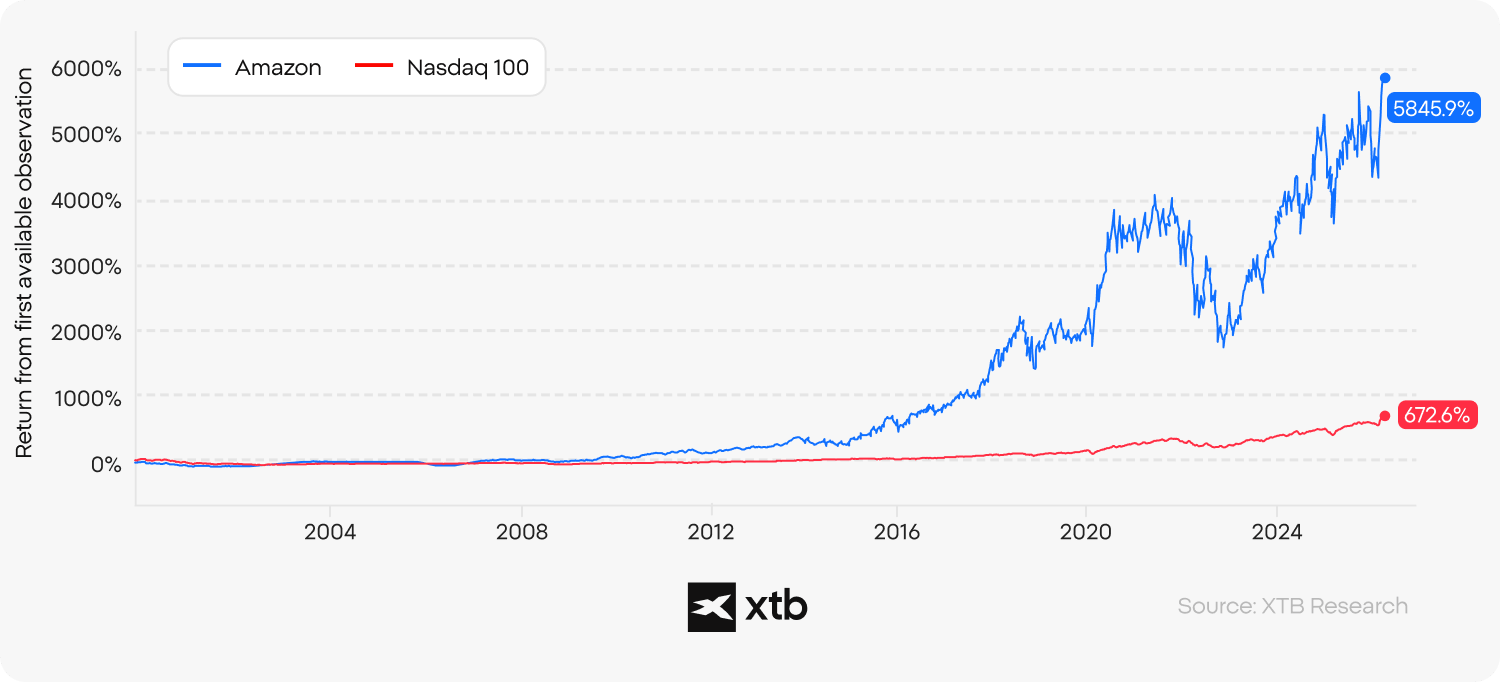
Amazon shares surged by 5845% since the May 2000 to May 2026, while Nasdaq 100 gained approximately 672%. The business growth explains why passive funds accumulated huge stakes in the company - investors see Amazon as a blue chip, connected not only to American consumers (e-commerce) but also to AI megatrend due to Amazon Web Services and AI infrastructure investments. Remember, past performance is not an indicator of future results.

FAQ
Jeff Bezos remains Amazon's largest individual shareholder, but his influence comes from being the biggest single owner rather than a controlling shareholder. In public companies, ownership is often fragmented among thousands of investors, making it possible for someone to be the largest shareholder while still owning less than 10% of the business. Bezos therefore retains significant influence, but major corporate decisions ultimately depend on the broader shareholder base.
In practice, institutional investors collectively have the greatest influence over Amazon because they own the majority of outstanding shares. However, institutions are not a single coordinated entity. Vanguard, BlackRock, pension funds, mutual funds, sovereign wealth funds, and hedge funds often have different investment objectives and voting preferences. Their combined ownership matters far more than any individual shareholder's stake.
Most founders experience substantial dilution as their companies grow. Raising capital, issuing stock to employees, conducting acquisitions, and expanding globally all require additional shares to enter circulation. Amazon transformed from a startup into one of the world's largest public companies, meaning ownership gradually spread among investors while Bezos retained a meaningful but minority stake.
No. Andy Jassy's role is based on management authority rather than ownership control. Like many executives of large public corporations, he receives compensation linked to stock performance, but his equity stake is tiny compared with those of major shareholders. His influence comes from leading the business and executing strategy, not from controlling voting rights.
MacKenzie Scott remains a notable shareholder despite significantly reducing her position since the 2019 divorce settlement. Over the years, she has sold and donated large blocks of Amazon stock as part of her philanthropic initiatives. While her ownership percentage has declined substantially from the stake she initially received, she still ranks among the company's larger individual shareholders.
These firms manage trillions of dollars on behalf of clients worldwide. Their large Amazon positions are primarily driven by index funds and ETFs that track broad market benchmarks such as the S&P 500 and Nasdaq indices. Because Amazon is one of the largest companies in the world by market capitalization, passive funds automatically allocate a substantial portion of assets to the stock.
Individual investors typically have very limited influence on their own because their ownership stakes are small. However, retail shareholders collectively represent a meaningful portion of Amazon's shareholder base. They can vote on corporate matters, elect directors, and participate in shareholder proposals. While a single investor is unlikely to affect outcomes, millions of investors together remain an important constituency.
The most reliable sources are regulatory filings submitted to the U.S. Securities and Exchange Commission (SEC). Institutional investors managing more than $100 million in qualifying assets must file Form 13F reports every quarter, disclosing many of their holdings. By monitoring these filings alongside insider transaction reports, investors can identify whether major funds, executives, or directors are increasing or reducing their exposure to Amazon stock.