



Hewlett Packard Enterprise (HPE.US) shares unexpectedly fell following the release of record results for the fourth quarter of fiscal 2026. The company beat analysts' expectations for both revenue and earnings per share and significantly raised its guidance for 2027. However, investors were concerned about the profitability outlook for the Cloud & AI segment, pricing pressures, and persistent component shortages. According to management, these shortages could continue until the second half of 2028. Dell (DELL.US) is scheduled to report earnings after today's US market close. As another major supplier of data center infrastructure, its results could influence broader investor sentiment toward companies involved in expanding AI computing capacity. Workday and Autodesk are also scheduled to report earnings.
-
HPE revenue surged 50% year over year to $14.5 billion, compared with expectations of approximately $14.35 billion. Adjusted earnings per share reached $1.43, beating the consensus estimate of $1.27, while Cloud & AI segment revenue increased 68.6% year over year to $11.3 billion.
-
The biggest concerns center on margins in the AI business. HPE expects its Cloud & AI operating margin to decline from 18.4% in the latest quarter to approximately 14% for fiscal 2027 as a whole. This would represent a deterioration of around 4.4 percentage points in segment profitability, despite continued revenue growth.
-
The company raised its fiscal 2027 revenue guidance to a range of $59.4 billion to $63.1 billion, representing year-over-year growth of 27–35%. At the same time, management expects supply constraints affecting DRAM, NAND, and other critical components to persist until at least the second half of 2028, potentially increasing the cost of fulfilling orders.
-
The scale of the stock's previous rally has also added to selling pressure, as HPE shares surged more than 17% yesterday ahead of the earnings release, suggesting that investor expectations may have been exceptionally high. Consequently, record revenue, stronger EPS, and upgraded guidance were not enough to offset concerns about future profitability.
Why did Wall Street sell HPE shares despite strong earnings?
The main concern is not a lack of demand for artificial intelligence infrastructure, but rather the risk that rapid revenue growth will fail to translate into a proportional increase in profits. The Cloud & AI segment remains the primary driver of HPE's expansion, but the growing contribution of relatively lower-margin AI servers, rising memory prices, and an expected normalization of selling prices could weigh on profitability. Raymond James analysts also highlighted the risk of margin pressure associated with large contracts, including the company's relationship with Oracle, although their assessment of the agreement's terms remains an interpretation rather than information confirmed by HPE.
Another important factor is the global shortage of components. Management has indicated that limited availability of DRAM, NAND, and other components could persist for another two years, complicating the fulfillment of a rapidly expanding order backlog. This is particularly important for AI server manufacturers, which, unlike suppliers of the most sought-after semiconductors, do not always have sufficient pricing power to pass the full increase in costs on to customers. The market is therefore increasingly distinguishing between companies benefiting from the AI boom through higher sales and those capable of converting that growth into sustained improvements in margins and cash flow generation.
AI demand remains at record levels, but monetization is becoming a challenge
Paradoxically, HPE's operating figures show no signs of weakening demand for artificial intelligence infrastructure. New AI-related orders reached a record $5.7 billion in the latest quarter, while the order backlog increased from $7.6 billion to $10.5 billion. Meanwhile, Networking segment revenue rose 12.3% year over year to $3.1 billion, and the acquisition of Juniper Networks strengthens HPE's position in networking infrastructure, which could become a more attractive source of profitability over the longer term than AI server sales alone.
The company therefore benefits from a substantial order backlog, expanding business operations, and prospects for further earnings growth, but investors are increasingly focusing on the quality of that growth. HPE forecasts at least $5.5 billion in free cash flow for fiscal 2027 and has announced an additional $5 billion share repurchase program. The long-term test for its business model, however, will be its ability to sustain profitability despite rising component costs and the growing contribution of large-scale AI contracts. The latest results once again demonstrate that record demand for artificial intelligence does not necessarily translate into record profitability for infrastructure manufacturers.
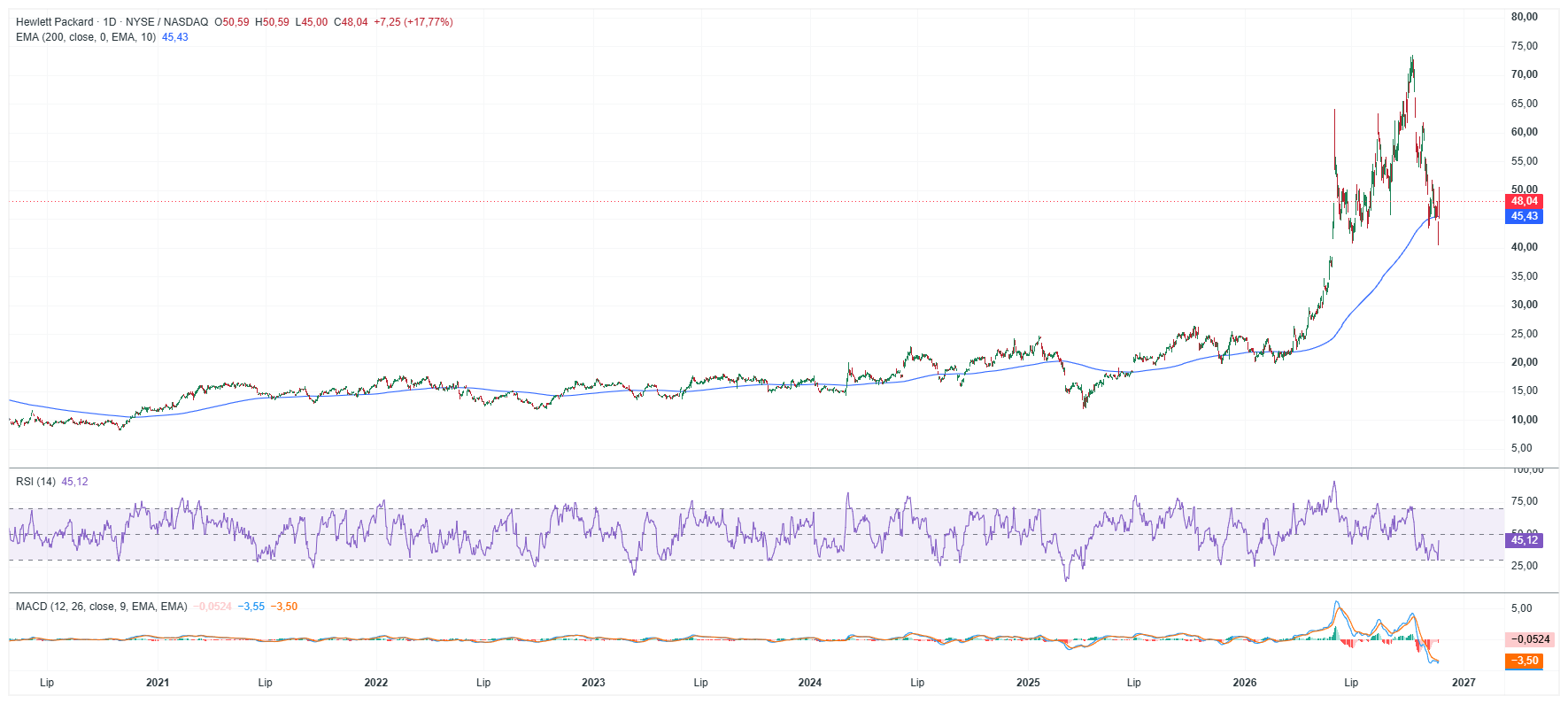
HPE.US chart (1D timeframe)
Following yesterday's US trading session, HPE shares declined and are trading at approximately $42 in pre-market trading today, down nearly 12%. The key 200-session exponential moving average (EMA200, shown as the blue line on the chart) is located near $46. A decisive break below this level, followed by a closing price below $46, could signal a more sustained bearish trend.
 Source: XTB
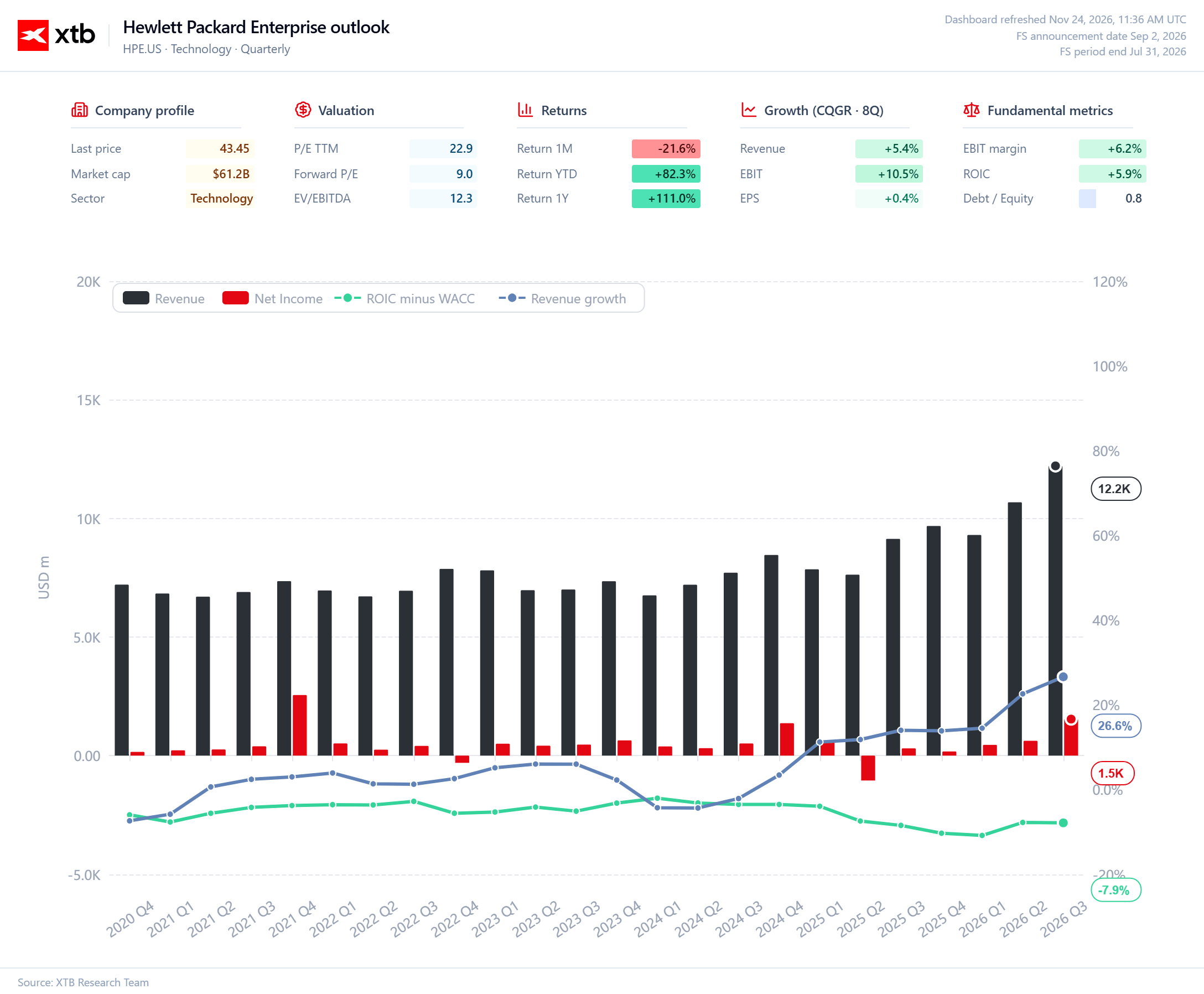
Hewlett Packard Enterprise's (HPE) financial results reveal a significant acceleration in business expansion that has not been accompanied by a proportional improvement in capital efficiency or net profitability. Quarterly revenue increased from approximately $7 billion in 2020–2023 to a record $12.2 billion in the third quarter of 2026, reflecting a substantial structural transformation of the business, including the impact of the Juniper Networks acquisition and growing demand for networking and server infrastructure. Particularly noteworthy is the acceleration in revenue growth to 26.6% year over year, which contrasts with considerably weaker eight-quarter EBIT growth (+10.5%) and almost stagnant EPS growth (+0.4%), suggesting that higher sales are translating into shareholder earnings only to a limited extent. Despite quarterly net income rising to approximately $1.5 billion, the historical volatility of this metric suggests a significant influence from one-off factors, making it difficult to assess the company's sustainable earnings-generating capacity. The most concerning signal remains the negative spread between ROIC and WACC, currently standing at approximately -7.9 percentage points, indicating that returns on invested capital are insufficient to cover the company's estimated cost of capital.
Importantly, the deterioration in this metric has coincided with rapid revenue expansion, potentially pointing to the capital-intensive nature of growth, margin pressure, or temporary costs associated with integrating acquired assets. From a valuation perspective, the divergence between the trailing P/E ratio of 22.9 and the forward P/E of just 9.0 is particularly interesting, as it implies expectations of a substantial improvement in future earnings, although their realization remains uncertain. The stock's 82.3% gain since the beginning of the year and 111% appreciation over the past twelve months suggest that investors have already priced in much of the expected benefits from the company's business transformation, while the 21.6% monthly decline highlights the valuation's growing sensitivity to earnings disappointment. The key question for HPE shareholders, therefore, is not whether the company can continue increasing revenue, but whether it can convert its expanding scale into sustained improvements in margins, cash flow, and ROIC exceeding its cost of capital, as only such an outcome would provide a fundamental justification for further growth in the company's value.
Source: XTB Research



Markets cool down after yesterday's surge 💥



Morning Wrap: Wall Street Rallies as Jensen Huang Returns, with Tech and Chip Stocks Leading the Gains

Too Big to Fail, Too Important to Walk Away. Jensen Huang Returns to Wall Street 🕶️
BREAKING: Jensen Huang Returns as Nvidia’s Chairman and Chief Executive Officer